
RBT practice exams online can be useful when they help you apply a concept, see why an answer is best, and decide what to review next. A high score by itself is not proof of readiness. The quality of the item, explanation, version alignment, and review process matters more than a colorful timer or a large question count.
Table of Contents
- RBT practice exams online: what should a useful resource contain?
- Check version and blueprint alignment first
- Evaluate question and explanation quality
- RBT practice exams online: use untimed, timed, and review modes
- Build an error log that changes your next session
- Connect practice to all six current domains
- Choose and use an online resource safely
- Original practice examples
- Frequently Asked Questions
- References
The current RBT Test Content Outline, 3rd edition, describes 43 tasks across six domains. The current exam frame presents 85 questions: 75 scored questions and 10 unscored pilot questions, with a 90-minute testing window described in current exam information. Practice resources should be labeled independent study content; they are not official, recalled, leaked, or BACB-endorsed questions.
RBT practice exams online: what should a useful resource contain?
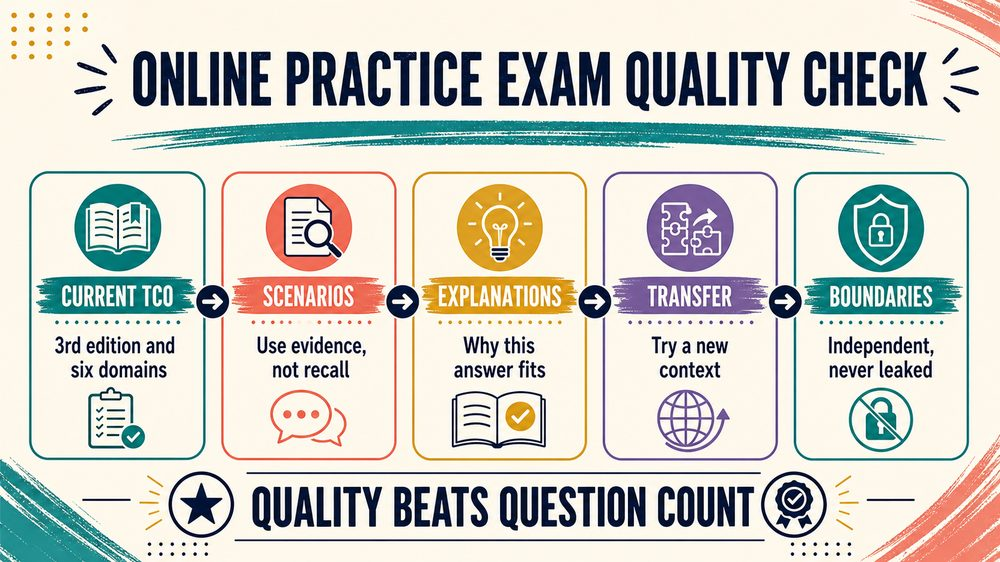
A good practice resource serves a learning purpose. It should give you a scenario or task decision, four plausible options when it uses a multiple-choice format, a clear answer, and an explanation that names the observable clue. It should also tell you which current TCO domain or task the item is intended to reinforce.
| Quality signal | What to look for | Warning sign |
|---|---|---|
| Current version | Names the RBT TCO 3rd edition and shows a review date or update policy. | Old task-list language with no version statement. |
| Scenario reasoning | Requires measurement, prompting, ethics, or role judgment in context. | Only asks for isolated definitions. |
| Explanations | Explains why the best answer fits and why distractors fail. | “Correct answer: B” with no reasoning. |
| Coverage | Maps practice across all six current domains. | Many questions repeat one popular topic. |
| Boundaries | States that content is independent and not official or leaked. | Claims to be real, recalled, or guaranteed. |
If you are comparing RBT practice exams online, treat the explanation as the main product. A difficult question with a weak explanation may create confusion; a simpler question with a precise explanation can reveal a reusable decision rule.
Check version and blueprint alignment first
Version drift is one of the easiest ways to study efficiently for the wrong exam. Before using a resource, check:
- Does it name the current RBT Test Content Outline, 3rd edition?
- Does its language match the current six-domain structure?
- Does it distinguish the assessment and certification process from the exam?
- Does it avoid presenting 85 presented questions as 85 scored questions?
- Does it identify its own update date or revision process?
A practice site does not become official because it uses the BACB name in a page title. Read the disclaimer, source list, and update statement. Keep an official BACB Handbook and TCO open as your authority when a practice explanation conflicts with a current requirement.
Evaluate question and explanation quality
Use a five-part check after each item:
- Target: What behavior, measurement, teaching step, or ethical decision is being tested?
- Evidence: Which words in the scenario support the answer?
- Role: Is the action within the RBT role, or does it require supervisor direction?
- Distractors: Why are the other options less accurate, less safe, or unsupported?
- Transfer: Where could the same rule appear with different materials, people, or settings?
For example: an item says an RBT notices that a learner’s prompted responses were recorded as independent. The useful explanation should point to the data distinction, recommend correcting the record through the authorized process, and identify the supervisor communication step. It should not simply say that “independence is better.”
When the explanation cannot identify the observable clue, mark the item for verification rather than memorizing it. Practice questions are tools for reasoning, not authorities that can override a written program or the current BACB requirements.
RBT practice exams online: use untimed, timed, and review modes
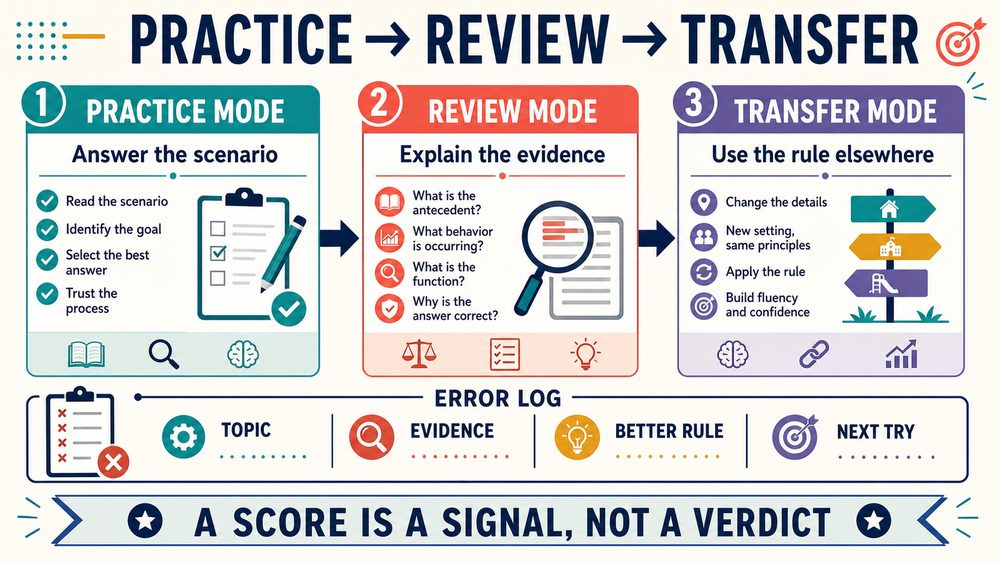
| Mode | Purpose | What to record |
|---|---|---|
| Untimed learning | Read the scenario, locate evidence, and study the explanation. | Concept, task, evidence, and question. |
| Timed set | Practice attention, pacing, and decision-making under a time limit. | Time used, unanswered items, and rushed errors. |
| Review mode | Rework missed and guessed items without looking at the prior answer. | Why the first choice failed and what rule transfers. |
| Mixed transfer | Combine domains so you must identify the relevant concept. | Domain confusion and recurring distractor patterns. |
Do not use a timer for every study session. If you have not learned how to distinguish frequency from rate or observation from interpretation, speed practice will only make the same error faster. Start untimed, then add timed sets when the reasoning is stable.
Build an error log that changes your next session
A useful error log is short enough to use. Create one row per missed or guessed item:
| Field | Example |
|---|---|
| Topic or task | Prompt fading, C.6 |
| My answer | Keep the prompt because the response was correct. |
| Better rule | Follow the assigned fading procedure to transfer control and independence. |
| Evidence I missed | The scenario says the program includes a prompt-delay plan. |
| Next transfer | Rework with a different learner response and material. |
Review the log by error type, not only by score: definition confusion, measurement unit, role boundary, data reading, prompt timing, ethics, or careless reading. A score can rise while one high-risk misunderstanding remains hidden.
Connect practice to all six current domains
The current TCO includes six domains: Data Collection and Analysis; Assessment; Behavior-Change Interventions; Behavior Reduction Interventions; Documentation and Reporting; and Ethics. A resource that covers only teaching vocabulary is incomplete.
- Data: measurement, graphs, and data quality.
- Assessment: preference, skill, and functional-assessment participation within the assigned role.
- Behavior change: skill acquisition, prompting, reinforcement, and generalization.
- Behavior reduction: antecedent strategies, differential reinforcement, extinction, crisis or emergency procedures, and safety boundaries.
- Documentation: objective notes, communication, data integrity, and reporting.
- Ethics: dignity, privacy, competence, boundaries, supervision, and self-reporting.
Tag every missed item to one domain and one concrete decision. If the online resource does not provide tags, create your own using the official TCO.
Choose and use an online resource safely
- Read the privacy policy before entering an email address or personal information.
- Do not upload client data, session notes, photos, or identifying details to a practice site.
- Confirm that explanations do not claim access to official or recalled exam items.
- Compare current requirements against BACB sources, especially when a page gives a number or deadline.
- Use accessibility features that support reading, contrast, keyboard navigation, or screen readers.
- Save your own study notes and error log so you can switch resources without losing learning evidence.
Online convenience is helpful, but a free resource is not automatically accurate and a paid resource is not automatically current. The same quality check applies to both.
Original practice examples
Scenario 1—timing: a candidate gets every item correct in untimed mode but leaves many unanswered in a timed set. The next step is short timed blocks plus review of reading and pacing errors, not immediately buying a harder bank.
Scenario 2—domain gap: a candidate scores well on teaching items but misses documentation and ethics questions. Add objective-note, privacy, boundaries, and clinical-direction scenarios to the next session.
Scenario 3—bad explanation: a resource says a choice is correct but contradicts the current written plan. Flag the item, check the official source, and do not treat the bank as the authority.
Scenario 4—privacy: a quiz asks for a real client example. Replace it with a fictional, de-identified scenario; never enter protected information into an unverified site.
These are newly written independent study examples, not official, recalled, leaked, or BACB-endorsed questions.
Bottom line: the best RBT practice exams online help you reason from evidence, review a precise explanation, and transfer the rule across all six domains. Choose for current alignment and learning quality, then let your error log—not a single score—decide what to study next.
Practice the reasoning behind the answer.
Use original RBT scenarios, explanations, and review prompts across the current six-domain outline.
See the three RBT mock exams →
Frequently Asked Questions
Are online RBT practice exams official?
No. Independent practice resources are not official BACB exams, recalled items, leaked items, or BACB endorsements. Use the current BACB Handbook and TCO as the authority.
How many questions should an online practice exam have?
Question count is only one quality signal. The current exam frame presents 85 questions, including 75 scored and 10 unscored pilot questions, but explanations, coverage, and review quality matter more than copying a number.
Should I practice timed or untimed?
Use untimed practice to learn the reasoning, then timed sets to practice pacing. Review every guessed item, not only incorrect answers.
How can I know whether a resource is current?
Look for explicit reference to the RBT Test Content Outline, 3rd edition, six-domain alignment, update information, and a clear independent-content disclaimer.
Can I use real client examples in an online quiz?
No. Use fictional examples and protect client privacy. Do not upload protected information to a practice site.
References
- Behavior Analyst Certification Board. RBT Handbook.
- Behavior Analyst Certification Board. RBT Test Content Outline (3rd ed.).
- Behavior Analyst Certification Board. RBT certification information.
- Behavior Analyst Certification Board. Ethics Codes and RBT Ethics Code (2.0).
- RBT practice exam resource. Reviewed for competitor research; not an endorsement.