

When you search for an RBT practice exam, it is easy to focus only on the final percentage. A better approach is to treat each practice set as a structured study session: answer the questions, identify the skill behind each item, and use the explanation to decide what to review next.
Table of Contents
- What a useful RBT practice exam should measure
- Turn each score into a study map
- Practice the decision, not only the definition
- A four-step review routine that scales
- Common mistakes that make practice scores misleading
- How to tell whether your review is working
This guide explains how to choose and use an independent practice resource aligned with the BACB RBT Test Content Outline, 3rd edition. The examples below are newly written for study and are not official, recalled, leaked, or BACB-endorsed questions.
What a useful RBT practice exam should measure
A useful practice exam should sample more than vocabulary. It should make you apply RBT concepts to a short situation, select the measurement that fits the question, and recognize when the correct action is to follow the written plan or contact the supervisor.
- Data collection: distinguish what is directly observable from an interpretation, and select a measurement system that matches the behavior.
- Assessment: recognize the purpose of preference or skill assessments and carry out the procedure as written.
- Skill acquisition: identify the relevant teaching step, prompt, reinforcement arrangement, or generalization opportunity.
- Behavior reduction: connect a plan to observable behavior and avoid choosing an intervention based only on a guess about function.
- Documentation and ethics: protect client information, communicate accurately, and escalate uncertainty instead of improvising outside the plan.
These areas reflect the kind of reasoning expected when an RBT applies a procedure under supervision. A practice set that tests only memorized definitions may feel comfortable while leaving important decision points unexamined.
Turn each score into a study map
Do not review only the questions you got wrong. Mark three categories: incorrect answers, correct answers chosen with low confidence, and correct answers supported by a clear reason. The second category often reveals a gap before it becomes a repeated error.
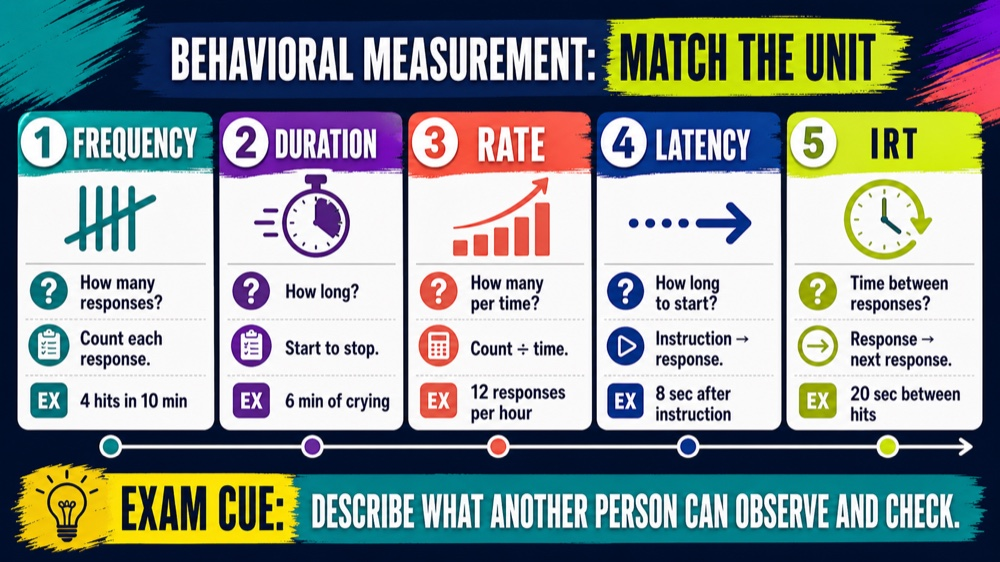
Example: measurement is not interchangeable
Imagine that a learner engages in four instances of hand biting during a 20-minute session. If the question asks for a count, the answer is frequency: four responses. If the same four responses occur in 20 minutes and the question asks for a time-based comparison, a rate can be calculated as 4 divided by 20, or 0.2 responses per minute.
- Do not call a count a rate when no time unit is included.
- Do not replace duration with frequency when the question asks how long the behavior lasts.
- Check whether percentage requires a denominator, such as correct responses divided by opportunities.
The important study move is to write the decisive clue beside the question. Number of responses points toward count; responses per unit of time points toward rate. This short note is more useful than rereading a definition without an example.
Example: implementation follows the plan
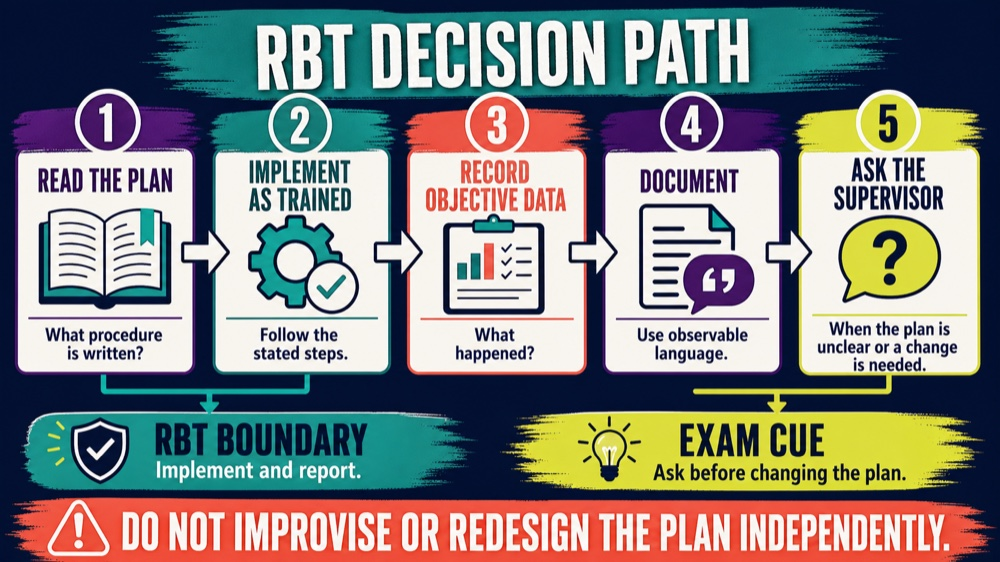
Suppose a written teaching program specifies a prompt sequence and a reinforcement schedule, but the learner is not progressing. The RBT should implement the stated procedure accurately, record relevant data, and communicate the concern to the supervisor. The RBT should not independently change the schedule because a different option seems faster.
On practice questions, watch for distractors that sound proactive but quietly ask the RBT to redesign an intervention, change a target, or interpret a clinical issue beyond the assigned role. The better answer often combines procedural fidelity, accurate documentation, and timely supervision.
Practice the decision, not only the definition
Strong preparation requires moving from What does this term mean? to What evidence in this situation changes my next step? Use comparison questions to make that shift.
| Question focus | Useful reasoning check |
|---|---|
| Preference assessment | What procedure is written, what choices are presented, and what must be recorded? |
| Prompt fading | Which prompt is being reduced, and is the learner responding more independently? |
| ABC data | What happened before and after the observable behavior, without treating a hypothesis as a fact? |
| Confidentiality | Is the information necessary to share, and is the communication channel authorized and appropriate? |
For example, if a practice item describes a family asking for a client video through a personal messaging app, the key issue is not whether the request sounds friendly. The key issue is confidentiality, approved communication procedures, and consultation with the supervisor or organization. If another item describes a learner refusing a task, do not automatically select escape extinction or a new consequence; first identify what the current plan says and what the RBT is authorized to implement.
A four-step review routine that scales
- Take a mixed set: work without notes, pause only to record an uncertainty, and avoid checking the answer after every item.
- Classify the miss: label it as vocabulary, measurement, procedure, scenario reasoning, ethics, or careless reading.
- Repair the rule: write one sentence explaining why the correct option fits and why the strongest distractor does not.
- Retest the transfer: answer a new scenario with different names, settings, or numbers to confirm that the concept—not the wording—was learned.
Keep an error log with the question topic, decisive clue, corrected rule, and next review date. If the same mistake appears twice, move the topic into a short targeted set before taking another full mixed practice exam.
Common mistakes that make practice scores misleading
- Chasing a percentage: a high score from familiar questions can hide weak transfer to new scenarios.
- Memorizing the answer letter: the goal is to explain the evidence, not remember that one item used option B.
- Choosing the most elaborate intervention: RBT questions usually reward accurate implementation of the assigned plan, not unsupervised treatment design.
- Ignoring ethics items: confidentiality, accurate representation, respectful communication, and supervision are part of competent practice, not optional extras.
- Calling practice official: independent questions can support preparation, but they must not be described as BACB questions or recalled content.
How to tell whether your review is working
Readiness is stronger when your performance is stable across several mixed sets and you can explain both correct and incorrect options. You should be able to identify the observable behavior, select the matching measurement or procedure, recognize the boundary of the RBT role, and state when you would follow up with a supervisor.
Use the official RBT Test Content Outline as the academic map, and use the site’s exam-prep materials or focused practice set to target weak areas. When you want a timed mixed experience, start with the free RBT mock exam and review the reasoning after you finish.
Bottom line: the best practice exam is not the one that produces the biggest number. It is the one that shows which RBT decisions you can explain, which distinctions still blur, and what you should study next.
Ready to practice the RBT concepts you just reviewed?
Try an independent, original RBT practice resource with exam-style questions, scoring, and answer explanations.
Frequently Asked Questions
How should I use an RBT practice exam?
Take it without looking up answers, classify each miss, review the underlying concept, and retest with a new mixed set.
How many RBT practice exams should I take?
Use enough practice sets to show consistent reasoning across mixed topics; a single high score is not a readiness guarantee.
Can a practice score predict my official result?
No. A practice score is a study signal, not an official score or a promise that you will pass.
References
- Behavior Analyst Certification Board. RBT Test Content Outline, 3rd edition.
- Behavior Analyst Certification Board. RBT Handbook.
- Behavior Analyst Certification Board. RBT Ethics Code.