

When you use an RBT exam practice test, the most valuable result is not the percentage at the top. It is the explanation of which RBT decision you can apply, which distinction you are guessing, and what to review next. A practice set becomes much more useful when it mirrors the current content outline and gives you a repeatable way to analyze misses.
Table of Contents
- What an RBT exam practice test should measure
- How to use an RBT exam practice test score as a diagnostic
- Practice an RBT exam practice test cue that changes the answer
- Compare answers on an RBT exam practice test before you click
- A four-pass review routine
- Common mistakes that inflate practice scores
- Know when to take the next practice set
The BACB RBT Test Content Outline, 3rd edition, describes 43 tasks across six domains and states that the examination includes 75 scored questions plus 10 unscored pilot questions. This guide is about using an independent, newly written study resource. The examples are original and are not official, recalled, leaked, or BACB-endorsed questions.
What an RBT exam practice test should measure
A useful test should ask you to recognize a concept, apply it to a short situation, and choose the next action that fits the written procedure and the RBT role. The current TCO gives you a better review map than a random list of terms:
| Domain | TCO share | Review question |
|---|---|---|
| A. Data Collection and Graphing | 17% | Can I select, calculate, enter, and interpret the measure the stem describes? |
| B. Behavior Assessment | 11% | Can I identify the assessment procedure and carry it out as written? |
| C. Behavior Acquisition | 25% | Can I recognize the teaching step, prompt, reinforcement, or generalization opportunity? |
| D. Behavior Reduction | 19% | Can I identify the function or procedure without inventing a new intervention? |
| E. Documentation and Reporting | 13% | Can I communicate objective facts, changes, concerns, and data irregularities? |
| F. Ethics | 15% | Can I protect information, accept supervision, and act within demonstrated competence? |
The percentages are a planning aid from the TCO, not a promise about the order of questions in one practice set. If a resource advertises a large question bank but does not explain domain coverage or provide reasoning, you may be practicing recognition of its answer style instead of transferable RBT skills.
How to use an RBT exam practice test score as a diagnostic
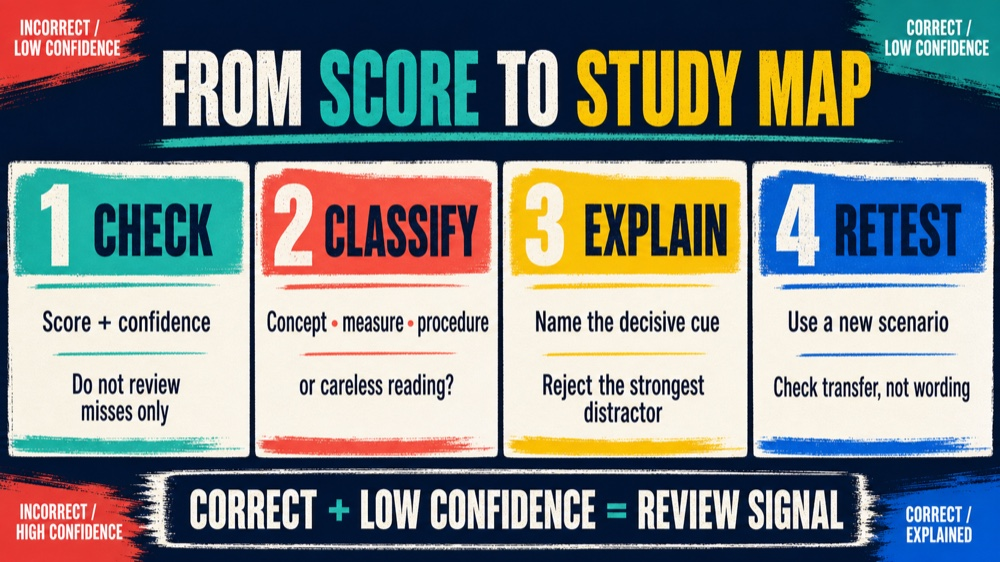
Start a practice set without notes and record confidence before checking each answer. Afterward, place every item into one of four buckets:
- Incorrect and low confidence: you need to relearn the concept or decision rule.
- Incorrect but high confidence: look for a precise misconception, such as confusing rate with frequency or selecting a consequence because it sounds helpful.
- Correct but low confidence: treat this as an early warning; you may have guessed your way into a correct score.
- Correct and well explained: keep the rule, then test it in a new setting so you know it transfers.
Write one sentence for the decisive clue in each missed item. For example, if the stem says that an RBT should record what happened during a session, the answer should be grounded in observable facts. If it asks what to do when data look unusual, the answer should include accurate documentation and timely clinical direction rather than hiding the irregularity or changing the plan independently.
Practice an RBT exam practice test cue that changes the answer
Good explanations show why one option fits the evidence and why a tempting distractor does not. Use the following original examples to practice that reasoning.
Worked calculation: choose the unit first
A learner engages in six episodes of yelling during a 30-minute session. If the question asks for frequency, record six episodes. If it asks for rate, calculate 6 divided by 30: 0.2 episodes per minute. If a separate item gives three correct responses out of five opportunities, the percentage is 3 divided by 5, or 60%. If it gives durations of 20, 30, and 40 seconds, the mean duration is 30 seconds.
The trap is treating every number as the same measure. Before calculating, underline what the stem asks for and write the unit: responses, responses per minute, seconds per response, or correct responses per opportunity. The TCO specifically includes calculating and summarizing data in different ways, so the unit is part of the answer.
Worked implementation decision: follow the written procedure
Imagine that a teaching program specifies least-to-most prompting and reinforcement after an independent response, but the learner is making slow progress. An RBT should implement the written steps, collect the relevant data, and communicate the concern to the supervisor. The RBT should not independently replace the prompt sequence or change the reinforcement schedule because another method seems faster.
When a practice question offers an elaborate treatment redesign as one option, check whether the stem is actually asking for implementation, documentation, or escalation. The correct response often combines procedural fidelity with timely supervision.
Compare answers on an RBT exam practice test before you click
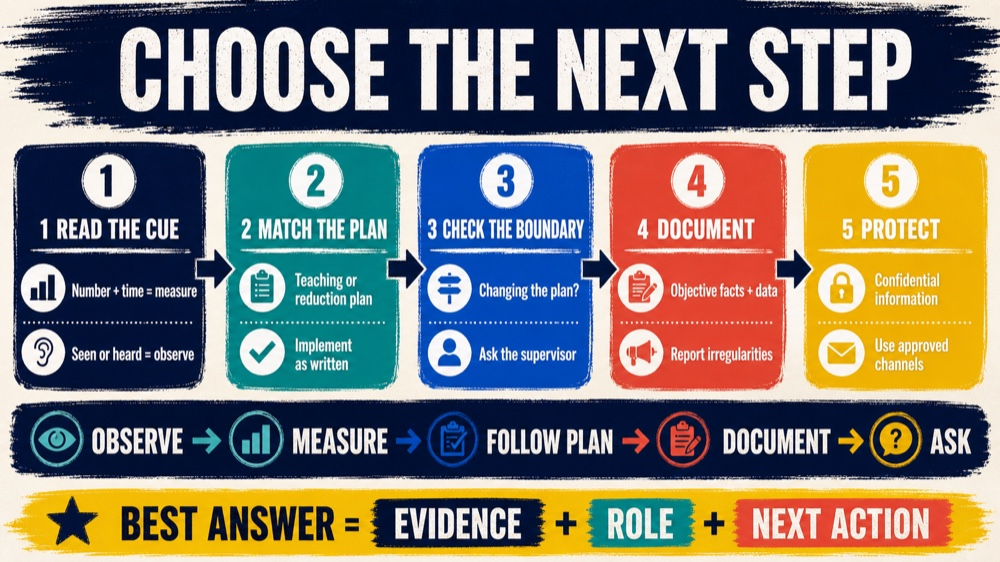
| If the stem emphasizes | Look for | Avoid |
|---|---|---|
| A number and a time unit | The requested calculation and its unit | Calling a raw count a rate |
| What was seen or heard | An observable, measurable description | Stating a guess about function as fact |
| A written teaching or reduction plan | Accurate implementation and data collection | Designing a new plan without authorization |
| An unusual result or client change | Objective documentation and supervisor direction | Deleting, disguising, or ignoring the irregularity |
| Client information or a public claim | Confidentiality, accuracy, and approved channels | Sharing casually or overstating credentials |
This comparison is where a practice test becomes more than flashcards. The strongest answer is usually anchored to the evidence in the stem, the procedure assigned to the RBT, and the next step that protects the learner and the integrity of the data.
A four-pass review routine
- Take a mixed set: answer without notes and mark confidence before reviewing.
- Label each miss: use categories such as vocabulary, measurement, assessment, teaching, behavior reduction, documentation, ethics, or careless reading.
- Repair the rule: write why the correct option fits and why the strongest distractor fails.
- Retest transfer: solve a new scenario with different names, settings, or numbers to check the concept rather than the wording.
Keep an error log with four columns: topic, decisive clue, corrected rule, and retest date. If the same topic appears twice, switch from another full-length set to a short section review. If the error involves a procedure you are not authorized to change, write the supervisor question you would ask instead of improvising.
Common mistakes that inflate practice scores
- Chasing one percentage: a familiar question set can make readiness look stronger than it is.
- Memorizing answer letters: the goal is to explain the evidence, not remember that one item used option C.
- Ignoring low-confidence correct answers: guesses are review signals even when they increase the score.
- Choosing the most dramatic intervention: RBT exam reasoning usually rewards accurate implementation of the assigned plan and appropriate escalation.
- Mixing official and independent material: an independent practice question should never be presented as an actual BACB question or recalled content.
Know when to take the next practice set
Take another mixed set after you can explain the rules behind your misses, not simply after the score feels high. Before you start, check that you can:
- match the requested measure to its unit and calculate it correctly;
- separate observable description from interpretation;
- identify the relevant teaching, assessment, or behavior-reduction procedure;
- document a concern or data irregularity and seek timely supervisor direction;
- recognize when confidentiality, competence, supervision, or public-statement boundaries control the answer.
Use the official RBT Test Content Outline as the academic map. For additional practice, compare the site’s exam-prep materials, focused practice set, and free RBT mock exam, then review explanations instead of treating a score as a guarantee.
Bottom line: the best practice test is not merely the longest or the one with the largest score. It is the resource that helps you identify the cue, apply the RBT task correctly, explain the distinction, and choose a safe next step under supervision.
Ready to practice the RBT concepts you just reviewed?
Try an independent, original RBT practice resource with exam-style questions, scoring, and answer explanations.
Frequently Asked Questions
What should an RBT practice test cover?
It should sample the six domains in the current RBT Test Content Outline and test application, not only memorized terms.
How should I review a missed practice question?
Identify the decisive cue, explain why the best answer fits, reject the strongest distractor, and retest the rule in a new scenario.
Does a practice score predict the official RBT result?
No. A practice score is a study signal, not an official score or a guarantee that you will pass.
References
- Behavior Analyst Certification Board. RBT Test Content Outline, 3rd edition.
- Behavior Analyst Certification Board. RBT Handbook.
- Behavior Analyst Certification Board. RBT Ethics Code.