
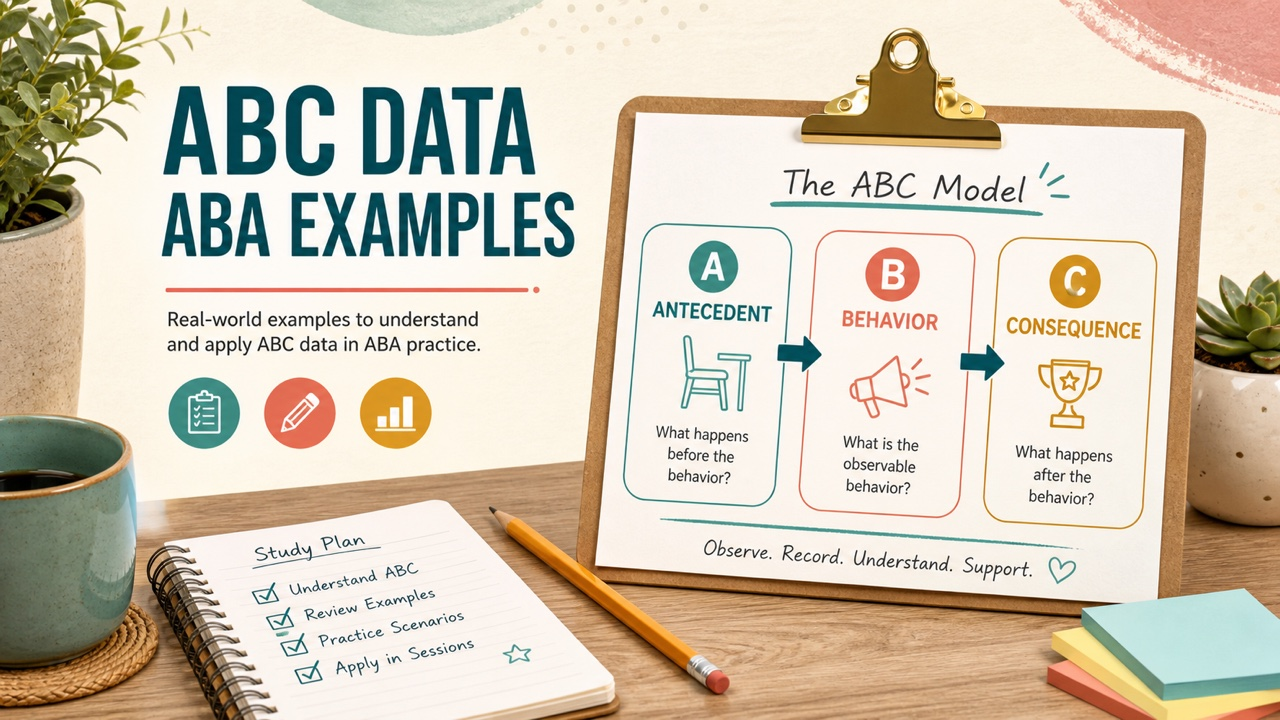
If you are searching for abc data aba examples, start with one simple rule: describe the event before, the observable response, and what changed immediately afterward. ABC notes are useful when they help a team test a functional hypothesis, not when they become a story about what a learner “wanted” or “felt.” This guide uses original scenarios to show how an RBT can record information clearly while staying inside a written plan and supervisor-directed role.
Table of Contents
- abc data aba examples: what ABC data actually captures
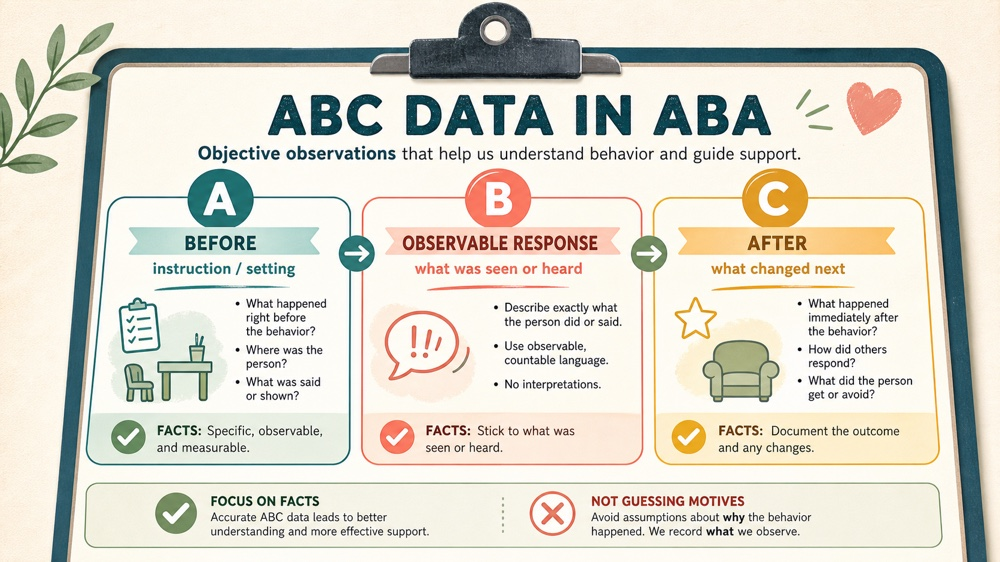
- Antecedent: record what happened before the response
- Behavior: define the response so another observer could agree
- Consequence: write what changed immediately after
- Four original abc data aba examples
- How to make an ABC record useful to the team
- ABC data compared with other measurement procedures
- RBT role boundaries and common errors
- Frequently Asked Questions
- References
Quick answer: In an ABC record, the antecedent is the relevant event or condition immediately before a target behavior, the behavior is written in observable and measurable terms, and the consequence is what happened immediately after. Record enough context to identify patterns—such as task, people, materials, time, and setting—without adding an unsupported diagnosis or motive.
Study boundary: This is independent exam-preparation content, not an official BACB handbook, application determination, or answer key. The examples in this article are newly written for study. They are not official, recalled, leaked, or BACB-endorsed exam questions. Requirements and policies can change, so use the current BACB handbook and your supervisor or requirements coordinator for decisions about an individual application or client program.
abc data aba examples: what ABC data actually captures
ABC stands for antecedent, behavior, and consequence. The three labels are a recording sequence, not proof that the antecedent caused the behavior. A single note can suggest a pattern, but a supervisor or qualified behavior analyst decides how assessment information should be interpreted and whether a plan should change.
Imagine a note that says, “The student became upset because the worksheet was too hard.” It may contain a useful observation, but “upset” and “too hard” are interpretations unless they are defined and supported. A stronger note might say, “When the instructor placed a five-item worksheet on the desk and said ‘start,’ the student pushed the worksheet to the floor, stood up, and walked three steps toward the door. The instructor blocked access to the hallway and presented a break card.” The second version gives the team something observable to review.
Antecedent: record what happened before the response
An antecedent can include an instruction, a transition, a change in materials, a peer interaction, a denied item, a person entering the room, or an internal event that can be measured when the plan defines how to record it. Write the closest relevant events in order. Include the demand or cue exactly when practical, because “asked to work” may be less useful than “presented two addition problems and said ‘complete number one.’”
- Task context: What activity, demand, transition, or free-operant condition was in place?
- Materials and access: Was a preferred item visible, removed, delivered, or unavailable?
- People and attention: Who was present, and what interaction occurred immediately before?
- Timing and setting: Where did it happen, and was there a relevant schedule or change?
Do not rewrite the antecedent as a conclusion. “The learner wanted attention” is not an antecedent observation. “The technician turned to speak with another student for 20 seconds” is an observation that can be compared with later events.
Behavior: define the response so another observer could agree
The behavior section should answer, “What did the person do that could be seen or heard?” Use topography, count, duration, latency, intensity scales, or another measure specified by the plan. Avoid labels such as “noncompliant,” “aggressive,” or “anxious” unless the treatment plan defines them with observable examples and exclusions.
| Vague wording | More observable wording |
|---|---|
| Refused work | Pushed the worksheet away twice and did not touch it for 30 seconds after the instruction. |
| Was aggressive | Hit the table with an open hand three times; no person was contacted. |
| Had a tantrum | Cried, dropped to the floor, and kicked both feet for 45 seconds. |
| Was distracted | Turned head away from the task for more than 5 seconds during the defined observation interval. |
Consequence: write what changed immediately after
In ABC recording, “consequence” means the event that followed the behavior, not necessarily a punishment or a bad outcome. It may be attention, a break, access to a tangible, task removal, no programmed response, or a change in the environment. Record what the adult or peer actually did and what access changed. Do not label an event as reinforcement merely because it came afterward; whether a consequence functions as reinforcement is an empirical question based on future behavior.
For example, “behavior was reinforced” is less precise than “the instructor said ‘okay, break,’ removed the worksheet, and started a two-minute timer.” The latter lets the team examine whether similar responses are followed by the same event and whether the written protocol was implemented.
Four original abc data aba examples
The following examples are independent study scenarios. Each one separates observation from interpretation and shows the type of detail an RBT might place in a session record when the plan calls for ABC data.
Example 1: attention-related pattern to investigate
Antecedent: During free play, the caregiver began a phone call and looked away from the learner. Behavior: The learner tapped the caregiver’s arm four times and called the caregiver’s name loudly. Consequence: The caregiver ended the call, looked at the learner, and responded for 15 seconds. The note should not conclude “the learner wanted attention” as a fact. It can record that social attention followed the response and flag the pattern for supervisor review.
Example 2: escape-related pattern to investigate
Antecedent: The technician placed a handwriting worksheet on the desk and gave the instruction, “Write your first line.” Behavior: The learner tore the top corner of the worksheet and moved the chair 1 meter away. Consequence: The technician followed the written safety and task procedure, moved materials as directed, and the worksheet was not presented again during that brief interval. Record the sequence; do not independently decide to remove or alter the demand outside the plan.
Example 3: tangible-access pattern to investigate
Antecedent: A tablet was placed in a locked cabinet while the learner was using a puzzle. Behavior: The learner pointed to the cabinet, said “tablet” twice, and pulled the cabinet handle. Consequence: The technician used the communication response and schedule written in the program, then recorded whether the tablet was delivered, delayed, or unavailable. The key is to document the actual programmed contingency, not to assume that every request should produce access.
Example 4: automatic or sensory possibility, not a conclusion
Antecedent: During a quiet waiting period, no task or social interaction changed for 3 minutes. Behavior: The learner hummed continuously for 20 seconds while looking toward the window. Consequence: No one spoke to the learner and the environment stayed the same. This may be worth recording as a different context, but it is not proof of an automatic function. A supervisor decides whether more systematic assessment is needed.
How to make an ABC record useful to the team
- Use the plan’s definitions: Confirm the target behavior, onset, offset, and exclusions before collecting data.
- Record immediately: Complete the note as close to the event as possible and distinguish direct observation from later discussion.
- Capture the same unit each time: If the protocol asks for the first antecedent and immediate consequence, do not mix in an unrelated event from ten minutes earlier.
- Include implementation details: Note prompts, safety steps, communication responses, and whether the planned procedure was followed.
- Protect privacy: Use the approved record system, avoid unnecessary identifying details, and follow confidentiality requirements.
- Ask for clarification: If two team members interpret a definition differently, pause and ask the supervisor rather than inventing a new measurement rule.
ABC data compared with other measurement procedures
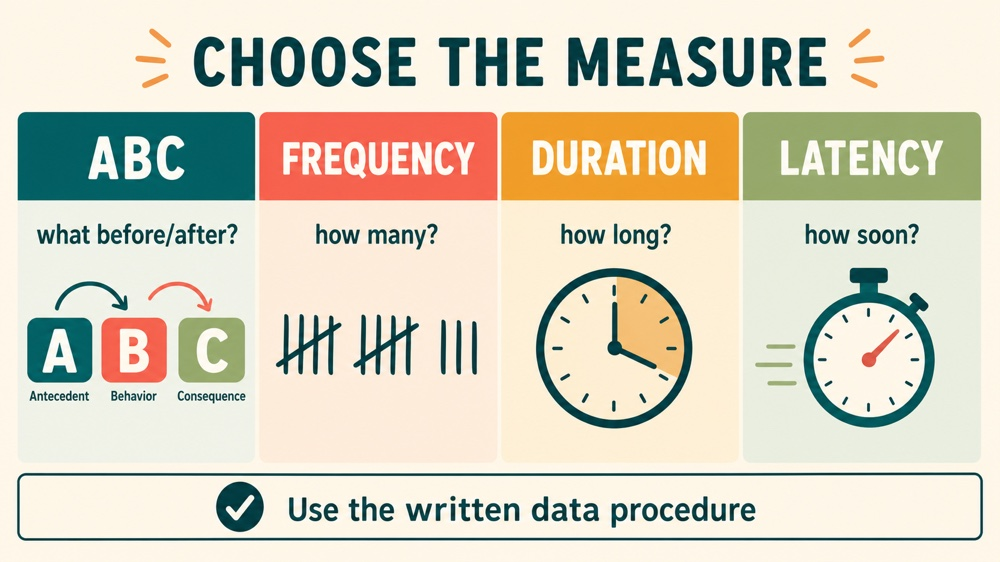
ABC notes answer a context question: what events commonly surround a response? Frequency, duration, latency, interval recording, and permanent-product measures answer different questions about how often, how long, how quickly, or whether a product was completed. They should not be substituted for one another just because one is easier.
| Procedure | Primary question | Common study trap |
|---|---|---|
| ABC recording | What observable events occurred before and after the response? | Writing a function as if it were directly observed. |
| Frequency | How many responses occurred? | Counting episodes without a defined onset or observation period. |
| Duration | How long did the response last? | Stopping the timer inconsistently. |
| Interval recording | Did the response occur during each defined interval? | Changing interval length mid-session. |
RBT role boundaries and common errors
An RBT is a paraprofessional who provides behavior-analytic services under the direction and close supervision of the responsible supervisor or requirements coordinator. A strong answer therefore separates what an RBT can implement as written from what requires assessment, clinical interpretation, plan changes, or supervisor direction.
Common errors include guessing a function from one event, changing a consequence to “see what works,” using subjective labels, backfilling data from memory, and discussing a client’s information in an unapproved channel. If the data suggest a safety concern, a new pattern, or a mismatch between the plan and the situation, follow the escalation and documentation steps in the plan.
Current exam frame: The current RBT Test Content Outline (3rd ed.) applies beginning January 1, 2026. It describes 43 tasks across six content domains. The current examination format is 75 scored questions plus 10 unscored pilot questions, four answer choices per item, and a 90-minute testing period. These facts explain the study frame; they do not turn an independent guide into an official BACB resource.
For study, practice turning each ABC note into three separate sentences. Then ask: Which words are directly observable? Which variables are missing? What decision belongs to the supervisor? That habit improves reasoning without turning a practice explanation into an official exam answer.
Ready to practice measurement concepts?
Use an independent RBT practice resource to review original scenarios, scoring, and explanations after you read the current official materials.
Review the RBT resource →
Frequently Asked Questions
What does ABC stand for in ABA data collection?
ABC stands for antecedent, behavior, and consequence. The record describes observable events before and after a defined response; it does not by itself prove a behavioral function.
What should I write for the behavior in an ABC note?
Write what another observer could see or hear, using the measurement definition in the plan. Include count, duration, or another required measure when applicable.
Is the consequence always a punishment?
No. In an ABC record, consequence means what happened immediately afterward. It can include attention, a break, access, no programmed response, or another environmental change.
Can an RBT decide the function from one ABC example?
No. An RBT records and communicates data according to the plan. Functional interpretation and plan changes belong to the responsible qualified professional.
Are these official BACB questions?
No. The scenarios here are newly written, independent study examples and are not official, recalled, leaked, or BACB-endorsed questions.