
RBT competency assessment answers are often searched by candidates who want to know what a correct performance looks like. The safest way to prepare is not to memorize a hidden answer key. Instead, learn to identify the observable task, follow the written procedure, perform the skill accurately, and explain when you would seek direction.
Table of Contents
- What do RBT competency assessment answers really test?
- A practical way to study competency scenarios
- Original study scenario: data collection
- Original study scenario: skill acquisition
- Documentation and communication matter
- Ethics and role boundaries
- Common preparation mistakes
- How to use competency feedback after practice
- RBT competency study checklist
- Frequently Asked Questions
- References
Quick answer: A competency assessment checks whether an applicant can perform relevant behavior-technician tasks under the conditions required by the assessment. Review your training materials, practice with feedback, and use the current BACB Handbook for eligibility and timing decisions.
Study boundary: This independent guide does not provide an official assessment answer key or secure examination material. The examples are original study scenarios. They are not official, recalled, leaked, or BACB-endorsed questions, and they do not replace an authorized assessor or supervisor.
Continue your review with RBT practice questions that reinforce measurement, prompting, supervision, and ethics.
What do RBT competency assessment answers really test?
A useful answer is usually tied to performance, not a definition alone. You may know that frequency means the number of occurrences, but the assessment may require you to record frequency while observing a defined behavior. You may know that reinforcement follows a response, but the assessment may require you to deliver it immediately and according to a written schedule.
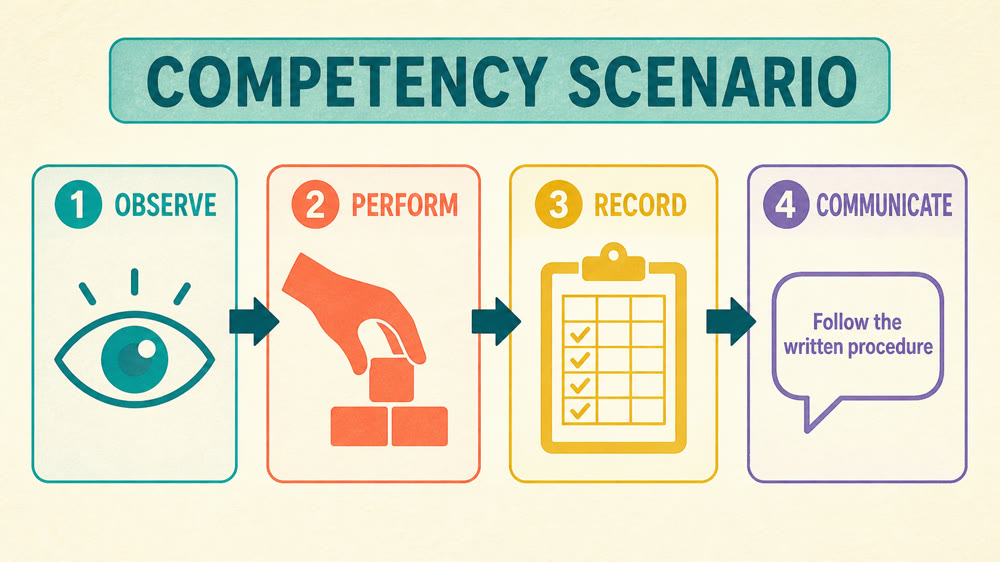
When reviewing rbt competency assessment answers, ask four questions: What behavior or task is observable? What procedure has been written? What response should the technician perform? What should be recorded or reported afterward? These questions help you separate a trained implementation step from an unauthorized clinical decision.
A practical way to study competency scenarios
- Read the conditions: Note the setting, materials, target response, and safety instructions.
- Find the operational definition: Identify what counts as a response and what does not.
- Follow the programmed step: Use the trained prompt, reinforcement, correction, or measurement procedure.
- Check the data rule: Record independent, prompted, incorrect, or no-response outcomes as directed.
- Communicate uncertainty: Ask the appropriate supervisor or assessor when a direction is unclear.
Original study scenario: data collection
Imagine that a plan defines hand biting as contact between a learner’s teeth and the skin of either hand. The assessment asks you to record frequency during a ten-minute practice session. A candidate should count each defined occurrence and avoid adding guesses about the learner’s emotion or purpose. If the same event is difficult to score consistently, the candidate should ask for clarification rather than silently inventing a rule.
The strongest rbt competency assessment answers distinguish observable recording from interpretation. “The learner bit the back of the left hand twice” is an observable report. “The learner bit because the task was frustrating” is a possible hypothesis, not a direct measurement statement. A competency task may require the first kind of description.
Original study scenario: skill acquisition
Suppose a written teaching procedure gives a learner an opportunity to match a card, waits for the programmed response window, and then delivers a trained prompt if needed. The technician should follow the prompt level, deliver the programmed consequence, and record the result according to the data sheet. The technician should not skip the prompt because the learner looks ready, add a new reward because the session is slow, or change the target without direction.
This scenario connects to behavior-acquisition tasks in the current RBT Test Content Outline. The outline contains 43 tasks across six domains, including data collection, assessment, behavior acquisition, behavior reduction, documentation and reporting, and ethics. The current examination includes 75 scored questions and 10 unscored pilot questions, but a competency assessment is a performance demonstration rather than a written exam.
Documentation and communication matter
A candidate can perform a teaching step correctly and still need to document the session accurately. Notes should identify what occurred, relevant variables, the procedures implemented, and the learner’s observable response. If illness, a schedule change, unusual sleep, medication information, or a safety event may affect performance, report it according to the applicable workplace process.
Good documentation does not exaggerate progress or hide errors. If a data sheet was completed late or a timing rule was misunderstood, report the problem promptly. Reliable communication gives the supervising team a chance to correct the procedure and protect the quality of future data.
Ethics and role boundaries
Competency is connected to ethical practice. An RBT should provide services only after demonstrating competence, follow ongoing supervision requirements, protect confidentiality, and treat people with dignity and respect. A candidate should never claim that a private assessment result proves a person’s diagnosis, future progress, or eligibility for a credential.
- Do not confirm or deny that someone is a client when asked by an unrelated person.
- Do not copy protected assessment content or search for leaked items.
- Do not perform a procedure you have not been trained to implement safely.
- Do not change a treatment plan because a different approach seems more convenient.
- Do ask for direction when the written instruction conflicts with safety or is unclear.
Common preparation mistakes
- Memorizing labels without rehearsing actions: Competency requires observable performance.
- Scoring by intuition: Use the operational definition and data rule.
- Ignoring timing: Prompting, reinforcement, and measurement may depend on precise timing.
- Overlooking communication: Report data irregularities and relevant session variables.
- Confusing implementation with plan design: Follow the written procedure and seek direction before changing it.
- Using unofficial claims: Independent practice material cannot guarantee certification or an exam result.
How to use competency feedback after practice
After a practice assessment, separate what you know from what you can perform fluently. A correct answer is useful, but the stronger question is whether you could explain the decision, identify the relevant boundary, and describe the next observable action. For example, if a scenario asks about a measurement choice, write one sentence naming the dimension of behavior and one sentence explaining why the choice fits the question. If a scenario involves prompting, write the least intrusive reasonable prompt and describe how you would look for a response before adding help.
Use a three-column review note for every missed or uncertain item: the scenario cue, your reasoning error, and the revised action. Common errors include choosing an intervention before defining the target behavior, treating a supervisor instruction as optional, and confusing a data summary with a clinical conclusion. Revisit the note after one day and again after one week. During the second review, answer from memory before checking your original explanation. This routine turns feedback into a repeatable study asset and helps you notice patterns instead of memorizing isolated phrases.
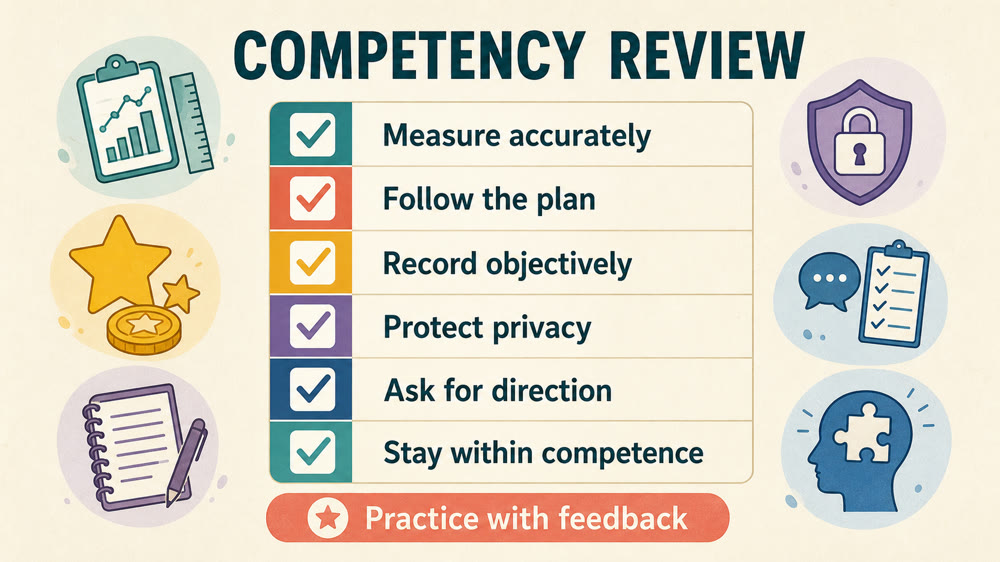
RBT competency study checklist
Before an assessment, review whether you can:
- Describe behavior and environment in observable, measurable terms.
- Implement continuous, discontinuous, or permanent-product recording as trained.
- Use reinforcement and prompts according to a written procedure.
- Record the difference between independent and prompted responding.
- Follow correction, crisis, and safety instructions within your training.
- Write objective notes and communicate concerns promptly.
- Protect confidentiality and recognize your scope of practice.
- Accept feedback and repeat the skill accurately.
Practice competency decisions
Use independent RBT-style practice to review measurement, prompting, documentation, supervision, and ethics.
Try the RBT practice resource →
Frequently Asked Questions
Are these official RBT competency assessment answers?
No. This article provides independent explanations and original study scenarios, not an official answer key or protected assessment content.
How should I study for a competency assessment?
Review current training materials, rehearse the skills, receive feedback, and practice identifying the procedure and recording rule in each scenario.
What if an assessment instruction is unclear?
Ask the authorized assessor or responsible supervisor for clarification. Do not invent a new scoring or treatment rule.
Does passing a competency assessment make an RBT independent?
No. RBTs provide services under ongoing supervision and within their demonstrated competence.
References
- Behavior Analyst Certification Board: Registered Behavior Technician Handbook, updated June 2026.
- Behavior Analyst Certification Board: RBT Test Content Outline (3rd ed.).
- Behavior Analyst Certification Board: RBT resources.
- RBT Training: independent RBT practice questions.