

RBT exam review works best when it is organized around the current official blueprint and the reasoning behind each task. A review session should help you identify what a question is asking, connect it to an observable RBT action, and recognize when the correct response is to follow the plan or ask for supervision.
Table of Contents
- How should an RBT exam review begin?
- Review the six current domains
- Use original scenarios instead of memorized answers
- Review errors by type
- Know the current examination context
- Build a weekly review cycle
- Keep the review ethical
- Use retrieval practice instead of rereading alone
- Final RBT exam review checklist
- Frequently Asked Questions
- References
Quick answer: Start with the current RBT Test Content Outline, divide its tasks into study domains, practice original scenarios, review your errors, and revisit weak concepts. Use the current BACB Handbook for eligibility, application, testing, and credential information.
Study boundary: This guide is independent. It does not contain official, recalled, leaked, or BACB-endorsed questions, and it cannot promise a score or credential.
Continue your review with RBT practice questions that reinforce measurement, prompting, supervision, and ethics.
How should an RBT exam review begin?
Begin by checking the source date and edition of your materials. The current RBT Test Content Outline, 3rd edition, organizes the blueprint into 43 tasks across six domains. Put that outline at the center of your review, then use class notes and practice resources as supporting material. If an older checklist conflicts with the current official document, do not average the two lists; verify the difference and study from the current source.
A good review question is not only “Did I choose the right option?” It is also “What observable fact made this option fit?” That second question builds flexible reasoning and helps you transfer a concept to a new scenario.
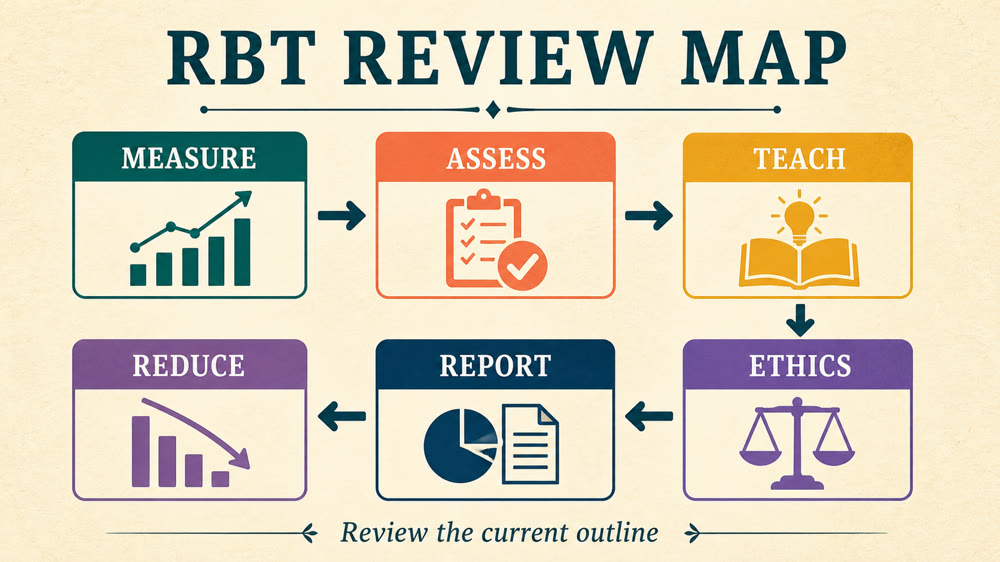
Review the six current domains
- Data Collection and Graphing: operational definitions, measurement systems, and reliable recording.
- Behavior Assessment: supporting assigned assessment procedures and reporting observations.
- Behavior Acquisition: prompting, reinforcement, teaching sequences, and generalization.
- Behavior Reduction: implementing written procedures, safety steps, and objective reporting.
- Documentation and Reporting: accurate notes, communication, and confidentiality.
- Ethics: dignity, competence, supervision, professional conduct, and boundaries.
Use original scenarios instead of memorized answers
For each task, write a short scenario with a setting, an observable response, a written procedure, and one decision point. Then explain the answer in one or two sentences. For example, if a plan says to record duration, do not switch to frequency because frequency feels easier. Identify the instructed measurement, apply it consistently, and ask for clarification if the operational definition is incomplete.
Original practice is safer and more useful than searching for “real” or recalled test items. Protected examination content should not be copied or shared. A study item can teach the same reasoning without pretending to be from the live test.
Review errors by type
Keep an error log with four columns: the concept, the mistaken choice, the reason for the mistake, and the correction rule. A missed prompt question may reflect confusion about timing; a missed ethics question may reflect confusion between a helpful intention and an authorized action. Name the underlying error so the next review is targeted.
- Definition error: Re-read the observable meaning of the term.
- Procedure error: Put the steps in sequence and identify the decision point.
- Role error: Separate implementation from independent plan design.
- Measurement error: Match the data system to the operational definition.
- Communication error: Identify who should receive the report and when.
Know the current examination context
The current examination includes 75 scored questions and 10 unscored pilot questions. Use this official context to plan attention and practice stamina, but do not treat it as a reason to seek protected content. Practice questions should be labeled as independent and should explain why an answer fits the scenario.
Check the current handbook for time limits, scheduling, identification, accommodations, and other administrative details. Those details can change, so avoid treating an old social-media post as a current rule.
Build a weekly review cycle
- Choose two or three current outline tasks.
- Read the definition and one trusted training explanation.
- Complete original scenarios without looking at notes.
- Explain each answer using observable facts and role boundaries.
- Record errors and repeat the weak step.
- Mix old and new tasks so recall remains flexible.
Keep the review ethical
Do not buy or distribute materials that claim to contain live, recalled, or leaked examination questions. Do not share private client information while inventing practice examples. Use fictional details, protect confidentiality, and ask a qualified instructor or supervisor when a work-related question is beyond study terminology.
Use retrieval practice instead of rereading alone
Rereading notes can feel productive because the material looks familiar, but exam preparation improves when you must produce an answer without seeing the explanation first. Create short prompts from each study section, such as define the target behavior, choose a measurement dimension, identify the next supervision question, or describe how a prompt would be faded. Answer aloud or in writing, then compare your answer with the official source and your course materials. Mark the exact part that was missing rather than labeling the whole topic as weak.
For scenario review, use a four-step response frame: identify the observable facts, name the role boundary, choose the action supported by the written plan, and state who should be consulted if the information is incomplete. This frame is especially useful when two answers sound compassionate or practical but only one respects the technician role. It also helps you avoid selecting an answer because it contains a familiar buzzword.
Keep an error log with the date, topic, reason for the miss, and a fresh example. Review the log after a short delay and remove an item only after you can explain it twice in different scenarios. Mix domains during later sessions so that you practice switching from measurement to prompting, documentation, supervision, or ethics. Schedule breaks and stop when attention has clearly dropped; tired guessing is not a reliable measure of readiness. The goal is a clear record of what to practice next, not a larger pile of highlighted pages.
Practice consistency.
Final RBT exam review checklist
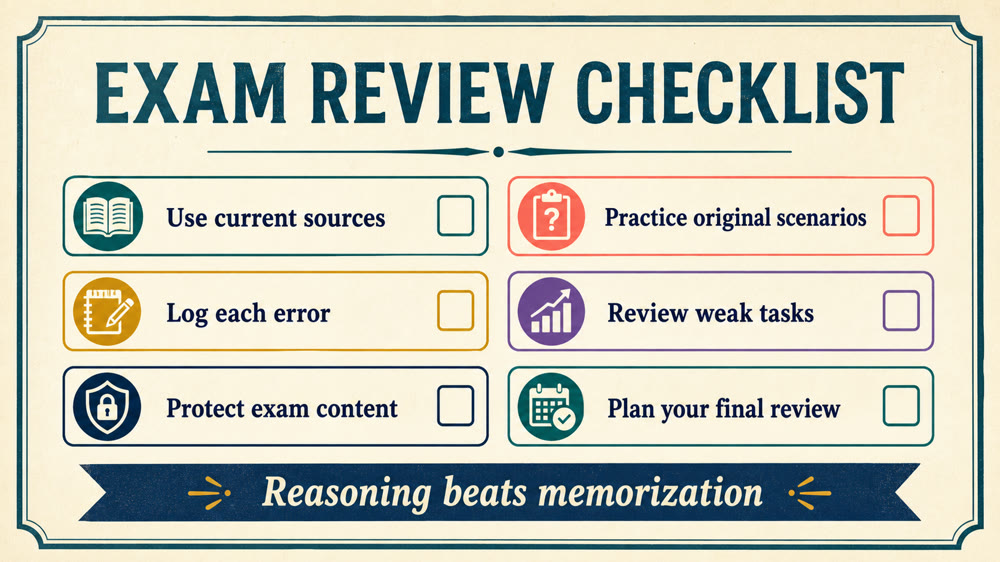
- Am I using the current official outline and handbook?
- Can I explain the six domains and 43 tasks?
- Can I choose a measurement system from a defined scenario?
- Can I follow a teaching or behavior-reduction procedure as written?
- Can I distinguish a prompted response from an independent response?
- Can I write an objective note and protect privacy?
- Can I identify when supervision or clarification is required?
- Am I using original practice rather than protected content?
Keep your review focused
Use independent RBT practice to identify weak concepts and return to the current official study sources.
Try the RBT practice resource →
Frequently Asked Questions
What should an RBT exam review include?
Use the current outline, review its six domains and 43 tasks, practice original scenarios, analyze errors, and revisit the handbook for official administrative information.
How many questions are on the current examination?
The current examination includes 75 scored questions and 10 unscored pilot questions. Verify current details in the official handbook.
Should I study recalled questions?
No. Use original practice and explanations. Do not seek or share official, recalled, leaked, or protected examination content.
Can a practice score promise success?
No. Practice can show study gaps, but it cannot promise a passing result or credential.
References
- Behavior Analyst Certification Board: Registered Behavior Technician Handbook, updated June 2026.
- Behavior Analyst Certification Board: RBT Test Content Outline (3rd ed.).
- Behavior Analyst Certification Board: RBT resources.
- RBT Training: independent RBT practice questions.