
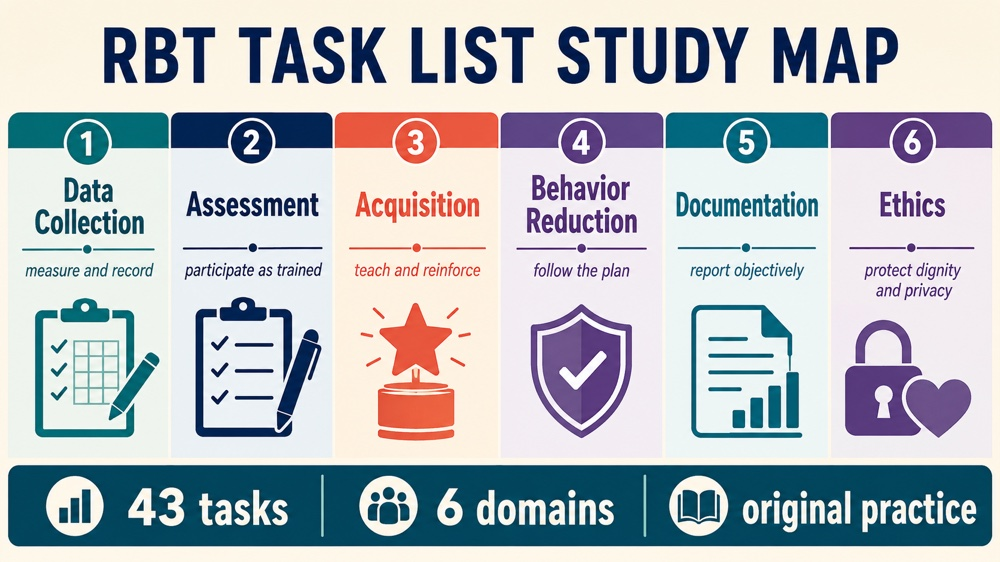
RBT task list 2.0 is a common search phrase for the RBT examination blueprint. The current BACB materials identify the operative document as the RBT Test Content Outline (3rd ed.), which describes 43 tasks across six domains for the examination beginning in 2026. Candidates should use the current outline and handbook rather than assuming that an older task-list label is still the controlling version.
Table of Contents
- Why the name causes confusion
- How to study rbt task list 2.0: the six domains
- Turn a task into an observable study target
- A data-collection scenario
- An acquisition scenario
- Use the outline with the 2026 examination
- How to recognize outdated study material
- Make a one-page task map
- RBT task list 2.0 study checklist
- Frequently Asked Questions
- References
Quick answer: Treat rbt task list 2.0 as a current-source study topic. Identify the official credential or document, follow the applicable procedure, practice an original scenario, and keep the RBT’s supervision boundary visible.
Study boundary: This independent guide is educational content. It is not a BACB policy, certification decision, legal opinion, answer key, or guarantee of examination success. Examples are original and are not official, recalled, leaked, or BACB-endorsed questions.
Why the name causes confusion
The words task list, blueprint, and test content outline are related but not interchangeable in every study conversation. A task list is often used informally to mean the collection of job skills a technician should understand. The BACB’s current examination document is the RBT Test Content Outline, 3rd edition. It identifies the knowledge, skills, and abilities expected of entry-level behavior technicians and organizes them into six content areas.
That wording matters because version changes can affect preparation. If a study guide says 2.0 but links to an older document, compare its headings and tasks with the current BACB file. Do not assume that a familiar number is current. Write the publication version, update date, and examination period at the top of your notes.
How to study rbt task list 2.0: the six domains
The outline gives candidates a structure for deciding what to practice. It is not a promise that every question will look like a definition question. Many exam items present a short situation and ask which technician action matches the task, data rule, ethical boundary, or written procedure.
| Domain | What to practice |
|---|---|
| Data Collection and Graphing | Measurement, data entry, calculations, trends, and reliability risks. |
| Behavior Assessment | Preference assessments, skill assessments, and participation in functional assessment components. |
| Behavior Acquisition | Reinforcement, teaching formats, prompting, chaining, discrimination, generalization, and maintenance. |
| Behavior Reduction | Functions, antecedent strategies, differential reinforcement, extinction, punishment, and crisis procedures. |
| Documentation and Reporting | Timely, objective communication about sessions, variables, concerns, and clinical direction. |
| Ethics | Competence, supervision, confidentiality, public statements, relationships, gifts, feedback, and cultural humility. |
Turn a task into an observable study target
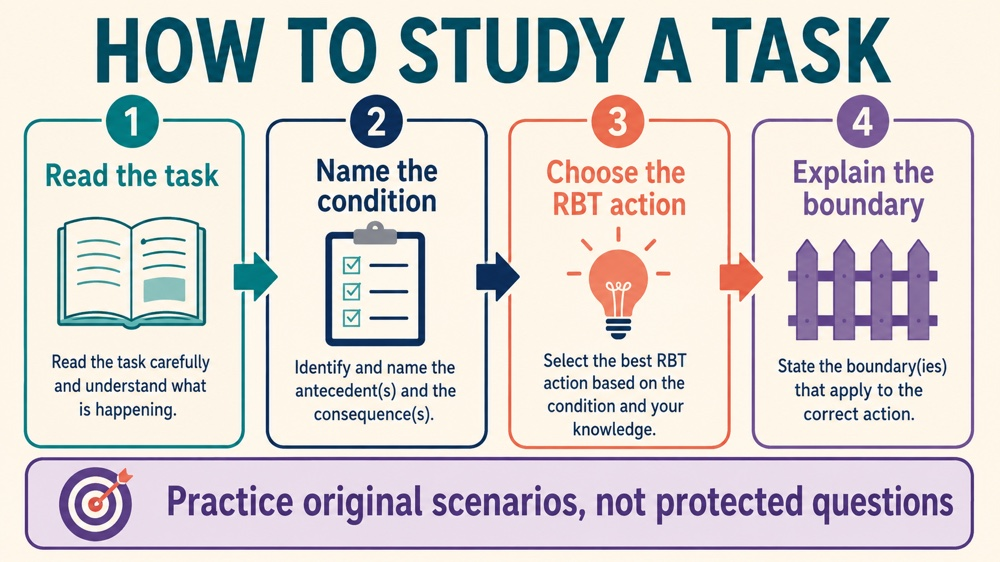
A task becomes easier to study when you convert it into a condition, action, and check. For example, “implement continuous measurement” can become: given an operational definition and session rule, record each qualifying response and calculate the requested summary without changing the definition. “Identify trends” can become: given a graph, describe level, trend, or variability in observable terms and avoid claiming a treatment caused the change without appropriate evidence.
- Copy the task wording into your notes without adding a new clinical rule.
- Write what materials or instructions an RBT would receive.
- Describe the observable action the technician performs.
- List the data, communication, or safety consequence of an error.
- Create one original scenario and explain why two tempting answers are wrong.
A data-collection scenario
An RBT is given a definition of property destruction and a frequency-recording form. During a session, the learner pushes an object off a table twice in quick succession. The question is not whether the learner was angry or whether the behavior deserves a different intervention. The study task is to apply the stated definition and recording rule, then communicate any ambiguity to the supervisor.
A strong answer distinguishes what was observed from what was inferred. It also respects the procedure’s start and stop rules. If the definition does not say whether two contacts in one episode count separately, the RBT should not create a new counting rule during the session. Record according to training and ask for clarification.
An acquisition scenario
A learner is being taught to request a break. The plan specifies a prompt hierarchy and a reinforcement rule. The learner reaches toward a break card after an instruction but before the planned prompt. The RBT should follow the programmed response and prompt-fading steps, deliver the programmed consequence when the response meets the criterion, and record the prompt level. The technician should not increase the reward or rewrite the criterion because the learner appears motivated.
This scenario links prompting, reinforcement, data collection, and role boundaries. The same event can test more than one domain. That is why studying the outline as isolated vocabulary is less effective than practicing decisions in context.
Use the outline with the 2026 examination
The current handbook states that the RBT examination contains 75 scored questions and 10 unscored pilot questions. It also describes 43 tasks organized into six content areas and a 90-minute testing period. Candidates should prepare with the current outline, their 40-hour training materials, and their competency-assessment materials. The BACB does not endorse a particular commercial study guide, and buying a study product does not promise a passing result.
Build a weekly rotation that follows the domain weighting while still revisiting every domain. Spend extra time on tasks that require calculation, discrimination between similar procedures, or a precise communication boundary. Keep a change log so that an old note does not silently replace a newer official source.
How to recognize outdated study material
- The document uses an older version label but does not identify the examination period.
- The domain names or number of tasks do not match the current BACB outline.
- The material presents unofficial questions as real, recalled, or guaranteed to appear.
- The source gives certification or application advice without linking to the current handbook.
- The explanation tells an RBT to independently modify a procedure or make a clinical decision.
- The answer focuses on memorized wording but never identifies the observable action or role boundary.
Make a one-page task map
A useful one-page map has six domain headings, the task numbers beneath them, one plain-language action for each task, and a short “ask the supervisor” note where independent judgment would be unsafe. Add a check box for data accuracy, documentation, and privacy. This turns the outline into a practice tool rather than a poster that is read once.
When you miss a practice item, tag the miss by cause: vocabulary, discrimination, calculation, reading the condition, or role boundary. Then write a new scenario for that cause. Repeating the same answer key without diagnosing the error can create confidence without improving performance.
For a weekly review, choose one task from each domain and explain it aloud in plain language. Then change one feature of the scenario: alter the measurement system, change the prompt level, add a schedule change, or introduce a privacy concern. If the answer changes, explain why. If it does not, identify the rule that stays constant. This makes the outline useful for transfer rather than simple recognition.
RBT task list 2.0 study checklist
- Can I explain why the current TCO is more reliable than an unlabeled task-list download?
- Can I name the six domains and give one observable technician action for each?
- Can I distinguish a data rule from a treatment-design decision?
- Can I connect prompting, reinforcement, measurement, and documentation in one scenario?
- Can I identify when a task requires supervisor direction?
- Can I verify that a study claim comes from the current BACB source?
A final check is to explain one task without using the task’s exact wording. If you can describe the condition, technician action, measurement or communication rule, and boundary in your own words, you are studying the skill rather than only recognizing the label. If you cannot, return to the official task and write a smaller scenario before moving on.
Practice the concept
Review rbt task list 2.0 with original RBT scenarios, current-source reminders, and clear role boundaries.
Try the RBT practice resource →
Frequently Asked Questions
Is RBT Task List 2.0 the current official name?
It is a common search phrase. The current BACB examination document is the RBT Test Content Outline (3rd ed.), so candidates should verify the version they use.
How many tasks are in the current outline?
The current TCO identifies 43 tasks organized into six domains. Check the official document for the exact task wording.
Should I study only the largest domain?
No. Domain weighting can guide time allocation, but all six domains remain relevant and the exam tests overall performance.
Are these official RBT questions?
No. The scenarios here are original learning examples, not official, recalled, leaked, or BACB-endorsed questions.
References
- Behavior Analyst Certification Board: Registered Behavior Technician Handbook, updated June 2026.
- Behavior Analyst Certification Board: RBT Test Content Outline (3rd ed.).
- Behavior Analyst Certification Board: RBT resources.
- RBT Training: independent RBT practice questions.