
RBT flashcards printable free can make review portable, but the cards should prompt observable decisions rather than repeat isolated definitions. Use the current RBT Test Content Outline and Handbook as sources, add original examples, and keep supervision and ethics visible. This guide explains how to design a printable deck that supports transfer without presenting it as an official BACB product or answer key.
Table of Contents
- RBT flashcards printable free: put the source and version on the deck
- Use one decision per flashcard
- Make data cards concrete
- Make acquisition and reduction cards
- Include assessment, documentation, and ethics
- Use a four-step review loop
- Connect cards to the current exam context
- Flashcard mistakes to avoid
- RBT flashcards printable free checklist
- Frequently Asked Questions
- References
Continue your RBT study with RBT exam study materials and original practice resources.
Quick answer: Treat rbt flashcards printable free as a current-source RBT study topic. Define the concept, connect it to an observable action, use original examples, and keep the supervision boundary visible.
Study boundary: This independent guide is educational content. It is not a BACB policy, certification decision, legal opinion, answer key, or guarantee of examination success. It does not promise a passing score or certification outcome. Examples are original and are not official, recalled, leaked, or BACB-endorsed questions.
Current exam context: The current BACB RBT Test Content Outline describes 43 tasks across six domains; the examination includes 75 scored questions and 10 unscored pilot questions in a 90-minute testing period. Verify the current handbook and outline before relying on a time-sensitive detail.
RBT flashcards printable free: put the source and version on the deck
Write the current outline title, version date, official URL, and check date on the first card. Use the Handbook for pathway and administrative details. Flashcards are a format, not an official blueprint, so a deck without source control can preserve an outdated task or number for a long time.
Keep a change log. When the source changes, mark affected cards for review rather than silently editing a definition. This makes a free printable deck easier to trust and maintain.
Use one decision per flashcard
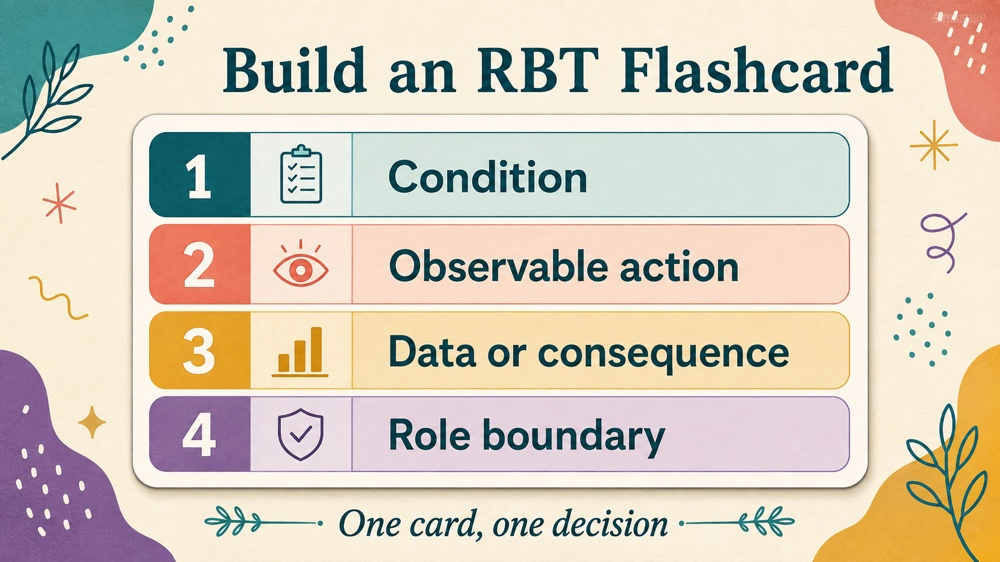
The front should contain one condition or question. The back should state the observable action, data or consequence rule, and the role boundary. A card that asks ‘What is reinforcement?’ is less useful than one that asks what the RBT records and implements after a qualifying response under a stated program.
- Choose one task or distinction.
- Write an original condition.
- Name the observable response or data rule.
- State the programmed action or consequence.
- Add a check-the-plan or seek-direction note when needed.
Make data cards concrete
Create separate cards for frequency, rate, duration, latency, interval recording, permanent product, percentage, and graphing. Put start and stop rules or a miniature example on the back. The operational definition and written program control the actual recording system, so the card should tell the learner to check the plan when procedures differ.
Add one error card for data integrity: what should the RBT do if a timer is missing or an interval was skipped? The answer should preserve honesty, document the barrier, and seek direction rather than reconstructing a value.
Make acquisition and reduction cards
For acquisition, write cards about prompting, fading, reinforcement, shaping, chaining, discrimination, generalization, and maintenance. For reduction, write cards about antecedent strategies, differential reinforcement, extinction, safety, and reporting. Each card should ask what the RBT implements and records, not what the technician independently designs.
Create reverse cards that begin with a short event and ask which concept is present. Change the setting or materials on the next card so recognition becomes discrimination.
Include assessment, documentation, and ethics
A printable deck should include assessment participation, objective documentation, confidentiality, competence, supervision, and reporting. Put a boundary note on cards involving function, treatment changes, caregiver requests, or safety. Knowing a term does not authorize a new procedure or independent interpretation.
Keep examples fictional and avoid client-identifying details. The deck should train the learner to protect privacy while recording enough observable information for the supervising team to respond.
Use a four-step review loop
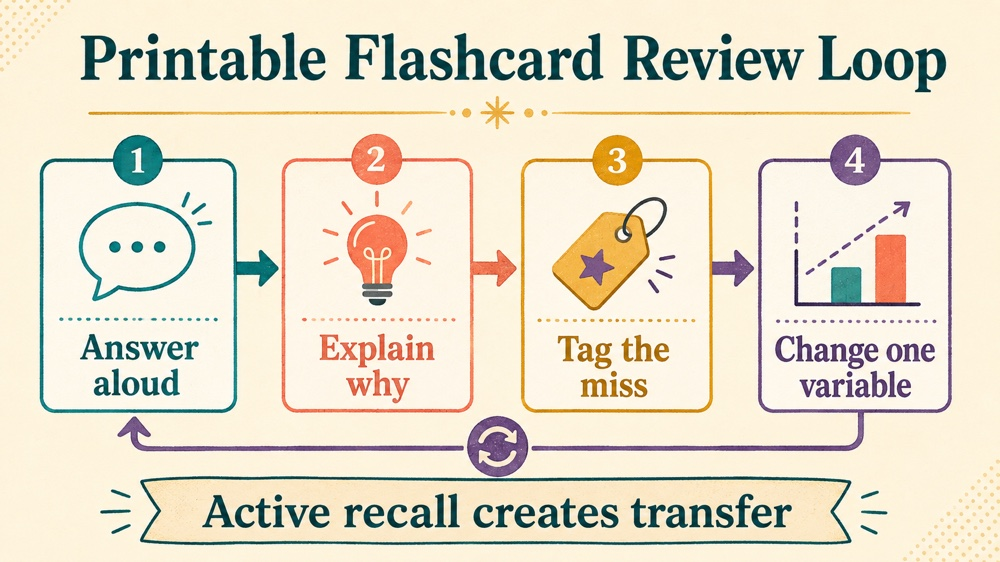
Review each card by answering aloud, explaining why, tagging the miss, and writing a new scenario. Tags can include vocabulary, measurement, discrimination, calculation, reading the condition, or role boundary. New scenarios should change one variable while preserving the underlying concept.
Interleave the deck. Mix a data card with a prompting card, an ethics card, and a documentation card. This resembles real decision-making better than completing one color or domain at a time.
Connect cards to the current exam context
The current RBT Test Content Outline describes 43 tasks across six domains. The examination includes 75 scored questions and 10 unscored pilot questions in a 90-minute testing period. Use these figures to plan coverage, not to claim that a printable deck reproduces or predicts the official examination.
When a card contains an administrative detail, link to the current Handbook and check its date. When it contains a teaching example, label it original. Provenance helps the learner know which statements require a source check.
Flashcard mistakes to avoid
- Using an unlabeled or outdated deck.
- Putting a keyword on the front without a condition or action.
- Calling original cards official, recalled, leaked, or BACB-endorsed.
- Memorizing a definition without practicing discrimination.
- Leaving out privacy, documentation, supervision, or competence.
- Turning a card into permission for an independent clinical change.
- Repeating easy cards while avoiding missed concepts.
RBT flashcards printable free checklist
- Does each card test one decision?
- Are the source title, version, and check date recorded?
- Do the cards cover all six current domains?
- Do backs include observable actions, data rules, and role boundaries?
- Are examples original and free of private information?
- Do I review misses and create new scenarios?
- Will I update the deck when official sources change?
Use RBT flashcards printable free as a study-tool format, not as a certification service. Keep cards short, source-linked, original, and connected to the plan. A good deck helps the learner choose an accurate action under changing facts.
Practice the concept
Review rbt flashcards printable free with original RBT scenarios, current-source reminders, and clear role boundaries.
Review the RBT study resource →
Frequently Asked Questions
What belongs on an RBT flashcard?
Use one condition, one decision, the observable action, the data or consequence rule, and a role-boundary explanation.
Are free printable flashcards official?
No. They are independent study tools. Use the current BACB outline and Handbook for official information.
How do flashcards support transfer?
Answer aloud, explain the rule, tag the miss, and write a new scenario with one changed variable.
Can I use recalled examination questions?
No. Use original scenarios that are not official, recalled, leaked, or BACB-endorsed.
References
- Behavior Analyst Certification Board: Registered Behavior Technician Handbook, updated June 2026.
- Behavior Analyst Certification Board: RBT Test Content Outline (3rd ed.).
- Behavior Analyst Certification Board: RBT resources.
- Behavior Analyst Certification Board: ethics resources.
- Behavior Analyst Certification Board: RBT Ethics Code (2.0).