
The search phrase BAS task list study guide is ambiguous: it may refer to a local course, an employer resource, or a mistaken spelling of another task-list query. This page does not invent an official BAS document. Instead, it shows how to verify the intended source and use the current RBT Handbook and Test Content Outline for safe, observable study decisions.
Table of Contents
- Clarify a BAS task list study guide source
- Use the current RBT task structure
- Study measurement without guessing
- Separate local materials from official requirements
- Practice assessment and teaching actions
- Include ethics and documentation
- Use a clarification-first review cycle
- Mistakes with acronym-based study guides
- BAS task list study guide checklist
- Frequently Asked Questions
- References
Then reinforce the concepts with free RBT mock exams and review the explanations.
Continue your RBT study with RBT exam study materials and original practice resources.
Quick answer: Treat bas task list study guide as a current-source RBT study topic. Define the concept, connect it to an observable action, use original examples, and keep the supervision boundary visible.
Study boundary: This independent guide is educational content. It is not a BACB policy, certification decision, legal opinion, answer key, or guarantee of examination success. It does not promise a passing score or certification outcome. Examples are original and are not official, recalled, leaked, or BACB-endorsed questions.
Current exam context: The current BACB RBT Test Content Outline describes 43 tasks across six domains; the examination includes 75 scored questions and 10 unscored pilot questions in a 90-minute testing period. Verify the current handbook and outline before relying on a time-sensitive detail.
Clarify a BAS task list study guide source
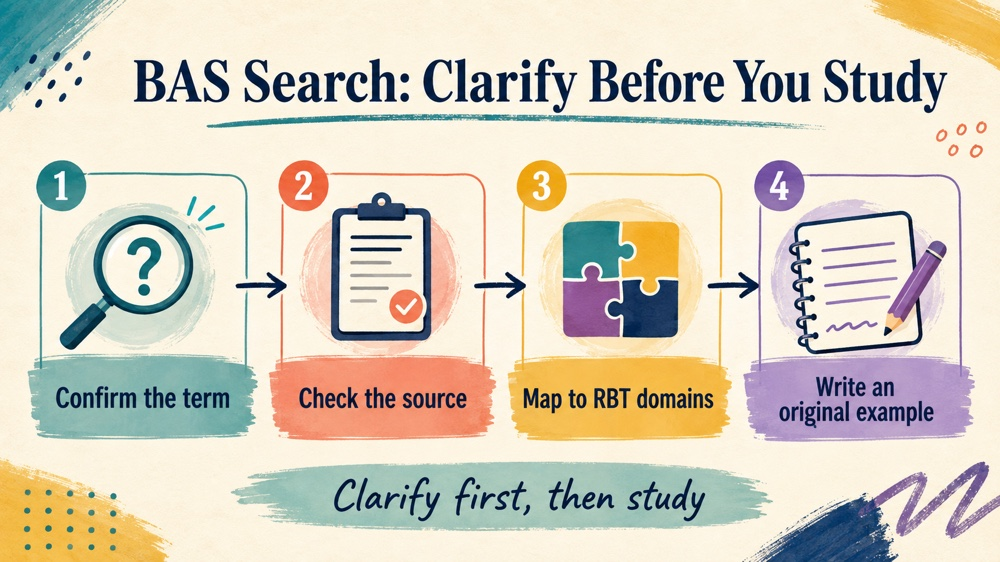
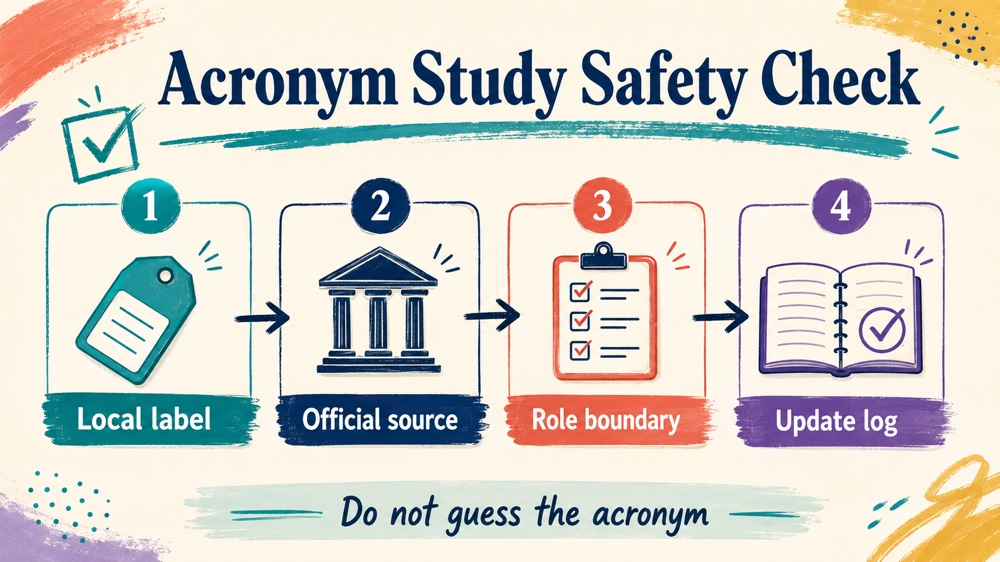
When a short acronym is unclear, do not infer its meaning from a search snippet. Check the document title, issuing organization, version date, and official URL. If the intended resource is about RBT examination preparation, compare it with the current BACB RBT Test Content Outline and Handbook.
Write the unresolved term in your source log and ask the course provider or supervisor what it denotes. A clarification is more reliable than building a full deck around an accidental expansion of an acronym.
Use the current RBT task structure
For RBT preparation, the current outline describes 43 tasks across Data Collection and Graphing, Behavior Assessment, Behavior Acquisition, Behavior Reduction, Documentation and Reporting, and Ethics. These six domains provide a stable framework while the ambiguous term is being clarified.
- Identify the intended document.
- Check its edition and date.
- Map any claimed RBT topics to the current outline.
- Write an original observable example.
- Mark any statement that requires supervision or source confirmation.
Study measurement without guessing
Review frequency, rate, duration, latency, interval recording, permanent product, percentage, and graphing through the written plan. Each example should identify the operational definition and scoring rules. If an acronym or local worksheet uses a different label, preserve the actual measurement rule rather than forcing a familiar word onto it.
When a data procedure is unclear, document the barrier and ask for direction. Never reconstruct a score or choose a measure just because its abbreviation appears familiar.
Separate local materials from official requirements
A course or employer may use internal labels, checklists, or competencies. Those materials can support training, but they do not automatically establish BACB eligibility or examination requirements. Label local content as local and link official claims to current BACB sources.
This separation also helps with study questions. A local instruction may be correct for a setting while a different official source controls certification administration.
Practice assessment and teaching actions
Use the current RBT domains to rehearse assigned assessment participation, prompting, reinforcement, shaping, chaining, discrimination, generalization, maintenance, and reduction procedures. Ask what the RBT implements and records. Do not use an unclear acronym as permission to diagnose, design treatment, or change a plan.
Write the handoff point next to every scenario: who answers the question, who approves the change, and what objective information is reported?
Include ethics and documentation
Regardless of what BAS denotes, an RBT study resource should cover objective notes, privacy, competence, supervision, accurate data, and reporting. Use the current RBT Ethics Code and fictional examples. The source label should never distract from professional conduct.
If a worksheet asks for more client detail than is needed, protect privacy and disclose only through the proper channel. A concise factual note is usually stronger than an expansive interpretation.
Use a clarification-first review cycle
Read the term, state what is known, identify what is ambiguous, check the source, and create an original scenario only after the meaning is confirmed. Tag uncertainty separately from a content miss. This keeps a terminology problem from becoming a false rule in the study deck.
The current examination includes 75 scored questions and 10 unscored pilot questions in a 90-minute testing period. Use the official outline for exam context and do not treat an acronym-based quiz as official or predictive.
Mistakes with acronym-based study guides
- Expanding an acronym without confirming the issuing source.
- Calling a local worksheet an official BACB task list.
- Using an old or undated PDF as current.
- Treating a practice score as eligibility or certification.
- Ignoring privacy, data integrity, supervision, or competence.
- Making a clinical change because a label sounds authoritative.
- Presenting original scenarios as official, recalled, or leaked questions.
BAS task list study guide checklist
- Have I confirmed what BAS means in the intended source?
- Have I checked the current BACB RBT Handbook and TCO?
- Can I map the material to the six current RBT domains?
- Are examples observable, original, and clearly labeled?
- Do I know where supervision controls the next step?
- Are privacy, documentation, ethics, and data integrity included?
- Will I update the guide when the source is clarified or changed?
Use BAS task list study guide as a clarification-first search topic. This page is independent educational content, not an official BAS document, certification decision, or promise of examination success. RBT Training is not affiliated with or endorsed by BACB.
Practice the concept
Review bas task list study guide with original RBT scenarios, current-source reminders, and clear role boundaries.
Review the RBT study resource →
Frequently Asked Questions
What does BAS mean in this search?
The phrase is ambiguous. Confirm the intended document or provider rather than assuming an expansion or inventing an official BACB resource.
What should I use for RBT task coverage?
Use the current BACB RBT Test Content Outline and Handbook, then label local study materials separately.
Can an acronym-based worksheet replace official sources?
No. It can support study, but official BACB materials control applicable RBT information.
Are examples on this page official questions?
No. They are original educational scenarios and are not official, recalled, leaked, or BACB-endorsed.
References
- Behavior Analyst Certification Board: Registered Behavior Technician Handbook, updated June 2026.
- Behavior Analyst Certification Board: RBT Test Content Outline (3rd ed.).
- Behavior Analyst Certification Board: RBT resources.
- Behavior Analyst Certification Board: ethics resources.
- Behavior Analyst Certification Board: RBT Ethics Code (2.0).