
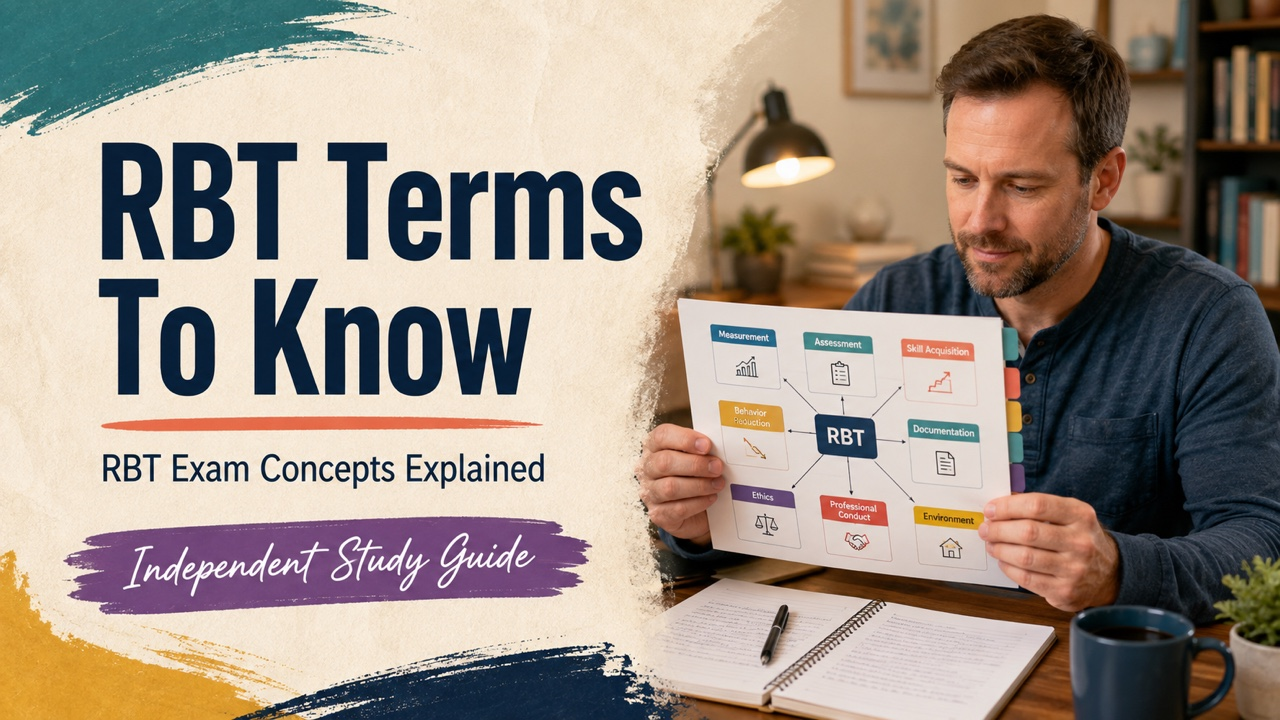
RBT terms to know are not just a memorization list. Each concept should connect to a current source, an observable action, a data or teaching implication, and a boundary around supervision and competence. This independent guide organizes common review topics without presenting itself as an official BACB glossary or examination answer key.
Table of Contents
- Start an RBT terms to know source log
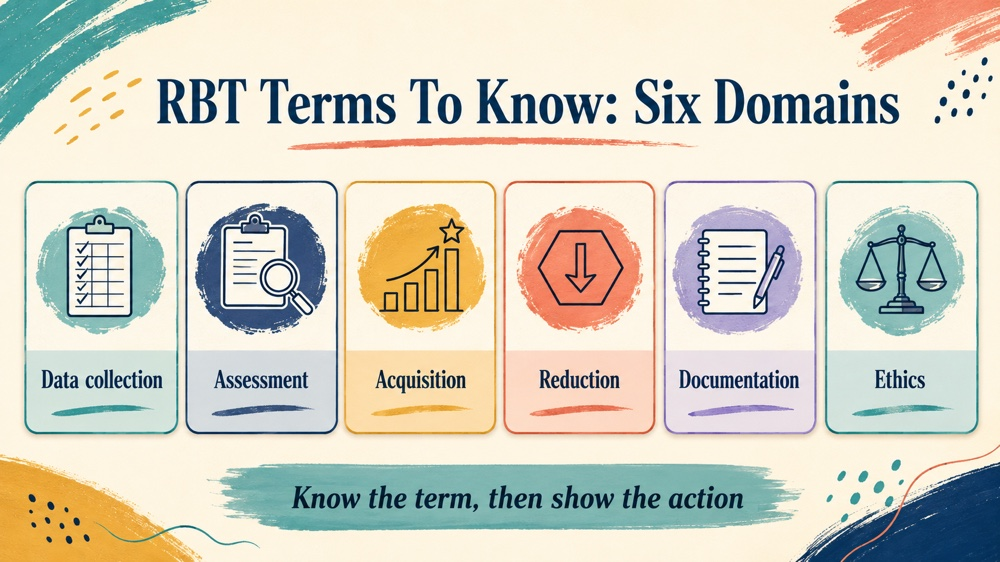
- Organize the terms by six domains
- Know measurement terms
- Know acquisition terms
- Know reduction and assessment terms
- Know documentation and ethics terms
- Use RBT terms to know for active recall
- Avoid terms-to-know mistakes
- RBT terms to know checklist
- Frequently Asked Questions
- References
Continue your RBT study with RBT exam study materials and original practice resources.
Quick answer: Treat rbt terms to know as a current-source RBT study topic. Define the concept, connect it to an observable action, use original examples, and keep the supervision boundary visible.
Study boundary: This independent guide is educational content. It is not a BACB policy, certification decision, legal opinion, answer key, or guarantee of examination success. It does not promise a passing score or certification outcome. Examples are original and are not official, recalled, leaked, or BACB-endorsed questions.
Current exam context: The current BACB RBT Test Content Outline describes 43 tasks across six domains; the examination includes 75 scored questions and 10 unscored pilot questions in a 90-minute testing period. Verify the current handbook and outline before relying on a time-sensitive detail.
Start an RBT terms to know source log
List the current RBT Test Content Outline, Handbook, and Ethics Code with version dates and official URLs. Add a check date because administrative and source details can change. Beside every term, leave space for the plain-language meaning, an original example, and the action the RBT can observe, implement, record, or report.
A short list is stronger when it records what is unknown. Mark terms that depend on the written program instead of filling them with a generic definition.
Organize the terms by six domains
Use Data Collection and Graphing, Behavior Assessment, Behavior Acquisition, Behavior Reduction, Documentation and Reporting, and Ethics as the organizing structure. The current outline describes 43 tasks across these domains. Grouping by domain helps the learner choose the right rule from a scenario.
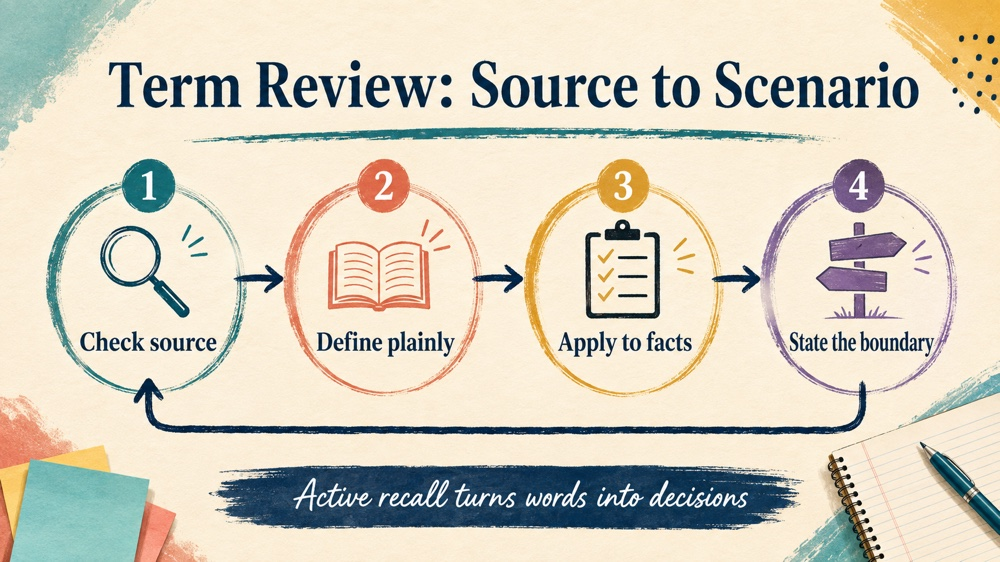
- Name the term.
- Check the source.
- Define it in plain language.
- Write an observable example.
- Mark the supervision or plan boundary.
Know measurement terms
Review frequency, rate, duration, latency, interval recording, permanent product, percentage, graphing, baseline, and data integrity. For each, state what is measured and the scoring start and stop rules. A term is not complete until the learner can distinguish it from related measures.
If a data procedure is unclear, preserve accuracy, document the barrier, and ask for direction. Do not choose a measure because its name sounds familiar.
Know acquisition terms
Review reinforcement, prompting, prompt fading, shaping, chaining, discrimination, generalization, maintenance, and task analysis. Connect each to a condition, response, programmed action, and recorded result. Keep program-specific criteria in the written plan.
Use a changed-variable scenario to test whether the learner understands the concept or only recognizes the vocabulary.
Know reduction and assessment terms
Study antecedent, consequence, function, differential reinforcement, extinction, safety, and assigned assessment participation with role boundaries. An RBT may implement trained procedures and report observations; the study term does not authorize independent diagnosis or redesign.
Write the handoff point beside each term. Ask who interprets the information and who approves a change.
Know documentation and ethics terms
Include objective note, confidentiality, competence, supervision, accurate record, reporting, and professional conduct. Use fictional examples and distinguish fact from interpretation. The Ethics Code belongs in the core review because documentation and communication are part of responsible practice.
Review whether each term guides a privacy-safe action. If a detail is not needed for the communication route, leave it out.
Use RBT terms to know for active recall
Cover the definition, infer the term from a new scenario, explain the controlling fact, check the source, and create another example. Tag misses by vocabulary, measurement, application, documentation, ethics, or role boundary. Revisit tags after a delay rather than rereading the same list.
The current examination includes 75 scored questions and 10 unscored pilot questions in a 90-minute testing period. Verify official BACB materials before relying on time-sensitive exam details.
Avoid terms-to-know mistakes
- Using an undated glossary as current.
- Memorizing labels without operational examples.
- Confusing observation, function, and interpretation.
- Leaving out privacy, documentation, competence, or supervision.
- Using a term as permission to change a plan.
- Copying recalled or protected examination items.
- Failing to update the list when official sources change.
RBT terms to know checklist
- Is each term linked to a current source and date?
- Are all six domains represented?
- Can I define the term and show an observable action?
- Are measurement rules and data integrity clear?
- Can I state the role boundary and handoff?
- Are examples original and privacy-safe?
- Do misses lead to active recall and a new scenario?
Use RBT terms to know as a practical, source-linked review map. Keep the language plain, the examples original, and the supervision boundary visible. RBT Training is independent educational content and is not affiliated with or endorsed by BACB.
Practice the concept
Review rbt terms to know with original RBT scenarios, current-source reminders, and clear role boundaries.
Review the RBT study resource →
Frequently Asked Questions
Which RBT terms should I know first?
Start with terms tied to the six current domains, then connect each to an observable action, data rule, and role boundary.
Can a list replace scenario practice?
No. Use active recall and original scenarios to apply terms under changing conditions.
Where should I check definitions?
Use current BACB materials and the written program or supervisor for details that depend on the service context.
Are the examples official questions?
No. They are original educational scenarios and are not official, recalled, leaked, or BACB-endorsed.
References
- Behavior Analyst Certification Board: Registered Behavior Technician Handbook, updated June 2026.
- Behavior Analyst Certification Board: RBT Test Content Outline (3rd ed.).
- Behavior Analyst Certification Board: RBT resources.
- Behavior Analyst Certification Board: ethics resources.
- Behavior Analyst Certification Board: RBT Ethics Code (2.0).