
RBT flashcards printable materials should be easy to scan, simple to update, and strong enough to prompt application rather than recognition alone. Put a current source, an original example, the data or teaching rule, and the supervision boundary on every card. This page is an independent study aid, not an official BACB resource or examination answer key.
Table of Contents
- Build an RBT flashcards printable source log
- Choose a card layout for active recall
- Print measurement and graphing cards
- Print teaching and behavior-change cards
- Print documentation and ethics cards
- Use RBT flashcards printable for delayed review
- Keep the printable deck current
- Avoid printable-card mistakes
- RBT flashcards printable checklist
- Frequently Asked Questions
- References
Continue your RBT study with RBT exam study materials and original practice resources.
Quick answer: Treat rbt flashcards printable as a current-source RBT study topic. Define the concept, connect it to an observable action, use original examples, and keep the supervision boundary visible.
Study boundary: This independent guide is educational content. It is not a BACB policy, certification decision, legal opinion, answer key, or guarantee of examination success. It does not promise a passing score or certification outcome. Examples are original and are not official, recalled, leaked, or BACB-endorsed questions.
Current exam context: The current BACB RBT Test Content Outline describes 43 tasks across six domains; the examination includes 75 scored questions and 10 unscored pilot questions in a 90-minute testing period. Verify the current handbook and outline before relying on a time-sensitive detail.
Build an RBT flashcards printable source log
Place the current RBT Test Content Outline, Handbook, Ethics Code, official URLs, and check date on the first page. A printable can travel between study sessions, so the source and version need to travel with it. Note which details depend on the written program.
Use a change log for revisions. If a term is ambiguous, label it and verify the intended source before printing a full deck.
Choose a card layout for active recall
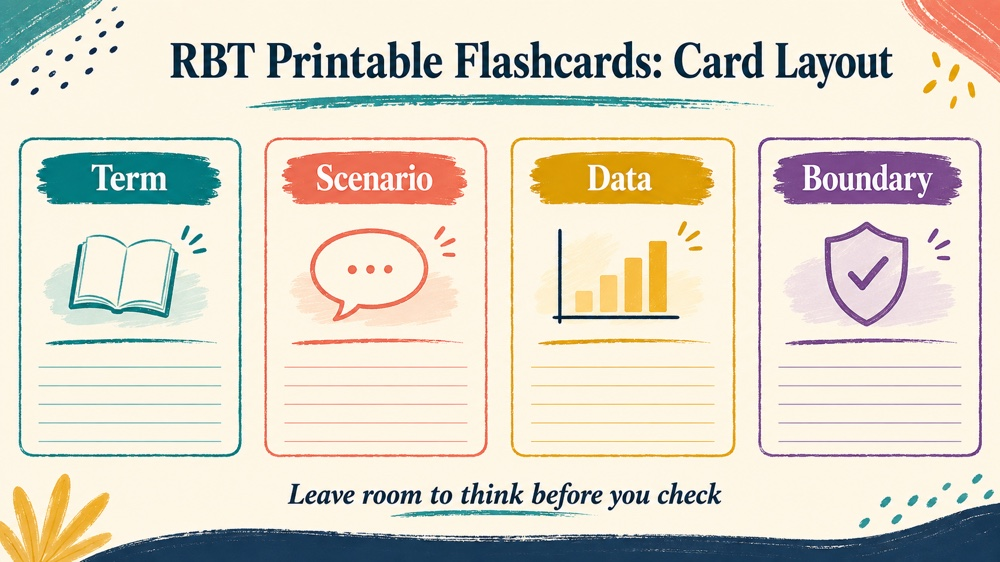
Use a large prompt, a concise definition, one original scenario, a data or teaching implication, and a role boundary. Leave writing space for the learner’s explanation. A printable card should support recall before the answer is visible.
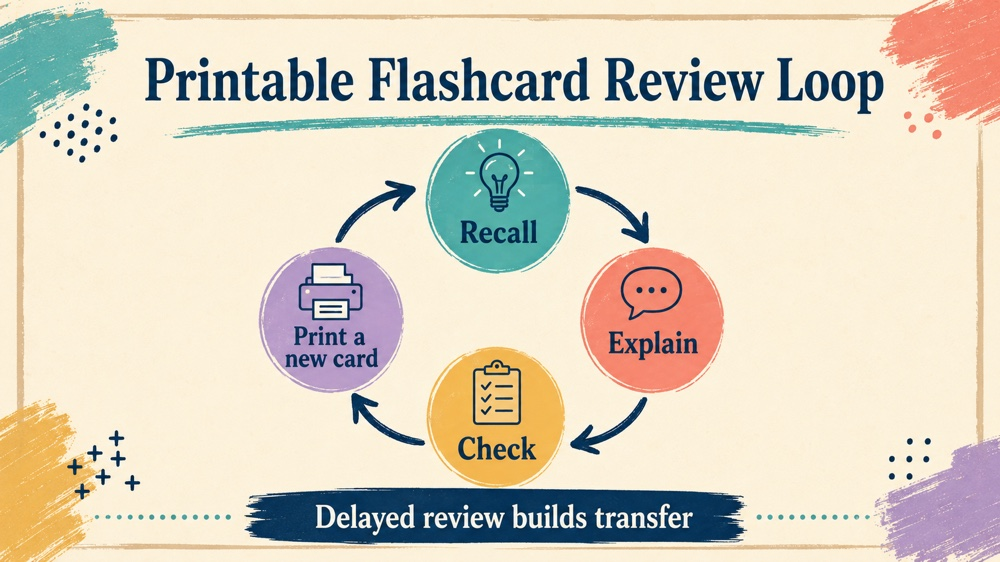
- Cover the explanation.
- Answer aloud.
- Write the observable action.
- Check the source.
- Create a new example after a miss.
Print measurement and graphing cards
Include frequency, rate, duration, latency, interval recording, permanent product, percentage, graphing, baseline, and data integrity. Use timelines, small tables, or blank fields to make start and stop rules concrete. State what one mark means.
If the operational definition is missing, the card should prompt the learner to identify the gap. Do not teach a convenient replacement measure.
Print teaching and behavior-change cards
Use reinforcement, prompting, fading, shaping, chaining, discrimination, generalization, maintenance, antecedent strategies, differential reinforcement, extinction, safety, and reporting. Pair each concept with a condition and the technician action permitted by the plan.
Create two cards that differ by one variable to practice discrimination. Keep independent clinical design outside the card’s scope.
Print documentation and ethics cards
Include objective notes, confidentiality, competence, supervision, accurate records, professional conduct, and reporting routes. Use fictional situations and ask what should be protected, recorded, or escalated. Keep examples free of identifying information.
A card is stronger when it distinguishes observation from interpretation. If interpretation is needed, name the appropriate supervisor or team.
Use RBT flashcards printable for delayed review
Shuffle the cards across domains, tag difficult cards, and schedule them for later review. After a miss, write a new scenario with a changed setting, instruction, or response. Compare explanation quality, not just how quickly the card was recognized.
The current examination includes 75 scored questions and 10 unscored pilot questions in a 90-minute testing period. Verify current official sources before relying on time-sensitive details.
Keep the printable deck current
Record the source check date, revise definitions and examples together, and remove cards that no longer match the official materials or written program. Store a clean master and a dated revision note so printed copies can be replaced deliberately.
When a learner finds a conflict, the correct action is to check the source and seek direction. A printed card is not higher authority than the program or supervisor.
Avoid printable-card mistakes
- Printing an undated third-party glossary.
- Making cards so dense that recall becomes rereading.
- Leaving out data, privacy, or role boundaries.
- Copying recalled or protected questions.
- Using a term as permission to change a plan.
- Including identifying details.
- Failing to replace outdated printed copies.
RBT flashcards printable checklist
- Is the master deck source-linked and dated?
- Does each card prompt active recall?
- Are original examples and data rules included?
- Are all six domains represented?
- Are privacy, competence, and supervision visible?
- Is there a revision or change log?
- Do missed cards lead to a new scenario and delayed review?
Use RBT flashcards printable as a practical, updateable review system. Keep the master source-linked, the cards original, and the role boundary visible on paper and on screen. RBT Training is independent educational content and is not affiliated with or endorsed by BACB.
Practice the concept
Review rbt flashcards printable with original RBT scenarios, current-source reminders, and clear role boundaries.
Review the RBT study resource →
Frequently Asked Questions
What makes printable flashcards effective?
A focused prompt, active recall space, original scenario, source, data implication, and role boundary.
Should printable cards include every definition?
Keep one decision per card and link to the current source for fuller context.
How do I handle an outdated printed card?
Replace it from the dated master deck and record the revision rather than silently keeping both versions.
Are the cards official examination questions?
No. Use original examples that are not official, recalled, leaked, or BACB-endorsed.
References
- Behavior Analyst Certification Board: Registered Behavior Technician Handbook, updated June 2026.
- Behavior Analyst Certification Board: RBT Test Content Outline (3rd ed.).
- Behavior Analyst Certification Board: RBT resources.
- Behavior Analyst Certification Board: ethics resources.
- Behavior Analyst Certification Board: RBT Ethics Code (2.0).