
The statement the rbt task list has is incomplete until the learner names what it has, which edition is being used, and how each task connects to current examination and workplace expectations. A task list can organize domains and observable competencies, but it does not replace the current BACB handbook, Test Content Outline, ethics requirements, or supervised practice. RBT candidates should study definitions, examples, data procedures, prompting, skill acquisition, behavior reduction, documentation, professional conduct, and role boundaries as connected decisions. This independent guide explains how to read the phrase the rbt task list has without treating a summary as an official answer key. Verify time-sensitive details against the current source and use original scenarios rather than recalled or leaked questions.
Table of Contents
- The RBT task list has: begin with the current edition
- Map domains to observable behavior
- The RBT task list has: role boundaries
- Use exam information carefully
- Turn every task into a study card
- Protect ethics and privacy while studying
- Check comprehension with comparisons
- Avoid task-list mistakes
- The RBT task list has checklist
- Frequently Asked Questions
- References
Continue your RBT study with RBT exam study materials and original practice resources.
Quick answer: Treat the rbt task list has as a current-source RBT study topic. Identify the exact action, source, data rule, and supervision boundary before deciding.
Study boundary: This independent guide is educational content. It is not a BACB policy, certification decision, legal opinion, answer key, or guarantee of examination success. Examples are original and are not official, recalled, leaked, or BACB-endorsed questions.
Current exam context: The current BACB RBT Test Content Outline describes 43 tasks across six domains; the examination includes 75 scored questions and 10 unscored pilot questions in a 90-minute testing period. Verify the current handbook and outline before relying on a time-sensitive detail.
When a study resource says the task list has a particular number of domains, tasks, or exam details, record the source and date. Official documents can be revised, and a search snippet may omit a qualification. Then translate each domain into observable practice: what would the technician do, what would be measured, what error would be reported, and who owns the next decision? This method supports both exam reasoning and responsible service delivery. It also makes gaps visible. If your notes contain a heading but no data rule, supervision boundary, or example, the heading is not yet a usable study guide.
The RBT task list has: begin with the current edition
Find the current handbook and Test Content Outline before trusting a number, label, or exam description. Note the title, edition, update date, and official source. Keep older notes separate so they are not mistaken for current requirements.
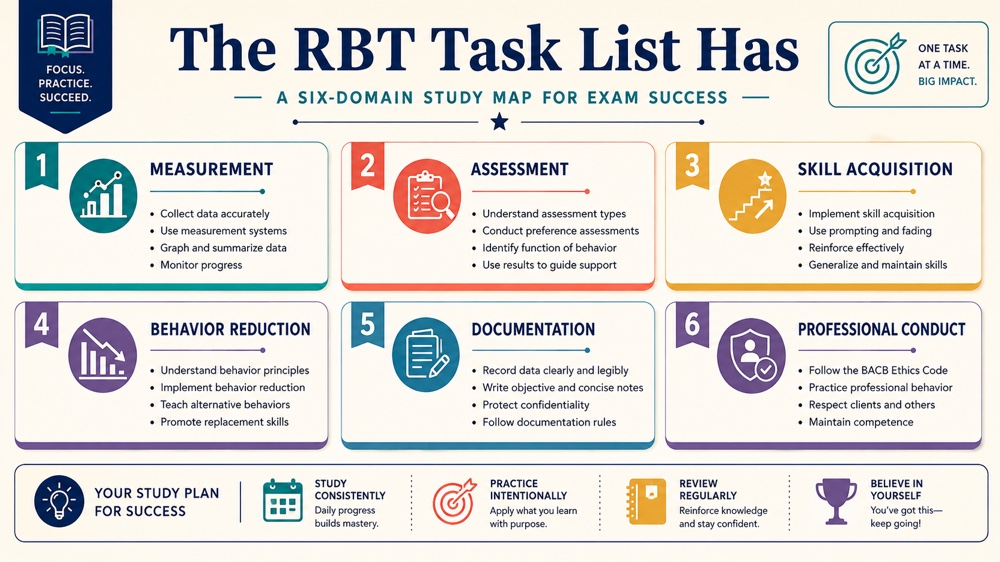
Map domains to observable behavior
A domain is easier to study when you connect it to an action, a defined response, a data measure, and an example. Avoid memorizing a heading without understanding what an entry-level RBT could actually implement under supervision.
The RBT task list has: role boundaries
A task list may describe competencies, but it does not grant independent authority to diagnose, interpret every assessment, redesign treatment, or make clinical decisions. Check assignment, training, supervision, and local policy.
Use exam information carefully
Exam format, timing, and content can change. Use the official source for current details, and treat third-party summaries as study aids rather than authority. Do not promise a score or imply that any practice item is a real examination question.
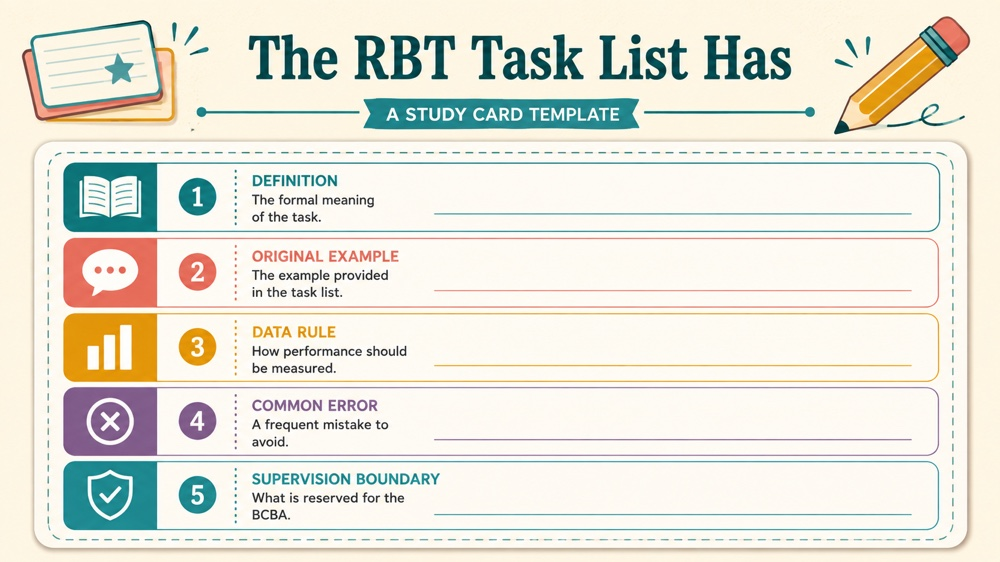
Turn every task into a study card
Write the definition, an original example, a likely error, the correct data rule, and the supervision question. A study card should help you distinguish implementation from interpretation and observation from unsupported inference.
Protect ethics and privacy while studying
Do not copy protected examination items, upload client records, or use identifying details in examples. Use fictional scenarios and current public sources. Ethical study habits reinforce ethical workplace habits.
Check comprehension with comparisons
Compare independent versus prompted response, observation versus interpretation, implementation versus design, and an assigned action versus an unauthorized change. These contrasts reveal the reasoning behind many exam options.
Avoid task-list mistakes
- Using an outdated outline as current authority.
- Treating headings as permission for independent practice.
- Studying recalled or leaked questions.
- Ignoring data definitions and prompt levels.
- Sharing protected records or test content.
- Failing to update notes after an official revision.
- Calling original scenarios official examination questions.
The RBT task list has checklist
- Which current document supports this statement?
- What domain or observable task is involved?
- What does the RBT implement or record?
- What is outside independent authority?
- What example and error pattern should I study?
- What source date should be written in my notes?
- What question belongs in supervision?
Use the rbt task list has as a source-verification and exam-study topic. RBT Training is independent educational content and is not affiliated with or endorsed by BACB.
Practice the concept
Review the rbt task list has with original RBT scenarios, current-source reminders, and clear role boundaries.
Review the RBT study resource →
Frequently Asked Questions
What does the RBT task list have?
It organizes current competencies and tasks for study, but the exact content and exam details should be checked against the current official BACB documents.
Can a task list replace supervision?
No. It is a study and competency framework, not a substitute for written programs, training, supervision, or local policy.
How should candidates use old notes?
Label them as historical, compare them with the current official source, and remove any outdated details from active study materials.
Are these official exam questions?
No. They are original educational scenarios and are not official, recalled, leaked, or BACB-endorsed.
References
- Behavior Analyst Certification Board: Registered Behavior Technician Handbook, updated June 2026.
- Behavior Analyst Certification Board: RBT Test Content Outline (3rd ed.).
- Behavior Analyst Certification Board: RBT resources.
- Behavior Analyst Certification Board: ethics resources.
- Behavior Analyst Certification Board: RBT Ethics Code (2.0).