
A good rbt task list study guide should do more than repeat a list of terms. It should show where a task fits in the current outline, what an RBT can observe or implement, which nearby concept is easy to confuse with it, and what to do when the written procedure is unclear. That structure turns a blueprint into a study map.
Table of Contents
- What an RBT task list study guide should do
- Check the edition in an RBT task list study guide
- Map an RBT task list study guide to six domains
- Build one page per task
- Add knowledge and distinction notes
- Study an RBT task list study guide by week
- Write original task-based practice
- Avoid these task-list study-guide mistakes
- Frequently Asked Questions
- References
This guide uses the BACB RBT Test Content Outline, 3rd edition, as the current content framework. The outline organizes 43 tasks across six domains. The current BACB Handbook controls examination and credentialing information, while official assessment materials control competency-assessment boundaries. An independent study guide can explain and organize learning; it cannot replace a primary source, supervision, an assessment, or a client-specific written plan.
RBT Training is not affiliated with, operated by, or endorsed by the Behavior Analyst Certification Board (BACB). The examples below are newly written for independent study. They are not official, recalled, leaked, or BACB-endorsed questions, and no guide, practice score, or study schedule can guarantee a passing result or certification.
What an RBT task list study guide should do
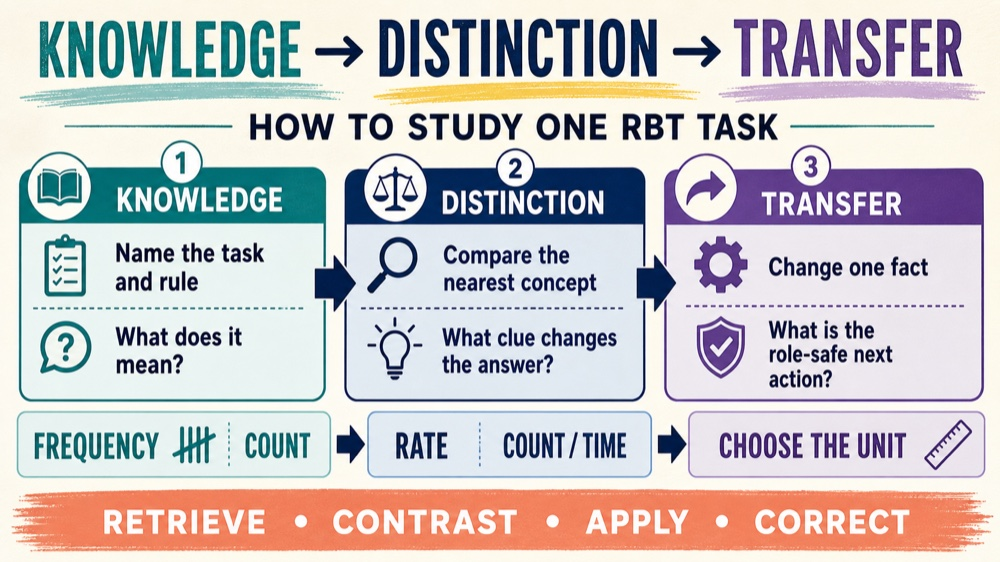
A useful rbt task list study guide turns each task into a short decision record. Every page should answer:
- What is the task? State the task label and plain-language meaning.
- What is observable? Identify what you can see, hear, count, time, or verify.
- What procedure controls? Connect the decision to the written plan or assigned protocol.
- What is the nearest contrast? Name the concept that could lead to a wrong answer.
- What is the role-safe next action? Implement, record, report, or ask.
- How will you transfer it? Create an original scenario with one changed fact.
A list of definitions supports first exposure, but it does not prove application. For example, a page on duration should show that the interval begins when the response starts and ends when it stops. It should also contrast duration with latency, which describes the delay before a response begins. The contrast is part of the task, not an optional extra.
| Study-guide layer | Question to ask | Evidence of understanding |
|---|---|---|
| Task label | Where does this fit in the current outline? | You can name the domain and task area. |
| Concept | What does the term mean here? | You can explain it without copying a sentence. |
| Observable clue | What fact supports the decision? | You separate data from interpretation. |
| Contrast | What nearby idea is different? | You can explain why a distractor fails. |
| Action | What should the RBT do next? | You stay within the plan and role. |
Check the edition in an RBT task list study guide
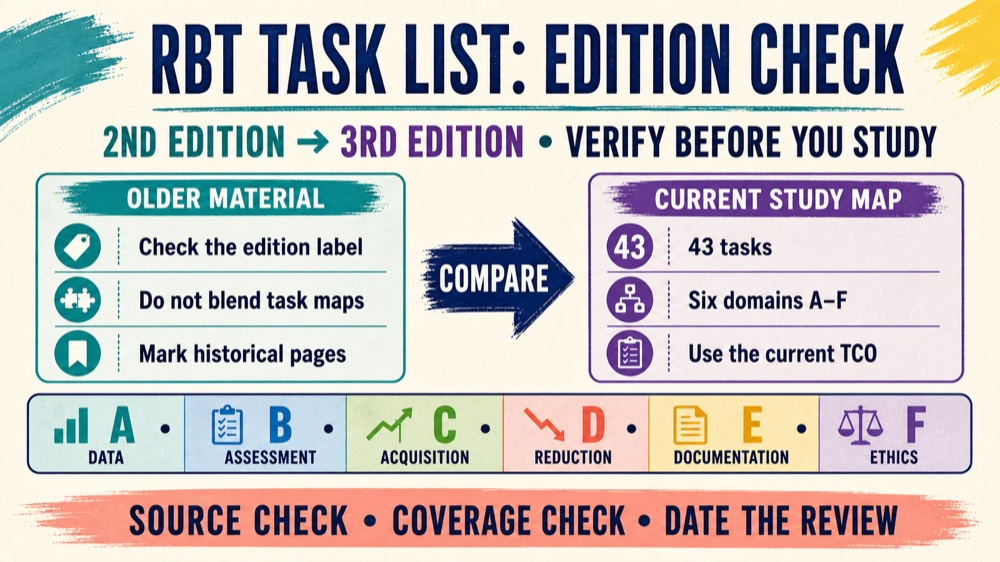
Edition checking is essential because search results still contain older RBT Task List materials. Before studying from an rbt task list study guide, record the exact edition and compare it with the current BACB outline.
- Find the edition name, publication date, and last update date.
- Confirm that the guide names the RBT Test Content Outline, 3rd edition, when it claims current coverage.
- Compare the domain names and task map with the current official document.
- Mark older 2nd-edition pages as historical or needing review; do not silently blend them into a current guide.
- Check whether examples, exam numbers, and ethics language have their own source labels.
The older Task List can be useful for understanding how a resource was organized, but an older label is not evidence of current requirements. A guide that says “updated” without naming what changed is incomplete. Write an edition note at the top of every page you keep.
Keep official facts separate from study explanations. The current Handbook describes 75 scored questions, 10 unscored pilot questions, four answer choices, and a 90-minute time limit. Those facts describe the secure examination format. A guide may create a 20-question quiz or an 85-question independent practice set, but its count does not reproduce or predict the secure exam.
Map an RBT task list study guide to six domains
The current outline contains 43 tasks across six domains. Use this table as a coverage audit, not as a personal score calculator:
| Domain | Tasks / outline share | Study questions |
|---|---|---|
| A. Data Collection and Graphing | 13 / 17% | What is observable? Which measurement fits? What does the graph show? |
| B. Behavior Assessment | 8 / 11% | Which assigned procedure applies? What can be observed and reported? |
| C. Behavior Acquisition | 19 / 25% | Which teaching step, prompt, reinforcement, or generalization decision fits? |
| D. Behavior Reduction | 14 / 19% | What does the written plan require? What should be recorded or escalated? |
| E. Documentation and Reporting | 10 / 13% | How can the note be objective, accurate, private, and useful? |
| F. Ethics | 11 / 15% | What protects competence, dignity, confidentiality, supervision, and boundaries? |
Use the percentages to allocate attention, not to invent a separate domain score. The tasks are a blueprint for coverage. Your study page should connect the task to a behavior-analytic decision and a safe professional response.
For example, a page on behavior acquisition should not stop at “reinforcement increases future behavior.” Add the observable clue, the programmed consequence, the role of the written plan, and a contrast with prompting. That makes the page useful for a scenario rather than only a vocabulary quiz.
Build one page per task
Use a stable one-page format so the guide is easy to review:
- Header: domain letter, task label, and current edition.
- Plain-language rule: one or two sentences in your own words.
- Observable anchor: what would be seen, heard, counted, or timed?
- Procedure anchor: what written instruction or assigned protocol controls?
- Common contrast: the nearest concept and the decisive difference.
- Original example: a short scenario with one clear clue.
- Correction box: what error did you make and what will you practice next?
- Source box: primary document, page/section if available, and check date.
Keep one task per page unless two tasks must be compared. A dense page can be useful, but a learner should be able to cover the answer and retrieve the decision. If the page cannot be used without rereading the paragraph, simplify the front-facing rule and move detail to a note.
Add knowledge and distinction notes
Separate two kinds of study notes:
- Knowledge note: the core term, definition, procedure, or fact you must recognize.
- Distinction note: the nearby term, tempting answer, or changed scenario that tests whether you can apply the knowledge.
Useful distinction families include frequency versus rate, duration versus latency, partial-interval versus whole-interval recording, DRA versus DRI versus DRO, extinction versus punishment, DTT versus NET, prompt versus reinforcement, maintenance versus generalization, and objective versus subjective documentation.
For example, a knowledge note can say “latency is the time between an instruction and response onset.” A distinction note can ask, “The question instead asks how long the response continues after onset. Which measure changes?” The second note forces you to locate the timeline rather than match a familiar word.
Ethics distinctions also need concrete clues. “Be professional” is too vague. A stronger page contrasts protecting confidential client information with sharing an identifiable story in a casual group chat, then states the approved communication and supervision route.
Study an RBT task list study guide by week
Use a seven-day loop:
| Day | Focus | Output |
|---|---|---|
| 1 | Edition, sources, and domain map. | Coverage checklist and three priority tasks. |
| 2 | Data collection and graphing. | Two measurement contrasts and one graph explanation. |
| 3 | Assessment and acquisition. | One assigned-procedure scenario and one teaching decision. |
| 4 | Behavior reduction. | Plan-fidelity and reporting corrections. |
| 5 | Documentation and ethics. | Objective-note rewrite and boundary decision. |
| 6 | Mixed retrieval. | Closed-book answers with error categories. |
| 7 | Transfer and review. | New scenarios for repeated errors and next-week targets. |
Do not use a completed checklist as proof that you are ready. Use it to choose the next practice. If you can define a term but cannot recognize it when the setting, person, or consequence changes, the task needs more transfer work.
Write original task-based practice
The examples below are newly written for independent study. They are not official, recalled, leaked, or BACB-endorsed questions:
- Data collection: a response occurs 12 times in a session. Identify the count before deciding whether the question asks for frequency or a time-based rate.
- Assessment: an assigned preference procedure requires a specific order, but one item is unavailable. Follow the written procedure and ask the supervisor rather than silently changing it.
- Acquisition: the learner responds independently under the plan. Record the response and do not add an unnecessary prompt.
- Reduction: a new safety event is not addressed by the current plan. Follow existing safety direction, record observable facts, and report through the responsible route.
- Documentation: replace “was defiant” with the instruction, observable response, timing, and consequence that occurred.
- Ethics: a friend asks for a recognizable client story. Protect confidentiality and use only approved, de-identified professional communication.
For every miss, label the error: wrong unit, unsupported inference, procedure change, scope problem, privacy risk, or confusion with a neighboring concept. Then write a new transfer item that changes one fact. The correction is where a task-list study guide becomes a study system.
Avoid these task-list study-guide mistakes
- Mixing editions: label older material and compare it with the current 3rd-edition outline.
- Studying only terms: add observable clues, contrasts, and role-safe actions.
- Treating blueprint percentages as personal scores: use them for coverage planning only.
- Copying secure or recalled content: create original scenarios and explanations.
- Changing a plan from a study note: follow the written instruction and supervision route.
- Writing subjective notes: replace labels with observable facts and accurate reporting.
- Ignoring documentation and ethics: keep all six domains in the review loop.
Bottom line: a strong RBT task list study guide is current, source-linked, task-mapped, contrast-rich, and built for correction. Use the 3rd-edition TCO as the map, separate official facts from independent notes, and practice the decision that each task requires.
Ready to test your task-list map?
Try free RBT practice questions after mapping the task list and use each explanation to choose your next review target.
Try Free RBT Practice Questions →
Frequently Asked Questions
Which RBT task list edition should a current study guide use?
Check the current BACB RBT Test Content Outline, 3rd edition, and label any older Task List material as historical or needing comparison.
How should I study a task-list page?
Retrieve the rule, identify the observable clue, explain the nearest contrast, and solve a new original scenario with one changed fact.
Are task-list study-guide examples official exam questions?
Independent examples should be newly written and clearly labeled. They are not official, recalled, leaked, or BACB-endorsed questions.
What if a task-list scenario conflicts with my written plan?
Follow the written plan and the established supervision route. Do not use a study guide as permission to change a client procedure.
References
- Behavior Analyst Certification Board. RBT Test Content Outline, 3rd edition.
- Behavior Analyst Certification Board. RBT Handbook, updated June 2026.
- Behavior Analyst Certification Board. RBT Ethics Code.