
The rbt initial competency assessment is the hands-on checkpoint in the RBT certification pathway. It is not the same as a multiple-choice practice test, a 40-hour training certificate, or the final RBT examination. An assessor must observe or evaluate the tasks in the current BACB packet and document that the applicant can perform them competently.
Table of Contents
- What the RBT initial competency assessment is
- Check timing and assessor requirements
- Understand the 19 task items
- Know the assessment types
- Prepare with knowledge and distinction practice
- Finish the form and upload it
- Avoid common assessment mistakes
- Frequently Asked Questions
- References
This guide follows the RBT Initial Competency Assessment Packet effective January 1, 2026, the RBT Handbook updated June 2026, and the RBT Test Content Outline (3rd ed.). Read the current BACB packet and Handbook before scheduling an assessment because forms, timing, and requirements can change.
RBT Training is not affiliated with, operated by, or endorsed by the Behavior Analyst Certification Board (BACB). The examples below are newly written for independent study. They are not official, recalled, leaked, or BACB-endorsed questions, and no practice score or study guide can guarantee a passing result or certification.
What the RBT initial competency assessment is
The rbt initial competency assessment is an evaluation of entry-level RBT tasks after the required 40-hour training. The current packet says that applicants must demonstrate competence on all task items in the form. The responsible assessor initials the completed tasks, records the assessment type used, and signs the final attestation.
Think of the pathway as three different gates:
| Gate | What it shows | What it does not show |
|---|---|---|
| 40-hour training | You completed the required instructional program. | It does not by itself prove that you can perform every task. |
| Competency assessment | You demonstrated the current packet’s task items to an assessor. | It is not the secure written certification examination. |
| RBT examination | You answered the current exam items at the required level. | It does not replace the supervised assessment or application documents. |
This separation matters when you study. A flashcard can help you define latency, prompting, or differential reinforcement, but the assessment may require you to implement a measurement procedure, perform a teaching step, write an objective note, or explain when to seek clinical direction. Prepare for the action named by the packet.
Check timing and assessor requirements
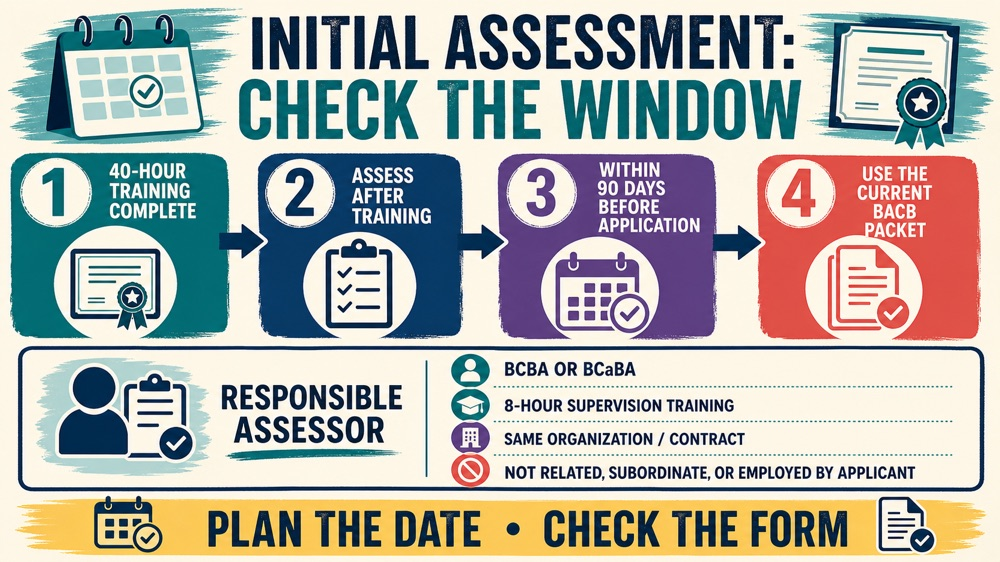
Complete the assessment after the required 40-hour training. The current packet states that the assessment cannot be completed more than 90 days before submitting the RBT certification application. Plan backward from the intended application date so that the signed form is still within the window when you upload it.
The responsible assessor is a BACB certificant who has completed the required 8-hour supervision training and meets the packet’s relationship and organizational requirements. The responsible assessor oversees the process, can delegate portions to qualified assistant assessors, maintains the assessment records, and remains responsible for quality. An assistant assessor must hold an active RBT certification or higher and demonstrate proficiency in the material before conducting delegated portions.
The relationship rules are not a minor administrative detail. The responsible assessor, applicant, assistant assessors, and client organization must have the employment or contractual relationships described in the packet. The assessor cannot be related to, subordinate to, or employed by the applicant during the assessment. Ask the assessor to confirm the current packet, organization relationship, and signature requirements before you begin.
The assessment may be conducted over one or more sessions, in person, live through the internet, or through recorded videos created specifically for the assessment, subject to the packet’s instructions. A convenient format is not permission to skip a required observation or use an informal checklist in place of the BACB form.
Make a timing record with:
- the date your 40-hour training was completed;
- the planned assessment date and format;
- the intended application submission date;
- the date that marks the 90-day boundary; and
- the current packet version you will use.
Understand the 19 task items
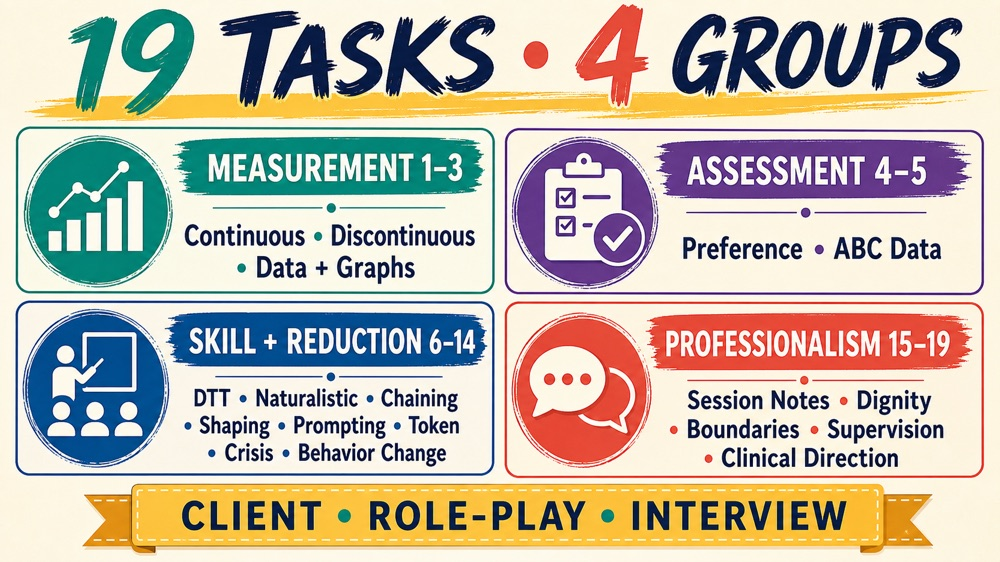
The current 2026 form contains 19 task items. It groups them into measurement, assessment, skill acquisition and behavior reduction, and professionalism and requirements. Use the grouping to organize practice, but follow the exact current packet when an item or assessment type is unclear.
| Group | Task items | What to rehearse |
|---|---|---|
| Measurement | 1–3 | Continuous measurement, discontinuous measurement, and entering data or updating graphs. |
| Assessment | 4–5 | Conducting preference assessments and collecting ABC data. |
| Skill acquisition and behavior reduction | 6–14 | DTT, naturalistic teaching, chaining, shaping, discrimination, prompting, token systems, crisis/emergency protocol, and one assigned behavior-change option. |
| Professionalism and requirements | 15–19 | Objective session notes, client dignity, professional boundaries, supervision standards, and clinical direction. |
Three of the skill-acquisition and behavior-reduction tasks must be demonstrated with a client under the current form’s instructions. Do not interpret “role-play available” as “no performance is needed.” The assessor chooses or follows the packet’s permitted method for each task and records it on the official form.
For exam preparation, map these 19 items back to the six TCO domains: A. Data Collection and Graphing, B. Behavior Assessment, C. Behavior Acquisition, D. Behavior Reduction, E. Documentation and Reporting, and F. Ethics. The current examination blueprint describes 43 tasks across those six domains, with 75 scored questions and 10 unscored pilot questions. The competency packet is a practical demonstration document; the TCO is the examination content map.
Know the assessment types
The packet uses three ways to evaluate a task. The assessor decides which permitted method fits the task and the circumstances:
- With a client: you perform the task with a client receiving behavior-analytic services.
- Role-play: you perform the task in a similar situation with another person acting in the client role when a client demonstration is not appropriate or possible.
- Interview: you accurately describe the concept, give examples or nonexamples when required, and answer live follow-up questions.
Do not study the three formats as three unrelated exams. The same concept may need a different response. For a measurement task, performance may involve selecting and using the procedure. For an ethics task, the packet may require an interview explanation about dignity, boundaries, supervision, or clinical direction. Practice the observable response and the verbal explanation separately.
| Assessment clue | Useful preparation | Common mistake |
|---|---|---|
| With a client | Review the written plan, materials, data path, and safety instructions. | Improvising a new procedure because the session is inconvenient. |
| Role-play | Practice the sequence and say what you would record or report. | Treating role-play as a vocabulary recital with no action. |
| Interview | Give a concise rule, observable example, nonexample, and supervision route. | Using vague words such as “be professional” without a decision. |
If competence is not demonstrated, the assessor may provide corrective feedback and assess the task on another day. Corrective feedback cannot be delivered on the final assessment of a task. Ask the assessor how the next attempt will be documented rather than assuming an incomplete mark is permanent or automatically passed.
Prepare with knowledge and distinction practice
Use two layers of notes. A knowledge note states the basic definition or procedure. A distinction note identifies the nearest tempting alternative and the fact that separates it. This is more useful than memorizing a list of terms because the assessor or examination item may change the setting, target, or wording.
- Continuous versus discontinuous measurement: identify whether the procedure records each response or samples behavior across intervals.
- Frequency versus rate: count occurrences first, then check whether the requested answer includes a time unit.
- Preference assessment versus ABC data: identify whether the procedure examines choices or records antecedent-behavior-consequence events.
- Prompt versus reinforcement: locate the support that precedes the response and the consequence that follows it.
- Objective note versus interpretation: replace labels such as “unmotivated” with observable actions, timing, and context.
- Clinical direction versus independent redesign: ask the supervisor when the written plan or safety direction does not answer the situation.
For example, imagine a role-play in which a learner does not respond after an instruction. A strong response identifies the programmed prompt, follows the written sequence, records the response and prompt level, and reports uncertainty. A weak response invents a new prompt hierarchy because it sounds clinically sophisticated. The assessment is checking faithful implementation, not independent treatment design.
Practice the professionalism items out loud. A complete answer to a boundary scenario should name the boundary, protect the client, and state the approved communication or supervision route. A complete answer to a clinical-direction scenario should identify when the plan is unclear and say whom you would contact. These examples are newly written for study and are not official questions.
Finish the form and upload it
After each task is demonstrated competently, the assessor initials the task and marks the assessment type used. When all task items are complete, the responsible assessor signs and dates the final attestation. Review the form before upload:
- all 19 task items are addressed;
- the selected assessment type is marked where required;
- the applicant name and BACB ID match the portal;
- the organization and assessor details are complete;
- the signature follows the BACB acceptable-signatures policy; and
- the pages are readable and in the current official format.
The completed Initial Competency Assessment is uploaded with the RBT certification application. The packet says non-BACB forms will not be accepted. Keep a private copy and ask the responsible assessor how records will be retained; the packet requires the responsible assessor to maintain assessment documentation for at least seven years.
Do not upload a screenshot of a practice worksheet as if it were the official form. A study worksheet can help you prepare, but it cannot replace the assessment, the assessor’s attestation, or the BACB application document.
Avoid common assessment mistakes
- Confusing the exam with the assessment: one is a practical demonstration and the other is the certification examination.
- Using an older packet: check the effective date and download the current BACB form.
- Starting before training is complete: the current packet places the assessment after the required 40-hour training.
- Missing the 90-day application window: schedule with the intended application date in view.
- Practicing only definitions: rehearse the client, role-play, and interview response that the task requires.
- Changing a written procedure: follow the plan and seek clinical direction when information is missing.
- Leaving form fields incomplete: unreadable or incomplete documentation can delay an application.
- Sharing identifiable client details: protect confidentiality during role-play, notes, and communication.
Bottom line: prepare for the RBT initial competency assessment as a documented demonstration of current tasks. Finish the qualifying training first, use the current BACB packet, practice both performance and explanation, follow the assessor’s permitted methods, and upload the complete signed form with the application.
Ready to rehearse the decisions?
Use independent RBT practice questions to identify which task distinction needs review before your assessment.
Try Free RBT Practice Questions →
Frequently Asked Questions
What is the RBT initial competency assessment?
It is a practical evaluation of the current BACB packet’s task items after the required training and before the certification application.
How many task items are on the 2026 form?
The current Initial Competency Assessment form effective January 1, 2026 contains 19 task items. Use the current packet because future revisions may change the form.
Can a practice quiz replace the competency assessment?
No. A quiz can support study, but the official assessment requires a qualified assessor to evaluate and document the permitted performance or interview method.
When should I complete the assessment?
Complete it after the required 40-hour training and no more than 90 days before submitting the RBT certification application, according to the current packet.
References
- Behavior Analyst Certification Board. RBT certification resources.
- Behavior Analyst Certification Board. RBT Initial Competency Assessment Packet, effective January 1, 2026.
- Behavior Analyst Certification Board. RBT Handbook, updated June 2026.
- Behavior Analyst Certification Board. RBT Test Content Outline, 3rd edition.
- Behavior Analyst Certification Board. RBT Ethics Code.