

RBT flashcards work best when the back of each card makes you explain a decision, not merely repeat a definition. A useful card has a precise term, an observable clue, the nearest contrast, and a short role-safe example. That design helps you move from vocabulary recall to the scenario reasoning expected of an entry-level behavior technician.
Table of Contents
- What useful RBT flashcards contain
- Map RBT flashcards to six domains
- Write knowledge and distinction cards
- Use RBT flashcards with active recall
- Build a personal-confusion deck
- Turn cards into scenarios
- Avoid these RBT flashcard mistakes
- Frequently Asked Questions
- References
This guide uses the BACB RBT Test Content Outline, 3rd edition, and the RBT Handbook updated June 2026 as the source boundary. The current outline organizes 43 tasks across six domains. Independent flashcards are study tools; they are not official BACB exam content, recalled questions, leaked questions, or BACB-endorsed materials.
RBT Training is not affiliated with, operated by, or endorsed by the Behavior Analyst Certification Board (BACB). Flashcards can support review, but they cannot replace required training, the competency assessment, supervision, the current Handbook, or a written plan. No deck or practice score can guarantee a passing result or certification.
What useful RBT flashcards contain
Good rbt flashcards answer more than “What does this word mean?” Use five fields:
- Term: name one concept, procedure, or task.
- Plain-language rule: explain it in your own words.
- Observable clue: say what would be seen, heard, counted, or timed.
- Nearest contrast: name the confusing alternative and the decisive difference.
- Role-safe example: state what the RBT would implement, record, report, or ask.
For example, a weak card says “Latency: time.” A stronger card says, “Latency is the time from an instruction or other specified event to response onset. Contrast it with duration, which measures how long the response continues after it begins. If the written plan asks for latency, record the delay before onset.” The second version gives you a retrieval rule and a changed-scenario anchor.
| Card side | Question | Quality check |
|---|---|---|
| Front | Can I retrieve the term from a clue? | It does not give away the answer through a definition. |
| Back | Can I explain the rule and contrast? | It names the observable feature and nearest distractor. |
| Example | Can I use it in a new setting? | The response stays within the written plan and role. |
| Correction | What will I review if I miss it? | There is a next card, not only a red mark. |
Map RBT flashcards to six domains
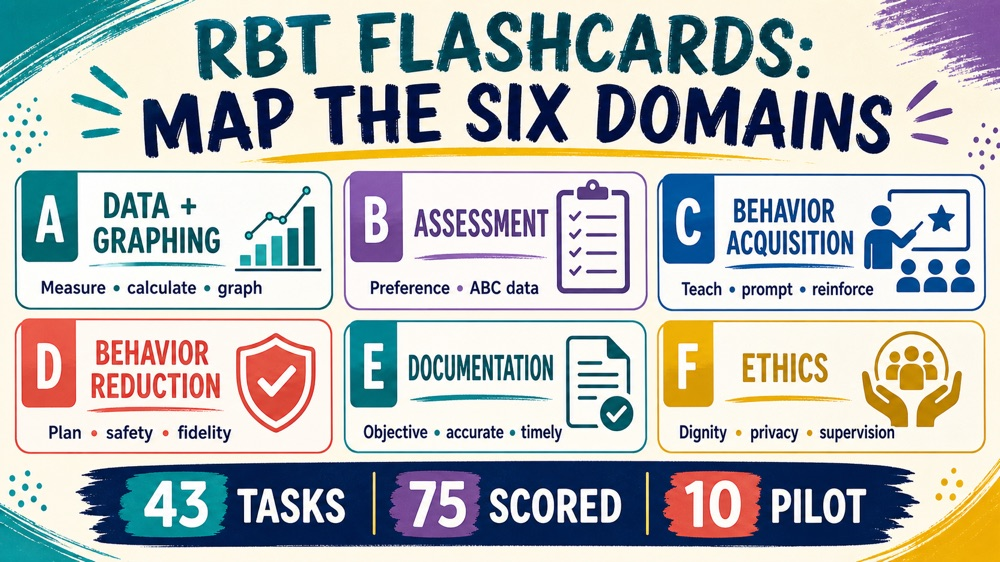
Use the current TCO as a coverage audit for rbt flashcards. The six domains and the Handbook’s scored blueprint are:
| Domain | Scored share | Card prompts |
|---|---|---|
| A. Data Collection and Graphing | 13 / 17% | What is observable? Which measurement, calculation, or graph feature fits? |
| B. Behavior Assessment | 8 / 11% | Which assigned assessment procedure applies, and what is the RBT’s role? |
| C. Behavior Acquisition | 19 / 25% | Which teaching, prompting, reinforcement, shaping, chaining, or generalization step fits? |
| D. Behavior Reduction | 14 / 19% | What does the plan require, and when should safety or uncertainty be reported? |
| E. Documentation and Reporting | 10 / 13% | How can the note be objective, accurate, timely, and private? |
| F. Ethics | 11 / 15% | What protects competence, supervision, dignity, confidentiality, and boundaries? |
The percentages help you distribute study time; they do not tell you which individual question or flashcard will appear. The current exam blueprint describes 75 scored questions and 10 unscored pilot questions. A deck can contain 50, 60, 79, or 200 cards without becoming an official exam format.
Label older cards. If a deck uses legacy domain names or a prior edition, keep an edition note on the card and compare it with the current 3rd-edition outline before treating it as current.
Write knowledge and distinction cards
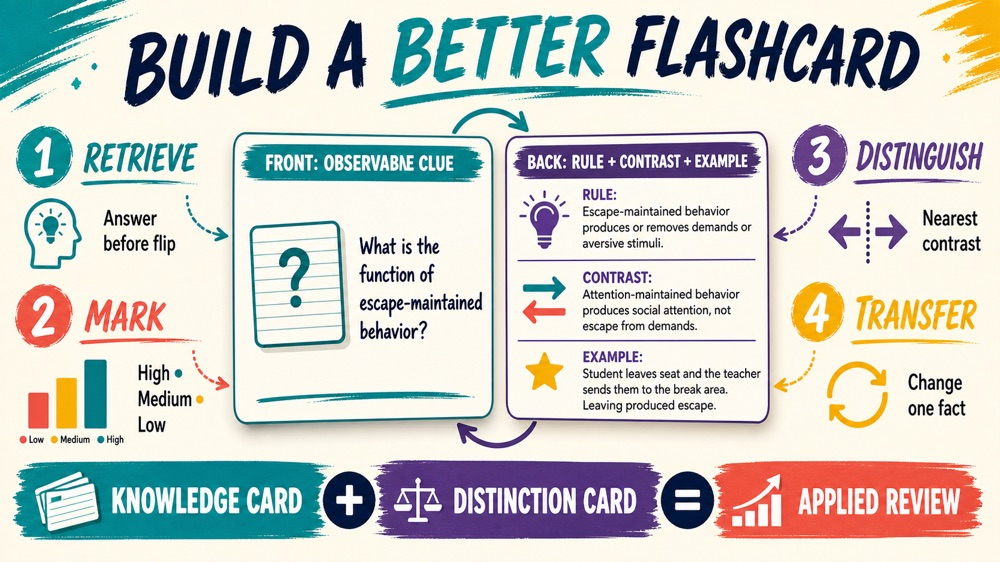
Separate two card types:
- Knowledge card: retrieves the core definition, procedure, or fact.
- Distinction card: forces you to choose between nearby concepts when one scenario feature changes.
Useful distinction families include frequency versus rate, duration versus latency, continuous versus discontinuous measurement, partial-interval versus whole-interval recording, DRA versus DRI versus DRO, forward versus backward chaining, prompt versus reinforcement, maintenance versus generalization, and objective versus subjective documentation.
| Front of distinction card | Back of distinction card |
|---|---|
| The question asks how long a response continues after onset. Which measure? | Duration. Latency is the delay before the response begins. |
| The question asks for occurrences per hour. | Rate. Count alone does not include the requested time unit. |
| The plan reinforces hand raising and does not reinforce shouting out. | Identify the programmed differential reinforcement procedure from the stated rule; do not choose from the label alone. |
| A note says “the learner was defiant.” What should change? | Replace the label with observable instruction, response, timing, and consequence. |
Do not make every card encyclopedic. One card should test one discrimination. Put the source label or TCO task on the bottom, then use a separate “why” card when the concept needs more space. Short cards are easier to retrieve; linked contrast cards carry the nuance.
Use RBT flashcards with active recall
Flip the card only after you have committed to an answer. Use a simple three-level confidence mark:
- High: you retrieved the rule and could give an example.
- Medium: you recognized the term but needed a prompt or hesitated between two options.
- Low: you guessed, could not state the distinction, or gave a role-unsafe example.
Review low-confidence and missed cards first. A correct answer that came from recognition is not the same as a correct answer retrieved from a clue. After flipping, close the card and say the rule again without looking. Then write one changed scenario.
Use short sessions. For example, review 15 new cards, then 15 due cards, then write three transfer examples. Stop adding new cards if the due pile is growing faster than you can explain the old ones. The point of spaced review is durable retrieval, not a large “known” number.
Keep a log with the card, date, confidence, error type, and next due date. If the same confusion persists for three reviews, turn it into a two-column contrast card with an explicit observable clue.
Build a personal-confusion deck
Generic decks cover common terms. Your personal-confusion deck covers the mistakes that your own practice reveals. Add a card when:
- you choose the correct answer for an uncertain reason;
- you confuse two procedures that use similar language;
- you calculate the wrong unit or start/stop point;
- you describe a clinical change instead of following the plan; or
- you write a subjective note or overlook confidentiality.
Use this template: “When the scenario gives [observable clue], choose [concept/action] because [rule]. Do not choose [nearest contrast] because [decisive difference]. If the written plan is incomplete, [role-safe next action].” This template keeps cards aligned with the six-domain content map and with the RBT role.
For ethics cards, avoid vague answers such as “be professional.” Name the protected interest, the boundary, and the reporting or supervision route. For example, a card about an identifiable client story should require you to protect confidentiality and use approved communication, not simply memorize the word “privacy.”
Turn cards into scenarios
Flashcards should lead to application. After reviewing a domain, close the deck and write one original scenario with a changed person, setting, target, or timing. Then answer five lines:
- What is directly observable?
- Which TCO domain or task does it represent?
- Which measurement or procedure fits?
- What is the nearest distractor?
- What would the RBT implement, record, report, or ask?
For example, after a duration-versus-latency card, write one scenario asking for the time from an instruction to response onset and another asking how long the response continues. If both answers use the same word, the cards need a stronger timeline diagram or contrast explanation.
Do not use flashcards as permission to change a client procedure. When your scenario conflicts with a written plan or leaves out safety direction, the study answer should preserve fidelity and identify the supervisor or designated professional to contact.
Avoid these RBT flashcard mistakes
- Counting cards instead of decisions: a large deck can still omit a nearest contrast.
- Copying old edition terms without a map: identify the current TCO and label legacy material.
- Writing definition-only backs: add observable clues, examples, and role-safe next actions.
- Flipping immediately: commit to an answer and mark confidence first.
- Studying only large domains: keep assessment, documentation, and ethics in the loop.
- Using official-sounding claims: independent cards are not official, recalled, leaked, or endorsed content.
- Rereading without transfer: change one fact and solve a new scenario.
Bottom line: effective RBT flashcards are small, source-labeled decision tools. Map them to all six current domains, pair knowledge cards with distinction cards, use active recall and confidence marks, and turn persistent errors into new scenarios.
Ready to test recall under pressure?
Use independent RBT practice questions after your flashcard review and let the explanations choose your next card.
Try Free RBT Practice Questions →
Frequently Asked Questions
Are RBT flashcards official BACB materials?
Independent flashcards are study tools, not official BACB exam forms or BACB-endorsed content. Use the current BACB documents for requirements and source facts.
How many RBT flashcards do I need?
There is no required deck size. Prioritize clear coverage of all six domains and add personal-confusion cards for concepts you repeatedly miss.
Should flashcards include examples?
Yes. Add an observable clue, nearest contrast, and role-safe example so you practice applying the term rather than only recognizing it.
Can flashcards replace practice questions?
No. Flashcards support retrieval; scenario-based practice tests whether you can use the concept when the setting, timing, or wording changes.
References
- Behavior Analyst Certification Board. RBT Test Content Outline, 3rd edition.
- Behavior Analyst Certification Board. RBT Handbook, updated June 2026.
- Behavior Analyst Certification Board. RBT Ethics Code.