
Exam accommodations for RBT candidates are requested through the BACB process when a current disability creates a need for an adjustment to the examination experience.
Table of Contents
- Exam accommodations for RBT: quick answer
- Who may request accommodations?
- What to prepare before starting the request
- What should qualified-professional documentation explain?
- The single-PDF rule
- When should you submit the request?
- How review and scheduling work
- Comfort aids and standard testing options
- Common mistakes that delay requests
- Frequently asked questions
RBT examination preparation
Exam Accommodations for RBT: 2026 Request Checklist
Exam accommodations for RBT candidates are requested through the BACB process when a current disability creates a need for an adjustment to the examination experience. This guide explains what to prepare, how the documentation should connect the condition to the requested accommodation, and why you should wait for the BACB response before scheduling.
Exam accommodations for RBT: quick answer
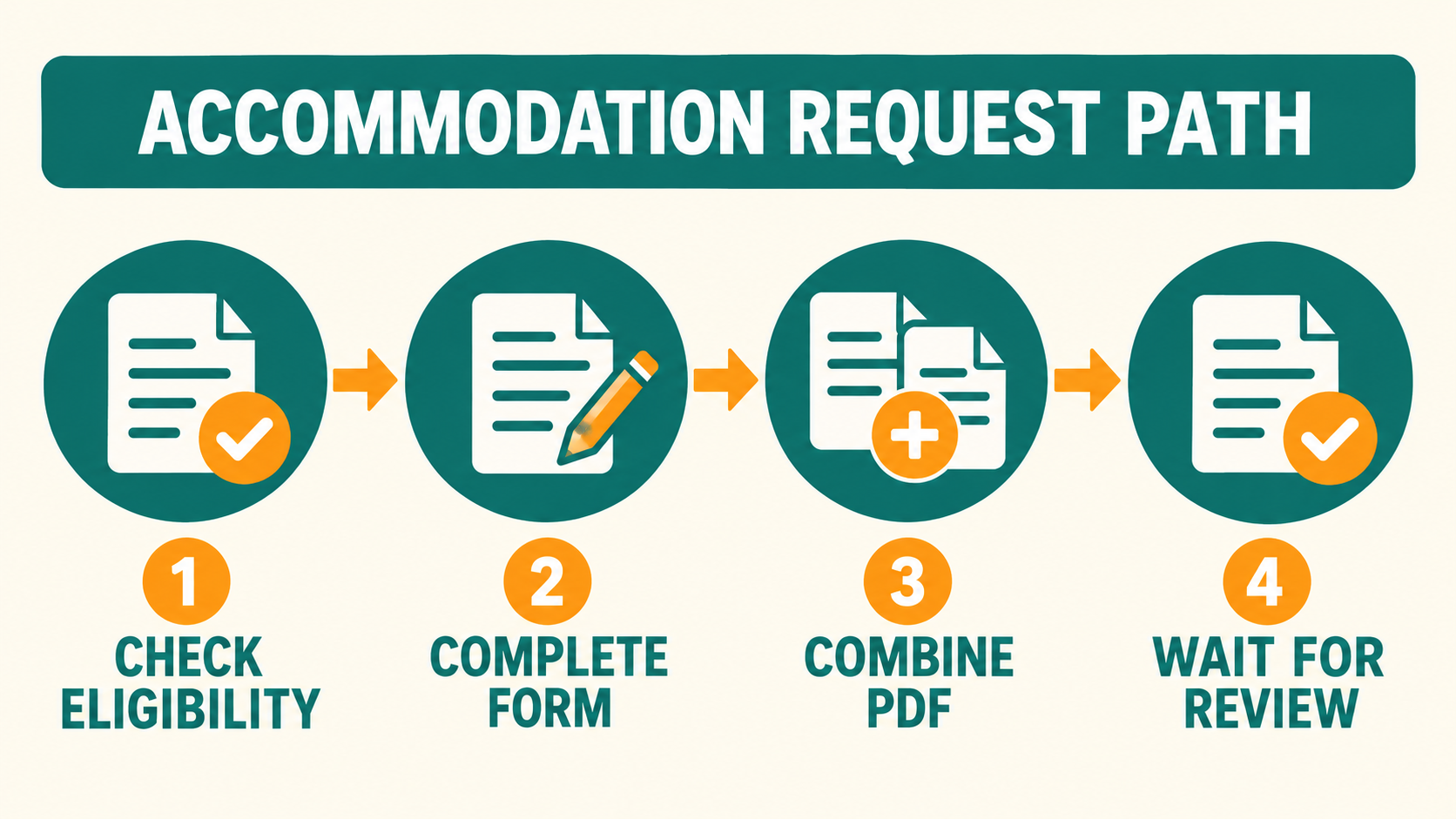
If you have a current disability as defined by the Americans with Disabilities Act or a comparable human-rights law in your country, you may request an examination accommodation. The request normally includes the BACB Examination Accommodation Request Form plus supporting documentation from a qualified professional. Combine the materials into one PDF and submit it through the current BACB route shown in your portal or the official accommodation instructions.
The BACB says its review is typically completed within 10–14 days after it receives the request and documentation. That is a typical review period, not a guarantee. If staff ask for more information, the review can take longer. Do not schedule the examination until you receive the email explaining the status of your request and how scheduling should proceed.
Who may request accommodations?
Accommodation requests are for candidates whose current disability creates a need for an adjustment to the examination process. The BACB’s materials refer to the ADA or a comparable human-rights law in the candidate’s country. The key question is not whether a person simply prefers a different testing setup; it is whether a documented disability and its functional impact support the requested accommodation.
Describe the request in functional terms. For example, documentation may need to explain how a limitation affects reading, processing, communication, vision, hearing, mobility, or another examination-related activity, and why the requested adjustment addresses that limitation. The BACB—not a training provider, employer, or test-preparation website—reviews the request.
What to prepare before starting the request
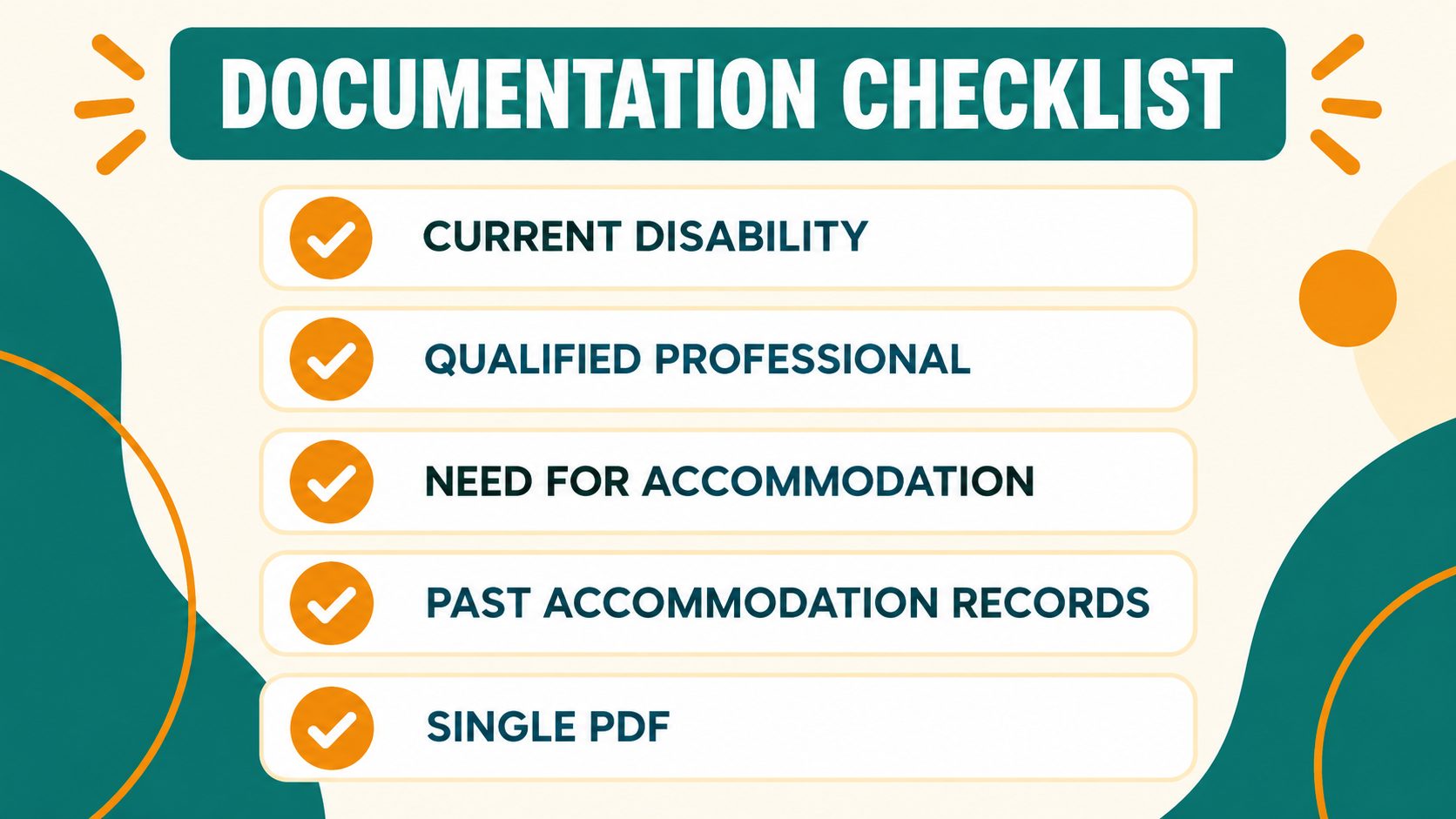
Start by reading the current BACB examination-accommodations instructions and noting the exact form and submission route. Then make a short preparation list:
- Your BACB account name and contact email.
- The exact accommodation or accommodations you are requesting.
- The reason each accommodation is needed for the examination.
- A current report or letter from a qualified professional.
- Past accommodation records, if they help document the need.
- A clean, readable PDF that contains the form and supporting documents.
Use the same legal name and email that appear in your BACB account. A mismatch can slow identity verification or create confusion when staff connect the request to your certification application. Keep a copy of every document and the submission confirmation for your records.
What should qualified-professional documentation explain?
The BACB handbook gives examples of qualified professionals such as a physician, school official, licensed psychiatrist, or licensed psychologist. The documentation should identify the disability and state the need for the requested accommodation. A diagnosis by itself may not answer the practical question: what adjustment is needed for this examination, and why?
A useful report is specific without revealing unnecessary private information. It should connect the current condition to the functional limitation, explain the recommended accommodation, and include the professional’s identifying information and credentials. If the accommodation is time-based, the report should explain why additional time is related to the documented limitation. If the request concerns a reader, breaks, assistive technology, or another support, the documentation should address that support directly.
Do not ask a provider to copy a template without clinical judgment. The BACB can request additional documentation, and a vague letter can create delay even when the underlying need is legitimate.
The single-PDF rule
For examination accommodations, the BACB instructs candidates to complete the request form and combine it with the required documentation into a single PDF. Treat this as a submission-quality check. Put the form first, follow it with the supporting report or reports, confirm that every page is readable, and open the final PDF yourself before submitting it.
Use a clear filename such as LastName_RBT_Exam_Accommodation_Request.pdf. Avoid password protection unless the BACB specifically tells you to use it. Do not send separate attachments merely because the files were created separately; merge them into the one PDF requested by the instructions. If the portal rejects the file, follow the current BACB troubleshooting or contact route rather than emailing sensitive records to an unverified address.
When should you submit the request?
Submit as early as you can in the certification and examination process. The BACB reviews certification applications and accommodation requests separately, so approval of one does not mean approval of the other. Early submission leaves time to respond if staff request clarification and reduces the chance that a desired test date arrives before the accommodation decision.
Current BACB pages have moved some submission functions into the BACB portal. Follow the route displayed in your account and verify that you are using the examination-accommodation category, not an unrelated contact form or an ACE-provider document form. Save the confirmation screen, date, and any reference number.
How review and scheduling work
After receipt, BACB staff review the request and supporting evidence. The typical review window is 10–14 days, but additional-documentation requests can extend it. Watch the email address connected with your BACB account, including spam or filtered folders. Read the decision carefully: it may explain whether the request is approved, whether more information is needed, and how to schedule with the approved arrangement.
Do not schedule first and hope the accommodation will be added later. The official handbook says candidates should wait for the email about the status of the request and scheduling instructions. Pearson VUE delivers the RBT examination in a computer-based testing format, but the accommodation decision determines what approved adjustment, if any, is attached to your appointment.
Comfort aids and standard testing options
Not every helpful testing preference requires a formal accommodation request. The BACB’s accommodations information notes that Pearson VUE has comfort aids that may not require official approval, although test-center staff inspect them before they are allowed into the testing room. The same page notes that computer-based testing centers are wheelchair accessible and that the control-plus/minus function can adjust screen magnification on examinations.
These standard options do not replace an accommodation request when your disability requires a different adjustment. Check the current Pearson VUE and BACB instructions before bringing any item. A test center can apply security rules even to an item that feels medically or practically useful.
Common mistakes that delay requests
- Waiting until the appointment: A late request leaves little time for review or additional documents.
- Submitting a diagnosis only: The records should explain the functional need and requested adjustment.
- Uploading multiple files: The BACB asks for the form and documentation combined into one PDF.
- Using a generic old form: Download the current form and follow the current portal route.
- Scheduling too early: Wait for the accommodation-status email before scheduling.
- Assuming certification approval equals accommodation approval: They are separate reviews.
- Sending sensitive records casually: Use the official portal or verified BACB instructions.
Frequently asked questions
How long does the BACB review take?
The BACB says the review is typically completed within 10–14 days after receiving the request and supporting documentation. It can take longer if additional documentation is requested.
Can I schedule the RBT exam while my request is pending?
Wait for the BACB email about the status of the request and how to schedule. Do not assume that a pending request will be attached automatically to an appointment.
Do I need a diagnosis in the documentation?
The documentation should identify the disability and explain the need for the requested accommodation. Ask a qualified professional what documentation is appropriate for your situation and follow the BACB’s current instructions.
Are certification and accommodation requests the same?
No. The BACB reviews them separately. A certification application approval does not constitute approval of an examination accommodation request.
Can I use a comfort aid without approval?
Some Pearson VUE comfort aids may not require official accommodation approval, but they can be inspected at the test center. Check the current BACB and Pearson VUE rules before test day.
Official sources: BACB Examination Information; RBT Handbook; BACB Accommodations Questions; BACB RBT examination resources. Retrieved September 27, 2026. Verify the current portal instructions before submitting personal documentation.
Ready to practice the RBT concepts you just reviewed?
Try an independent, original RBT practice resource with exam-style questions, scoring, and answer explanations.
References
- Behavior Analyst Certification Board. RBT Test Content Outline, 3rd edition.
- Behavior Analyst Certification Board. RBT Handbook.
- Behavior Analyst Certification Board. RBT Ethics Code.