

RBT team communication examples are most useful when they show the source of the information, the observable facts, and the next decision or direction needed.
Table of Contents
- RBT team communication examples: quick answer
- Use the three-part reporting formula
- RBT team communication examples for caregivers
- RBT team communication examples for teachers
- RBT team communication examples for other service providers
- Examples of what to tell the supervisor
- Report variables that may affect client progress
- Examples for data and implementation concerns
- Urgent communication and emergency routes
- Follow up and document the communication
- Common communication mistakes
- Frequently asked questions
RBT documentation, reporting, and professional communication
RBT Team Communication Examples: What to Say and Report
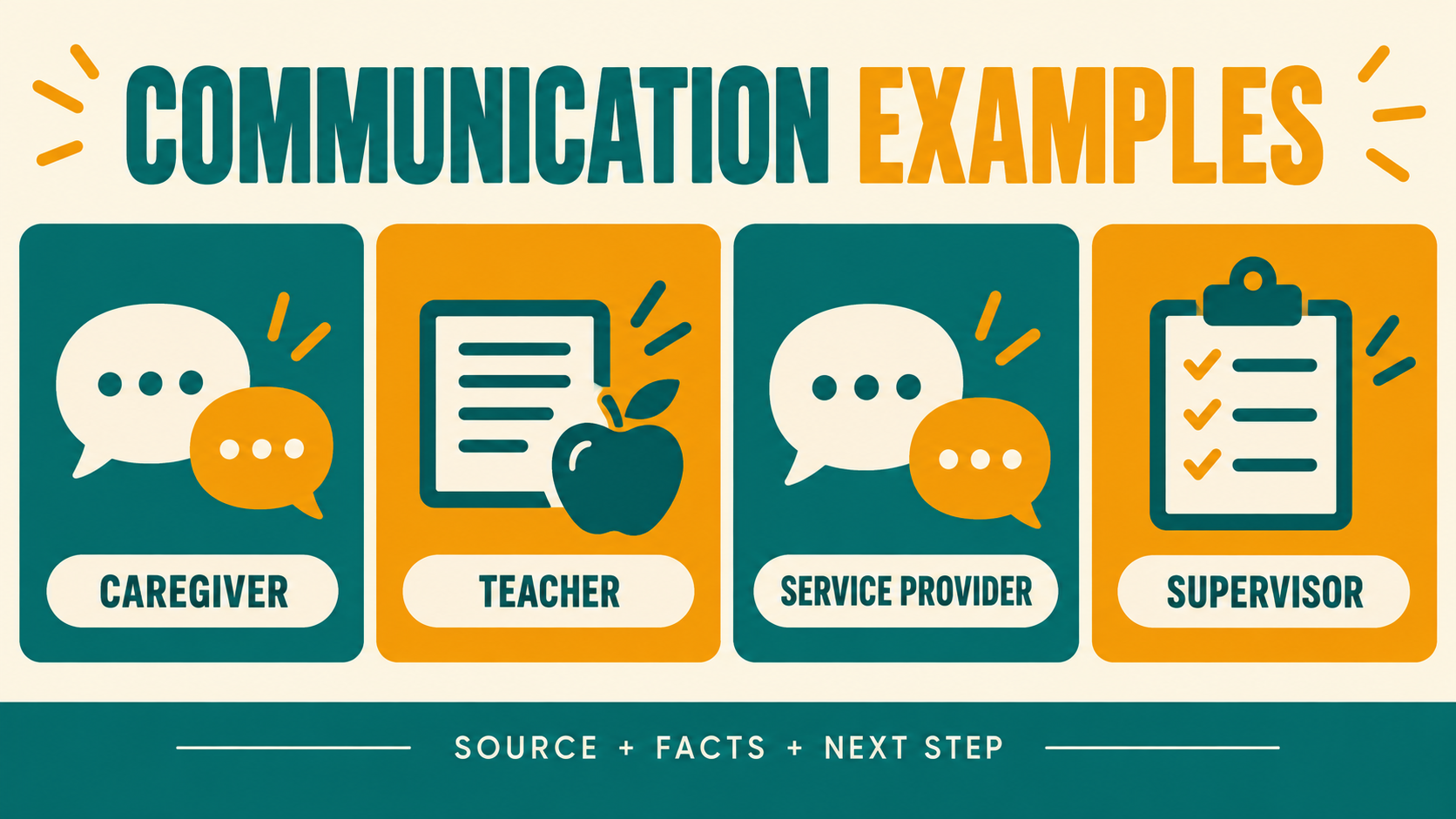
RBT team communication examples are most useful when they show the source of the information, the observable facts, and the next decision or direction needed. This guide gives practical language for communicating with caregivers, teachers, other service providers, and supervisors while keeping clinical decisions with the authorized team.
RBT team communication examples: quick answer
When another team member shares a concern or suggestion, listen, identify who provided the information, clarify what happened and when, record objective facts through the approved process, and tell the supervisor in a timely manner. Use the correct urgent route when there is immediate danger or a safety event.
The BACB RBT Test Content Outline identifies communicating concerns and suggestions from the intervention team—including caregivers, teachers, and service providers—with a supervisor in a timely manner. The RBT’s job is to route useful information and seek direction, not to diagnose the problem, promise a change, or independently rewrite the program.
Use the three-part reporting formula
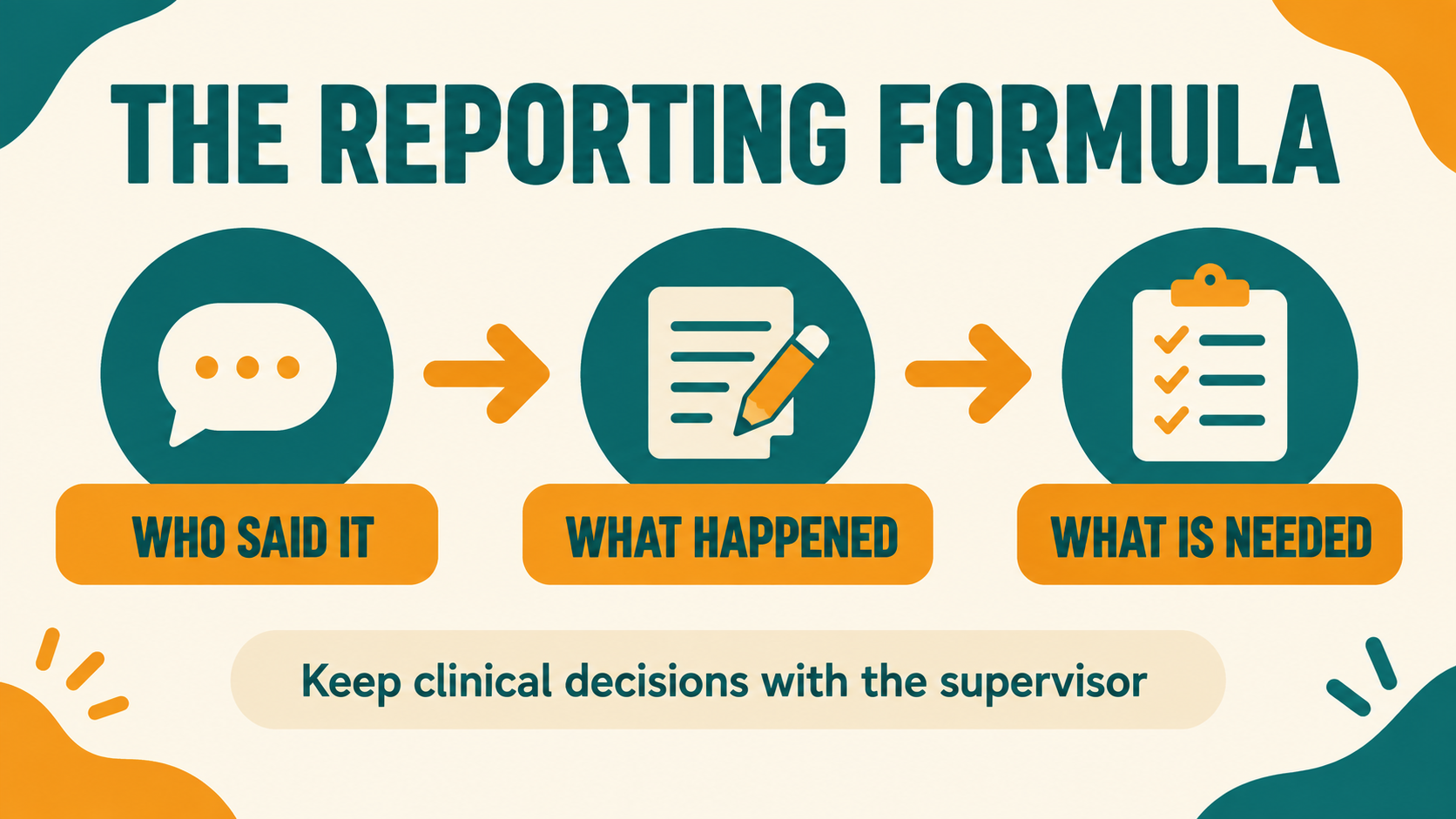
A simple structure keeps a message concise and prevents interpretation from replacing evidence:
- Who said it: Identify the caregiver, teacher, service provider, supervisor, or other authorized source.
- What happened: State the observable event, timing, setting, frequency, change, or question. Separate what you observed from what someone else reported.
- What is needed: State whether you need clarification, clinical direction, a safety response, more data, or a team follow-up.
For example: “The classroom teacher reported that the student left the group twice during math today. I observed one exit during the afternoon session. Should I collect the additional data you want before the team reviews the schedule?” This message preserves the source, distinguishes reports, and asks for direction.
RBT team communication examples for caregivers
Caregivers may observe sleep, eating, communication, routines, medication changes, community behavior, or generalization that the RBT does not see during a session. Treat the caregiver as an important information source without turning a report into a clinical conclusion.
Caregiver reports a change at home: “Thank you for telling me that requests have been harder after school this week. I’ll record the example and share the change with the supervisor. I won’t change the program on my own, but I can ask what information the team wants next.”
Caregiver suggests a new strategy: “I understand why that routine feels helpful at home. I’ll pass the suggestion to the supervisor so the team can decide whether it fits the written plan and how it should be evaluated.”
Caregiver asks for a medical answer: “I can document the medication-related change and notify the supervisor through our approved process. I cannot advise you to change medication or make a medical decision.”
Caregiver is frustrated: “I hear that this has been difficult. Can you tell me what happened, when it started, and what you would like the team to review? I will route those details to the supervisor.”
Do not dismiss a caregiver because the concern occurs outside your session. Do not promise that the program will change because the caregiver made a suggestion.
RBT team communication examples for teachers
A teacher may report a classroom pattern, a schedule change, a peer interaction, an academic demand, or a successful strategy. Ask what the teacher directly observed and keep school information in the authorized communication channel.
Teacher reports a classroom pattern: “The teacher reported three times leaving the reading group between 9:00 and 9:30. I’ll share the timing and context with the supervisor. Would you like the classroom team to continue its normal documentation while the supervisor reviews it?”
Teacher suggests changing a prompt: “Thank you for the suggestion. I can share how the current prompt was implemented, but the supervisor needs to approve a program change. I’ll ask what the team wants us to try and how to measure it.”
Teacher reports a success: “The teacher reported that the student used the break card independently during science. I’ll record the setting and share it so the team can consider whether the skill is generalizing.”
Be careful with labels such as “attention-seeking” or “refusal.” Ask for the observable action and the surrounding conditions instead.
RBT team communication examples for other service providers
Speech-language, occupational, medical, educational, and other service providers may share information that affects coordination. Communicate only through authorized channels and do not represent yourself as qualified to interpret another profession’s assessment.
Another provider reports a schedule change: “The service provider reported that the appointment moved from Tuesday to Thursday. I’ll document the change and tell the supervisor because it may affect the session schedule.”
Another provider asks about the behavior plan: “I can describe the part of the plan I am authorized to implement. For questions about changing goals or procedures, I’ll connect you with the supervisor.”
Two plans appear inconsistent: “I noticed that the instruction I received today differs from the current written plan. I have not improvised a new procedure. I’m asking the supervisor to clarify which direction is current.”
Examples of what to tell the supervisor
The supervisor usually needs a message that is brief but complete. Include the source, date and setting, observable facts, what you already did within the plan, and the question that needs direction.
- Concern: “Caregiver reported two nights of disrupted sleep before today’s session. I observed lower task engagement during the first 20 minutes. Please advise whether you want a variable report, additional data, or another response.”
- Suggestion: “Teacher suggested using a visual timer during transitions. I have not changed the procedure. Can you review whether the suggestion fits the plan and specify how to implement and measure it if approved?”
- Data irregularity: “The event count in the session note does not match the raw tally. I preserved both records and have not edited the original. How should I correct and document the discrepancy?”
- Training need: “I am not yet confident implementing the new prompting procedure. Please provide modeling, rehearsal, or observation before I use it independently.”
- Chain-of-command question: “I sent the concern through the normal channel at 10:00 a.m. and have not received direction. What is the approved backup contact for this type of issue?”
These examples seek direction instead of hiding uncertainty. Asking for help is part of safe, competent service delivery.
Report variables that may affect client progress
The current RBT training outline includes timely documentation and reporting of variables such as illness, medication changes, and schedule changes. Report the variable without claiming that it caused a behavior or outcome.
Use language such as, “Caregiver reported a new medication schedule beginning yesterday; I do not know whether it affected today’s data,” or, “The session occurred in a different room because the usual space was unavailable.” If you do not know the exact time, write that the time is unknown and identify the source. Never fill an information gap with a guess.
Examples for data and implementation concerns
Communication is especially important when data are missing, unusual, or inconsistent with the procedure. First protect the original record. Then describe the discrepancy and ask for direction.
Missing data: “The frequency tally was not completed for the first 10 minutes because the materials were unavailable. I documented the missing interval and need direction on the approved correction.”
Possible procedural drift: “I delivered the instruction before the programmed prompt on two trials. I recorded the deviation and would like feedback before the next session.”
Unexpected response: “The client showed a response not described in the current plan. I followed the written safety direction, documented what occurred, and need guidance before the next occurrence.”
Urgent communication and emergency routes
Do not wait for a routine supervision meeting when there is immediate danger, a serious injury, a medical emergency, or another event identified as urgent by the written plan. Use the emergency procedure and contact the required person or service first. Documentation should follow as soon as it is safe and appropriate.
For a time-sensitive but nonemergency concern, use the same-day supervisor channel. State the risk, current facts, and action already taken. Do not promise a caregiver that an issue will be fixed, and do not delay a required report while trying to write a perfect message.
Follow up and document the communication
Use the authorized session note, communication log, incident form, or other approved record. Record who received the message, when it was sent, the response or direction received, and any follow-up that remains open. The exact form depends on the workplace and event.
Protect confidentiality by using approved systems, limiting unnecessary identifiers, and avoiding personal social-media messages. If a person asks you to bypass the supervisor or share another client’s information, explain the boundary and use the proper route.
Common communication mistakes
- Reporting a conclusion instead of facts: Replace “attention-seeking” with the observable behavior and context.
- Removing the source: Identify whether the detail came from a caregiver, teacher, provider, or your direct observation.
- Promising a change: Say that you will route the suggestion, not that the plan will change.
- Changing the plan in the moment: Follow current written direction and ask the supervisor.
- Using an unapproved channel: Protect privacy and preserve the required record.
- Delaying urgent information: Use the emergency or same-day route before routine documentation.
- Failing to close the loop: Confirm what direction was received and what remains unresolved.
Frequently asked questions
What are good RBT team communication examples?
Good examples identify the source, describe observable facts and timing, and state the direction or follow-up needed. They do not turn a report into a diagnosis or an unauthorized plan change.
Can an RBT tell a teacher or caregiver that the plan will change?
No. The RBT can acknowledge the suggestion and tell the person that it will be routed to the supervisor. The authorized team decides whether a clinical change is appropriate.
How should an RBT report a medication change?
Use the approved supervisor and documentation route, identify who reported the change and when, and avoid giving medical advice or claiming that the medication caused a behavior change.
What if a team member asks me to ignore a concern?
Do not hide a relevant concern. Preserve the facts, use the approved chain of command, and seek supervisor or Requirements Coordinator direction. For serious or ongoing issues, follow the current workplace and BACB reporting resources.
Should every conversation be written in the session note?
Not necessarily. Follow the organization’s approved process; a communication, incident, medical-variable, or supervision record may be required instead of or in addition to a session note.
What if I am unsure what to say?
Use the formula: who said it, what happened, and what is needed. State what you know, identify what you do not know, and ask the supervisor for the next authorized step.
Official sources: BACB RBT Test Content Outline (3rd ed.); BACB RBT 2026 40-Hour Training Requirements and Curriculum Outline; BACB RBT supervision resources; BACB Supervision, Assessment, Training, and Oversight. Retrieved September 28, 2026. Follow the current legal, regulatory, workplace, privacy, and emergency requirements.
Ready to practice the RBT concepts you just reviewed?
Try an independent, original RBT practice resource with exam-style questions, scoring, and answer explanations.
References
- Behavior Analyst Certification Board. RBT Test Content Outline, 3rd edition.
- Behavior Analyst Certification Board. RBT Handbook.
- Behavior Analyst Certification Board. RBT Ethics Code.