
When someone searches for an rbt task list, they may be looking for the older BACB Task List, the current RBT Test Content Outline, or a study guide that mixes both. That edition difference matters. The document name, domain labels, task wording, examination window, and study priorities can change even when familiar concepts remain.
Table of Contents
- What the RBT task list is
- Compare the 2nd and 3rd editions
- Map the current RBT task list to six domains
- Separate task statements from exam questions
- Turn the RBT task list into study notes
- Practice knowledge and distinction points
- Build an edition-safe review loop
- Avoid these RBT task-list mistakes
- Frequently Asked Questions
- References
This guide separates the RBT Task List (2nd ed.) from the RBT Test Content Outline (TCO), 3rd ed. It uses the official BACB documents to build a current study map for 2026 examination preparation. It also explains why task counts and examination-question counts are not interchangeable.
RBT Training is not affiliated with, operated by, or endorsed by the Behavior Analyst Certification Board (BACB). The examples below are newly written for independent study. They are not official, recalled, leaked, or BACB-endorsed questions. No task map, practice score, or study guide can guarantee a passing result or certification.
What the RBT task list is
The phrase rbt task list usually refers to the BACB document that describes the knowledge, skills, and abilities expected of an entry-level Registered Behavior Technician. It is a blueprint, not a practice test. Training providers use it to organize instruction, and the certification examination uses the current content outline to define what can appear on the exam.
A blueprint does not tell an RBT to invent a client procedure. It identifies the skill or knowledge area, while the written behavior plan, supervisor direction, workplace requirements, and applicable ethics rules control implementation. For example, a task about prompting does not authorize an RBT to redesign a prompt hierarchy. It tells the learner what kind of decision to understand and apply under supervision.
| Document | What it does | What it does not do |
|---|---|---|
| Task List or TCO | Defines content areas and task statements for training and examination preparation. | It is not a client-specific treatment plan or a signed competency assessment. |
| Study guide | Explains terms, contrasts, examples, and a review sequence in plain language. | It cannot replace the current BACB source or supervision. |
| Practice question set | Rehearses retrieval and scenario decisions using independent content. | It is not an official, recalled, or leaked BACB exam. |
| Competency assessment | Documents an assessor’s evaluation of required practical or interview tasks. | It is not the same as knowing the task-list definition. |
Keep those evidence types separate while studying. A learner can recognize a definition and still need practice identifying the observable clue, following the written procedure, recording accurately, or seeking clinical direction.
Compare the 2nd and 3rd editions
Older pages often call the document the RBT Task List (2nd ed.). The official 3rd-edition document is titled the RBT Test Content Outline and describes examination content beginning in 2026. Both are BACB documents, but a current article should label which one controls each claim.
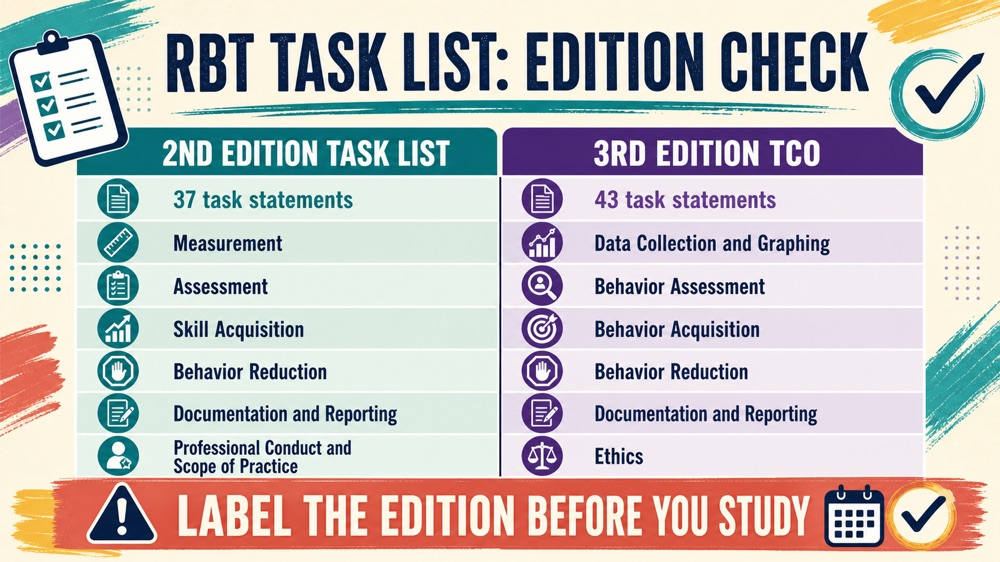
| Check | RBT Task List (2nd ed.) | RBT TCO (3rd ed.) |
|---|---|---|
| Primary use in this comparison | Historical training and exam blueprint. | Current 2026 examination content framework. |
| Domain labels | Measurement; Assessment; Skill Acquisition; Behavior Reduction; Documentation and Reporting; Professional Conduct and Scope of Practice. | Data Collection and Graphing; Behavior Assessment; Behavior Acquisition; Behavior Reduction; Documentation and Reporting; Ethics. |
| Task statements | 37 task statements across six areas. | 43 task statements across six domains. |
| Exam format facts | Use the historical document only when discussing its applicable period. | 75 scored questions and 10 unscored pilot questions in the current outline. |
| Study rule | Keep as a labeled crosswalk; do not silently blend wording. | Use as the current map, then verify the latest BACB materials. |
The most useful change for study is not simply a new title. The 3rd-edition TCO reorganizes and clarifies the content for current examination use. For example, the current outline places data and graphing, assessment, acquisition, reduction, documentation, and ethics in six named domains, while the older document uses familiar but different labels. Concepts can overlap without making the documents interchangeable.
Write an edition note at the top of every downloaded PDF or saved webpage. Record the document title, version, update date, and the examination period it describes. If a study page says “3rd edition” but cites only an older Task List, flag it for review instead of assuming that the label is accurate.
Map the current RBT task list to six domains
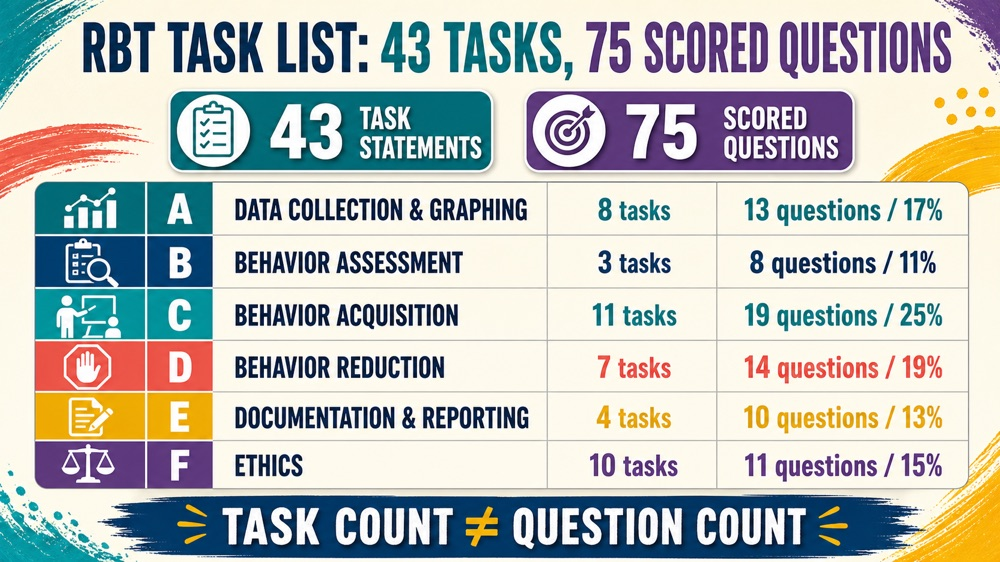
The current TCO contains 43 tasks across six domains. The task count and the number of questions assigned to a domain are different fields in the official document. Use this table as a coverage map, not as a personal score calculator.
| Domain | Task statements | Exam questions and share | Study emphasis |
|---|---|---|---|
| A. Data Collection and Graphing | 8 | 13 questions, 17% | Measurement selection, calculation, graphs, observable definitions, and data reliability. |
| B. Behavior Assessment | 3 | 8 questions, 11% | Preference assessments and assigned components of skill or functional assessment. |
| C. Behavior Acquisition | 11 | 19 questions, 25% | Reinforcement, teaching procedures, prompts, fading, generalization, maintenance, and shaping. |
| D. Behavior Reduction | 7 | 14 questions, 19% | Functions, antecedent interventions, differential reinforcement, extinction, punishment, effects, and crisis procedures. |
| E. Documentation and Reporting | 4 | 10 questions, 13% | Timely communication, clinical direction, variables affecting progress, and objective session communication. |
| F. Ethics | 10 | 11 questions, 15% | Competence, supervision, confidentiality, public statements, boundaries, gifts, feedback, and cultural responsiveness. |
The numbers explain a common search-result error: a page may say that Domain A has 13 items when the official TCO’s 13 is the number of exam questions, while the domain contains eight task statements. A strong rbt task list study page names both fields so learners do not build a false checklist.
Start with every domain, then allocate additional review time to the domains with more examination questions and to the task types you repeatedly miss. Do not skip ethics or documentation because their task counts are smaller. A question can test a small domain through a detailed scenario.
Separate task statements from exam questions
A task statement is a content target. An exam question is one item that samples that target. One task can support several different question forms: a definition, a calculation, a contrast, a procedural sequence, or a role-boundary decision. Conversely, a single question can require more than one piece of knowledge.
Use three columns in your notes:
- Task: write the domain and task label from the current TCO.
- Decision: state what the stem asks you to select, calculate, implement, record, or report.
- Evidence: underline the observable fact or written instruction that supports your answer.
For example, if a question gives the number of responses and the session length, first decide whether it asks for frequency or rate. If it asks how long the response continues, compare duration with latency before choosing. The task map tells you the content area; the timeline and units tell you the decision.
Keep the official examination structure separate from an independent practice set. The current TCO states 75 scored questions and 10 unscored pilot questions, but an independent website may create a different number of questions for study. Its number is not evidence that it has reproduced the secure examination.
Turn the RBT task list into study notes
Use one repeatable note for every task:
- Source line: edition, domain, task label, and official document.
- Plain-language rule: explain the task without copying the source sentence.
- Observable anchor: identify what would be seen, heard, counted, timed, or verified.
- Nearest contrast: name the concept that could produce a tempting wrong answer.
- Role-safe action: implement the written plan, record accurately, communicate, or seek direction.
- Original example: change one fact and solve a new scenario.
- Correction note: record why a missed answer was wrong and what to review next.
Knowledge notes answer “What does this mean?” Distinction notes answer “How is it different from the nearby term?” Both matter. A definition-only page can feel familiar while leaving the learner unable to discriminate between partial-interval and whole-interval recording, DRA and DRO, acquisition and maintenance, or an objective note and an interpretation.
| Note type | Example prompt | Quality check |
|---|---|---|
| Knowledge | What is latency? | Defines the delay before response onset and names the start and end points. |
| Distinction | What if the stem asks how long the response continues? | Contrasts duration with latency using the timeline. |
| Role | What if the written procedure is unclear? | Does not improvise; follows the supervision route. |
| Evidence | Which words in the stem support the answer? | Separates observable facts from assumptions about intent. |
Practice knowledge and distinction points
Write original examples rather than copying secure exam language. Here are safe study prompts:
- Measurement: choose between frequency, rate, duration, and latency from the unit and timeline in the scenario.
- Assessment: follow the assigned preference-assessment procedure and report when a required item or step is unavailable.
- Acquisition: distinguish a prompt from reinforcement by asking when each event occurs and what it is intended to do.
- Reduction: separate an antecedent intervention from a consequence and follow the written plan rather than guessing a function.
- Documentation: replace “was uncooperative” with the instruction, observable response, timing, and consequence.
- Ethics: protect confidential information and ask for direction when competence, supervision, boundaries, or public statements are uncertain.
For every item you miss, label the error: wrong unit, unsupported inference, procedure change, scope problem, privacy risk, or neighboring concept. Then create a second example that changes one fact. This delayed correction step is more useful than simply rereading the same definition.
Build an edition-safe review loop
Use this seven-day loop for an rbt task list review:
| Day | Review | Output |
|---|---|---|
| 1 | Edition, source files, and six-domain map. | One current-reference sheet and a list of older pages to verify. |
| 2 | Data Collection and Graphing. | Two measurement contrasts and one graph explanation. |
| 3 | Behavior Assessment and Behavior Acquisition. | One assigned-procedure scenario and one teaching decision. |
| 4 | Behavior Reduction. | Plan-fidelity, function, and safety corrections. |
| 5 | Documentation and Reporting. | Objective-note rewrite and supervisor communication route. |
| 6 | Ethics. | Confidentiality, competence, boundaries, and feedback decisions. |
| 7 | Mixed retrieval and transfer. | New scenarios for repeated errors and next-week targets. |
At the end of the loop, check the source date again. If a page or PDF has no edition label, no reference, or a task/question count that does not add up, do not use it as the sole study authority. The current BACB resource page and current TCO should be your recheck points.
Avoid these RBT task-list mistakes
- Mixing editions: label 2nd-edition material and compare it with the current 3rd-edition TCO.
- Confusing tasks with questions: record both counts and do the arithmetic before studying.
- Using a task list as a treatment plan: follow the client-specific written plan and supervision.
- Studying only definitions: add nearest contrasts, observable clues, and role-safe actions.
- Calling independent content official: mark every original question and explanation clearly.
- Skipping documentation or ethics: include all six domains in the review cycle.
- Treating a checklist as proof of readiness: use errors and transfer performance to choose the next target.
Bottom line: use the current RBT TCO, 3rd edition, as the 2026 examination map, and keep the RBT Task List, 2nd edition, as an explicitly labeled historical crosswalk. Track task statements separately from examination-question distribution, then study each item through knowledge, distinction, evidence, and role-safe action.
Ready to test your task-list map?
Use independent RBT practice questions after you label the edition, map the domain, and record the reason behind each answer.
Try Free RBT Practice Questions →
Frequently Asked Questions
Which RBT task list should I use for the 2026 exam?
Use the current BACB RBT Test Content Outline, 3rd edition, for 2026 examination content. Label the 2nd-edition Task List as historical when you use it for comparison.
How many tasks are in the current RBT TCO?
The current TCO contains 43 task statements across six domains. It separately describes 75 scored questions and 10 unscored pilot questions.
Are task-list study questions official BACB questions?
Independent study questions should be newly written and clearly labeled. They are not official, recalled, leaked, or BACB-endorsed questions.
Can the task list replace supervision or a written behavior plan?
No. It is an examination and training blueprint. Follow the client-specific written plan and seek clinical direction through the established supervision route.
References
- Behavior Analyst Certification Board. RBT Test Content Outline, 3rd edition.
- Behavior Analyst Certification Board. RBT Task List, 2nd edition.
- Behavior Analyst Certification Board. Task Lists for BACB Certifications.
- Behavior Analyst Certification Board. RBT Handbook, updated June 2026.
- Behavior Analyst Certification Board. RBT Ethics Code.