

A sample RBT exam can be useful before a full mock, but only if you know what the sample is designed to measure. A 10-question warm-up, a 20-question domain drill, and an 85-item timed simulation are not interchangeable. They can all be good resources when their scope, timing, and review purpose are clear.
Table of Contents
- What a sample RBT exam can tell you
- Check the current RBT scope
- Choose the right sample length
- Read the scenario and distractors
- Map results to six domains
- Build a sample-to-study loop
- Practice sample RBT exam decisions
- Avoid these sample-exam traps
- Frequently Asked Questions
- References
This guide explains how to evaluate a sample RBT exam against the current RBT Test Content Outline, 3rd edition. You will learn how to use short samples for diagnosis, how to read distractors, how to avoid old-edition and “official questions” claims, and how to move from a small sample to a balanced study plan.
RBT Training is independent and is not affiliated with, operated by, or endorsed by the Behavior Analyst Certification Board (BACB). The examples and practice prompts below are newly written for independent study. They are not official, recalled, leaked, or BACB-endorsed questions. No sample score guarantees a passing result or a clinical outcome.
What a sample RBT exam can tell you
A short sample is a diagnostic snapshot. It can show whether you recognize a measurement unit, follow a role boundary, distinguish a teaching procedure, or read an ethical cue. It cannot establish broad readiness by itself because a small item set may overrepresent one domain or happen to match what you already reviewed.
| Sample format | Best use | What it cannot prove |
|---|---|---|
| 5–10 questions | Warm-up, vocabulary check, or one narrow decision rule. | Stable performance across the full outline. |
| 15–25 questions | Mixed-domain diagnostic before choosing a study block. | Full-test pacing or endurance. |
| 40–50 questions | Longer applied practice with enough room for error patterns. | Exact prediction of the real exam result. |
| 75–85 questions | Full-length simulation and timing practice. | Official status, unless the BACB itself identifies the content as official. |
Use the sample to answer a narrow question such as “Can I distinguish latency from duration?” or “Do I choose the assigned plan over an improvised intervention?” Then use a different resource to answer the broader readiness question. That separation makes the result more honest and more useful.
Short samples are especially useful after a correction session. If you just reviewed discontinuous measurement, take a fresh set that mixes partial interval, whole interval, and momentary time sampling. Do not repeat the exact same items until the score reflects memory rather than discrimination.
Check the current RBT scope
The current RBT TCO is the RBT Test Content Outline, 3rd edition. It describes 43 tasks across six domains. Current exam context includes 75 scored questions and 10 unscored pilot questions. A sample RBT exam may have any number of practice items, but it should explain how its content maps to the current outline.
| Current domain | What a sample may test | Study question after an error |
|---|---|---|
| A. Data Collection and Graphing | Definitions, measurement selection, data recording, and graph interpretation. | Did I identify the unit and the observation rule? |
| B. Behavior Assessment | Preference, skill, and assessment information under assigned procedures. | Did I separate observed preference from a functional conclusion? |
| C. Behavior Acquisition | Teaching plans, prompting, reinforcement, shaping, chaining, and generalization. | Did I follow the written teaching procedure? |
| D. Behavior Reduction | Behavior definitions, plan implementation, safety, and data-based reporting. | Did I avoid guessing function or improvising a treatment? |
| E. Documentation and Reporting | Objective notes, communication, data integrity, and reporting changes. | Did I record observable facts and protect accuracy? |
| F. Ethics | Confidentiality, scope, supervision, conflicts, and professional conduct. | Did I choose the role-safe and privacy-protective action? |
Be careful with pages that still describe only “measurement, assessment, skill acquisition, behavior reduction, documentation, and professional conduct” without acknowledging the 3rd-edition domain names or current task count. Older terminology can still help you recognize a concept, but it should not be presented as the current source without an edition note.
Choose the right sample length
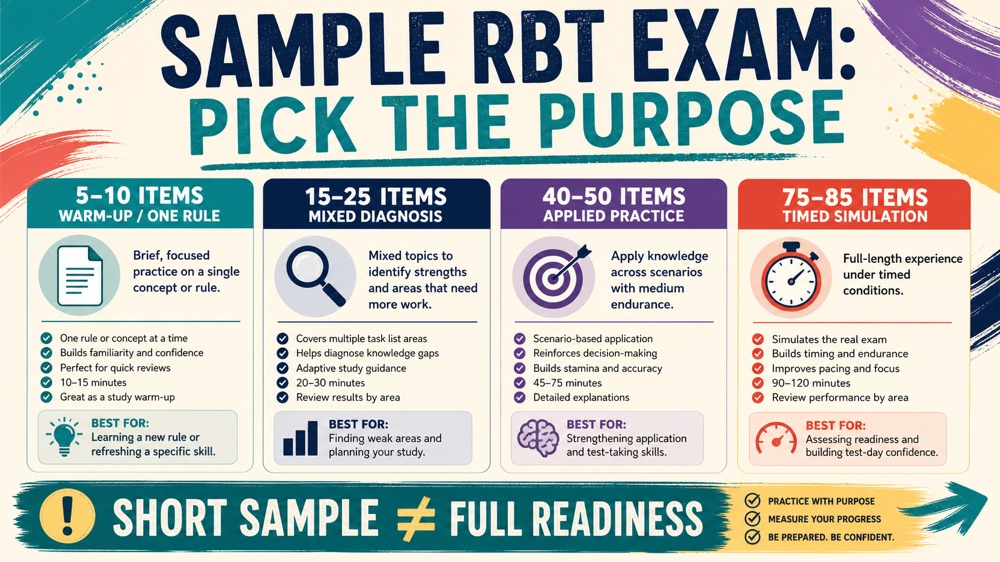
Match the length to your immediate study goal:
- Warm-up: use 5–10 items to activate vocabulary and identify one obvious gap. Do not use the percentage as a readiness judgment.
- Diagnosis: use 15–25 mixed questions and tag each item by domain, confidence, and decision rule.
- Application: use 40–50 scenario questions when you need practice reading context and eliminating plausible distractors.
- Simulation: use 75–85 items under a planned time window when you need to evaluate pacing, stamina, and review strategy.
Take a short sample before and after a study block, but change the item set. If the pre-test and post-test use the same questions, the improvement may be recognition. A fresh scenario asks whether the rule transferred.
Also record confidence, not only correctness. A correct answer selected after eliminating two options is different from a correct answer you can explain immediately. Low-confidence correct responses deserve review because they may not be stable under time pressure.
Read the scenario and distractors
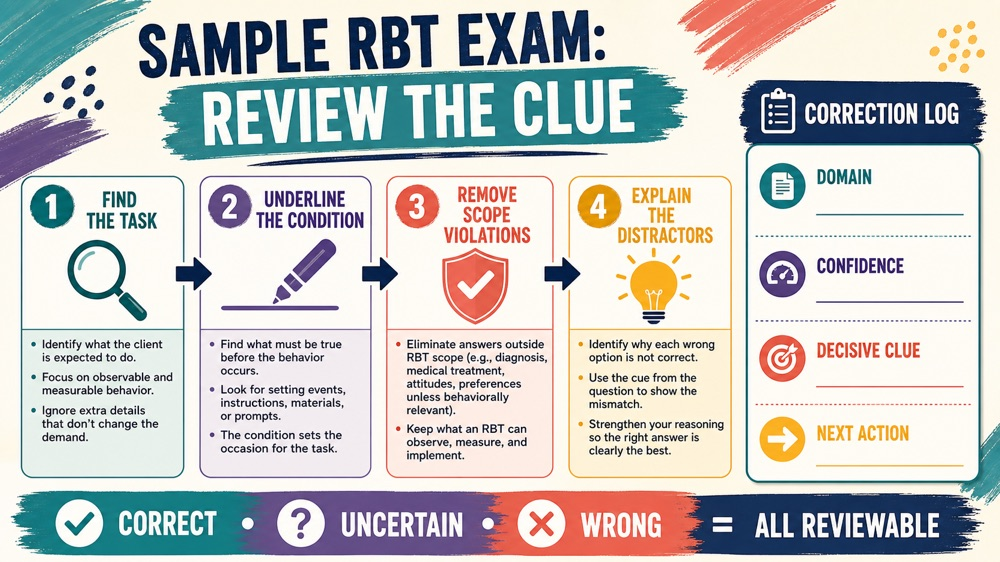
Many RBT questions are easier when you identify the controlling detail before looking for the most appealing answer. Use a four-pass reading routine:
- Find the task: is the item asking for a measurement, assessment step, teaching response, documentation action, or ethical choice?
- Underline the condition: look for “according to the plan,” “after the instruction,” “at the end of the interval,” “observable,” or “confidential.”
- Remove scope violations: eliminate answers that ask the RBT to diagnose, change a plan independently, disclose protected information, or promise an outcome.
- Explain the distractors: state why the remaining options do not fit the condition, unit, or role.
For example, if a scenario says the written plan specifies a partial-interval procedure, the key is not which method seems easiest. The key is the plan-defined scoring rule. If a caregiver asks for a diagnosis, the role-safe response is not to guess; it is to follow the established communication and supervision route.
A sample that gives only the correct letter is less valuable than one that explains the decisive clue and the distractor logic. The explanation should teach a transferable rule, not just defend a single sentence.
Map results to six domains
After the sample, create a simple coverage map. It does not need to imitate the official exam distribution exactly; it needs to show what your sample actually tested.
| Result field | Example entry | Next action |
|---|---|---|
| Domain | A. Data Collection and Graphing | Review continuous versus discontinuous measurement. |
| Confidence | Correct, low confidence | Complete two fresh scenarios without notes. |
| Decisive clue | “At the end of each interval” | Contrast momentary time sampling with partial interval. |
| Distractor error | Chose a clinically active answer | Review RBT role and written-plan boundaries. |
| Retest evidence | Two new items, explained aloud | Move the concept to maintenance review. |
If most questions in a sample come from one domain, do not infer that domain is the largest part of the real exam. The sample’s design controls the sample’s coverage. Use the official TCO for the academic map and your correction log for your personal map.
Keep the evidence separate: a practice-site score is a learning signal; the official source defines scope; and a supervisor or responsible behavior-analytic professional handles workplace clinical direction. Mixing those roles creates false certainty.
Build a sample-to-study loop
A repeatable loop can be completed in 30–60 minutes:
- Attempt: answer the sample without looking up definitions.
- Classify: mark correct, incorrect, or correct-but-uncertain.
- Locate: tag the domain, concept, and controlling clue.
- Correct: write one sentence explaining the rule in your own words.
- Apply: complete a new scenario with the same concept but different surface details.
- Schedule: retest later rather than immediately repeating the same item.
For the first attempt, use a clean answer sheet. During review, use a different color to record the reason for the correction. This creates a visible difference between “I knew it,” “I guessed it,” and “I learned it after feedback.”
Do not copy client information into a public answer log. Practice examples should stay independent and de-identified. In the workplace, documentation and communication follow the assigned privacy and supervision requirements.
Practice sample RBT exam decisions
These original prompts are designed to test how you use a sample rather than reproduce official exam items:
- A 10-question quiz includes only measurement terms. What can its score tell you, and what can it not tell you about six-domain readiness?
- A sample page calls its questions “official” but provides no BACB source and contains an old-edition task map. What should you verify before studying?
- You choose the correct answer but cannot explain why the distractors fail. How should the item be classified in your correction log?
- A sample uses immediate feedback, while your full mock uses a timer and hides explanations. Why should you not compare the percentages as if they measured the same condition?
- The scenario says the RBT should follow the written plan, but one answer changes the procedure because it seems faster. Which clue controls the choice?
- Your sample has 18 items: 10 from Domain C, 4 from A, and 4 from F. What is the correct way to describe its coverage?
For every prompt, answer with a source check, a decisive clue, and a next action. That is how a sample becomes a study instrument rather than a number on a screen.
Avoid these sample-exam traps
- Overreading a small score: treat a short sample as a snapshot, not a prediction.
- Repeating identical items: use fresh scenarios to test transfer.
- Ignoring confidence: review guesses and low-confidence correct responses.
- Accepting “official” language: verify the source, edition, and independence statement.
- Mixing old and current terminology: record the edition before building a study plan.
- Reading only the correct letter: learn the clue and why the distractors fail.
- Assuming sample coverage is exam weighting: use the official TCO for scope and the sample for diagnosis.
Bottom line: a sample RBT exam is most valuable when its purpose is clear, its current scope is transparent, and its explanations lead to a fresh application. Use short samples for diagnosis, full simulations for timing, and a correction loop for durable learning.
Want a clearer next study step?
Use independent RBT practice questions, record confidence, and retest the decision rule with a fresh scenario.
Try Free RBT Practice Questions →
Frequently Asked Questions
What is a sample RBT exam?
It is an independent practice set designed to sample RBT concepts or scenarios. Its item count and scope should be stated clearly.
Can a 10-question sample predict my exam result?
No. A short sample can diagnose a narrow concept or warm up your reasoning, but it cannot establish stable six-domain readiness.
Should a sample RBT exam use current 3rd-edition content?
Yes, if it claims current alignment. Check for the RBT Test Content Outline, 3rd edition, a source link, and a transparent task or domain map.
Why review correct answers?
A correct guess or low-confidence answer may not be stable. Review the decisive clue and distractor logic so the rule transfers to a fresh scenario.
How should I use a sample before a full mock?
Use it as a diagnostic, select a targeted study block, then complete a different fresh sample before attempting a full timed simulation.
References
- Behavior Analyst Certification Board. RBT Test Content Outline, 3rd edition.
- Behavior Analyst Certification Board. RBT Handbook, updated June 2026.
- Behavior Analyst Certification Board. RBT Ethics Code.