
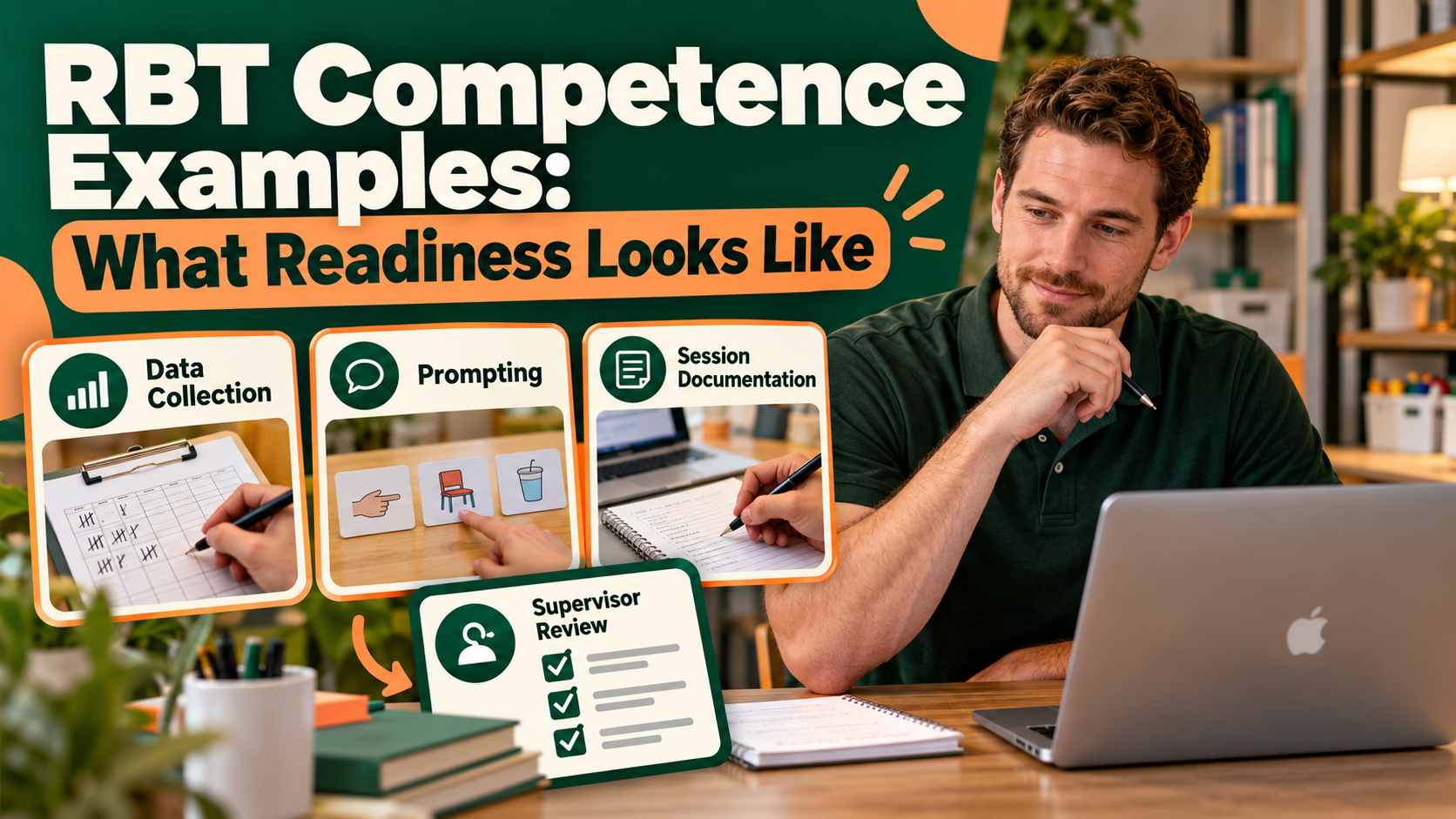
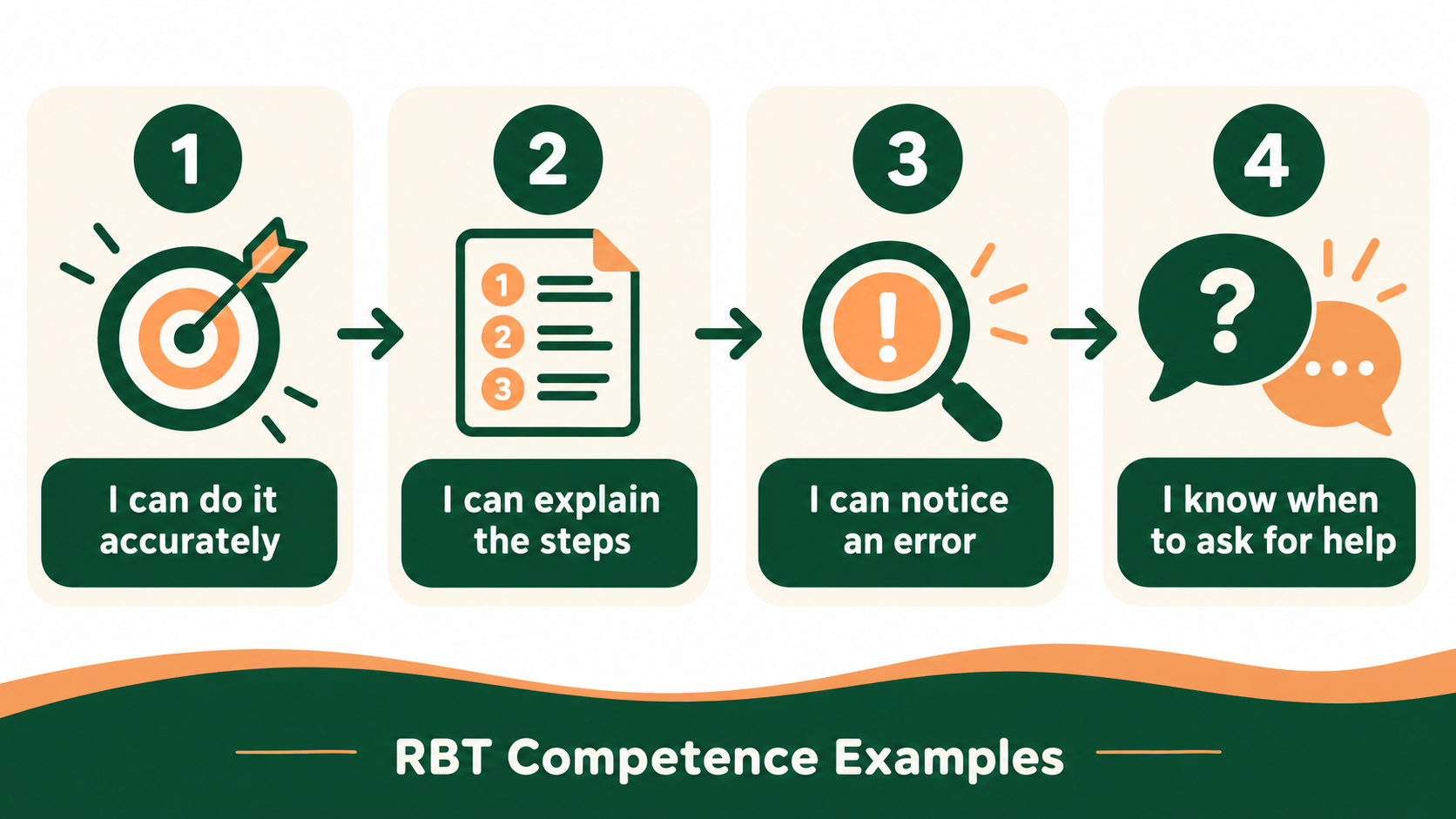
RBT competence examples are task-specific: an RBT can perform a skill accurately, explain the steps, notice an error, and know when to seek supervisor support.
Table of Contents
- RBT competence examples: how to use them
- Example 1: data collection
- Example 2: prompting
- Example 3: reinforcement
- Example 4: documentation
- Example 5: communication and feedback
- Example 6: noticing an error
- What examples do not prove
- Frequently asked questions
- Sources and scope note
RBT SKILLS GUIDE · OBSERVABLE READINESS
RBT Competence Examples: What Readiness Looks Like
Concrete examples across data, prompting, reinforcement, documentation, and knowing when to ask for help.
RBT competence examples are task-specific: an RBT can perform a skill accurately, explain the steps, notice an error, and know when to seek supervisor support.
The RBT Ethics Code (2.0) requires services only after a supervisor confirms demonstrated competence. The examples below help readers recognize observable readiness, but they do not certify an RBT, authorize a procedure, or replace a supervisor’s observation and feedback.
RBT competence examples: how to use them
For every example, ask four questions:
- Can the RBT describe the current procedure and its important steps?
- Can the RBT perform the task accurately under the required supervision?
- Can the RBT recognize a mistake, unexpected condition, or missing information?
- Can the RBT communicate the concern and follow the approved next step?
A person may be strong in one area and still need training in another. Competence can also change when the client, setting, equipment, communication system, or procedure changes.
Good examples describe behavior that another trained observer could see or verify. “The RBT is naturally good with clients” is too vague to guide supervision. “The RBT followed the written prompt sequence across observed opportunities, recorded the assigned measure, and reported one unclear step” gives the supervisor something concrete to review. Observable examples also make feedback less personal: the discussion can focus on the task, the context, and the next practice opportunity.
Use a mix of routine and boundary examples. Readiness should appear during ordinary implementation, but it should also include recognizing when the routine no longer fits—such as a missing material, a changed communication method, or a safety concern. Knowing when to ask for help is part of competence, not evidence that competence is absent.
Example 1: data collection
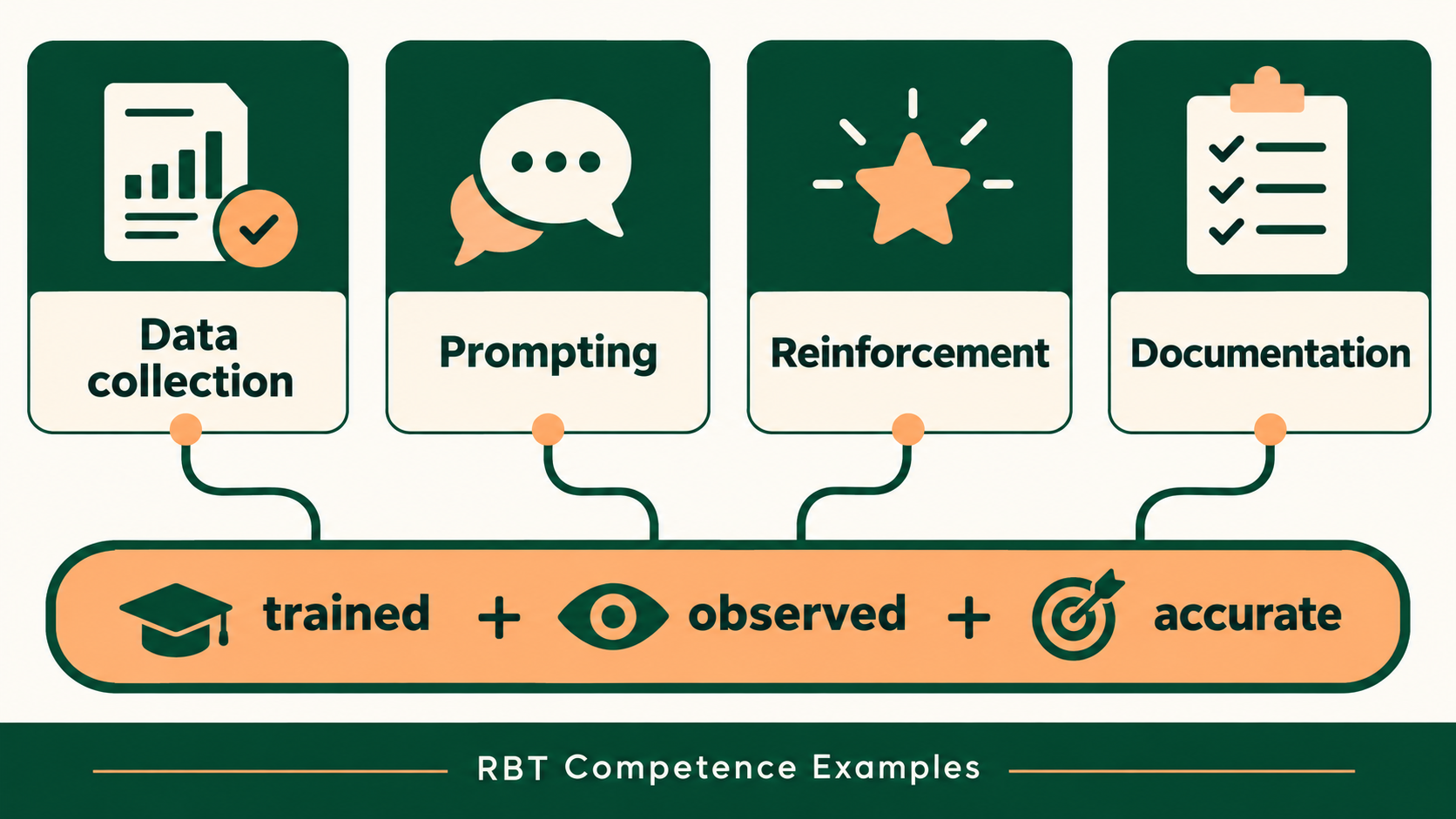
A competent RBT can locate the current operational definition, identify the assigned measurement system, and record what occurred without guessing. If the target is frequency, the RBT knows what counts as one event. If the target is duration, the RBT understands when timing starts and stops according to the plan.
Competence also appears in error recognition. The RBT notices when an observation was missed, the timer failed, or the definition does not match the event. Instead of filling the gap with an invented number, the RBT follows the correction process and tells the supervisor if interpretation may be affected.
A supervisor may verify this skill through direct observation, a practice exercise, record review, or another task-appropriate method. The specific verification belongs to the supervisor and workplace.
Example 2: prompting
A competent RBT can identify the prompt procedure, deliver the prompt as trained, wait the required interval when applicable, and record the learner’s response. The RBT does not add extra prompts simply because the learner is taking longer than expected or remove a step because it feels awkward.
Prompting competence includes noticing when the learner’s communication, distress, or access changes the situation. The RBT follows safety and plan requirements, communicates the observation, and asks whether the procedure needs review. The RBT does not independently redesign the prompt hierarchy.
Example 3: reinforcement
A competent RBT can identify the authorized reinforcement arrangement, deliver the consequence consistently, and record relevant responses. The RBT uses materials and choices as directed and monitors whether the learner can access the communication or selection method.
Readiness does not mean assuming that a preferred item will work for every learner or every day. If a reinforcer loses value, the learner communicates a preference change, or the plan appears unclear, document the observable information and ask the supervisor. Do not introduce an unapproved reward system or change the schedule independently.
Example 4: documentation
A competent RBT can write an objective record that matches the session: what was attempted, what response occurred, what data were collected, and what relevant variables affected implementation. The note separates observation from interpretation and avoids labels about character, motivation, or diagnosis.
Documentation competence includes confidentiality. Use the approved system, share necessary information only with authorized people, and correct mistakes through the required process. An RBT should not backdate a note, estimate missing data, or send identifiable details through a personal channel.
Example 5: communication and feedback
A competent RBT can give the supervisor a concise factual update: what happened, when, what was tried, what data were affected, and what question remains. The RBT asks for clarification when the direction is unclear and can restate the next step to confirm understanding.
After feedback, the RBT can identify the specific change, practice it, and request follow-up observation when needed. Professional communication does not require pretending to understand. It requires being honest about the gap and using the correct route.
A useful supervision conversation can compare the expected step with the observed step, identify the effect on data or safety, and agree on what will happen next time. The RBT can prepare by bringing the current plan, the relevant record, and one specific question. This keeps competence review focused on improvement rather than on a vague impression.
Example 6: noticing an error
Error recognition is a core readiness behavior. An RBT may notice that the wrong data form was used, a prompt was delivered out of sequence, an entry has the wrong time, or a safety step was unclear. The competent response is not to hide the error or immediately invent a workaround.
Instead, protect immediate safety, stop further propagation of inaccurate information, tell the supervisor or designated record owner, and follow the approved correction process. Document the relevant facts and actions. The exact route depends on the workplace and the seriousness of the event.
What examples do not prove
Examples do not prove that an RBT is ready for every procedure. They do not replace training, a supervisor’s verification, ongoing supervision, or setting-specific requirements. They also do not prove that a treatment plan is effective or that a learner will respond in one predictable way.
Use the examples as prompts for supervision:
- Which task should I demonstrate?
- What errors are most important to catch?
- What evidence will show that I am ready?
- When should I pause and ask for direction?
- How should I document training, feedback, and follow-up?
Frequently asked questions
Are these RBT competence examples an official checklist?
No. They are educational examples. The supervisor and applicable workplace or setting determine the assessment method and readiness standard for a particular task.
Does confidence prove competence?
No. Confidence can support learning, but competence requires accurate performance, appropriate supervision, and task-specific verification.
What if I can perform a task but cannot explain it?
Tell the supervisor. The gap may show that you need more instruction or practice, especially if explaining the steps is necessary for error recognition and safe implementation.
Can I use an example to change the plan?
No. Use examples to understand and discuss performance. The supervisor or authorized treatment team decides whether a plan or procedure changes.
Sources and scope note
This guide is based on the BACB RBT Ethics Code (2.0), the RBT Test Content Outline (3rd ed.), and the BACB Registered Behavior Technician Handbook. Requirements can change, and employer, payer, school, state, and legal rules may add obligations. Check current sources and ask the appropriate supervisor about your situation.
Ready to practice the RBT concepts you just reviewed?
Try an independent, original RBT practice resource with exam-style questions, scoring, and answer explanations.
References
- Behavior Analyst Certification Board. RBT Test Content Outline, 3rd edition.
- Behavior Analyst Certification Board. RBT Handbook.
- Behavior Analyst Certification Board. RBT Ethics Code.