
An RBT competency assessment study guide PDF can help you organize practice, but it should not blur three different things: the official Initial Competency Assessment, independent preparation material, and the RBT certification examination. The current packet effective January 1, 2026 changed important details from older resources, so a PDF is useful only when you verify which form and version it is teaching.
Table of Contents
- RBT Competency Assessment Study Guide PDF: What It Should Cover
- Start with the 2026 official packet
- Separate competency assessment from the RBT exam
- Practice the three assessment formats
- Map the 19 task items
- How to use an RBT competency assessment study guide PDF
- Check scope and documentation boundaries
- Common PDF mistakes
- Frequently Asked Questions
- References
This guide explains what to check in a competency-assessment PDF, how to practice the performance formats, and how to keep the assessment separate from exam study. It uses the current BACB packet for the assessment-specific facts and the current RBT Test Content Outline for exam-preparation context.
RBT Training is an independent educational resource. It is not affiliated with, operated by, or endorsed by the Behavior Analyst Certification Board (BACB). The examples and practice prompts below are newly written for independent study; they are not official, recalled, leaked, or BACB-endorsed questions. No guide, rehearsal, or practice score guarantees a passing result.
RBT Competency Assessment Study Guide PDF: What It Should Cover
A useful PDF should help you prepare for demonstrated performance, not only memorize vocabulary. Before you use one, look for a visible edition or effective date, a task map, the allowed assessment type for each item, examples and nonexamples where an interview is expected, and a clear reminder that the official BACB form controls.
| PDF feature | Quality check | Why it matters |
|---|---|---|
| Current packet | Does it identify the packet effective January 1, 2026? | Older guides may still describe a 20-item form or outdated relationship rules. |
| Task map | Are all 19 current task items visible? | A page count is not evidence that the current form is covered. |
| Performance method | Does it distinguish client, role-play, and interview? | Reading an answer is different from demonstrating a skill. |
| Correction path | Does it show how to respond after feedback? | Competence is demonstrated after practice and reassessment, not by guessing a checklist. |
| Official-form boundary | Does it say the BACB form must be used? | An independent worksheet cannot replace the form submitted with an application. |
Be cautious when a product uses “exam,” “assessment,” and “certification” as interchangeable words. A competency assessment asks an assessor to evaluate performance of specified tasks. The RBT examination tests knowledge and application through test questions. A PDF can support preparation for both, but the learning activities and evidence are not the same.
Start with the 2026 official packet
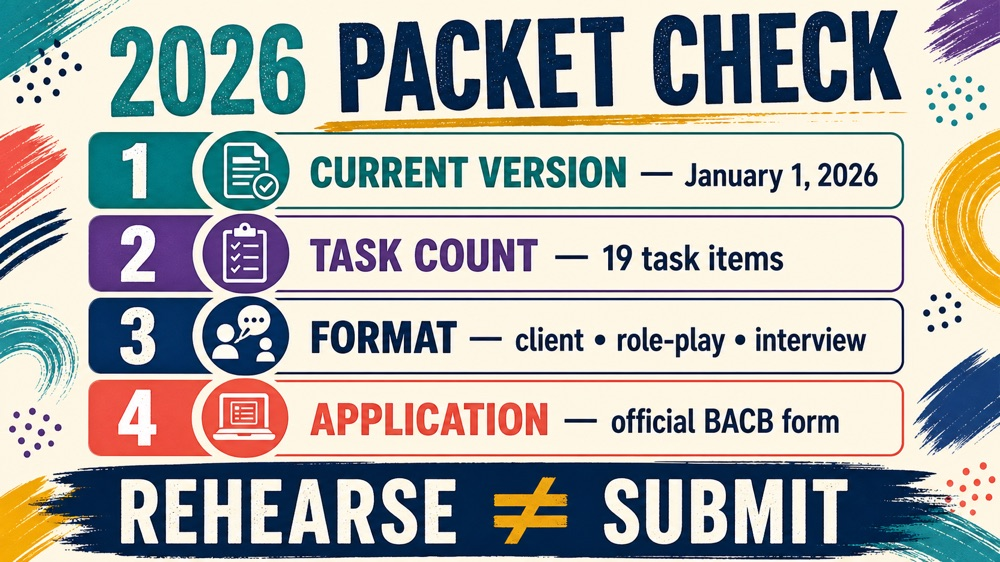
The current BACB Initial Competency Assessment Packet is effective January 1, 2026. It states that the applicant must complete the assessment after the 40-hour training and no more than 90 days before submitting an RBT certification application. It also specifies how the assessment may be conducted and what must be documented.
| Requirement to verify | What the current packet says | Study implication |
|---|---|---|
| Timing | After the 40-hour training and within the 90-day application window | Do not treat an old practice calendar as a current eligibility rule. |
| Assessment setting | In person, live online, or by observation of purpose-created recorded videos | Rehearse the performance format your assessor will use. |
| Assessment types | With a client, role-play, or interview depending on the task instructions | Prepare to perform, explain, and give examples or nonexamples. |
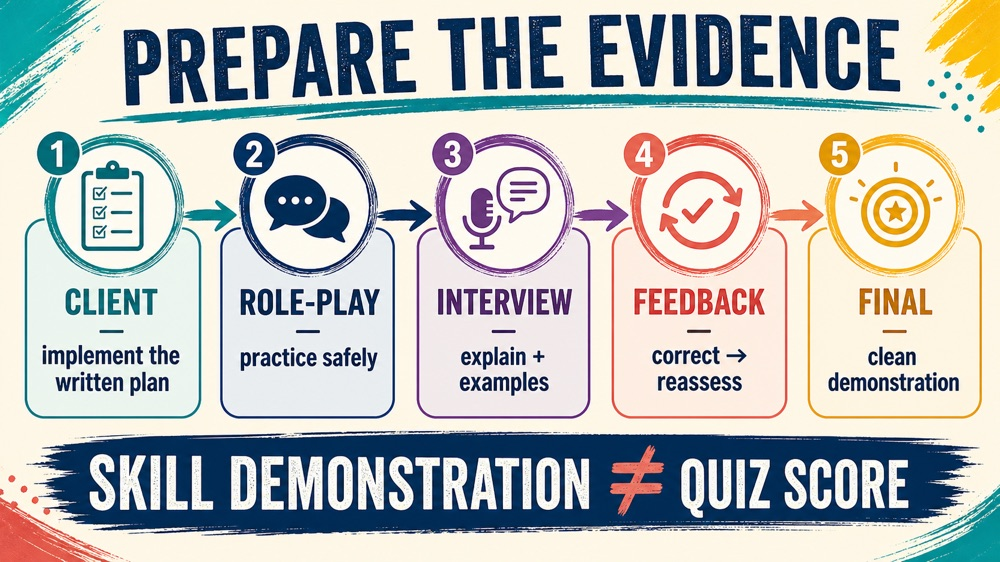
| Feedback | Corrective feedback may lead to another assessment day; it may not be delivered on the final assessment of a task | Log the skill gap and return for a clean demonstration. |
| Submission | The completed Initial Competency Assessment must accompany the application; non-BACB forms are not accepted | Use an independent PDF as rehearsal material, never as the application form. |
The packet also describes relationship and assessor expectations. The responsible assessor must meet the current qualification and organizational requirements, and assistant assessors must meet the stated certification and proficiency conditions. Because these details are administrative and time-sensitive, verify them in the official packet instead of relying on a screenshot, a marketplace PDF, or a video description.
Separate competency assessment from the RBT exam
Many search results place competency guides beside RBT exam study guides, which can make the sequence look like one large test. Keep the purposes separate:
| Competency assessment | RBT examination |
|---|---|
| Assessor observes or interviews the applicant on required task items. | The candidate answers standardized multiple-choice exam questions. |
| Evidence can be a client demonstration, role-play, or interview. | Evidence is the selected answer under exam conditions. |
| The official packet effective January 1, 2026 lists 19 task items. | The current TCO describes 43 tasks across six exam-content domains. |
| Corrective feedback and a later reassessment may be part of preparation. | Practice explanations should identify the rule and the distractor mismatch. |
| The official completed BACB form is required for the application. | Independent practice questions are not official or recalled exam items. |
The current RBT Test Content Outline, 3rd edition, provides exam scope: 43 tasks across six domains, with exam context of 75 scored questions and 10 unscored pilot questions. These numbers belong in exam planning, not as a substitute for the competency packet. If a PDF claims that its “20 competency tasks” are the current 2026 form, flag the version and check the official document before studying from it.
Practice the three assessment formats
A strong study guide tells you what the assessor can observe. Use one rehearsal for each format:
- With a client: practice implementing only the written program, collecting the requested data, and maintaining dignity and safety. Do not improvise a new procedure for the sake of looking confident.
- Role-play: ask a partner to act as a learner or caregiver, then practice the same steps with generic, non-identifying details. Agree in advance on what the role-play is meant to test.
- Interview: answer in plain language, define the concept, give an example, name a nonexample when appropriate, and say when you would seek clinical direction.
For a measurement prompt, do not only recite “frequency” or “duration.” Explain what is observed, what is recorded, and what the written procedure requires. For an ethics or professionalism prompt, do not only say “ask the supervisor.” Identify the uncertainty, protect the client’s information, and use the correct supervision route.
Practice aloud with a timer, but do not turn the timer into a performance goal. The target is accurate implementation and communication that another qualified person can evaluate.
Map the 19 task items
The current 2026 packet groups the 19 items into four practical sections:
| Section | Task items | Preparation emphasis |
|---|---|---|
| Measurement | 1–3: continuous measurement, discontinuous measurement, data and graphs | Implement the procedure, enter data accurately, and update the graph as instructed. |
| Assessment | 4–5: preference assessments and ABC data | Follow the assessment instructions and describe what was observed without guessing function. |
| Skill Acquisition and Behavior Reduction | 6–14: teaching, prompting, token systems, crisis/emergency, and one selected intervention area | Rehearse the written protocol; three tasks in this section must be demonstrated with a client. |
| Professionalism and Requirements | 15–19: session notes, dignity, boundaries, supervision requirements, and clinical direction | Explain objective documentation, ethical conduct, and when to seek supervisor input. |
Use this map to audit a PDF, not to replace the packet. A guide can be comprehensive while still using its own page order. The important question is whether you can trace every current task item to a practice method and a final demonstration.
How to use an RBT competency assessment study guide PDF
Use the PDF as a rehearsal system with four fields per task:
- Performance target: what must be observed or explained?
- Controlling instruction: which written-plan or packet condition decides the response?
- Common drift: what would make the demonstration inaccurate, unsafe, subjective, or outside scope?
- Evidence of readiness: what would a qualified assessor see or hear?
For example, for objective session notes, write a neutral description of what occurred, the relevant measurement, and the response to the programmed procedure. Do not write that a client was “unmotivated” when you mean that the client did not begin the task within the specified interval. For clinical direction, prepare a concise example: the plan is unclear, a safety issue arises, or a requested change exceeds your role. Then state that you would document and contact the supervisor according to the workplace process.
After each rehearsal, mark one of three outcomes: demonstrated, needs correction, or not yet practiced. A highlighted page is not evidence of competence. A repeatable demonstration observed by the appropriate assessor is the relevant endpoint.
Check scope and documentation boundaries
Competency preparation should increase precision, not encourage independent clinical decision-making. Keep these boundaries visible:
- Implement the written plan: practice the procedure that is assigned and ask for clarification when it is incomplete or conflicting.
- Protect client information: use fictional examples in a public study document and never paste identifying information into screenshots or notes.
- Document objectively: record observable events, measurements, and actions rather than labels or assumptions.
- Follow safety protocol: crisis or emergency procedures must be practiced according to the applicable protocol, not invented from a generic PDF.
- Use the official form: an independent study guide can organize practice but cannot be submitted in place of the BACB packet.
If a PDF tells the RBT to diagnose, determine function independently, change an intervention without authorization, or promise a client outcome, stop and compare the advice with the written plan, supervisor direction, handbook, and ethics code.
Common PDF mistakes
- Using a 2nd-edition guide without a version note: record the edition and effective date before studying.
- Calling the competency assessment an exam: practice performance evidence and interview explanation separately.
- Counting pages instead of task items: map the current 19 items and their assessment types.
- Ignoring the client-demonstration rule: plan supervised practice for the three required client demonstrations.
- Replacing the official packet: use the current BACB form for the application.
- Memorizing scripts: learn the decision rule so you can respond to a changed client or workplace scenario.
- Sharing real client details: use generic examples and protect confidentiality.
Bottom line: a useful RBT competency assessment study guide PDF names the current packet, maps all 19 task items, distinguishes client, role-play, and interview practice, and keeps the official form and supervision boundaries visible. Use it to rehearse observable performance; use the current TCO and exam materials for separate knowledge preparation.
Ready to connect rehearsal with exam practice?
Use independent RBT questions for knowledge checks, and keep competency demonstrations under the current packet and qualified assessor process.
Try Free RBT Practice Questions →
Frequently Asked Questions
What should an RBT competency assessment study guide PDF include?
It should identify the current packet, map the 19 task items, distinguish client, role-play, and interview formats, provide examples, and explain how to practice under supervision.
Is the competency assessment the same as the RBT exam?
No. The competency assessment evaluates demonstrated skills and interview responses; the RBT examination tests knowledge and application through exam questions.
How many tasks are in the 2026 initial competency assessment?
The packet effective January 1, 2026 lists 19 task items. Confirm the current packet before relying on older materials that describe a different count.
Can I submit an independent PDF instead of the BACB form?
No. Use an independent PDF for rehearsal only. The completed official BACB Initial Competency Assessment is the form required for the application.
How should I practice the client demonstrations?
Practice with the qualified assessor and the applicable written program. Three tasks in the Skill Acquisition and Behavior Reduction section must be demonstrated with a client under the current packet.
References
- Behavior Analyst Certification Board. RBT Test Content Outline, 3rd edition.
- Behavior Analyst Certification Board. RBT Handbook, updated June 2026.
- Behavior Analyst Certification Board. RBT Initial Competency Assessment Packet, effective January 1, 2026.
- Behavior Analyst Certification Board. RBT Ethics Code.
- RBT Competency Assessment Study Guide resource. Reviewed for competitor research; not an endorsement.
- RBT competency walkthrough resource. Reviewed for competitor research; not an endorsement.