

An ABA RBT practice exam can be useful when it makes you apply an RBT rule to a new scenario and then explains the decision. It becomes much less useful when it is only a vocabulary quiz, repeats the same items, or suggests that an independent practice score is an official pass result. The best practice exam is a diagnostic tool: it shows what to review next.
Table of Contents
- ABA RBT Practice Exam: What It Should Test
- Check the source and edition
- Compare study mode and timed mode
- Audit questions and explanations
- Use the six-domain map
- Turn a score into a study decision
- How to use an ABA RBT practice exam
- Common practice-exam mistakes
- Frequently Asked Questions
- References
This guide explains how to evaluate an independent RBT practice exam, choose between timed and study modes, read explanations, and turn a missed item into a focused retest. It also keeps the RBT blueprint separate from broader ABA or BCBA-level material.
RBT Training is an independent educational resource. It is not affiliated with, operated by, or endorsed by the Behavior Analyst Certification Board (BACB). The examples and practice prompts below are newly written for independent study; they are not official, recalled, leaked, or BACB-endorsed questions. No practice exam, score, or study plan guarantees a passing result.
ABA RBT Practice Exam: What It Should Test
A strong independent practice exam tests more than whether you recognize a term. It asks you to identify the observable clue, select the measurement or procedure that fits, follow the written plan, and distinguish an RBT action from a decision that belongs with the supervisor. The item should teach the reasoning that produced the answer.
| Quality feature | What to look for | Why it matters |
|---|---|---|
| Scenario application | The stem supplies a context and a decisive clue. | RBT questions require discrimination, not only definition recall. |
| Current blueprint | The page names the RBT TCO, 3rd edition, and maps content to A–F. | Broad ABA topics can crowd out RBT-relevant coverage. |
| Explanation depth | The rationale states why the correct option fits and why the distractors do not. | An answer letter cannot repair a misconception. |
| Independent wording | Items are newly written and clearly labeled as practice. | “Real,” “recalled,” or “leaked” claims are not a quality signal. |
| Review path | The result points to a domain, task, and next study action. | A score becomes useful only when it changes what you do next. |
Look for a balance of measurement, assessment, skill acquisition, behavior reduction, documentation, and ethics scenarios. A practice exam that contains only flashcard-style definitions may feel easy while leaving the decision points untested.
Check the source and edition
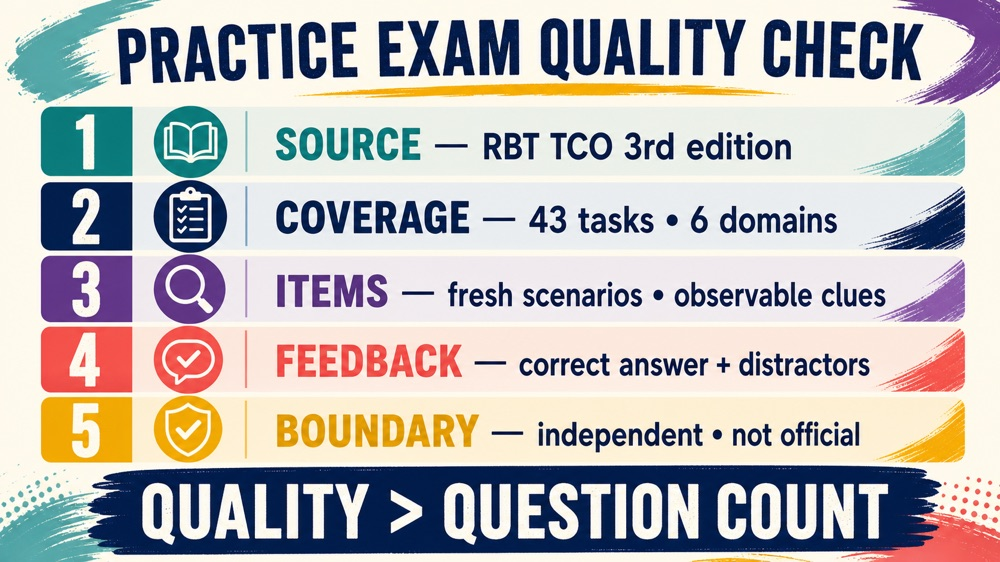
The current academic anchor is the RBT Test Content Outline, 3rd edition. It describes 43 tasks across six domains. The current exam context used in this workflow includes 75 scored questions and 10 unscored pilot questions. An independent practice exam can mirror the broad structure, but it must not present its own questions as official BACB content.
| Verification step | Question | Red flag |
|---|---|---|
| Edition | Does the provider name the 3rd edition and link to the source? | “Updated” appears without a version or date. |
| Domain map | Can you see where each question belongs? | Everything is labeled only “ABA knowledge.” |
| Question status | Does the page say the items are independent practice? | It implies the items are recalled or leaked. |
| Exam context | Does it distinguish 75 scored from 10 unscored pilot questions? | It treats all presented questions as a scored official sample. |
| Source update | Can you check the last revision and broken links? | Old 2nd-edition labels remain mixed into current headings. |
A current source check is especially important when a practice page uses phrases like “real RBT exam questions” or “exact pass guarantee.” Those phrases do not tell you whether the item is academically sound. Prefer transparent descriptions of the source, author or reviewer, update process, and independent-content boundary.
Compare study mode and timed mode
Use different modes for different jobs. A timed attempt is useful for stamina and pacing; an untimed attempt is better for learning why an option is correct. Do not interpret a score from one mode as if it measured the other.
| Study mode | Timed mode |
|---|---|
| Pause to identify the clue and compare options. | Follow a fixed time limit and answer without immediate feedback. |
| Read the full explanation after each item. | Review all explanations after submission. |
| Best for learning a new domain or repairing a misconception. | Best for checking pacing, attention, and test-day routine. |
| Keep a correction note beside the item. | Record item number, domain, confidence, and time pressure. |
Start with study mode when a concept is unfamiliar. Move to a timed attempt after you can explain the relevant distinctions without looking. If a timed score drops, ask whether the problem was content, pacing, fatigue, or reading accuracy before changing your entire study plan.
Audit questions and explanations
Use a five-part check on every practice item:
- Observable stem: what did the RBT actually see, hear, measure, or receive as an instruction?
- Decisive clue: which word or condition changes the answer?
- Scope: is the selected action implementing the plan, documenting, or seeking supervision?
- Distractor mismatch: why does each wrong option fail—wrong measurement, wrong timing, wrong function, or wrong role?
- Transfer: can you solve a new scenario when one feature changes?
Consider a measurement item. If the stem asks how long a response lasts, duration is the relevant dimension; if it asks for the time from instruction to response onset, latency is the controlling clue. A good explanation names that distinction. It does not simply say “B is correct.”
Consider a documentation item. “The client was defiant” is an interpretation. A stronger note describes the observable response and the relevant antecedent or consequence according to the recording procedure. The same rule should transfer when the setting or target changes.
Use the six-domain map
Map each missed item to one of the current RBT exam domains:
- A — Data Collection and Graphing: measurement selection, recording, data integrity, and graph interpretation.
- B — Behavior Assessment: preference or assessment procedures and objective observation.
- C — Behavior Acquisition: implementing teaching, prompting, reinforcement, chaining, shaping, and generalization procedures as written.
- D — Behavior Reduction: implementing reduction procedures safely and using the plan rather than guessing function or inventing an intervention.
- E — Documentation and Reporting: objective notes, accurate communication, records, and confidentiality.
- F — Ethics: dignity, boundaries, supervision, competence, and professional conduct.
Use the domain as a starting point, not a final diagnosis. Two wrong answers in Domain A can reflect different gaps: one may be a duration-versus-latency confusion, while another may be a graph-reading problem. Write the task-level distinction in your correction log.
Turn a score into a study decision
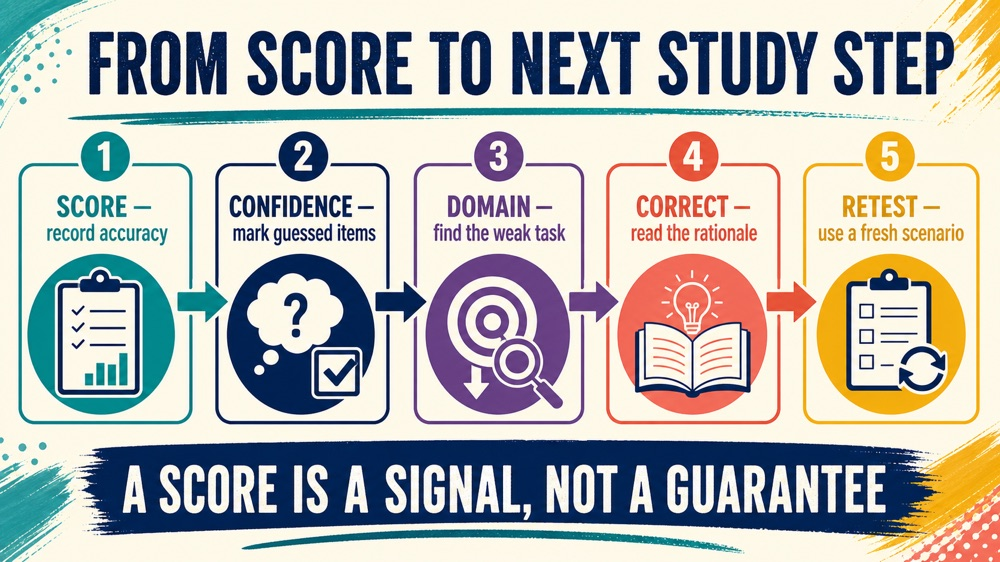
A practice score is a snapshot of one set of independent items. Use it with confidence and error data:
| Pattern | Likely next action |
|---|---|
| Wrong and low confidence | Return to the source concept, write the distinction, and solve a fresh item. |
| Wrong but high confidence | Check for a rule inversion, scope error, or overgeneralized definition. |
| Correct but low confidence | Retest later; guessing is not stable mastery. |
| Correct and slow | Practice identifying the decisive clue before reading every distractor repeatedly. |
| Several errors in one domain | Use a focused domain set before another full-length attempt. |
Do not chase a green or high score by memorizing the same answer order. Change the scenario and keep the rule. A practice platform that lets you review explanations, filter by domain, and retake new items supports learning better than a counter that only records attempts.
How to use an ABA RBT practice exam
Use a repeatable three-round plan:
- Baseline: take a mixed, untimed set and mark confidence before seeing the answer.
- Repair: study the exact concept and contrast behind every wrong or guessed item; do not skip distractor analysis.
- Verify: take a new timed set after a delay, then compare domain accuracy, confidence, and pacing.
When the result page gives a percentage, add your own notes: item type, domain, decisive clue, and next variation. A score without this context cannot tell you whether you are ready to move from study mode to timed mode.
Keep the use of any independent practice exam honest. It is a preparation resource, not a substitute for the official BACB outline, handbook, requirements, or supervised clinical direction.
Common practice-exam mistakes
- Calling independent questions official: use “original practice” or “exam-style” only when the boundary is clear.
- Using a score as a guarantee: a practice result is diagnostic, not a promise.
- Studying only the easiest mode: combine explanation learning with occasional timed practice.
- Ignoring distractors: the wrong option often reveals the exact confusion to repair.
- Mixing RBT and BCBA scope: keep the question tied to the current RBT TCO and supervised technician role.
- Repeating identical items: test transfer with a fresh scenario and a changed decisive feature.
- Skipping source checks: verify edition, task map, update date, and references.
Bottom line: an ABA RBT practice exam is valuable when it is source-transparent, current, scenario-based, explanation-rich, and connected to a correction loop. Use it to decide what to study next, not to claim official status or a guaranteed result.
Ready to turn a score into a better next session?
Use independent RBT practice questions, then record the domain, decisive clue, distractor mismatch, and retest plan.
Try Free RBT Practice Questions →
Frequently Asked Questions
What makes an ABA RBT practice exam useful?
It uses current RBT scope, original scenario-based items, clear explanations for every option, and a review path that identifies the next study action.
Is an independent RBT practice exam official?
No. Independent practice can resemble the structure or reasoning demands of an exam, but it is not official, recalled, leaked, or BACB-endorsed content.
Should I take a practice exam timed?
Use untimed study mode to learn and timed mode to check pacing and stamina. Interpret each result according to the mode used.
How should I read a low practice score?
Break it down by domain, confidence, item type, and explanation. Then repair the specific distinction before taking another new set.
Can broad ABA practice questions replace RBT-specific practice?
Not reliably. Broad ABA material may include concepts outside the RBT outline or role. Map practice to the current RBT TCO and supervised technician scope.
References
- Behavior Analyst Certification Board. RBT Test Content Outline, 3rd edition.
- Behavior Analyst Certification Board. RBT Handbook, updated June 2026.
- Behavior Analyst Certification Board. RBT Ethics Code.
- Free RBT practice exam resource. Reviewed for competitor research; not an endorsement.
- RBT practice questions resource. Reviewed for competitor research; not an endorsement.
- RBT practice-exam comparison resource. Reviewed for competitor research; not an endorsement.