
The rbt 19 task competency assessment is the 2026 Initial Competency Assessment structure applicants use to demonstrate competent performance before applying. The packet divides 19 tasks into measurement, assessment, skill acquisition and behavior reduction, and professionalism requirements. This guide maps the groups and explains the client, role-play, interview, timing, and completion rules without replacing the official packet.
Table of Contents
- RBT 19 task competency assessment: the structure
- Tasks 1–5: measurement and assessment
- Tasks 6–14: skill acquisition and behavior reduction
- Tasks 15–19: professionalism and requirements
- Assessment types and client demonstrations
- Timing and documentation rules
- Frequently asked questions
- Official references and final reminder
RBT Initial Competency Assessment task map and completion rules
RBT 19-Task Competency Assessment: What Each Group Covers
Map the 19 tasks, client demonstrations, assessment types, timing, and documentation requirements before the packet is signed.
The rbt 19 task competency assessment is the 2026 Initial Competency Assessment structure applicants use to demonstrate competent performance before applying. The packet divides 19 tasks into measurement, assessment, skill acquisition and behavior reduction, and professionalism requirements. This guide maps the groups and explains the client, role-play, interview, timing, and completion rules without replacing the official packet.
Use the current RBT Initial Competency Assessment Packet, effective January 1, 2026. The official packet controls the exact task wording and fields.
RBT 19 task competency assessment: the structure
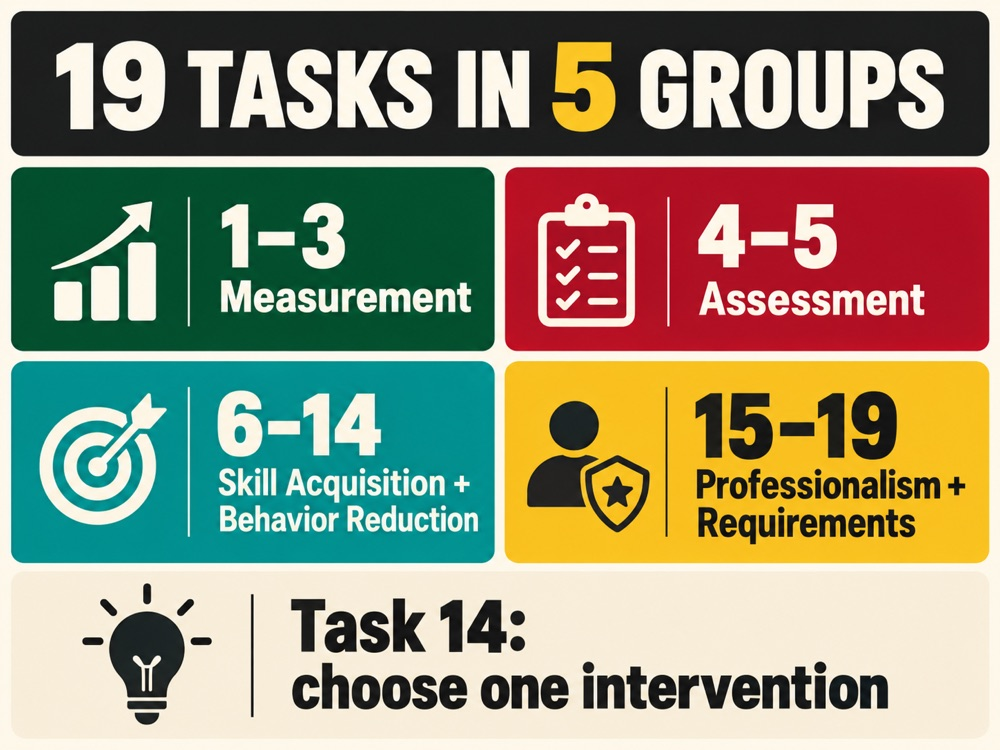
All task items 1–19 must be completed. The groups are:
| Task group | Tasks | Main emphasis |
|---|---|---|
| Measurement | 1–3 | Continuous measurement, discontinuous measurement, and data/graphs. |
| Assessment | 4–5 | Preference assessments and ABC data. |
| Skill acquisition and behavior reduction | 6–14 | Teaching, prompting, behavior-reduction, crisis, and selected intervention skills. |
| Professionalism and requirements | 15–19 | Session notes, dignity, boundaries, supervision, and clinical direction. |
Tasks 1–5: measurement and assessment
Tasks 1–3: Measurement. The applicant demonstrates continuous measurement, discontinuous measurement, and entering data or updating graphs. The packet gives examples such as frequency, duration, latency, IRT, interval procedures, and momentary time sampling.
Tasks 4–5: Assessment. The applicant conducts preference assessments and collects ABC data. The assessor chooses an allowed assessment type shown in the packet and records the result after the task is performed competently.
These first five tasks are not a reason to skip the later clinical and professionalism sections. A complete packet requires all 19 task items, with the task-specific assessment method properly marked.
Tasks 6–14: skill acquisition and behavior reduction
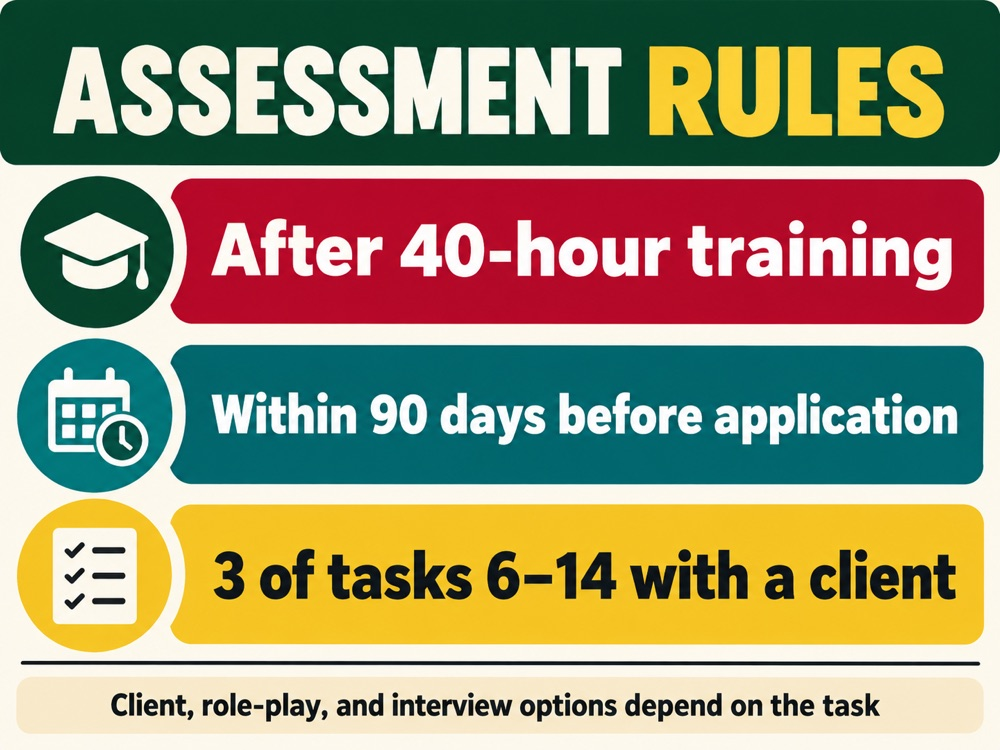
Tasks 6–14 cover applied implementation skills. The packet requires that three tasks from this section be demonstrated with a client. That is a section-specific rule: the three client demonstrations must come from tasks 6–14.
- 6: Discrete-trial teaching.
- 7: Naturalistic teaching, such as incidental teaching.
- 8: Task-analyzed chaining procedures.
- 9: Shaping.
- 10: Discrimination training.
- 11: Prompting and prompt fading.
- 12: Token systems.
- 13: Crisis or emergency procedures according to protocol.
- 14: One selected intervention: antecedent interventions, differential reinforcement, or extinction.
Task 14 is a choice, not three separate required tasks. The applicant demonstrates one of the listed intervention options using an allowed assessment type. The assessor should record which option was selected and complete the packet’s corresponding field.
Tasks 15–19: professionalism and requirements
The final group uses practical documentation and interview questions:
- 15 — Session Notes: Generate objective session notes describing what occurred.
- 16 — Client Dignity: Give examples of maintaining client dignity.
- 17 — Professional Boundaries: Give examples of maintaining professional boundaries.
- 18 — Supervision Requirements: Describe BACB supervision standards for RBTs.
- 19 — Clinical Direction: Describe a situation in which the applicant would seek clinical direction from a supervisor.
Tasks 16–19 are interview tasks in the current packet. Task 15 may use a client, role-play, or interview option, depending on the assessor’s administration of the task. The applicant should prepare to explain decisions, examples, and nonexamples rather than memorize one sentence.
Assessment types and client demonstrations
The packet uses three assessment types:
- With a client: The assessor observes the applicant performing the task with a client receiving behavior-analytic services.
- Role-play: The applicant performs in a situation similar to one that might occur with a client, when circumstances do not permit client evaluation.
- Interview: The assessor conducts a live in-person or online interview and the applicant describes or discusses the concept, including examples or nonexamples when applicable.
The assessment may occur over one or more sessions, in person, live online, or through recorded videos created specifically for the assessment. The allowed option still depends on the task’s instructions. A convenient assessment method cannot override a task-specific client or interview requirement.
Timing and documentation rules
The Initial Competency Assessment must be completed after the 40-hour training is complete and no more than 90 days before submitting the RBT certification application. Plan the assessment date from the application schedule rather than completing it too early and assuming the packet remains valid indefinitely.
When the assessor observes competent performance, the assessor initials the box next to the task and marks the assessment type used. If the applicant does not demonstrate competence, the assessor may provide corrective feedback and assess the task on another day. Corrective feedback may not be delivered on the final assessment of that task.
After all tasks are performed competently, the responsible assessor signs and dates the final attestation. Applicants must submit the completed BACB Initial Competency Assessment with the certification application; non-BACB forms are not accepted. The responsible assessor must maintain assessment documentation for at least seven years.
Frequently asked questions
Do I have to complete all 19 tasks?
Yes. The current packet states that all task items 1–19 must be completed. Some tasks have choices of assessment type, but that does not remove the task.
Can the three client demonstrations be any three tasks?
No. Three of tasks 6–14 must be demonstrated with a client. Follow the packet’s section-specific rule.
Do I complete all three Task 14 intervention options?
No. Task 14 asks the applicant to demonstrate one of the listed options: antecedent interventions, differential reinforcement, or extinction.
Can the assessment happen online?
The packet allows in-person, live internet, or recorded videos created specifically for the assessment, subject to the task-specific assessment type and assessor administration.
Does a signed packet guarantee certification?
No. It documents the competency assessment. BACB still controls application review, action items, exam authorization, and certification decisions.
Official references and final reminder
Review the current Initial Competency Assessment Packet, the BACB document-version updates, and the application tips. The current packet, Handbook, portal instructions, and assessor’s directions control if requirements change.
This article is an educational summary of public BACB assessment guidance, not individualized certification, legal, employment, immigration, or financial advice. Resolve uncertain timing, task, client, or documentation questions with the responsible assessor and current BACB instructions before submitting.
Ready to practice the RBT concepts you just reviewed?
Try an independent, original RBT practice resource with exam-style questions, scoring, and answer explanations.
References
- Behavior Analyst Certification Board. RBT Test Content Outline, 3rd edition.
- Behavior Analyst Certification Board. RBT Handbook.
- Behavior Analyst Certification Board. RBT Ethics Code.