
The rbt initial competency assessor requirements identify who may oversee an RBT Initial Competency Assessment, what training the responsible assessor needs, how the organization relationship works, and what responsibilities cannot be delegated away. This guide focuses on assessor eligibility and oversight, not the separate list of assessment tasks or the assistant assessor role.
Table of Contents
- RBT initial competency assessor requirements: the short answer
- Responsible assessor credential and training
- Organization and client relationship
- Oversight, signature, and records
- Where assistant assessors fit
- Pre-assessment checklist
- Frequently asked questions
- Official references and final reminder
RBT Initial Competency Assessment, responsible assessor, and oversight
RBT Initial Competency Assessor Requirements: Who Qualifies?
RBT initial competency assessor requirements: confirm the responsible assessor’s credential, supervision training, organization relationship, and recordkeeping duties before the assessment begins.
The rbt initial competency assessor requirements identify who may oversee an RBT Initial Competency Assessment, what training the responsible assessor needs, how the organization relationship works, and what responsibilities cannot be delegated away. This guide focuses on assessor eligibility and oversight, not the separate list of assessment tasks or the assistant assessor role.
Use the current RBT Initial Competency Assessment Packet. BACB currently lists the packet as effective January 1, 2026 and version 1/2026. An older packet or informal provider checklist should not replace the current requirements.
RBT initial competency assessor requirements: the short answer
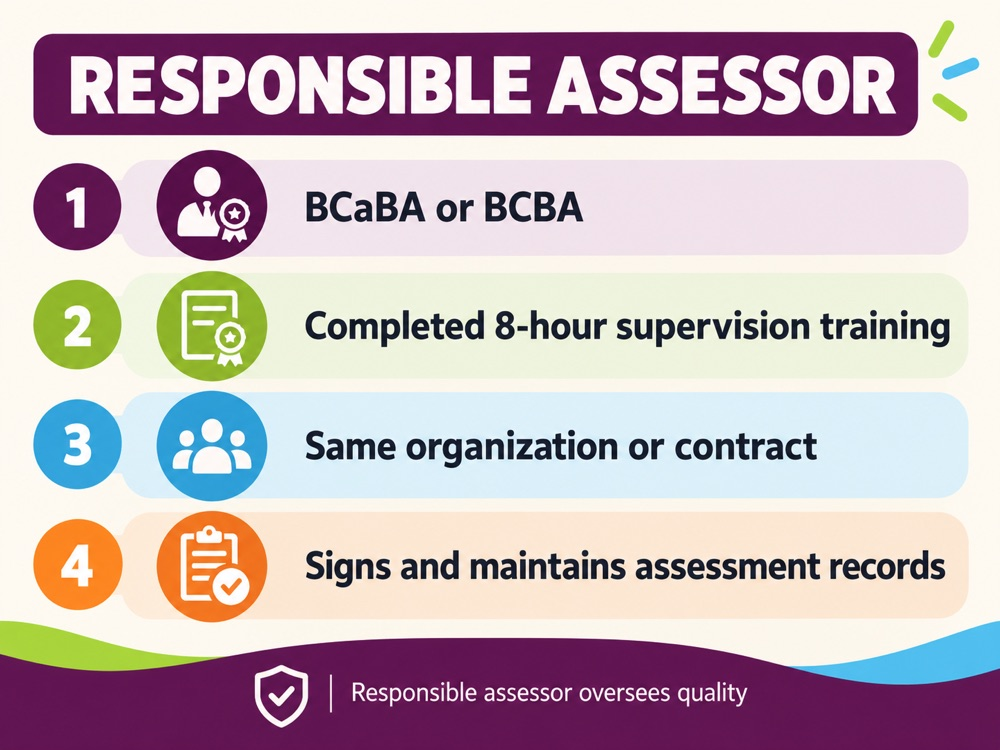
The responsible assessor must satisfy four practical conditions:
- Be a BACB certificant who is a BCaBA or BCBA.
- Have completed the 8-hour supervision training.
- Have the required employment or contractual relationship with the applicant and the clients involved in the assessment.
- Oversee the assessment, sign the packet, maintain records, and ensure quality even when assistants conduct portions.
Passing the first three gates does not make a person a hands-off signer. The responsible assessor owns the oversight function. The packet also contains restrictions on relationships that could compromise the assessment, so an organization should review both qualifications and independence before scheduling.
Responsible assessor credential and training
The current packet identifies the responsible assessor as a BCaBA or BCBA who has completed the 8-hour supervision training. An RBT, trainer without the required credential, or unrelated licensed professional should not be substituted because they are experienced with the applicant.
The 8-hour training requirement is a separate qualification from general experience. Verify that it was completed before the assessor oversees the assessment. BACB’s supervision-and-training overview also lists BCaBAs and BCBAs as the responsible individuals for assessing RBTs and identifies the 8-hour supervision training requirement.
The same person may have delivered the RBT 40-hour training and serve as the assessor when the current assessment requirements and relationship rules are satisfied. Training history alone does not remove the credential, supervision-training, independence, or recordkeeping requirements.
Organization and client relationship
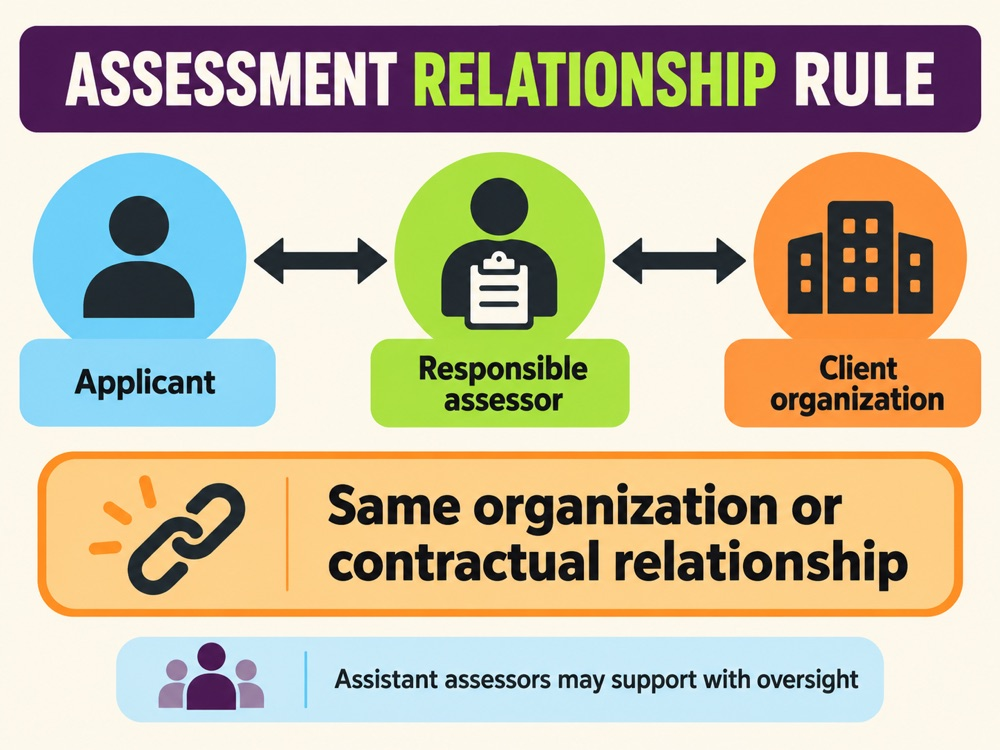
The relationship rule connects the assessor to the applicant and the clients involved in the assessment. The responsible assessor must be employed at the same organization as, or have a contractual relationship with, the applicant and client(s) involved in the assessment. The organization must also be the entity providing services to the client involved.
If the responsible or assistant assessor is a BCaBA, that assessor’s supervisor must also be employed at or contracted with the same organization where the client receives services. This extra layer matters because the supervision relationship must connect to the service organization, not only to the applicant.
| Relationship question | What to confirm |
|---|---|
| Applicant and assessor | Same organization employment or a qualifying contract. |
| Client and service provider | The organization is the entity providing services to the client involved. |
| BCaBA assessor | The BCaBA’s supervisor has the required relationship with the same service organization. |
| Whole assessment | The relationship applies to the assessment, not only to one task delegated to an assistant. |
Oversight, signature, and records
The responsible assessor must ensure the assessment is conducted according to the packet, sign the Initial Competency Assessment, maintain records of assessments conducted, and ensure quality standards even when assistant assessors participate. These are active responsibilities, not a formality at the end.
Before signing, the responsible assessor should know which tasks were assessed, which assessment type was used, who conducted each portion, and where the supporting notes or records are stored. The packet requires all task items to be completed and says incomplete documents will not be accepted. The assessor should therefore review the packet for initials, assessment types, signatures, applicant information, and required client demonstrations.
Recordkeeping should be organized so the assessor can respond if documentation is requested later. Keep the completed packet and assessment records securely under the current BACB requirements and organization policy. A signature is a certification of the assessment process, not a guarantee that BACB will approve the application.
Where assistant assessors fit
The responsible assessor may delegate some or all assessment tasks to an assistant assessor who has demonstrated proficiency through direct observation and holds an active RBT certification or higher. Multiple assistant assessors may be used for one assessment.
Delegation does not erase responsibility. The responsible assessor still ensures quality, confirms that assistants are qualified, reviews the completed packet, and signs the assessment. An assistant’s participation should be traceable to the tasks and assessment types they conducted.
The packet also says the responsible assessor and assistant assessor(s) may not be related to, subordinate to, or employed by the applicant during the assessment. Compensation paid to the assessor for assessment services is not treated as employment by the applicant under that rule. When in doubt, document the relationship and use the current packet’s wording.
Pre-assessment checklist
- Packet version: Confirm the January 1, 2026 packet and current BACB document version.
- Credential: Verify the responsible assessor is a BCaBA or BCBA.
- Supervision training: Confirm completion of the 8-hour supervision training.
- Relationship: Document the employment or contract path linking applicant, assessor, client, and service organization.
- Independence: Check that no prohibited related, subordinate, or applicant-employment relationship exists.
- Assistants: Verify active RBT-or-higher certification and direct-observation proficiency for each assistant.
- Quality review: Plan who will review every task, assessment type, initial, signature, and client-demonstration requirement.
- Records: Decide where the completed packet and supporting assessment records will be stored.
Frequently asked questions
Can an RBT be the responsible assessor?
No. The responsible assessor must be a BCaBA or BCBA with the required 8-hour supervision training. An active RBT may qualify as an assistant assessor when the current packet’s assistant requirements are met.
Can a BCaBA assess an RBT?
Yes, a BCaBA may serve as the responsible assessor when the credential, 8-hour supervision training, relationship, independence, and oversight requirements are met. The packet adds a supervisor relationship requirement for a BCaBA involved in the assessment.
Can an assessor be the person who provided the 40-hour training?
Yes, the packet says it is permissible for the assessor to be the same person who delivered the RBT 40-hour training, provided all assessor requirements are satisfied.
Can an outside assessor perform the assessment?
Only if the person has the required contractual relationship with the applicant and client-service organization and satisfies every other current requirement. Being outside the organization by itself does not establish eligibility.
Does the assessor’s signature guarantee certification?
No. It confirms the assessment under the packet. BACB still controls application review, action items, exam authorization, and certification decisions.
Official references and final reminder
Review the current Initial Competency Assessment Packet, BACB’s supervision and training overview, the application-processing updates, and the application tips. The current packet, Handbook, portal instructions, and organization records control if requirements change.
This article is an educational summary of public BACB assessment guidance, not individualized certification, legal, employment, immigration, or financial advice. Resolve uncertain credential, relationship, independence, or documentation questions with the organization and current BACB instructions before the assessment.
Ready to practice the RBT concepts you just reviewed?
Try an independent, original RBT practice resource with exam-style questions, scoring, and answer explanations.
References
- Behavior Analyst Certification Board. RBT Test Content Outline, 3rd edition.
- Behavior Analyst Certification Board. RBT Handbook.
- Behavior Analyst Certification Board. RBT Ethics Code.