

If you are asking how to study for the RBT exam, start by choosing a process you can repeat, not a giant pile of tabs. The current RBT exam rewards more than word recognition: you need to identify the observable clue, apply a procedure, distinguish close concepts, and choose an action that stays within the supervised technician role.
Table of Contents
- How to study for the RBT exam: start with source truth
- Phase one: freeze the current scope
- Phase two: build concept and contrast cards
- Phase three: study all six domains
- Phase four: practice scenarios and corrections
- Phase five: add timed review
- How to know what to study next
- Common study mistakes
- Frequently Asked Questions
- References
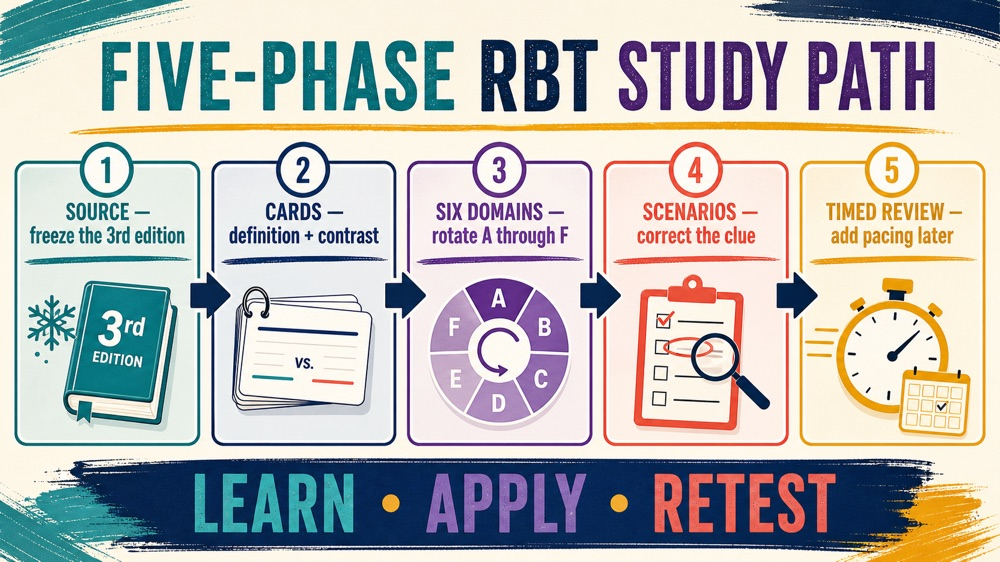
This guide gives you a five-phase study path: verify the source, learn the rule, map the six domains, practice new scenarios, and use timed review only after the underlying decisions are stable. Each phase ends with evidence you can record and a clear next step.
RBT Training is an independent educational resource. It is not affiliated with, operated by, or endorsed by the Behavior Analyst Certification Board (BACB). The examples and practice prompts below are newly written for independent study; they are not official, recalled, leaked, or BACB-endorsed questions. No study plan, practice score, or article guarantees a passing result.
How to study for the RBT exam: start with source truth
Before you make flashcards or buy a question bank, identify the documents that control scope and requirements. The current academic anchor is the RBT Test Content Outline, 3rd edition. It describes 43 tasks across six domains. The exam context used in this workflow includes 75 scored questions and 10 unscored pilot questions.
| Source or artifact | What it controls | Study action |
|---|---|---|
| RBT Test Content Outline, 3rd edition | Exam content and task scope | Map every study topic to A–F and a task range. |
| Current RBT Handbook | Application, examination, and certification process information | Verify process questions instead of trusting a third-party summary. |
| RBT Ethics Code | Professional conduct and ethical boundaries | Practice dignity, confidentiality, supervision, and truthful communication. |
| Independent practice material | Explanations and fresh rehearsal | Check its edition, originality, and scope before using it. |
Keep a version note at the top of your study file. If a page uses older task labels or counts, mark it as a cross-reference rather than silently mixing it into the current plan.
Phase one: freeze the current scope
Create a one-page scope map before studying details. List the six domains and the task ranges, then add three columns: “understand,” “apply,” and “retest.” This prevents a familiar topic from taking all your time while a less familiar domain stays invisible.
- A — Data Collection and Graphing: measurement, data integrity, and graphs.
- B — Behavior Assessment: preference or assessment support and objective observation.
- C — Behavior Acquisition: teaching procedures, prompts, reinforcement, shaping, chaining, and generalization.
- D — Behavior Reduction: reduction procedures, safety, and following the written plan.
- E — Documentation and Reporting: objective notes, communication, and confidentiality.
- F — Ethics: dignity, boundaries, supervision, competence, and professional conduct.
At this phase, do not try to master every term. The goal is navigation: you should know where to place a missed question and which source to use when a practice explanation is unclear.
Phase two: build concept and contrast cards
Use a four-field card for each important concept:
- Definition: what does the term mean in observable, usable language?
- Example: what would it look like in a short session scenario?
- Nearest contrast: which concept is easiest to confuse with it?
- Controlling clue: what word, unit, timing, or plan instruction decides?
| Card pair | Controlling question |
|---|---|
| Frequency / rate | Is the count linked to a unit of time? |
| Duration / latency | How long did the response last, or how long before it started? |
| Partial / whole interval | Does any occurrence count, or must it fill the interval? |
| Preference / reinforcer | Was a stimulus selected, or did its consequence effect change behavior? |
| Objective note / interpretation | Could another observer verify the statement? |
Cards should help you make a decision, not only recite a paragraph. If you cannot write a fresh example, the concept is not ready to leave the learning phase.
Phase three: study all six domains
Rotate through the six domains instead of finishing one giant chapter and forgetting the first. A simple cycle is:
- Read one small concept from the current domain.
- Write the definition and nearest contrast.
- Solve two or three original scenarios.
- Record the exact clue for any miss or guess.
- Return to the previous domain with one retrieval question before moving on.
Some learners spend too much time on terms they enjoy. Let your correction log set the emphasis. If measurement errors are stable but documentation errors are frequent, shift the next session rather than following a fixed percentage split copied from an unverified page.
Phase four: practice scenarios and corrections
Scenario practice should happen before the final review, not only the day before the test. Use a three-pass loop:
| Pass | What you do | What you record |
|---|---|---|
| First answer | Choose an option and mark confidence before feedback. | Answer, confidence, and time. |
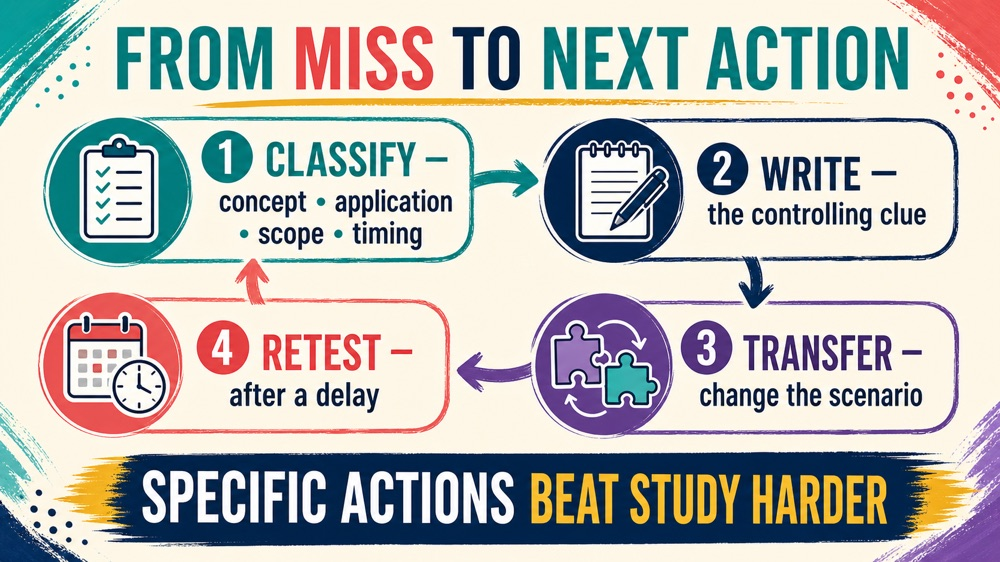
| Explanation | Identify the observable clue and the distractor mismatch. | One-sentence correction rule. |
| Transfer | Write or solve a new scenario with one feature changed. | Whether the rule still works. |
For example, if a stem describes data recorded at the exact end of each interval, ask whether the scoring moment—not any point in the interval—controls the method. If an option tells an RBT to change an intervention independently, compare it with the written-plan and supervision boundary. A correction is complete only when the rule survives a changed scenario.
Phase five: add timed review
Timing should be a later variable, not the first thing you optimize. Begin with untimed study sets so you can read explanations and build accurate distinctions. Then add:
- Timed domain sets: practice switching between reading and deciding without losing the clue.
- Mixed sets: move between all six domains and record which transitions slow you down.
- Full-length practice: rehearse the long-session routine and review the result after submission.
If you run out of time, separate pacing from knowledge. Did you reread the stem, debate two plausible options, or spend too long on one unfamiliar term? The fix may be a reading routine, a contrast card, or a focused concept review.
How to know what to study next
Use four signals rather than a single percentage:
| Signal | Interpretation | Next action |
|---|---|---|
| Wrong and low confidence | The concept or language is unfamiliar. | Return to the source and make a contrast card. |
| Wrong and high confidence | A rule may be inverted or overgeneralized. | Compare the chosen option with the nearest distractor. |
| Correct and low confidence | The answer may be a guess. | Retest later with a changed scenario. |
| Correct and slow | The concept is present but the decision routine is inefficient. | Practice identifying the clue before rereading all options. |
Set a next-session action that is small enough to complete: three measurement contrasts, five objective-note rewrites, or one focused ethics scenario set. Specific actions create better evidence than “study harder.”
Common study mistakes
- Starting with random questions: establish the current source and map first.
- Memorizing isolated definitions: add a contrast, clue, and fresh example.
- Studying only a favorite domain: rotate through A–F and track blind spots.
- Using old materials without labels: record the edition and update date.
- Taking timed mocks too early: learn the decisions before making pacing the main variable.
- Repeating the same questions: use new scenarios to measure transfer.
- Trusting guarantees or recalled-item claims: use independent material honestly and protect exam security.
Bottom line: the best answer to how to study for the RBT exam is a repeatable loop: anchor to the current TCO, learn definitions with contrasts, cover all six domains, practice fresh scenarios, correct the exact clue, and add timing only after accuracy is stable.
Ready to turn a plan into practice?
Use independent RBT questions, then record the domain, clue, correction, and next retrieval action.
Try Free RBT Practice Questions →
Frequently Asked Questions
How to study for the RBT exam with limited time?
Start with the current TCO, choose one or two high-confusion concepts, solve fresh scenarios, and keep a correction log. Use short retrieval sessions consistently rather than only reading.
How to study for the RBT exam when definitions are easy but scenarios are hard?
Underline the observable clue, write the nearest contrast, and solve a new scenario in which only one condition changes. Review why each distractor fails.
How to study for the RBT exam across six domains?
Make a domain map for A through F, rotate topics, and track errors by task rather than spending all your time in one familiar area.
How to study for the RBT exam without memorizing answer patterns?
Use independent questions, explain the decision rule aloud, and retest with new scenarios after a delay. Repeating the same answer order measures memory, not transfer.
Do I need a practice exam before scheduling the test?
Practice exams can help you identify gaps and rehearse pacing, but use official BACB resources for current eligibility and scheduling requirements and do not treat a practice score as a guarantee.
References
- Behavior Analyst Certification Board. RBT Test Content Outline, 3rd edition.
- Behavior Analyst Certification Board. RBT Handbook, updated June 2026.
- Behavior Analyst Certification Board. RBT Ethics Code.
- RBT exam study strategy resource. Reviewed for competitor research; not an endorsement.
- RBT exam preparation resource. Reviewed for competitor research; not an endorsement.
- RBT study-guide and practice resource. Reviewed for competitor research; not an endorsement.