
These RBT collaboration examples show how to share observations, ask focused questions, respect decision ownership, and make the next role-safe action visible.
Table of Contents
- What makes RBT collaboration examples useful?
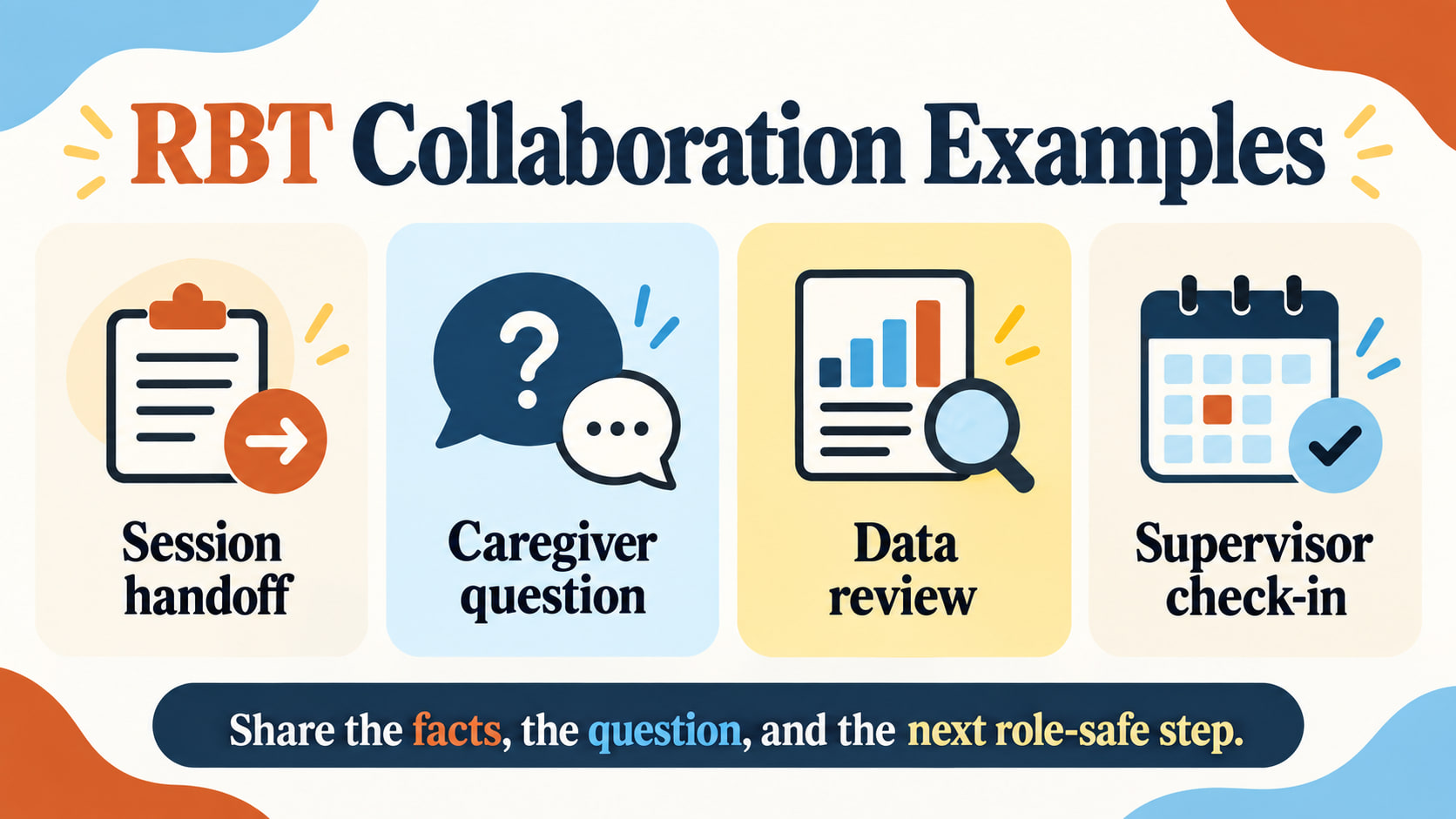
- Example 1: a session handoff
- Example 2: a caregiver question
- Example 3: a data review question
- Example 4: a supervisor check-in
- A role-safe collaboration checklist
- Frequently Asked Questions
- Sources and further reading
RBT teamwork examples and communication guide
RBT Collaboration Examples: Clear Teamwork in Practice
Use practical examples to share observations, respect decision ownership, protect privacy, and make the next action visible.
These RBT collaboration examples show how to share observations, ask focused questions, respect decision ownership, and make the next role-safe action visible. The examples are intentionally general and newly written. They are not individualized clinical instructions, official examination questions, or substitutes for a current plan and supervision.
Collaboration is not simply agreeing with another person. An RBT can contribute useful information while leaving diagnosis, treatment design, plan changes, and supervision to the responsible professional or authorized process. The strongest example makes both the useful contribution and the boundary easy to see.
What makes RBT collaboration examples useful?
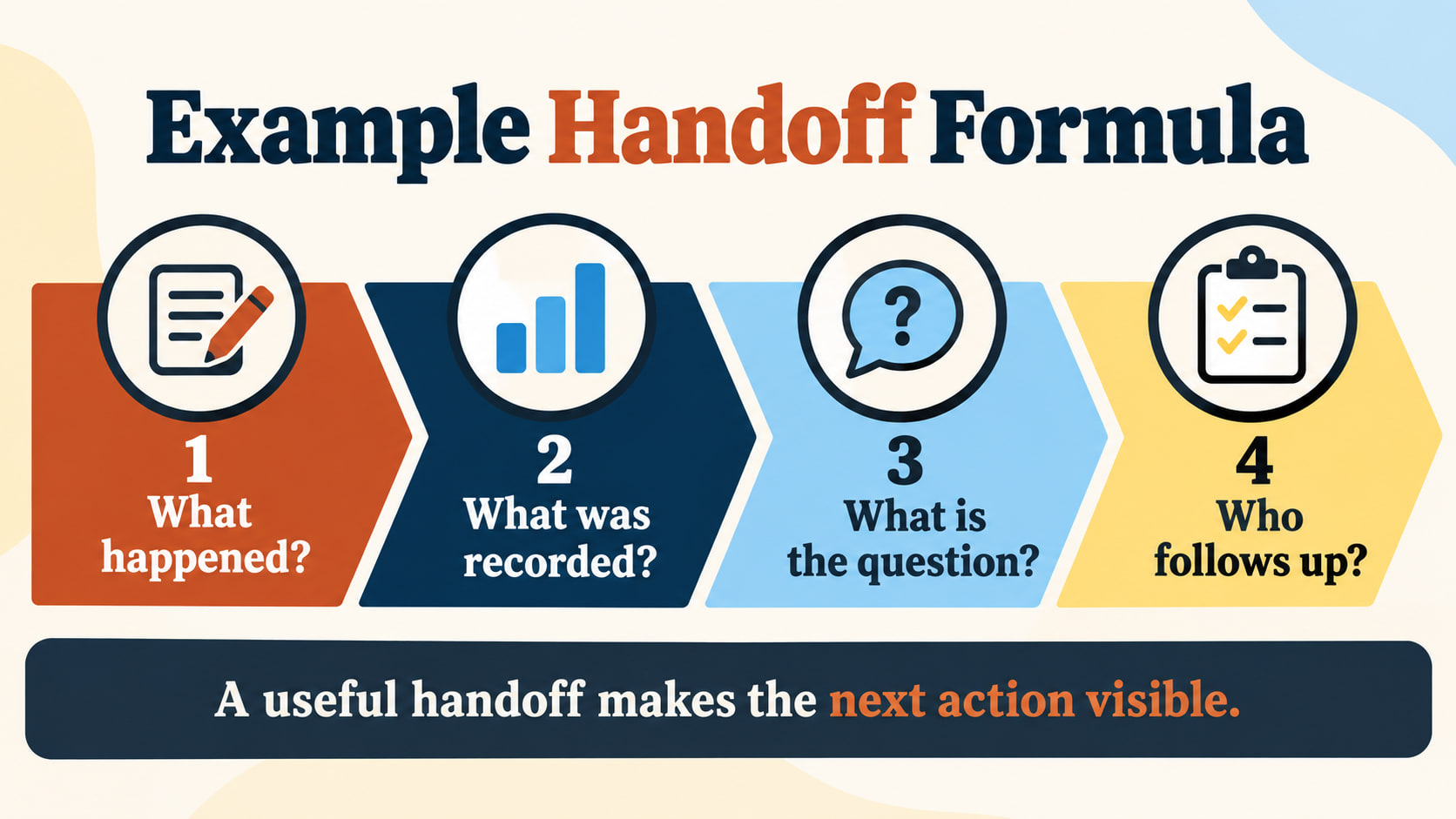
A useful example includes four parts:
- What happened: the relevant event or question in plain language.
- What was recorded: the data, note, document, or observation available to the team.
- What is the question: the exact point that needs clarification or review.
- Who follows up: the person or process that owns the next decision.
Do not add client-identifying details just to make an example sound realistic. A team can practice the communication structure without naming a person, location, date, or other unnecessary identifier.
The point of an example is not to provide a script that fits every learner or setting. It is to show the reasoning pattern: describe the event, identify the source, ask the right question, and route the next decision. Adapt the wording to the organization’s policy and the supervisor’s instructions.
Keep the tone neutral and the action narrow. A good collaboration message gives the next person enough context to respond without asking the RBT to interpret more than was observed today.
Example 1: a session handoff
Situation: An RBT is handing off a session observation to the supervisor or next authorized team member. The final transition took longer than the earlier transitions, and the current procedure was followed until the end of the session.
Useful message: “During the final transition, the learner left the table twice after the instruction. I recorded the events using the current definition and did not change the procedure. Could you review whether this should be noted as a deviation or brought to supervision?”
Why it works: The message identifies the event, the recording action, the boundary, and the question. It does not claim to know why the transition changed or tell the supervisor what the plan should be.
Example 2: a caregiver question
Situation: A caregiver asks why a routine seems difficult and requests that the RBT use a different approach immediately.
Useful response: “I hear that the routine has been difficult at home. I can share what I observed during the session and pass your concern to the supervisor. I should not change the assigned procedure without that review. What part of the routine would you like the team to understand first?”
Why it works: The RBT acknowledges the concern without confirming an interpretation, offers a role-appropriate action, and asks for a focused detail. The caregiver’s question can then be routed through the approved channel without an improvised plan change.
Keep the conversation private and use the organization’s required documentation or communication process. Do not promise that the supervisor will agree or that a particular change will occur.
Example 3: a data review question
Situation: An RBT notices that a data pattern looks different from recent sessions and wonders whether a measurement or implementation question needs review.
Useful message: “The recorded rate is higher in the last three sessions than in the previous set. I used the current measurement definition and would like to confirm that I am applying the timing rule consistently. Could we review one example during supervision?”
Why it works: The RBT reports a pattern without declaring that the learner has regressed or that the plan is ineffective. The question is specific: review the measurement and implementation before anyone makes a broader interpretation.
If the RBT finds a documentation error, correct it through the approved process. Do not alter old records to make the pattern look smoother, and do not hide uncertainty from the team.
Example 4: a supervisor check-in
Situation: The RBT receives two pieces of guidance that appear to conflict, or a team member suggests a change that is not reflected in the written procedure.
Useful question: “I have the current written procedure in front of me, and today I heard a suggestion to use a different prompt sequence. Before I change anything, which instruction should I follow, and where should the approved direction be documented?”
Why it works: The RBT makes the conflict visible, identifies the source checked, and asks the supervisor to clarify decision ownership. The RBT continues the current approved procedure unless and until the responsible process provides a clear change.
When the answer arrives, repeat the next step in your own words and record what policy requires. A collaboration loop is not complete until the team knows what happens next.
A role-safe collaboration checklist
Before sending a handoff or entering a team conversation, ask:
- Did I state what happened without adding a diagnosis or assumption?
- Did I identify the data, note, or current procedure I checked?
- Did I ask one clear question instead of requesting a vague opinion?
- Did I use the approved channel and minimum necessary information?
- Did I identify who owns the next decision?
- Did I say what I will do while the question is being reviewed?
Collaboration examples are useful when they can be observed and practiced. Ask a supervisor to give feedback on one sentence, handoff, or question. Improve the wording without changing the underlying role boundary.
Frequently Asked Questions
Can an RBT collaboration example include a plan change?
An example can show how an RBT raises a possible plan question, but the RBT should not independently make the change. The responsible professional or authorized process must clarify and document the direction.
What information should an RBT share with the team?
Share the relevant observable facts, data, current procedure, question, and required follow-up through an approved channel. Avoid unnecessary client-identifying information.
How should an RBT respond when a caregiver disagrees?
Listen respectfully, distinguish the concern from an interpretation, document or route the question as required, and ask the supervisor for guidance when the issue involves a clinical or plan-level decision.
What is the most important part of a team handoff?
Make the next action visible. State what happened, what was recorded, what remains uncertain, and who is expected to review or follow up.
Sources and further reading
- BACB RBT Test Content Outline, 3rd edition
- BACB Supervision and Training resources
- BACB RBT Handbook
- BACB Ethics Codes and RBT Ethics Code resources
Explore RBT communication training, supervision learning, and role-safe practice resources for your next team handoff.
Ready to practice the RBT concepts you just reviewed?
Try an independent, original RBT practice resource with exam-style questions, scoring, and answer explanations.
References
- Behavior Analyst Certification Board. RBT Test Content Outline, 3rd edition.
- Behavior Analyst Certification Board. RBT Handbook.
- Behavior Analyst Certification Board. RBT Ethics Code.