

RBT supervision examples are most useful when they turn a vague concern into an observable question, a clear request for direction, and a documented follow-up.
Table of Contents
- What effective supervision examples show
- RBT supervision examples for data questions
- When a new skill needs more training
- When a safety concern needs prompt direction
- How to use feedback after observation
- What to document after supervision
- RBT role boundaries in supervision
- Common supervision mistakes
- Frequently asked questions
- Sources and further reading
RBT SUPERVISION GUIDE · PRACTICAL SCENARIOS
RBT Supervision Examples: Practical Scenarios for Better Practice
Turn everyday questions about data, new skills, safety, and feedback into focused supervision conversations.
RBT supervision examples are most useful when they turn a vague concern into an observable question, a clear request for direction, and a documented follow-up. An RBT may notice a data irregularity, receive a new teaching procedure, face a safety change, or need help applying feedback. The professional response is not to guess or quietly redesign the plan. It is to state what happened, identify the written procedure, ask for timely direction, and implement the authorized next step.
The current BACB RBT Test Content Outline connects supervision with documentation and reporting: communicate team concerns, seek clinical direction in a timely manner, report variables that may affect progress, and communicate objectively about a session. It also describes effective supervision practices such as instruction, modeling, rehearsal, feedback, and observation. This guide uses original scenarios to make those ideas concrete. It is educational content, not individualized clinical advice or an official BACB answer key.
What effective supervision examples show
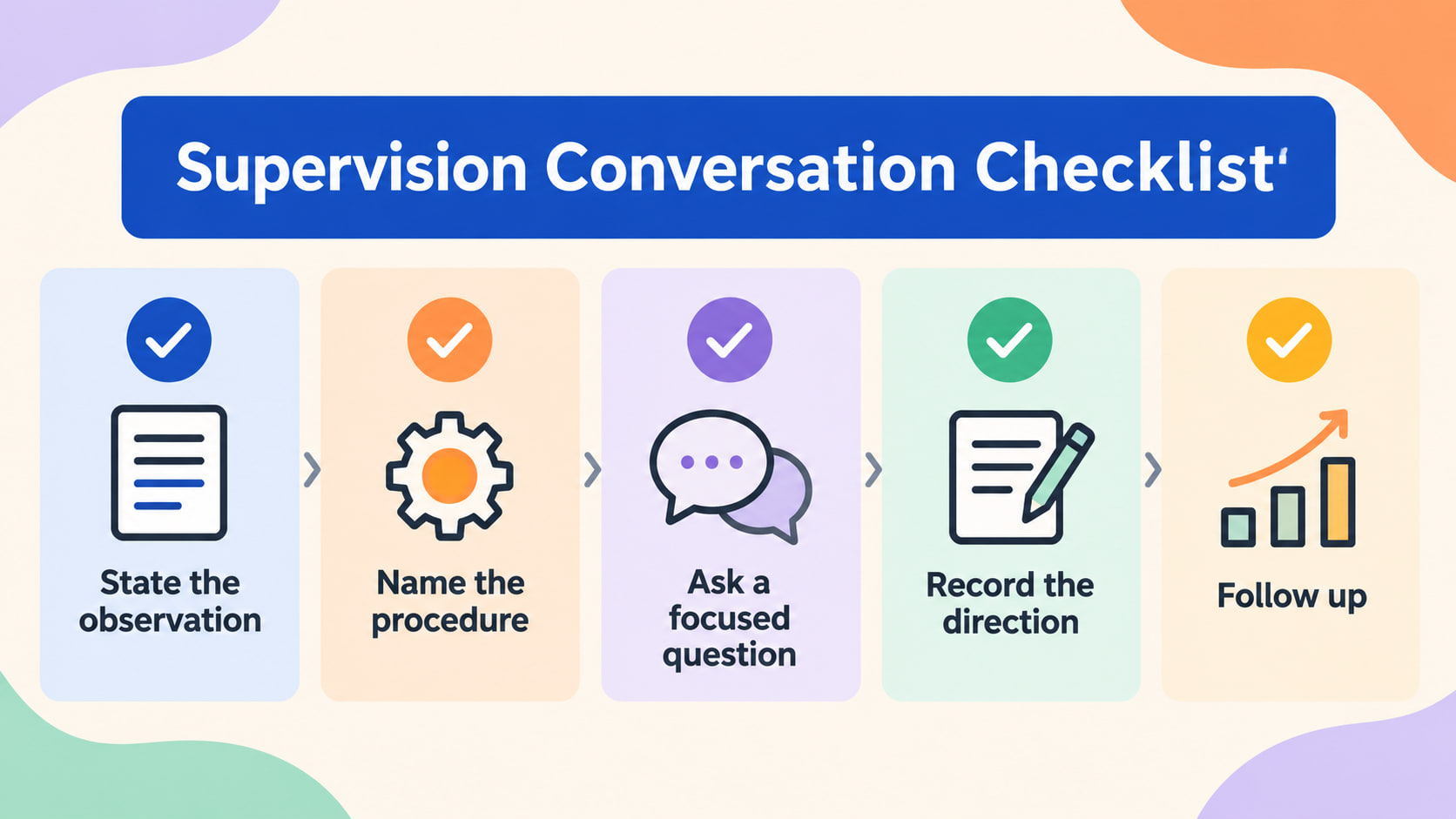
A strong supervision conversation has five parts:
- Observation: state what you saw, heard, measured, or could not complete.
- Procedure: identify the written plan, training step, or data rule involved.
- Question: ask one focused question instead of presenting a broad complaint.
- Direction: record the instruction or practice step the supervisor provides.
- Follow-up: apply the direction as trained and report what happened next.
For example, “I was unsure whether the response met the operational definition during trial four; should I score it as no response or review the example with you?” is more useful than “The data looked wrong.” The first statement gives the supervisor a specific decision point and preserves the RBT role boundary.
RBT supervision examples for data questions
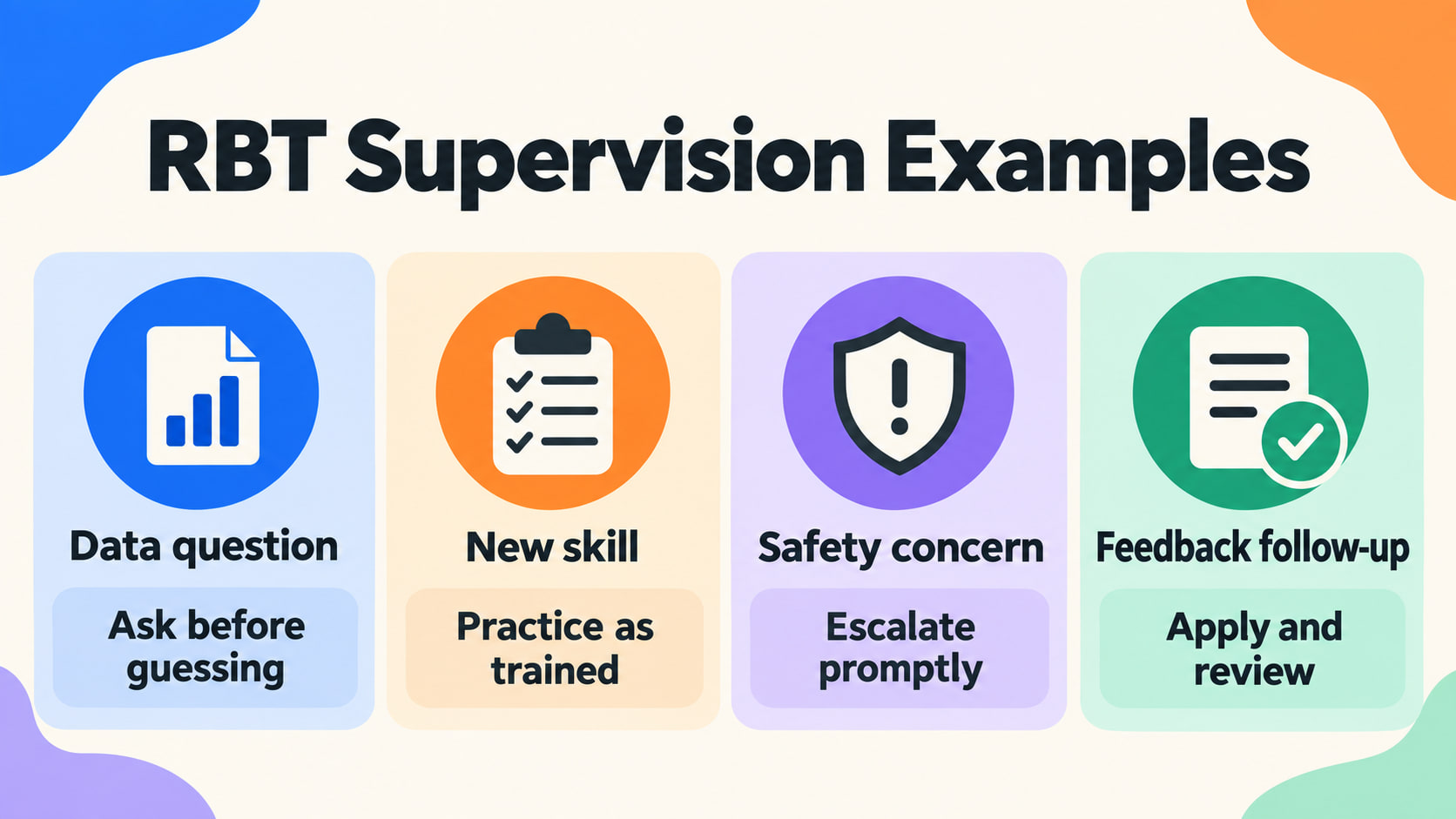
Scenario: An RBT is recording duration, but the session ends before the behavior stops. The RBT is not sure whether the data system requires the observation to close at the end of the session or whether another rule applies.
Weak response: choose a number that feels reasonable so the data sheet looks complete.
Better supervision conversation: “The behavior began at 2:10, and the session ended at 2:18 while it was still occurring. The written data rule says to record duration, but I am unsure how to close this observation. Which rule should I use, and should I mark the entry for review?”
This example separates the observable event from the question. The RBT does not invent a measurement rule or hide the irregularity. The supervisor can clarify the procedure, correct the record if needed, and decide whether the team needs a data-quality follow-up.
Use the same structure when a graph looks different from previous sessions. Describe the trend or unusual value, check whether schedule, medication, illness, staffing, materials, or other documented variables changed, and ask which information should be reported. Avoid concluding that a learner “regressed” from one surprising point without the team’s review.
When a new skill needs more training
Scenario: A supervisor asks the RBT to implement a teaching procedure the RBT has observed but has not yet practiced independently. The RBT understands the general goal but is uncertain about the prompt delay and reinforcement rule.
Better response: request instruction, modeling, rehearsal, and feedback before attempting the step independently. A focused question might be: “Could you model one trial, then watch me rehearse the prompt delay and reinforcement step before I run the next teaching block?”
Demonstrating willingness to learn is not an admission of incompetence. It is a way to protect service quality and ensure the task is performed within demonstrated competence. If the RBT still cannot perform the procedure accurately after practice, the RBT should communicate that limitation and follow the supervisor’s direction about assignment, retraining, or observation.
Do not replace an unclear procedure with a personal preference. An RBT can report that a direction is unclear, but the RBT should not independently change prompts, mastery criteria, reinforcement schedules, or treatment targets.
When a safety concern needs prompt direction
Scenario: A planned activity includes materials that are no longer available, and the learner begins moving toward an area identified in the safety plan. The RBT is unsure whether the usual activity can continue safely.
Safety changes should be escalated promptly through the workplace chain of command and the current safety procedure. The RBT should follow trained emergency steps, protect the learner and others within the role, and communicate the facts: what changed, what risk was observed, what immediate step was taken, and what direction is needed. A supervision question could be: “The planned materials are missing, and the learner moved toward the restricted area at 10:12. I followed the current safety step and paused the activity. What approved alternative should I use?”
Urgent danger, medical needs, safeguarding concerns, or emergencies may require emergency or organizational procedures in addition to supervision. A supervision article does not replace those routes. When immediate safety is at stake, address the immediate risk first and document the actions taken.
How to use feedback after observation
Scenario: During observation, the supervisor says the RBT delivered a prompt too quickly and did not record the learner’s independent response opportunity.
A productive follow-up does not argue from intention. Ask what observable behavior should change: “For the next trial, should I wait the stated interval before prompting, then record whether the response was independent, prompted, or absent?” The RBT can then rehearse the step, apply it during the next opportunity, and ask the supervisor to confirm whether the timing and record match the written procedure.
Feedback may identify a training need, a documentation correction, or a question about procedural fidelity. Record the date, the skill reviewed, the direction received, and the next practice step according to workplace requirements. Do not alter records to hide the original error. A transparent correction gives the team better information than a data sheet that looks perfect but is not accurate.
What to document after supervision
Use the system required by the employer or supervising team. A concise note can include:
- the date, setting, and procedure discussed;
- the objective observation or data question;
- the direction, demonstration, or feedback provided;
- the action the RBT will take next;
- any follow-up observation, correction, or training need.
Keep language observable and protect confidential information. “Two trials were recorded without the required response-prompt code; supervisor reviewed the coding rule and observed three corrected trials” is more useful than “I received supervision about data.” Do not include client details in an unapproved personal note or public message.
RBT role boundaries in supervision
The RBT role includes implementing assigned services after demonstrating competence, collecting data, describing observations, receiving feedback, and communicating concerns. Supervision does not mean that an RBT should make independent clinical decisions. Follow the current written plan and supervisor direction for treatment changes, new procedures, goals, measurement systems, and safety responses.
It is also reasonable to ask who has authority to answer a question. A scheduling issue may go to an employer contact, a clinical procedure question to the responsible supervisor, a credentialing question to the BACB, and an urgent safety issue to the emergency or safeguarding route. Use the correct channel and keep the handoff clear.
Common supervision mistakes
- Waiting until the end of the week: communicate time-sensitive safety, data, or client-progress concerns promptly.
- Using labels instead of observations: replace “the learner was difficult” with what happened and how it was measured.
- Changing the plan quietly: ask for direction rather than improvising a new intervention or criterion.
- Recording only the feedback: preserve the question, direction, and follow-up step required by the workplace system.
- Oversharing: use approved systems and disclose only the information needed by the recipient.
- Treating examples as rules: the current plan, training, workplace policy, and BACB requirements control the actual situation.
Frequently asked questions
What makes a good RBT supervision example?
A good example shows an observable situation, the relevant procedure, the focused question, the direction received, and the follow-up. It does not authorize an independent clinical change.
When should an RBT ask for supervision?
Ask when a procedure, data rule, safety direction, training need, or client-progress variable is unclear or changes. Use the timely communication route required by the workplace and current supervision plan.
Can an RBT change a procedure if the usual step is not working?
Do not independently change a treatment procedure, target, prompt, reinforcement rule, or mastery criterion. Record the observation and seek direction from the responsible supervisor.
Are these official BACB examination questions?
No. These are original educational scenarios. They are not official, recalled, leaked, or BACB-endorsed questions, and they cannot guarantee examination success.
The most useful supervision habit is simple: describe what happened, connect it to the written procedure, ask one focused question, record the direction, and follow up. That pattern makes supervision practical while keeping the RBT within competence and role boundaries.
Sources and further reading
Ready to practice the RBT concepts you just reviewed?
Try an independent, original RBT practice resource with exam-style questions, scoring, and answer explanations.
References
- Behavior Analyst Certification Board. RBT Test Content Outline, 3rd edition.
- Behavior Analyst Certification Board. RBT Handbook.
- Behavior Analyst Certification Board. RBT Ethics Code.