

Repaso para examen de RBT works best as a structured review of current official materials, observable scenarios, data, ethics, and role boundaries—not as memorizing leaked questions.
Table of Contents
- repaso para examen de RBT: the short answer
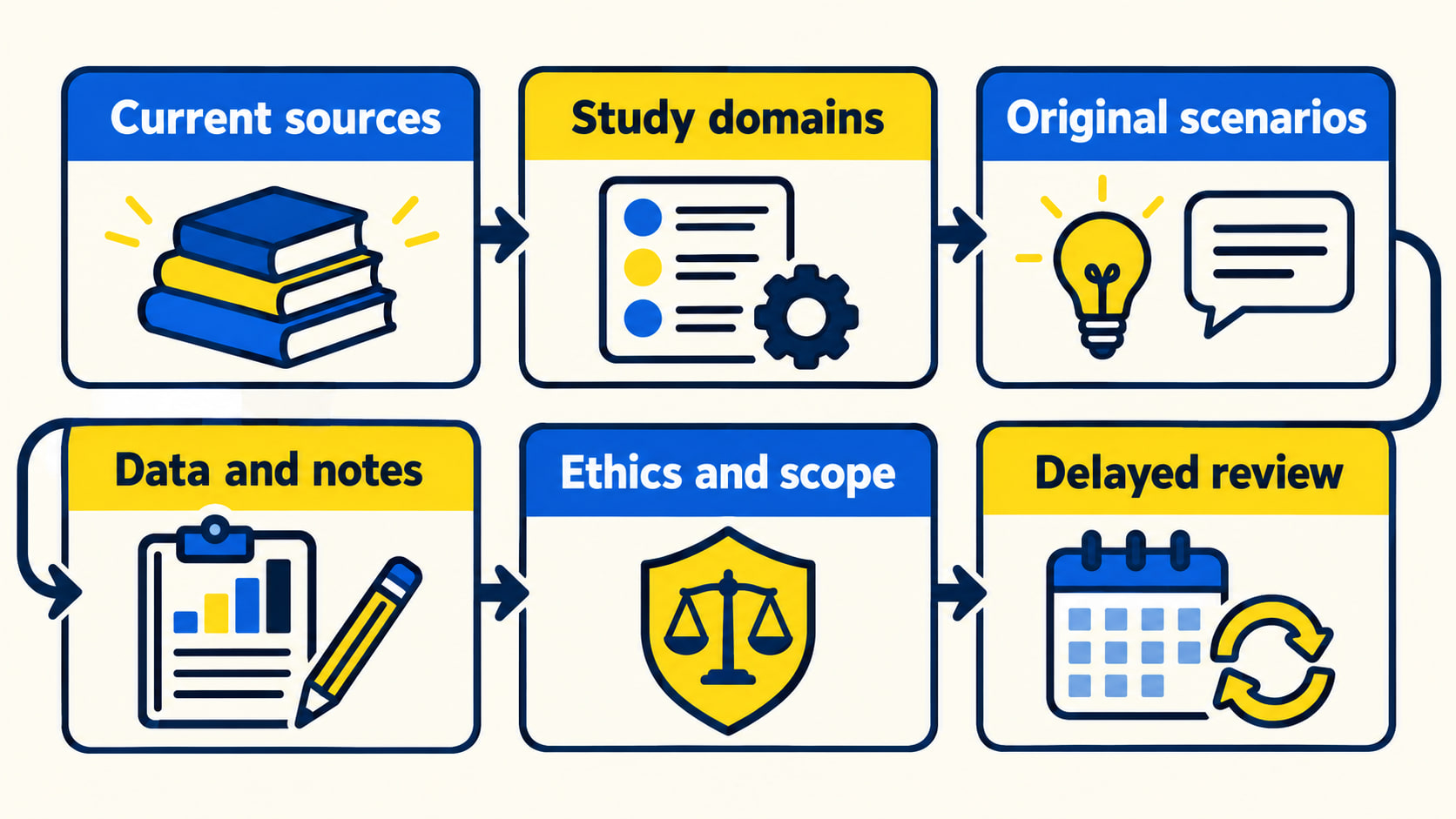
- Start with current sources
- Map the study domains
- Practice observable scenarios
- Review data and documentation
- Add ethics and role boundaries
- Build a repeatable schedule
- Use an error log, not just more questions
- Avoid weak study habits
- Frequently asked questions
- References
RBT EXAM GUIDE · STUDY PLANNING
Repaso para Examen de RBT: A Practical Study Plan
Organize current sources, observable scenarios, data questions, ethics, and role boundaries into a repeatable review routine.
Repaso para examen de RBT works best as a structured review of current official materials, observable scenarios, data, ethics, and role boundaries—not as memorizing leaked questions. The Spanish phrase “repaso para examen de RBT” can describe a review session, a study guide, or a personal plan. The useful plan is the one that turns a broad topic into a concrete action and a reasoned answer.
This independent guide is educational content. The current BACB Test Content Outline, Handbook, and official resources control examination decisions. Original examples here are not official, recalled, leaked, or BACB-endorsed questions, and no study article can guarantee a score or certification.
repaso para examen de RBT: the short answer
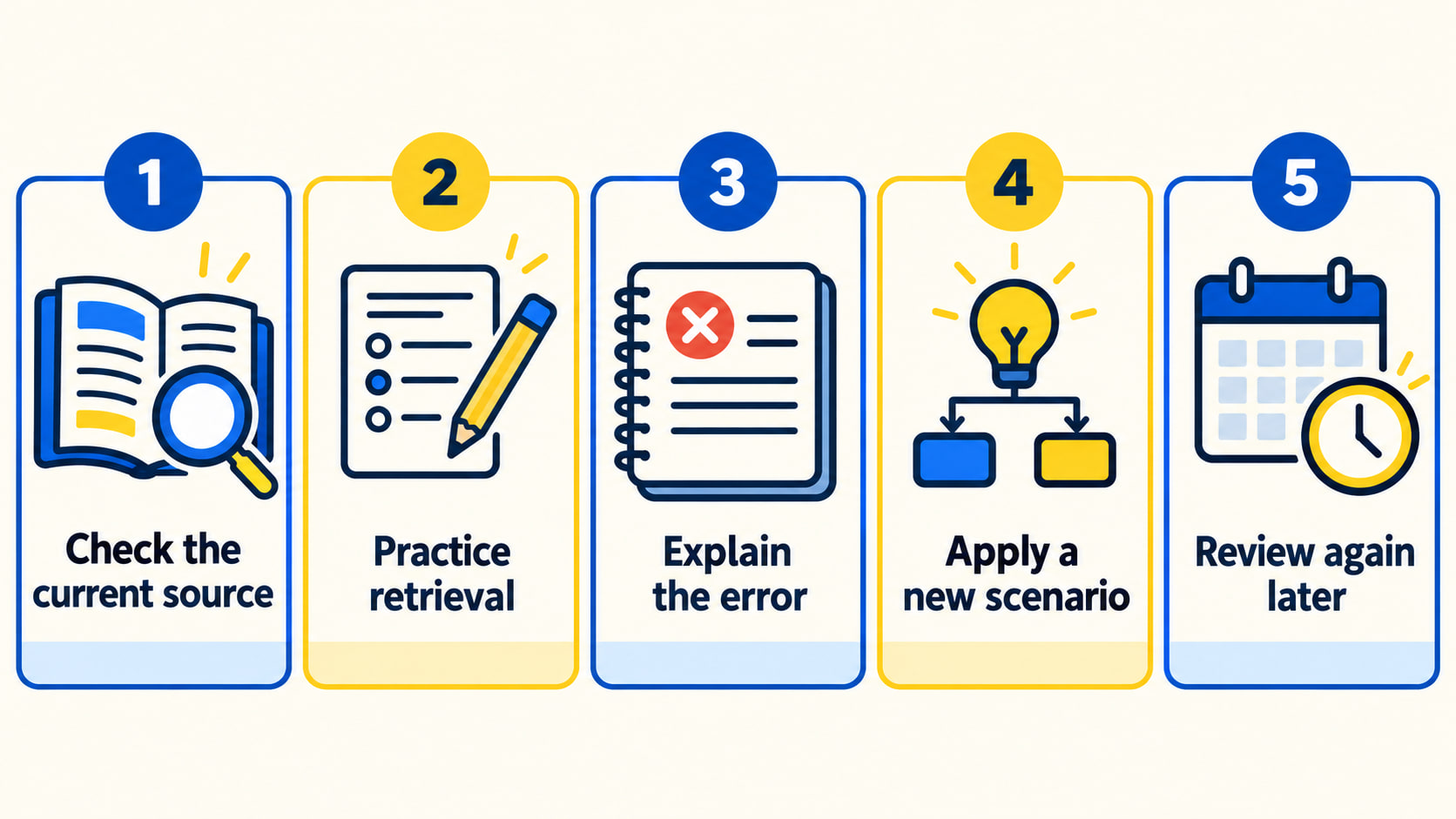
Start with the current outline, divide the material into study domains, practice one observable scenario at a time, explain why an answer fits, and keep a short error log. Review the error log again after a delay instead of rereading only the topics that feel familiar.
Start with current sources
Open the current BACB materials before building flashcards. Check the publication date and distinguish requirements, definitions, examples, and local workplace procedures. A copied summary may omit a transition or update. Use a study note to point back to the official source rather than treating your note as the authority.
Do not search for recalled examination questions. Build original practice situations instead. A good practice item describes an observable setting, a procedure, a response, and a decision point. It asks what the RBT should do within the assigned role.
Map the study domains
Create a one-page map with the major areas in the current outline: measurement and data, assessment-related support, skill acquisition, behavior reduction, documentation and reporting, and professional conduct and scope. Your exact labels should follow the current official version.
For each area, write four prompts:
- What would the RBT observe?
- What procedure or definition controls?
- What would the RBT implement or record?
- When should the RBT report or ask for direction?
Practice observable scenarios
Scenario practice is stronger when it separates facts from interpretation. For a data question, identify the defined start and stop points. For a skill-acquisition question, identify the instruction, response, prompt, consequence, and recording rule. For a safety or ethics question, identify the boundary and the person who should provide direction.
After choosing an answer, explain why the closest distractor fails. It may sound helpful but quietly ask the RBT to change a plan, invent a measurement rule, disclose private information, or make an independent clinical decision. That explanation is often more useful than memorizing a letter choice.
Review data and documentation
Keep a small data-and-documentation set in your review. Compare frequency, duration, latency, interval, and percentage only when the definition and recording rule support the comparison. Practice describing what happened without adding an unsupported motive. If a session variable affects the record, identify it objectively and follow the reporting route.
When a data sheet is incomplete or a procedure is unclear, the safe study answer usually includes seeking timely direction. It does not include making the data look complete, changing the definition, or silently correcting a record without authorization.
Add ethics and role boundaries
Ethics review is not a final decoration. Include dignity, privacy, confidentiality, competence, truthful documentation, respectful communication, and scope of practice in scenario practice. Ask what information is necessary, who is authorized to receive it, and what the RBT should do when the request conflicts with the current procedure.
Remember that a correct study answer does not authorize a real-world change. In practice, follow the written plan and supervisor direction. Report safety concerns and uncertainty through the approved route.
Build a repeatable schedule
Use short cycles: source review, retrieval practice, one original scenario, error explanation, and delayed review. A weekly plan might assign one domain to a focused session, then use a mixed session to prevent recognition from becoming the only skill. Keep the final session lighter: review definitions, common errors, and the official logistics rather than trying to learn an entire domain overnight.
Track what you can explain without notes, what you can apply to a new scenario, and what still requires a source check. Confidence is useful, but it is not evidence that every current requirement has been reviewed.
For bilingual review, write the English term used by the current source next to your Spanish study note. Then define the term with an observable action instead of translating it into a vague synonym. This is especially useful when a question uses a technical label but the scenario describes a data decision, a documentation step, or a scope boundary. Keep the official wording available for verification.
Use an error log, not just more questions
When you miss an item, record the reason in one sentence: definition confused, condition overlooked, data rule missed, role boundary ignored, or source needs checking. Write the corrected reasoning without copying a purported answer key. After a day or two, solve a new scenario that tests the same distinction. This shows whether you learned the concept or only remembered the original wording.
Before the examination, verify logistics and current instructions through official channels. Gather only the materials that are permitted, avoid last-minute rumor threads, and give yourself enough time to read each scenario for its observable facts. A calm final check is more useful than adding an unverified list of “most likely” questions.
Keep the final plan realistic: short focused sessions, sleep, source checks, and honest notes about uncertainty. The purpose of repaso is clearer reasoning, not a promise that every possible question can be predicted.
Avoid weak study habits
- Relying on an old summary without checking the current official source.
- Memorizing answer patterns instead of identifying the observable facts.
- Studying only familiar topics and avoiding the error log.
- Treating an unofficial question bank as recalled or guaranteed content.
- Confusing a study explanation with permission to change a live procedure.
Frequently asked questions
Is this an official BACB study guide?
No. It is independent educational content. Use current BACB materials for official information.
Can I study only with flashcards?
Flashcards can help with retrieval, but add original scenarios and explanations so you can apply a concept to observable facts.
Does a strong study plan guarantee a pass?
No. A plan can organize preparation, but it cannot guarantee an examination result or certification.
Ready to practice the RBT concepts you just reviewed?
Try an independent, original RBT practice resource with exam-style questions, scoring, and answer explanations.
References
- Behavior Analyst Certification Board. RBT Test Content Outline, 3rd edition.
- Behavior Analyst Certification Board. RBT Handbook.
- Behavior Analyst Certification Board. RBT Ethics Code.