

RBT data collection examples are easiest to study when each measure is matched to the question, operational definition, observation window, and recording rule.
Table of Contents
- rbt data collection examples: match the measure to the question
- Frequency and rate examples
- Duration examples
- Latency examples
- Interval and momentary examples
- Permanent-product examples
- Data quality: operational definitions, fidelity, and privacy
- How to choose among common procedures
- RBT role and what the data do not prove
- Frequently Asked Questions
- References
RBT DATA GUIDE – MEASUREMENT PRACTICE
RBT Data Collection Examples: Match the Measure to the Question
Choose the written measurement procedure, record it consistently, and explain what the data do and do not show.
If you are looking for rbt data collection examples, focus on the question each procedure is meant to answer. A count, a rate, a duration, a latency measure, an interval mark, and a permanent product can all describe behavior, but they are not interchangeable. This guide uses original practice scenarios to show how an RBT can select the measure written in a program, record it consistently, and communicate what the data show without adding a clinical conclusion.
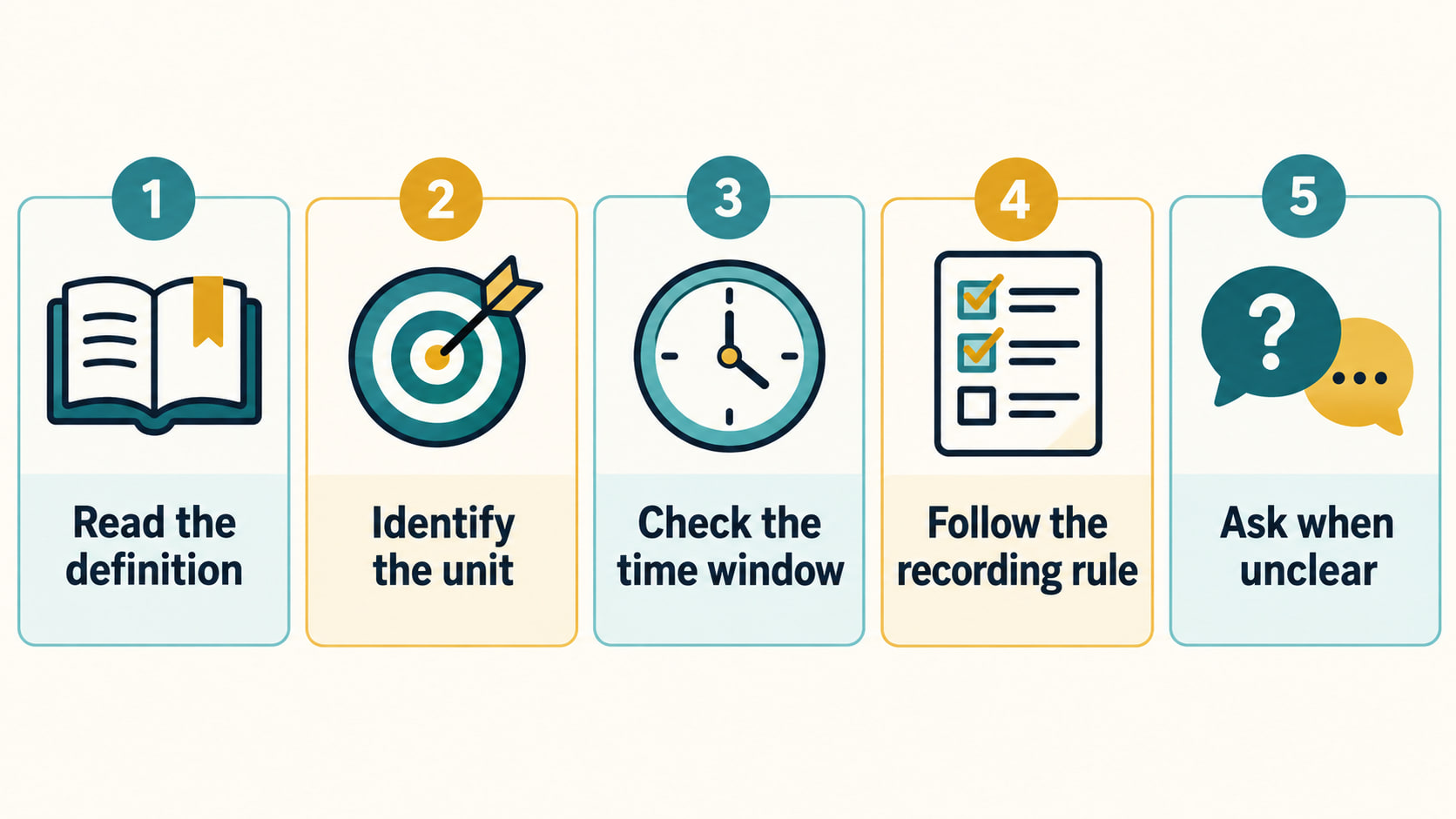
Quick answer: Start by reading the operational definition and the data sheet. Identify the observation window, the response unit, the onset and offset rules, and what counts as an opportunity. Then record only what the procedure asks for. If the form or definition is unclear, ask the supervisor before changing the measurement system.
Study boundary: This is independent exam-preparation content, not an official BACB handbook, task answer key, or application determination. The examples in this article are newly written for study. They are not official, recalled, leaked, or BACB-endorsed exam questions. Requirements and policies can change, so use the current BACB handbook and your supervisor or requirements coordinator for decisions about an individual application or client program.
rbt data collection examples: match the measure to the question
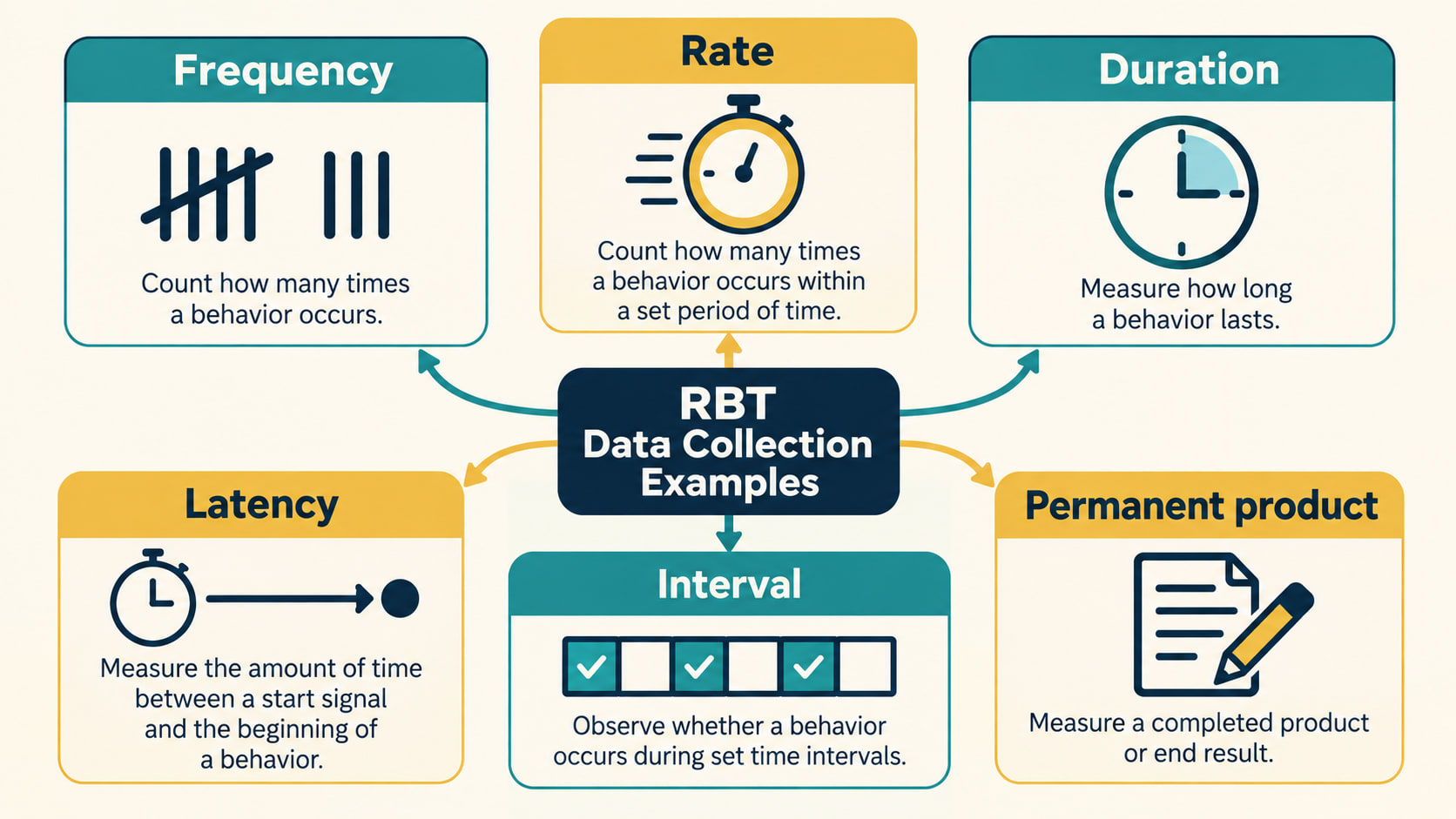
Data collection is not simply writing down everything that happens. It is a structured way to represent a behavior so a team can compare performance across time or conditions. “How many times?” points toward frequency or rate. “How long?” points toward duration. “How quickly after the instruction?” points toward latency. “Did it occur during the interval?” points toward an interval procedure. “Was the assignment completed?” may point toward permanent-product recording.
Before collecting, ask four questions: What is the target response? What is the unit? What begins and ends an observation? What does the plan say to do after an error, missing value, or safety event? A familiar measure can still be wrong when the unit or window does not match the program.
Frequency and rate examples
Frequency is the number of defined responses. Rate expresses a count per unit of time. For example, if a learner raises a hand 8 times in a 20-minute lesson, the frequency is 8 and the rate is 0.4 responses per minute. If another lesson lasts 40 minutes and also has a frequency of 8, comparing raw counts alone hides the difference in opportunity to respond.
Original scenario: A plan defines “calling out” as speaking an answer aloud without being called on, with one count after the voice stops for at least 2 seconds. During a 30-minute group activity, the technician records 6 calls. The note should include the session length and the count. It should not count every word in a continuous sentence unless the definition says to do so.
Rate is useful when observation lengths vary, but it does not solve every comparison problem. Changes in task difficulty, number of opportunities, or setting may still matter. Follow the plan’s graphing and reporting rules rather than choosing a new denominator independently.
Duration examples
Duration measures how long a response lasts. The team needs a clear onset and offset. If “crying episode” begins with audible crying and ends after 10 consecutive seconds without crying, the technician can time each episode using the defined rule. “Cried a lot” is not a duration measure.
Original scenario: The program defines task refusal as pushing materials away and turning the body away from the work area. The learner begins at 10:05:00 and returns hands to the task at 10:06:20. Record 80 seconds if the plan’s onset and offset rules are met. If the learner briefly touches the materials for 2 seconds, do not reset or stop the timer unless the plan says that is the offset criterion.
Latency examples
Latency is the time between a specified event, such as an instruction, and the beginning of the target response. It is different from duration: latency asks how soon the response starts, while duration asks how long it continues.
Original scenario: After the teacher says “open your book,” the learner opens the book 12 seconds later. If the plan defines a 20-second response window and says to stop timing at the first correct movement, record a latency of 12 seconds. Do not start the timer when the teacher walks toward the desk unless that is the defined antecedent.
Interval and momentary examples
Interval procedures divide the observation into defined periods and apply a recording rule to each period. Partial-interval recording marks whether the behavior occurred at any point in the interval. Whole-interval recording marks whether it occurred for the entire interval. Momentary time sampling checks whether it is occurring at a specific instant, often at the end of the interval. These methods answer different questions and can overestimate or underestimate behavior in different ways.
Original scenario: In a 10-minute observation with 20 thirty-second intervals, the plan uses partial-interval recording for hand flapping. If the response occurs for 2 seconds in interval 4, mark interval 4 according to the partial-interval rule. Do not convert that mark into “30 seconds of behavior,” and do not use a whole-interval rule because it feels more precise.
Permanent-product examples
Permanent-product recording measures a lasting outcome produced by a response, such as completed problems, sorted items, or a correctly assembled routine. The product must be reliably linked to the behavior and the plan must define what counts as correct. A completed worksheet may show an outcome, but it may not reveal every response that occurred while completing it.
Original scenario: A plan defines independent sorting as placing each item in the matching bin without an added prompt. At the end of the trial, the technician counts 9 correctly sorted items and notes that 2 items were placed after a model prompt. The product count alone should not be reported as 11 independent responses.
Data quality: operational definitions, fidelity, and privacy
- Read the definition first: Know the response topography, onset, offset, examples, and nonexamples.
- Use the same unit: Do not switch between count, rate, percentage, and duration without a written instruction.
- Record in real time when possible: If a delay is unavoidable, follow the approved process and distinguish direct observation from reconstruction.
- Mark prompts correctly: A prompted response may not count as independent when the program separates those outcomes.
- Check procedural fidelity: Note whether the opportunity, cue, materials, and consequence were delivered as written.
- Protect records: Use the approved system, limit identifying details, and report a data-integrity concern to the appropriate person.
How to choose among common procedures
| Question | Possible procedure | What can go wrong |
|---|---|---|
| How many responses occurred? | Frequency | Counting without a stable definition or observation window. |
| How many per minute? | Rate | Using the wrong time denominator. |
| How long did it last? | Duration | Inconsistent onset or offset. |
| How quickly did it begin? | Latency | Starting from an event that is not the defined cue. |
| Did it occur in a period? | Interval recording | Using the wrong interval rule. |
| What lasting outcome was produced? | Permanent product | Assuming the product proves every behavior was independent. |
RBT role and what the data do not prove
An RBT is a paraprofessional who provides behavior-analytic services under the direction and close supervision of the responsible supervisor or requirements coordinator. A strong answer therefore separates what an RBT can implement as written from what requires assessment, clinical interpretation, plan changes, or supervisor direction.
Data can reveal a pattern, but one session does not automatically establish a function, diagnose a condition, or justify a new intervention. If the data sheet does not match the written plan, a definition is ambiguous, or a safety event occurs, document and communicate through the required channel. Do not rewrite the data to make a graph look cleaner.
Current exam frame: The current RBT Test Content Outline (3rd ed.) applies beginning January 1, 2026. It describes 43 tasks across six content domains. The current examination format is 75 scored questions plus 10 unscored pilot questions, four answer choices per item, and a 90-minute testing period. These facts explain the study frame; they do not turn an independent guide into an official BACB resource.
For study, take one scenario and name the question, unit, window, and error rule before naming the procedure. That sequence is more reliable than memorizing a list of labels without context.
Practice selecting the right data procedure
Use independent RBT-style scenarios to test measurement decisions, then compare your reasoning with the current official training materials.
Review the RBT resource →
Frequently Asked Questions
What should I do first when collecting ABA data?
Read the operational definition and written data procedure. Identify the target, unit, observation window, onset, offset, and recording rule before the session begins.
What is the difference between frequency and rate?
Frequency is a count of responses. Rate expresses that count per unit of time, which can help compare observations with different lengths.
Is a permanent product proof that a response was independent?
Not necessarily. The product shows an outcome. Check whether the program separately records prompts, errors, or assistance.
Can an RBT choose a different measure if the current one is inconvenient?
No. Implement the written procedure and ask the supervisor about a change. A different measure can answer a different question.
Are these official BACB questions?
No. The scenarios are newly written independent study content and are not official, recalled, leaked, or BACB-endorsed exam questions.