

Learning RBT terms and definitions is necessary, but memorizing a word list is not enough. A useful term study method tells you what a concept means, what it is commonly confused with, which current RBT domain it supports, and what the concept looks like in an observable situation. That is how vocabulary becomes usable reasoning instead of a page of familiar phrases.
Table of Contents
- What RBT terms and definitions should help you do
- Use the current RBT Test Content Outline as your scope check
- Organize RBT terms and definitions by current domain
- Write a decision-ready definition
- High-value measurement and assessment terms
- High-value acquisition and reduction terms
- Documentation and ethics terms
- Turn RBT terms and definitions into original scenarios
- Build a review loop for a glossary
- Common RBT terms-and-definitions mistakes
- Frequently Asked Questions
- References
The current RBT Test Content Outline, 3rd edition, describes 43 tasks across six domains. The current examination context includes 75 scored questions and 10 unscored pilot questions. Use the current BACB TCO and Handbook for official scope and process facts; use independent glossaries, flashcards, and practice scenarios as study tools.
RBT Training is an independent educational resource. It is not affiliated with, operated by, or endorsed by the Behavior Analyst Certification Board (BACB). The explanations and examples below are newly written for independent study. They are not official, current, retired, recalled, leaked, or BACB-endorsed questions. No glossary, practice score, or study schedule can guarantee a passing result or certification.
What RBT terms and definitions should help you do
A definition is useful when it helps you make or recognize a decision. “Reinforcement” should not remain a vague synonym for reward; it should help you identify a consequence that increases future behavior under stated conditions. “Duration” should not remain “how long”; it should prompt you to look for an onset and offset. “Objective note” should lead you toward observable description rather than an unsupported interpretation.
| Definition layer | Question to ask | What a strong answer contains |
|---|---|---|
| Term | What is the word or abbreviation? | The exact term and its current, relevant use. |
| Core meaning | What relation, event, or procedure does it describe? | A precise plain-language definition. |
| Observable clue | What would I see, count, time, or record? | A feature that can be checked in a session or stem. |
| Nearest contrast | What similar term could be the distractor? | One specific boundary, not a second synonym. |
| Role-safe action | What should an RBT implement, record, or ask? | Plan-based action and appropriate supervision boundary. |
| Original example | What would this look like in context? | A new scenario that does not claim to reproduce an exam item. |
Search results for “RBT terms and definitions” include broad ABA glossaries, online flashcards, printable PDFs, and large searchable databases. A large inventory can be useful for browsing, but it can also mix advanced concepts, older labels, or BCBA-level material into an RBT study session. Start with the current TCO, then decide which terms support the task you are studying.
Use the current RBT Test Content Outline as your scope check
The current RBT Test Content Outline, 3rd edition, is the source for exam scope. It contains 43 tasks across six domains. A glossary can organize terms related to those tasks, but no independent glossary becomes the official vocabulary list simply because it has a high card count or says “exam definitions.”
| Current official fact | How to use it while studying | What not to infer |
|---|---|---|
| 43 tasks | Check whether your term list traces to all six current domain families. | A list of 100 terms is automatically more complete than a list of 40. |
| 75 scored questions | Study across the scope, not only the most familiar high-volume topic. | A 75-term list or 75-item quiz is the official scored form. |
| 10 unscored pilot questions | Understand the official 85-question context when planning independent pacing. | You can identify the unscored items during the exam. |
| Four answer choices | Learn why the nearest distractor fails under the clue in the stem. | The answer containing the most technical vocabulary is correct. |
The Handbook remains the authority for eligibility, training, the initial competency assessment, application steps, scheduling, accommodations, security, and test-day rules. A glossary can support learning, but it cannot replace the current official instructions or demonstrate hands-on competence.
When a glossary uses older headings such as Measurement, Skill Acquisition, Documentation, or Professional Conduct and Scope of Practice, treat those labels as a cross-reference. Use the current TCO names for current study notes, and mark any term whose definition or scope needs a source check.
Organize RBT terms and definitions by current domain
Organizing by domain makes a definition list more useful than alphabetical order alone. The task ranges below total 43 and provide a coverage check:
| Domain | Task range | Term families | Decision prompt |
|---|---|---|---|
| A. Data Collection and Graphing | A.1–A.8 | Operational definition, frequency, rate, duration, latency, interval recording, graph. | What is observable, what unit is requested, and what data system fits? |
| B. Behavior Assessment | B.1–B.3 | Preference assessment, skill assessment, ABC observation, assessment data. | What procedure is assigned and what conclusion requires supervisor input? |
| C. Behavior Acquisition | C.1–C.11 | Prompt, fading, reinforcement, shaping, chaining, discrimination, maintenance, generalization. | What teaching step is written and what response contacts the consequence? |
| D. Behavior Reduction | D.1–D.7 | Antecedent, consequence, function, replacement behavior, extinction, safety procedure. | What does the plan direct, what is measured, and what must be reported? |
| E. Documentation and Reporting | E.1–E.4 | Objective note, data integrity, communication, record handling. | Could another professional verify the description without guessing? |
| F. Ethics | F.1–F.10 | Confidentiality, dignity, competence, supervision, boundaries, integrity. | Which action protects the client and stays within role and supervision? |
Use the table to find holes. A list that has dozens of acquisition terms but no privacy, documentation, or assessment terms is not balanced for the current scope. A list that includes a word under a domain but gives no observable or role clue is also incomplete for application practice.
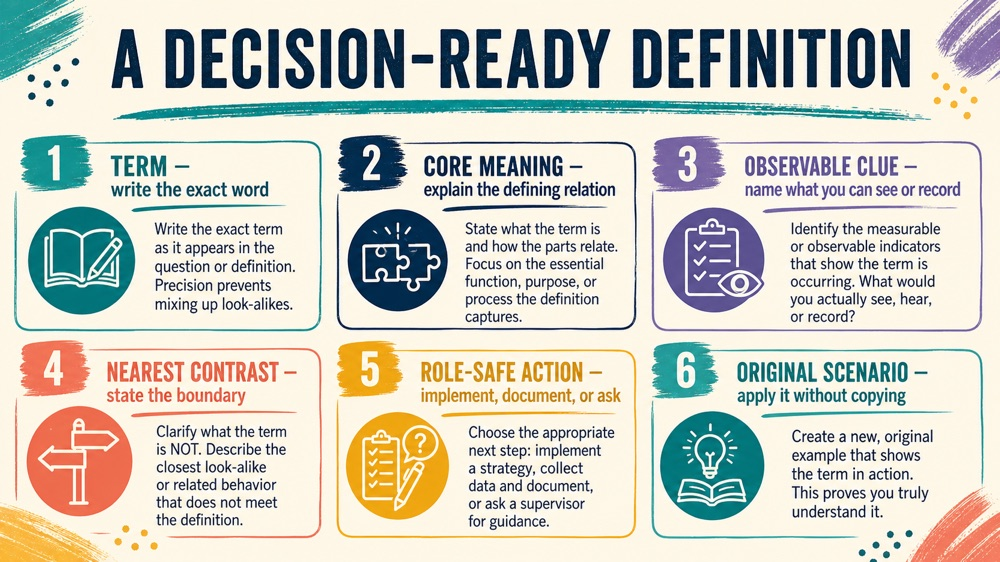
Write a decision-ready definition
Use a six-line template for every word you miss or cannot explain. The template is deliberately compact so you can use it in a notebook, glossary, or printable card:
- Term: write the word exactly, including an abbreviation when relevant.
- Plain meaning: explain the defining relation in one sentence.
- Observable feature: name what a technician could see, count, time, or record.
- Nearest contrast: identify the similar concept and the boundary between them.
- Role-safe action: state whether the RBT implements, documents, reports, or asks.
- Original scenario: add a new example and one plausible distractor.
For example, a weak definition says “latency is delay.” A decision-ready definition says latency is the time between a specified stimulus or instruction and the beginning of the response, so the stem must identify both the starting event and response onset. The nearest contrast may be duration, which measures how long the response continues after it begins. The definition now tells you what to look for.
Do not force every concept into the same measurement language. A privacy term, a teaching procedure, and a data system have different observable clues. The template is a reasoning scaffold, not a claim that every term has one official sentence or one universal example.
High-value measurement and assessment terms
Measurement and assessment terms are often confused because several refer to what happens around the same session. Keep the decision boundary visible:
| Term | Plain definition | Nearest distinction |
|---|---|---|
| Operational definition | An objective, observable, and measurable description of a target response. | It describes what counts; it is not a guess about why the learner acted. |
| Frequency | The total count of response occurrences during an observation. | Rate adds a time denominator; frequency alone does not. |
| Rate | The number of responses divided by a specified unit of time. | The answer must state or calculate the time unit. |
| Duration | The amount of time from response onset to offset. | Latency is time before response onset, not time the response lasts. |
| Latency | The time between a defined stimulus and the beginning of a response. | IRT is time between two consecutive responses. |
| Partial-interval recording | Score the interval if the behavior occurs at any point during it. | Whole-interval requires occurrence throughout the interval. |
| Preference assessment | A procedure for identifying items or activities the learner selects under defined conditions. | Selection does not by itself prove that an item functions as reinforcement. |
| ABC observation | Recording relevant antecedent, behavior, and consequence events as they occur. | A record of events is not automatically a completed functional analysis. |
When a question asks for a measurement, start with the requested unit rather than the behavior label. For example: if a learner engages in 12 responses in 30 minutes, frequency is 12 and rate per hour is 24. Duration cannot be selected unless the stem provides onset and offset information. The controlling clue is the requested measurement, not the word that sounds most technical.
High-value acquisition and reduction terms
Acquisition and reduction vocabulary often appears in pairs. Define each term by the relation between the plan, the learner response, and what follows:
| Term | Plain definition | What to mark in a scenario |
|---|---|---|
| Prompt | An added cue or assistance that increases the chance of a correct response. | It usually occurs before or as the response is being evoked. |
| Prompt fading | Systematically reducing assistance so the learner responds with less support. | What level of help the plan says to use next. |
| Shaping | Reinforcing successive approximations toward a target response. | Which closer version of the behavior is currently reinforced. |
| Chaining | Teaching a multi-step behavior by linking component steps. | Whether the procedure is forward, backward, or whole-task as written. |
| Generalization | Performance of a learned skill across people, materials, settings, or examples. | What stimulus or context has changed. |
| Maintenance | Continued performance of a skill over time or after teaching support changes. | Whether the skill persists beyond acquisition conditions. |
| DRA | Differential reinforcement of an alternative response. | Which alternative response is reinforced instead of the target response. |
| DRO | Differential reinforcement of the absence of a specified target response for a defined interval. | The time window and the behavior whose absence is measured. |
| Extinction | Withholding the maintaining reinforcer for a response according to the written plan. | What consequence has historically maintained the response and what the plan directs. |
A vocabulary definition does not authorize independent plan changes. If a prompt hierarchy, reinforcement schedule, extinction procedure, or safety response is unclear, follow the written plan and contact the appropriate supervisor. The exam concept and the workplace action must remain connected to role and supervision.
Documentation and ethics terms
Many definition lists underweight documentation and ethics because those terms seem less technical. They are still decision points. Use a second-observer test: could another authorized professional understand what happened from the note without adding a mental-state explanation?
| Term | Decision-ready meaning | Role reminder |
|---|---|---|
| Objective documentation | Recording observable events, data, procedures, and relevant context without unsupported inference. | Describe what occurred; do not turn a guess into a fact. |
| Data integrity | Accurate, complete, timely recording and protection of the data record. | Correct errors through the approved process; never invent missing data. |
| Confidentiality | Protecting client information from unauthorized access or disclosure. | Use approved channels and share only what the role and purpose require. |
| Competence | Performing assigned responsibilities with the training, skill, and supervision required. | Ask for instruction when the task exceeds current competence. |
| Supervision | Ongoing professional oversight, feedback, and support within the certification structure. | Use the supervision route when a plan, risk, or uncertainty needs review. |
| Professional boundary | A limit that protects the client, relationship, and integrity of service. | Do not let convenience or a personal relationship control a service decision. |
These are study explanations, not a replacement for the current BACB ethics and supervision requirements. If a practice item asks what to do with a privacy concern or unclear procedure, the safest reasoning usually starts with accurate documentation, the established communication route, and the RBT’s scope rather than improvisation.
Turn RBT terms and definitions into original scenarios
After recall, write one short scenario per weak term. Keep the item new and label it as independent practice. A strong scenario includes a controlling clue, one tempting distractor, and an explanation that names the boundary.
- Choose the domain: start with A, B, C, D, E, or F.
- Select a term pair: frequency/rate, prompt/reinforcement, preference/reinforcer, acquisition/maintenance, or objective note/interpretation.
- Add the clue: specify the time unit, response condition, plan direction, or privacy issue.
- Ask one decision question: choose the measure, next action, or best description.
- Explain the distractor: state which condition the wrong option ignores.
For example: an RBT records that a learner selected a toy during a preference assessment and later delivered the toy after a correct response. The selection tells you about preference; the later increase in correct responding is the evidence you would inspect when discussing reinforcement. Do not collapse both terms into “the learner likes it.”
For another example: a session note says, “The learner was uncooperative and wanted attention.” Rewrite it with observable details: “When the instruction was presented, the learner pushed the worksheet away and left the table for 20 seconds.” The rewrite tests objective documentation, not just vocabulary recall.
Build a review loop for a glossary
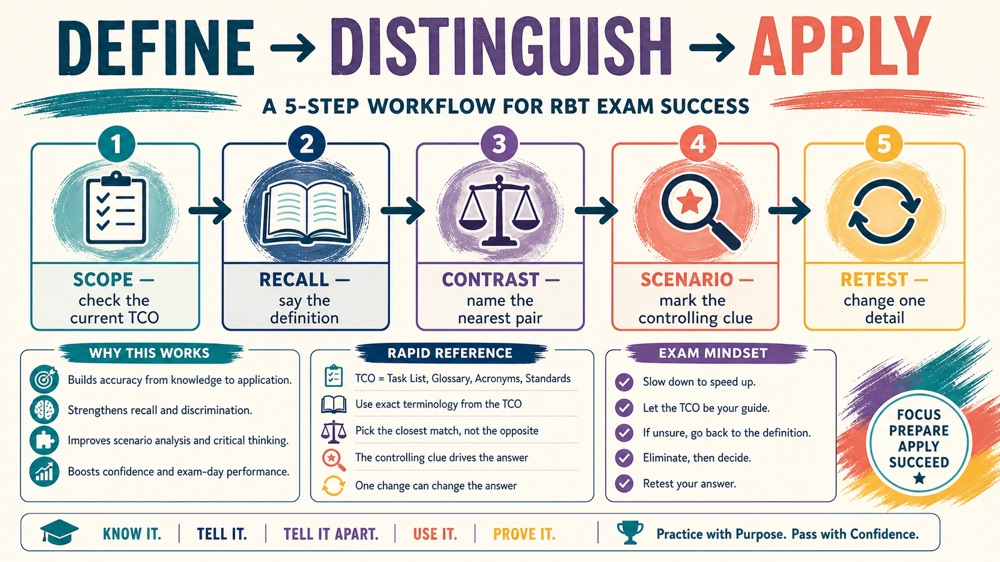
Use a glossary in six passes instead of reading the same list repeatedly:
| Pass | Action | Record |
|---|---|---|
| Scope | Check edition, source note, and A–F coverage. | Terms needing a source check. |
| Recall | Define the term before looking at the answer. | Sure, narrowed-down, or guessed. |
| Contrast | Name the nearest related term and the difference. | One controlling feature. |
| Apply | Answer a new two-sentence scenario. | Chosen action and rejected distractor. |
| Report | State what an RBT records, follows, or asks. | Role-safe next step. |
| Retest | Change one detail and answer again later. | Whether the distinction transfers. |
Use a short domain set to repair one gap, then a mixed set to test transfer. A useful goal is not “I read 100 definitions”; it is “I can identify the controlling clue and explain why the nearest alternative fails.” That goal matches how concept words become useful in scenario questions and supervised practice.
Common RBT terms-and-definitions mistakes
- Counting terms instead of checking scope: volume does not guarantee six-domain or 43-task coverage.
- Using a broad ABA glossary as an RBT blueprint: advanced or unrelated entries may require different training and context.
- Learning synonyms without boundaries: “how long” does not distinguish duration from latency.
- Confusing preference with reinforcement: selection and behavior change are different evidence.
- Confusing a definition with authorization: knowing a procedure does not allow an RBT to modify a plan independently.
- Writing interpretations as observations: “upset” or “seeking attention” needs observable support before it belongs in a note.
- Copying secure or copyrighted question content: write original examples and never seek current, recalled, leaked, or official items.
- Treating a practice score as a guarantee: use the score to choose the next correction, not to predict certification.
Bottom line: Study RBT terms and definitions as decision tools. Start with the current 3rd-edition TCO, map terms to all six domains and 43 tasks, write precise definitions with near-neighbor contrasts, apply them to original scenarios, and keep a correction log. A glossary becomes valuable when it helps you see what the stem is actually asking and choose a plan-based, observable, role-safe response.
Ready to use the terms?
Practice current-domain scenarios, mark the controlling clue, and turn each definition error into the next review action.
Try Free RBT Practice Questions →
Frequently Asked Questions
What RBT terms and definitions should I study first?
Start with terms tied to the six current domains: measurement, assessment, acquisition, reduction, documentation and reporting, and ethics. Prioritize words that have a close contrast, such as frequency and rate or preference and reinforcement.
Are online RBT glossaries official BACB materials?
Most online glossaries and flashcards are independent study resources. Check the current BACB TCO and Handbook for official scope and process, and do not treat a provider’s definition list or card count as official examination content.
How many tasks are in the current RBT outline?
The current RBT Test Content Outline, 3rd edition, describes 43 tasks across six domains. A glossary can map terms to those task families, but it does not replace the outline or required training.
Why are some RBT definitions easy to confuse?
Many terms share a context but differ in the controlling feature: count versus time-based rate, before-response prompt versus after-response reinforcement, selection versus demonstrated behavior change, or observation versus interpretation.
How can I remember definitions for scenario questions?
Define the term, name the nearest contrast, mark the controlling clue in an original scenario, choose the role-safe action, and retest after changing one detail. This builds application instead of answer-letter memory.
Can RBT terms and definitions guarantee a passing result?
No. A glossary, PDF, flashcard deck, or practice score cannot guarantee a passing result, certification, or performance on the official examination.
References
- Behavior Analyst Certification Board. RBT Test Content Outline, 3rd edition.
- Behavior Analyst Certification Board. RBT Test Content Outline, 3rd-edition PDF.
- Behavior Analyst Certification Board. RBT Handbook.
- Behavior Analyst Certification Board. Examination Information.
- Independent ABA terms and definitions glossary. Reviewed for competitor research; not an endorsement.
- Independent RBT flashcard glossary. Reviewed for competitor research; not an endorsement.
- Independent RBT glossary. Reviewed for competitor research; not an endorsement.