
RBT exam questions and answers are useful only when the answer key teaches the decision behind the answer. A long question bank can improve retrieval, pacing, and scenario familiarity, but repeating an answer letter does not prove that you understand the current RBT scope or can apply a role-safe procedure.
Table of Contents
- What good RBT exam questions and answers should do
- Verify the current exam frame
- Read a stem in five moves
- Audit an answer explanation
- Map questions to six domains
- Original RBT exam question examples
- Turn wrong answers into a correction log
- Choose the right practice format
- Use a seven-day answer-review plan
- Frequently Asked Questions
- References
The current BACB RBT Test Content Outline, 3rd edition, organizes 43 tasks across six domains. The written examination context includes 75 scored questions and 10 unscored pilot questions, with four answer options and 90 minutes. A third-party practice page may choose 15, 20, 75, or 85 items, but its question count is not the authority and its score is not a BACB score.
RBT Training is not a BACB certification program and is not affiliated with or endorsed by the BACB, Pearson VUE, or the independent providers reviewed here. The examples in this guide are newly written for independent study. They are not official, recalled, leaked, or BACB-endorsed questions. No practice score, course, or answer key can guarantee certification or a passing result.
Use the current BACB TCO and Handbook for official examination and certification information. Use a practice resource to rehearse evidence reading, concept selection, implementation boundaries, and explanation quality.
What good RBT exam questions and answers should do
A useful set of RBT exam questions and answers should make you do more than recognize a definition. It should ask you to:
- identify the observable fact that controls the decision;
- select the measurement, assessment, teaching, reduction, documentation, or ethics concept that fits;
- follow the written plan and stay within the RBT role;
- distinguish the best answer from a plausible but unsupported distractor; and
- explain how one changed fact would change the answer.
| Feature | What to ask | Warning sign |
|---|---|---|
| Question label | Is the item original independent study content? | “Real,” recalled, leaked, or exact secure questions. |
| Correct answer | Does it connect to evidence in the stem? | Only an answer letter or a generic definition. |
| Wrong answers | Does the explanation show why the nearest distractor fails? | Every distractor is dismissed without a rule. |
| Source map | Can the concept be traced to the current TCO or study material? | Older labels presented as the current authority. |
| Transfer | Can you solve a changed-fact version? | Score rises only because the same item repeats. |
For example: if a question asks how long a behavior lasts, “duration” is not correct merely because you memorized the word. The stem must define a start and stop boundary. If the question instead asks how long it takes the learner to begin responding after an instruction, the controlling relationship is different. The answer explanation should make that contrast visible.
Verify the current exam frame
Before using any RBT exam questions and answers, check the edition and exam facts against current BACB sources:
- Content outline: use the RBT Test Content Outline, 3rd edition, rather than assuming a page’s “Task List 3.0” label is enough.
- Task scope: the current outline contains 43 tasks arranged in six domains.
- Presented versus scored: the exam context includes 75 scored questions and 10 unscored pilot questions. A provider may present 85 items in a simulation.
- Format: the Handbook describes four answer options and 90 minutes.
- Certification boundary: an independent question bank cannot approve an application, issue a credential, reveal secure content, or set an official passing score.
Some pages list a private passing benchmark as if it were a universal BACB rule. Treat provider thresholds as study signals only. The secure examination’s scoring and eligibility decisions belong to the BACB process.
Read a stem in five moves
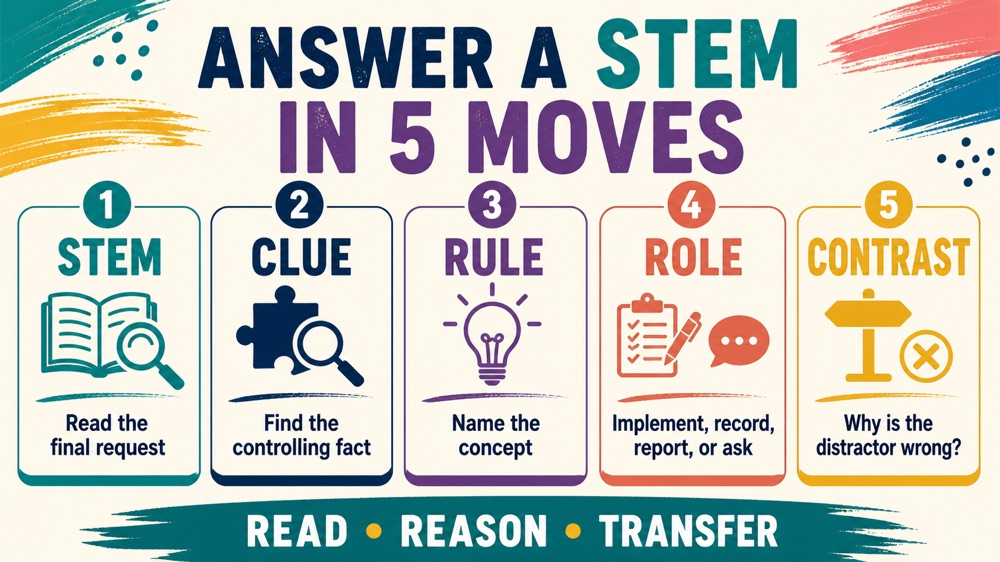
When two options both sound reasonable, use this sequence:
- Stem: read the question’s final request first, then read the full situation without guessing the topic.
- Clue: underline the observable action, measurement boundary, written-plan instruction, time relation, or ethical condition.
- Rule: name the concept or current task that fits that clue.
- Role: ask whether the answer says to implement, record, report, ask, or stop safely—or improperly asks the RBT to redesign or independently decide.
- Contrast: eliminate the nearest distractor and state the changed fact that would make it correct.
Do not add facts that the stem did not provide. A question may be testing whether you can follow a specified procedure, not whether you can invent a better one. Words such as “most appropriate,” “first,” “best,” “observable,” “according to the plan,” and “except” change the task.
Audit an answer explanation
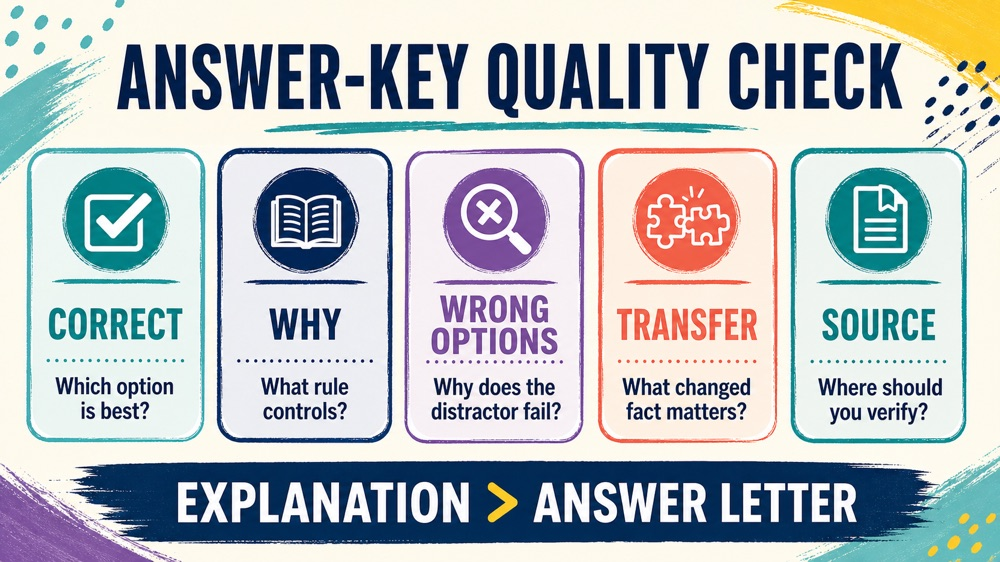
Use a five-field audit before you trust an answer key:
| Field | Required question | Example of a strong explanation |
|---|---|---|
| Correct | Which option is best? | “B, because the stem gives an onset and offset for the behavior.” |
| Why | What rule makes it best? | “Duration records how long the behavior occurs.” |
| Wrong options | Why is the nearest alternative not supported? | “Latency measures delay before the response begins, not the response’s length.” |
| Transfer | What changed fact would change the answer? | “If the stem timed instruction-to-response delay, latency would fit.” |
| Source | Where should you verify the concept? | “Use the current TCO and the relevant training or supervisor material.” |
If an explanation says “A is correct because it is the definition” but never points to the stem, mark it for review. If a question conflicts with the written client plan, do not let a generic internet answer override the plan. In practice, ask the responsible supervisor; in study, record the conflict rather than forcing a memorized answer.
Map questions to six domains
Tag every miss and low-confidence correct answer to the current TCO:
| Domain | Tasks | Question patterns |
|---|---|---|
| A. Data Collection and Graphing | A.1–A.8 | Definitions, measurement selection, calculations, data entry, graphs, and trends. |
| B. Behavior Assessment | B.1–B.3 | Preference or skill assessment steps, ABC information, and role limits in functional assessment. |
| C. Behavior Acquisition | C.1–C.11 | Teaching procedures, prompting, reinforcement, chaining, shaping, discrimination, generalization, and maintenance. |
| D. Behavior Reduction | D.1–D.7 | Antecedents, assigned reduction procedures, differential reinforcement, safety, and reporting. |
| E. Documentation and Reporting | E.1–E.4 | Objective notes, data communication, privacy, and timely escalation. |
| F. Ethics | F.1–F.10 | Supervision, competence, boundaries, dignity, confidentiality, cultural humility, and self-reporting. |
Use domain tags to choose the next action, not to create a false precision score. A missed measurement question may reflect a definition gap, a calculation error, or failure to read the unit. Those require different repairs.
Original RBT exam question examples
The following examples are newly written for this guide. They are not official, recalled, leaked, or BACB-endorsed questions.
- Domain A — measurement: A learner begins crying after a demand and stops 45 seconds later. The RBT starts the timer at crying onset and stops it when crying ends. Best answer: duration recording. The onset and offset define the interval. If the stem asked for time from the demand to crying onset, latency would be the nearest contrast.
- Domain B — assessment: The BCBA gives the RBT a written paired-choice preference-assessment procedure. Best answer: follow the written presentation and recording steps. Selecting a different assessment method independently is a clinical decision outside the described implementation role.
- Domain C — acquisition: A teaching plan says to wait three seconds before using the next prompt level. Best answer: follow the wait and prompt sequence. Prompting immediately may change the procedure and the data. If the plan explicitly changed the wait, the answer would follow the updated instruction.
- Domain D — reduction: A safety plan specifies what to do when behavior escalates. Best answer: follow the written safety procedure, protect the client, document observable facts, and notify the supervisor. Inventing a new consequence because it “worked once” is not plan fidelity.
- Domain E — documentation: A note says, “The client was manipulative and had a bad session.” Best answer: replace labels with observable actions, context, data, procedures, and communication. A changed fact such as “the supervisor requests a brief note” does not make subjective labels objective.
- Domain F — ethics: A friend asks the RBT to share a recognizable story about a client. Best answer: protect confidentiality and decline to share identifiable information. A casual setting does not remove privacy obligations.
- Mixed reasoning: A practice site says its answer is “the real exam answer.” Best answer: treat the claim as a warning, use official BACB sources for exam facts, and study original content. A page’s branding cannot authenticate secure examination content.
- Supervision: The RBT is unsure whether a procedure is still current after a plan change. Best answer: pause the uncertain decision as appropriate, follow the authorized direction, and ask the supervisor. “Do whatever seems fastest” ignores role and client-specific context.
For each example, write the answer in your own words, identify one distractor, and create a changed-fact version. That third step catches recognition without understanding.
Turn wrong answers into a correction log
A correction log should preserve the reasoning, not just the percentage:
| Column | What to write |
|---|---|
| Item and condition | Question ID, date, timed or untimed, open or closed book. |
| Domain and task | Current A–F domain and the closest task pattern. |
| Your answer | What you chose and how confident you were. |
| Controlling clue | The exact stem fact that should control the decision. |
| Rule and contrast | Why the correct answer fits and the nearest distractor fails. |
| Changed fact | One revised condition and the answer it would produce. |
| Next action | Read a source, redo a calculation, ask a supervisor, or retest later. |
Review low-confidence correct answers as well as wrong answers. A lucky answer with a weak explanation is not mastery. Also check for repeated items, copied answer patterns, outdated domain names, and explanations that conflict with current BACB material.
Choose the right practice format
| Format | Best use | What it cannot tell you |
|---|---|---|
| 10–20 original questions | Find one concept gap quickly. | Full endurance or balanced domain coverage. |
| Domain quiz | Repair a repeated task pattern. | Mixed-domain switching and pacing. |
| 75-question set | Review the scored-question count as a study format. | Official score or certification readiness. |
| 85-question timed simulation | Rehearse the presented-item and 90-minute condition. | Prediction of secure questions or a passing result. |
| Study mode with explanations | Learn the rule immediately after responding. | Unaided retrieval under test conditions. |
Use study mode first when the concept is new. Use timed mixed practice later, then spend at least as much time reviewing the explanations as selecting answers. More questions are not automatically better questions.
Use a seven-day answer-review plan
- Day 1: take a short mixed diagnostic; record confidence and domain, not just total correct.
- Day 2: repair the highest-frequency concept error using current study materials.
- Day 3: practice a second domain and write a changed-fact version for each miss.
- Day 4: review documentation, ethics, supervision, and role-boundary contrasts.
- Day 5: run a timed mixed set; flag uncertain items and protect pacing.
- Day 6: audit the answer explanations and correct the correction log.
- Day 7: retest only the repaired patterns with fresh wording; do not inflate confidence by repeating the same items.
Keep your study claims accurate. An improved practice result shows that performance changed under that resource and condition. It does not prove eligibility, certification, or a future exam outcome. No independent resource can guarantee certification or a passing result.
Bottom line: choose RBT exam questions and answers that are current, original, scenario-based, role-safe, and explained at the level of the controlling clue. Verify official facts with the BACB, map errors to the six-domain TCO, contrast the nearest distractor, and retest a changed fact. That process builds understanding more reliably than collecting answer letters.
Ready to review your next RBT question set?
Practice original scenarios, read the explanation behind every answer, and use the correction loop to choose what to study next.
Try Free RBT Mock Exams →
Frequently Asked Questions
Where can I find reliable RBT exam questions and answers?
Use original independent practice content for study, but verify current exam facts with the BACB RBT Test Content Outline, 3rd edition, and RBT Handbook. No third-party answer bank is official BACB examination content.
How many questions should an RBT practice set have?
A short diagnostic, a 75-question scored-length set, and an 85-question presented-length simulation can serve different purposes. The current exam context includes 75 scored and 10 unscored pilot questions, but a provider’s count does not create an official score.
Should I read the answer before attempting the question?
Try the question first, record your confidence, then read the explanation. Explain the controlling clue and nearest distractor before moving on.
What makes an answer explanation useful?
It identifies the correct option, links it to evidence in the stem, explains why the nearest distractor fails, shows a changed-fact transfer, and points you to an appropriate current source or study rule.
Are online RBT exam questions real or leaked?
Responsible independent resources should use original questions. Do not seek recalled or leaked secure examination content, and do not treat “real” or “exact” marketing language as proof.
Can practice answers guarantee that I will pass?
No. A practice result can guide study, but no independent question bank, course, score, or answer key can guarantee certification or a passing result.
References
- Behavior Analyst Certification Board. RBT Test Content Outline, 3rd edition.
- Behavior Analyst Certification Board. RBT Test Content Outline, 3rd-edition PDF.
- Behavior Analyst Certification Board. RBT Handbook.
- Behavior Analyst Certification Board. RBT examination resources.
- RBT Hub practice-question categories. Reviewed for competitor research; not an endorsement.
- CertifiedRBT practice set. Reviewed for competitor research; not an endorsement.
- RBTPracticeExame resource. Reviewed for competitor research; not an endorsement.
- MyRBTPrep practice resource. Reviewed for competitor research; not an endorsement.