

Is the RBT exam hard? It can feel challenging, but “hard” is not one fixed property of the exam or the candidate. The current test asks an entry-level behavior technician to apply concepts to new situations, read closely, manage a 90-minute window, and stay inside supervision and ethics boundaries.
Table of Contents
- Is the RBT exam hard? The short answer
- Is the RBT exam hard? Four factors that make it feel hard
- Use pass-rate data as context, not a prediction
- Measure readiness with six signals
- Prepare Domains A and B
- Prepare Domains C and D
- Prepare Domains E and F
- Practice original scenarios that feel difficult for the right reason
- Use a seven-day difficulty-reduction plan
- Use a calm test-day routine
- Frequently Asked Questions
- References
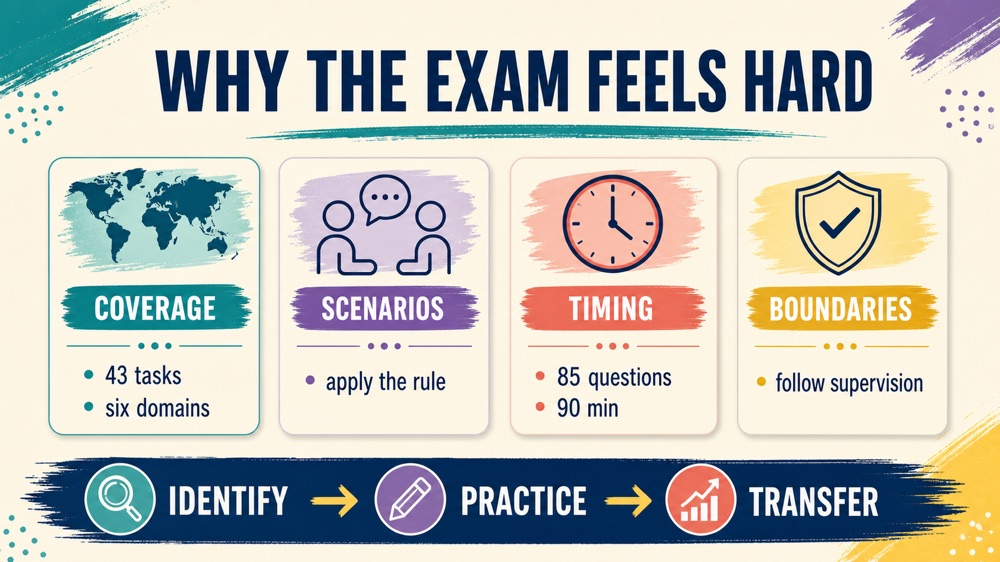
The current BACB frame is 85 multiple-choice questions, 75 scored questions, 10 unscored questions, four possible answers per question, and 90 minutes. The RBT Test Content Outline, 3rd edition, describes 43 tasks across six domains. That combination creates breadth and application demands, but it does not tell us how any individual candidate will perform.
This is independent educational content. RBT Training is not the BACB, is not a certification program, and is not affiliated with or endorsed by the BACB. Examples are newly written and are not official, recalled, leaked, or BACB-endorsed questions. No course, study guide, practice score, or employer can guarantee certification or a passing result.
Is the RBT exam hard? The short answer
The exam is neither automatically easy nor automatically difficult. It is usually most demanding when a learner has memorized vocabulary but has not practiced choosing the RBT-appropriate action in a new scenario. It may feel more manageable when the learner can identify observable details, connect them to a current task, reject the nearest distractor, and explain what to do if the plan is unclear.
| If this is weak | The exam may feel like | Train this |
|---|---|---|
| Definition only | Every option sounds familiar. | Use a new setting and a concrete nonexample. |
| Measurement | Simple data questions become slow calculations. | Choose the measure, calculate, and interpret the graph. |
| Plan fidelity | Two intervention options both sound helpful. | Find the written procedure and supervision boundary. |
| Documentation and ethics | The “nice” answer conflicts with the professional answer. | Practice pause, protect, and communicate decisions. |
| Pacing | One ambiguous stem consumes too much time. | Flag, move, and return after a first pass. |
So the useful answer to is the RBT exam hard is: it is hard in identifiable ways, and those ways can be practiced. Do not let a reassuring slogan or a frightening anecdote replace an evidence-based readiness check.
Is the RBT exam hard? Four factors that make it feel hard
1. The content is broad
The TCO contains 43 tasks across data collection and graphing, behavior assessment, behavior acquisition, behavior reduction, documentation and reporting, and ethics. You need enough range to recognize the task even when the setting changes from a clinic to a classroom, home, community, or telehealth context.
2. The questions are applied
A definition may be the starting point, but a stem can ask what the RBT should do first, what data to collect, which prompt to use, or when to contact the supervisor. The correct option often depends on one observable detail rather than the most impressive technical term.
3. The clock changes the experience
Eighty-five questions in 90 minutes is a timed computer-based task. The average is a little over one minute per question, but the exam includes time for the terms and conditions, navigation tutorial, load time, and review. Use pacing practice to avoid spending a full minute on a single confusing stem before you know the rest of the form.
4. Role boundaries matter
An answer can sound clinically sophisticated and still be wrong for an RBT if it independently changes treatment, announces function, reveals client information, or ignores a safety plan. The examination tests entry-level implementation under direction, not unsupervised clinical authority.
Use pass-rate data as context, not a prediction
The BACB publishes annual testing data, but a group pass rate cannot calculate your personal chance of passing. The latest annual report available in the research record lists 2025 RBT first-time and retake results separately. Training-provider pass rates also vary by provider, cohort, selection, and testing context. Those figures can show that outcomes vary; they cannot tell you that a particular mock score guarantees your result.
Be careful with claims such as “the exam is easy because most people pass” or “the exam is impossible because someone failed.” Both statements erase the candidate’s preparation, training, language, test conditions, and prior experience. Use official rates to understand population-level context and use your own error log to make study decisions.
A better question is: Which type of decision do I miss repeatedly, and can I explain the correct action in a new context? That question produces a useful next step.
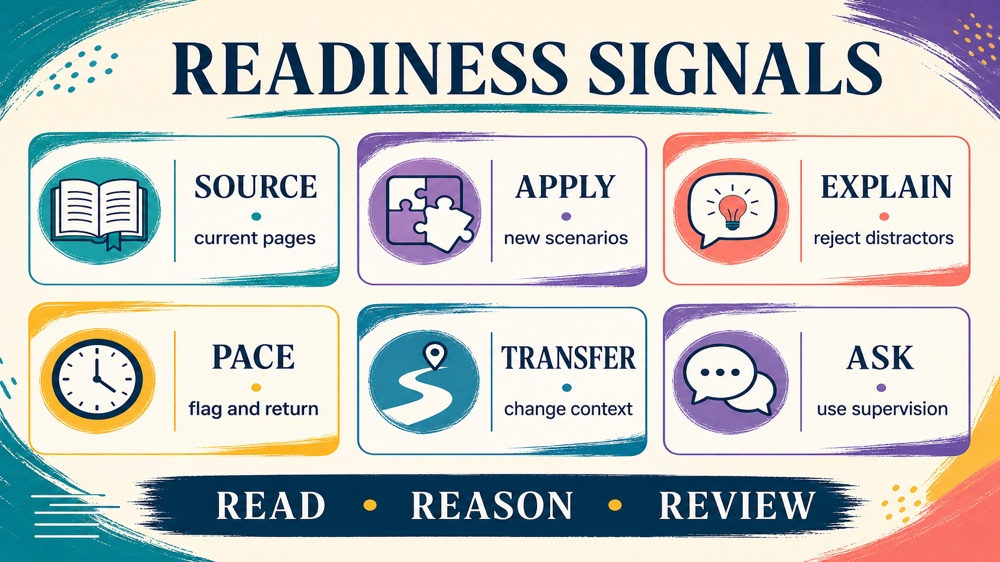
Measure readiness with six signals
| Signal | Ready evidence | Not ready yet |
|---|---|---|
| Source | You can find the current Handbook and TCO and know what each controls. | You rely on a screenshot, old PDF, or unnamed “official” summary. |
| Apply | You choose a role-appropriate action in a new scenario. | You recognize terms but cannot decide what happens next. |
| Explain | You state the rule and reject the nearest distractor. | You remember only an answer letter. |
| Pace | You complete mixed practice with time to review. | You spend all your time on the first difficult items. |
| Transfer | You solve the same rule in a new setting or behavior. | You need the original wording to get it right. |
| Ask | You know when to follow the plan and contact supervision. | You choose independent treatment changes to appear decisive. |
Use these signals instead of an arbitrary “ready” percentage. A score is useful only when you know what it measures and what you do next.
Prepare Domains A and B
Domain A: practice frequency, rate, duration, latency, IRT, discontinuous measurement, permanent product, operational definitions, graphs, and data quality. Ask what the measure records and what it cannot prove. If staff changed the measurement system, check fidelity before declaring a behavior change.
Domain B: practice preference and skill assessment participation, descriptive ABC information, and the RBT’s interpretation limit. The RBT can follow the procedure, collect data, and report observations. The RBT should not independently diagnose, announce a function, or redesign the assessment.
For example: a learner selects one of two items, and the stem asks what to record. Focus on the selection under the stated procedure; do not claim that the item is a reinforcer in all contexts without further evidence.
Prepare Domains C and D
Domain C: identify the instruction, response, prompt, consequence, fading, chaining, discrimination, reinforcement, shaping, token system, and generalization step. Reinforcement is defined by its effect on future responding, not by whether the consequence feels like a reward.
Domain D: identify the likely function from the provided information and follow the written intervention and safety plan. Distinguish antecedent interventions, differential reinforcement, extinction, punishment effects, crisis procedures, extinction burst, and resurgence. Do not select a new procedure merely because it sounds more powerful.
The applied difficulty in these domains often comes from two plausible answers. Choose the one that uses the facts, preserves procedural integrity, and stays within the RBT’s role.
Prepare Domains E and F
Domain E: write objective, timely notes and report variables that may affect progress, including illness, medication changes, schedule changes, caregiver concerns, and data irregularities when required by the procedure. Replace “bad session” with observable information.
Domain F: protect confidentiality, dignity, competence, supervision, public statements, relationships, gifts, and cultural responsiveness. Ask whether the option preserves the client relationship and uses the correct reporting channel.
For example: a neighbor asks whether a child you saw at a store is a client. The hard part is not knowing a definition; it is choosing not to confirm or deny the relationship even when a friendly answer feels natural.
Practice original scenarios that feel difficult for the right reason
These examples are newly written for this article and are not official examination questions:
- Data: A rate looks higher after a session becomes shorter. Best reasoning: inspect the time unit and compare rate rather than raw frequency.
- Assessment: A response follows a demand once. Best reasoning: record the sequence and seek supervisor interpretation rather than independently declaring escape function.
- Acquisition: A plan says to fade prompts, but a technician gives the same full prompt every trial. Best reasoning: follow the prompt-fading plan and report the concern.
- Reduction: A response temporarily increases after extinction starts. Best reasoning: recognize a possible burst, follow the written and safety plan, and communicate.
- Documentation: A medication change is reported before session. Best reasoning: document and report the variable according to procedure.
- Ethics: A parent asks for a screenshot of another client’s graph. Best reasoning: protect confidentiality and decline through the correct channel.
- Pacing: Two options remain plausible after careful reading. Best reasoning: mark the item, move to the next, and return after completing the first pass.
Use a seven-day difficulty-reduction plan
- Day 1: read the current Handbook and TCO; make the six-domain map.
- Day 2: complete Domain A practice and log measurement or graph errors.
- Day 3: complete Domain B and C practice; write role-boundary rationales.
- Day 4: complete Domain D practice; review function, differential reinforcement, extinction, and safety.
- Day 5: complete Domain E and F practice; review documentation, privacy, supervision, and ethics.
- Day 6: complete an untimed mixed set, then rewrite every miss as a transfer scenario.
- Day 7: complete a timed 85-question practice session and review pacing, guesses, and errors.
Do not repeat the same mock exam until the score rises. That can measure memory of the items rather than understanding. Use a new set, a changed context, or a new explanation prompt.
Use a calm test-day routine
- Read the current appointment and identification instructions before leaving.
- Do not bring prohibited materials into the testing room; follow the current Handbook and Pearson VUE instructions.
- Use the first pass to answer clear items and flag items that need more thought.
- When two options seem plausible, return to the observable fact, written plan, and RBT role.
- Do not assume a strange-looking item is unscored; treat every item as examination content.
- Use the remaining time for review rather than changing answers without a reason.
Bottom line: asking “is the RBT exam hard” is reasonable, but the answer becomes useful only after you name the source of difficulty. Train breadth, applied reasoning, pacing, transfer, and supervision judgment; use official current materials and original practice; and evaluate progress through an error log rather than a guarantee.
Turn exam anxiety into a next study step
Use original practice, six-domain review, and clear explanations to identify what to work on next.
Try Free RBT Practice Questions →
Frequently Asked Questions
Is the RBT exam hard for everyone?
No. Difficulty varies with prior training, familiarity with applied behavior-analytic concepts, test-taking experience, language, pacing, and the ability to apply a rule in a new scenario. No article can predict an individual result.
What makes the RBT exam feel difficult?
The main factors are broad six-domain coverage, applied scenarios with plausible distractors, a 90-minute window, and questions that test supervision, documentation, ethics, and plan fidelity.
How can I know whether I am ready?
Check whether you can find current sources, apply concepts in new scenarios, explain distractors, complete mixed practice with time to review, transfer a rule, and recognize when to ask for supervision.
Does the pass rate show whether I will pass?
No. Official annual pass rates are group-level context and may separate first attempts from retakes. They cannot calculate your personal probability or replace an error-based readiness review.
Should I memorize the 10 unscored questions?
No. Candidates should treat every examination item as content and should not try to identify or discuss unscored items. Use the official format only to practice pacing.
Can a mock exam guarantee that the real exam will be easy?
No. A mock exam can build familiarity and reveal weak concepts, but no mock score, course, study guide, or provider can guarantee a passing result.
References
- Behavior Analyst Certification Board. RBT Handbook.
- Behavior Analyst Certification Board. Examination Information.
- Behavior Analyst Certification Board. RBT Test Content Outline (3rd ed.).
- Behavior Analyst Certification Board. RBT 3rd-Edition Test Content Outline PDF.
- Behavior Analyst Certification Board. Annual Data Report.
- Behavior Analyst Certification Board. RBT resources.
- RBT Practice Test exam questions explainer. Reviewed for competitor research; not an endorsement.
- True Progress Therapy difficulty article. Reviewed for competitor research; not an endorsement.
- RBT Practice Exam structure explainer. Reviewed for competitor research; not an endorsement.