

RBT competency is the practical demonstration step in the current RBT certification route. It asks an assessor to observe whether you can perform the tasks on the Initial Competency Assessment, not merely recognize a definition on a multiple-choice quiz.
Table of Contents
- RBT competency assessment versus the written RBT exam
- RBT competency: current 2026 rules to verify first
- Who can conduct an RBT competency assessment?
- What the 19 RBT competency tasks cover
- How to prepare for RBT competency without memorizing a script
- What happens when a task is not yet competent?
- Use this pre-submission RBT competency checklist
- Follow the RBT competency timeline to the written exam
- Connect RBT competency to the six-domain exam map
- Frequently Asked Questions
- References
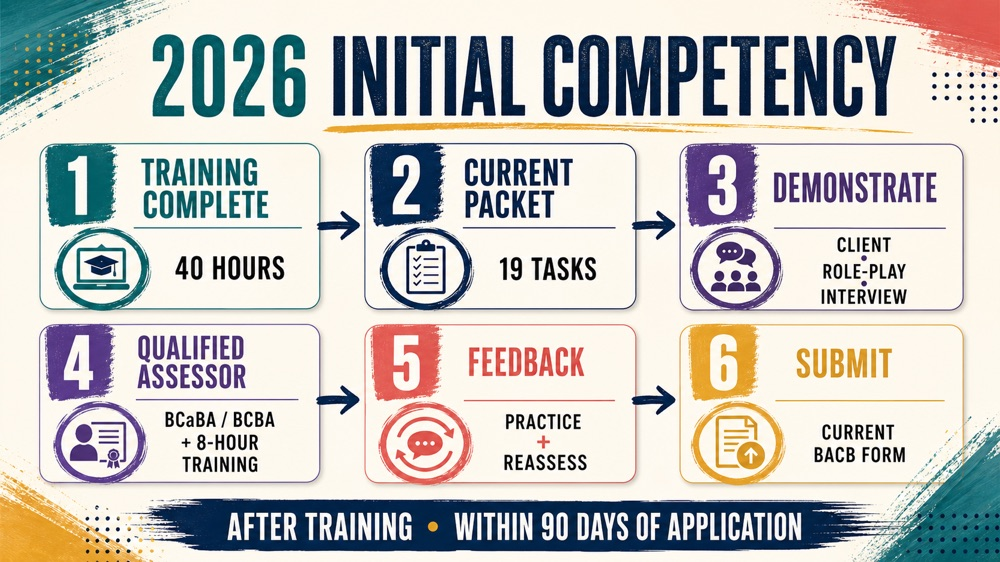
For applicants under the 2026 requirements, the current packet is effective January 1, 2026. The Initial Competency Assessment is completed after the 40-hour training and no more than 90 days before the RBT certification application. The current form contains 19 task items, and the completed BACB form must be submitted with the application. The written RBT examination is a separate later gate.
This is independent educational content. RBT Training is not the BACB, is not a certification program, and is not affiliated with or endorsed by the BACB. Examples below are newly written and are not official, recalled, leaked, or BACB-endorsed questions. No training course, assessor, study guide, or practice score can guarantee certification or a passing result.
RBT competency assessment versus the written RBT exam
Both steps matter, but they measure different performances. Confusing them can lead a candidate to study the wrong way or schedule the wrong step.
| Question | Initial competency assessment | Written RBT examination |
|---|---|---|
| What is observed? | Whether you can perform the listed technician tasks competently. | Whether you can select the best answer to current exam questions. |
| When? | After the 40-hour training and within the application timing window. | After the application is approved and you receive authorization to test. |
| How? | Client, role-play, or live interview as allowed by each task in the packet. | Computer-based multiple-choice examination through the current testing process. |
| What is submitted? | The completed current BACB assessment form with initials and final attestation. | The examination result is reported through the testing and certification process. |
| What should practice look like? | Rehearse the action, communication, documentation, safety, and escalation. | Practice concepts, scenarios, distractor analysis, pacing, and exam security. |
A strong practice-question score does not complete the competency assessment. Conversely, performing a skill once does not replace study for the written exam. Treat them as connected but separate evidence.
RBT competency: current 2026 rules to verify first
Use the current BACB Initial Competency Assessment Packet as the controlling document. The following summary is a navigation aid:
- Training first: complete the qualifying 40-hour training before beginning the Initial Competency Assessment.
- Timing: complete the assessment no more than 90 days before submitting the RBT certification application.
- All 19 items: every task item on the current form must be completed competently, and the document must be complete for consideration.
- Allowed formats: the packet allows one or more sessions and describes in-person, live internet, and recorded video created specifically for the assessment; each task still has its own allowed assessment types.
- Client demonstrations: three tasks in the Skill Acquisition and Behavior Reduction section must be demonstrated with a client.
- Current form: non-BACB forms will not be accepted with the application.
- Corrective feedback: when competence is not demonstrated, the assessor may provide feedback and reassess on another day; corrective feedback cannot be delivered on the final assessment of a task.
- Records: the responsible assessor maintains assessment documentation according to the current packet, including a minimum seven-year retention statement.
Because requirements can be updated, check the live BACB page and download the packet again before scheduling. An old PDF in a folder, a screenshot from a training group, or an unlabeled “2026 form” from a template site is not enough evidence.
Who can conduct an RBT competency assessment?
The responsible assessor must be an active BCaBA or BCBA who has completed the required 8-hour supervision training. The assessor must have the relationship required by the current packet with the applicant and the client organization. The assessor and any assistant assessor cannot be related to, subordinate to, or employed by the applicant during the assessment. The official packet also permits the assessor to be the person who delivered the 40-hour training, provided the other requirements are met.
A responsible assessor may delegate portions to an assistant assessor who has demonstrated proficiency and holds an active RBT certification or higher. The responsible assessor remains responsible for quality, the final signature, and the records. If a BCaBA or RBT is involved, the supervision and organization relationship must still meet the current packet.
| Before you schedule | Evidence to request | Red flag |
|---|---|---|
| Credential and training | Assessor certification status and completed supervision training. | “Anyone who has worked in ABA can sign.” |
| Organization relationship | Shared organization or contract relationship involving the client services. | A detached online signer who has no permitted relationship. |
| Assessment version | Current BACB packet effective for your application date. | A form with no version or an old Task List reference. |
| Quality process | Instructions for tasks, feedback, assistant oversight, and final signature. | A promise to initial every box without observing performance. |
What the 19 RBT competency tasks cover
The current form groups the 19 tasks into four practical sections. Study the section as a performance system, not as a list of words:
| Section | Task range | Performance focus |
|---|---|---|
| Measurement | 1–3 | Implement continuous measurement, implement discontinuous measurement, and enter data or update graphs. |
| Assessment | 4–5 | Conduct preference assessments and collect ABC data according to the procedure. |
| Skill Acquisition and Behavior Reduction | 6–14 | Implement teaching, prompting, chaining, shaping, discrimination, token systems, crisis or emergency procedures, and the selected intervention category. |
| Professionalism and Requirements | 15–19 | Write objective session notes, protect dignity, maintain boundaries, describe supervision standards, and identify when to seek clinical direction. |
The list shows why “knowing the terms” is not enough. A candidate may define latency but still start the timer at the wrong event. A candidate may describe differential reinforcement but fail to follow the written schedule. A candidate may write a detailed note that includes a private client detail that does not belong in the record. Practice the action and the boundary.
How to prepare for RBT competency without memorizing a script
Begin with the current packet and your 40-hour training materials. For each task, write four short prompts:
- Set-up: What materials, data sheet, client readiness, or role-play arrangement does the procedure require?
- Action: What do I do, say, record, or implement?
- Decision point: What would make me pause, follow the plan, or contact the supervisor?
- Documentation: What objective evidence or form field must be completed afterward?
Original practice example: the assessment asks you to implement a continuous measurement procedure. Do not recite “frequency, duration, latency, and IRT” and stop. Identify the behavior’s operational definition, the start and stop or count rule, the observation window, the timing device, and the data entry. If the definition is ambiguous, explain that you would clarify it before collecting data rather than inventing a rule.
Another example: the assessor asks about clinical direction. A strong response names a situation such as a safety concern, an unclear treatment change, an unexpected medical or medication variable, or a data pattern that may require plan review. It also names the correct next action: follow the immediate safety protocol, preserve the objective record, and contact the supervisor through the required channel.
Practice with role-play, but do not turn the role-play into a memorized performance that falls apart when the setting changes. Ask the trainer to vary the materials, activity, prompt, or client response while keeping the procedure constant. The goal is accurate, safe, plan-aligned performance.
What happens when a task is not yet competent?
The current packet describes a feedback-and-reassessment path. If you do not demonstrate a task competently, the assessor may give corrective feedback and assess the task on another day. The process repeats until competence is demonstrated, and the final assessment of that task cannot include corrective feedback delivered during the final attempt.
This is different from a written exam score. The packet is not described as an 80% quiz with a universal pass percentage. The responsible assessor initials the task after observing competent performance, marks the assessment type, and signs the final attestation after all tasks are completed. Ask the assessor what needs to be practiced, document the feedback, and schedule a legitimate reassessment.
Do not ask for a signature to “get the application moving” if the skill was not observed. A signature represents an attestation. Do not conceal the need for correction by switching to an easier client or changing the program without authorization. Correct the skill under direction.
Use this pre-submission RBT competency checklist
- Version: I downloaded the current BACB Initial Competency Assessment Packet and checked its effective date.
- Training: My qualifying 40-hour training was completed before the assessment and its certificate matches the current route.
- Assessor: The responsible assessor and assistant assessors meet the current credential, supervision, organization, and relationship rules.
- Tasks: All 19 task items are completed, with the required assessment type marked for each one.
- Client work: Three tasks in the Skill Acquisition and Behavior Reduction section were demonstrated with a client as required.
- Evidence: The assessor actually observed competent performance and gave feedback before, not during, the final assessment attempt.
- Form: Applicant name, BACB ID, organization fields, initials, assessor information, signature, and date are complete.
- Timing: The assessment is after training and within 90 days before the application submission.
- Privacy: Client information and any assessment recordings are handled under the applicable organization and BACB requirements.
- Application: I will submit the completed current BACB form with the certification application rather than a template copy.
If any item is uncertain, pause and ask the responsible assessor or consult the live BACB resource. A generic blog checklist cannot override the packet.
Follow the RBT competency timeline to the written exam
| Stage | Candidate action | Evidence |
|---|---|---|
| 1. Current requirements | Read the Handbook, transition guidance, training requirements, and assessment packet. | Versioned source log. |
| 2. 40-hour training | Complete qualifying training and retain the certificate. | Completion record and required statement. |
| 3. Competency assessment | Demonstrate all current tasks with the permitted assessor and formats. | Completed current BACB assessment form. |
| 4. Application | Submit the form and other documents within the current timing windows. | Portal receipt and correspondence. |
| 5. Authorization | Wait for the application determination and respond to corrections. | Current authorization. |
| 6. Exam preparation | Study the 3rd-edition TCO, practice original scenarios, and follow exam rules. | Error log and pacing practice. |
| 7. Supervised role | Follow supervision and scope requirements after certification. | Supervisor relationship and required records. |
The 2026 transition also distinguishes initial assessment for new applicants from recertification processes for people who are already certified. A current RBT’s renewal path may use different transition rules and future professional-development requirements. Do not use a recertification packet for an initial application; check the current BACB guidance for your status.
Connect RBT competency to the six-domain exam map
The Initial Competency Assessment and the written exam overlap in concepts but not in format. The current TCO describes 43 tasks across six domains:
| Domain | Exam study connection | Competency performance connection |
|---|---|---|
| A. Data Collection and Graphing | Choose measures, read data, and identify graphing decisions. | Implement continuous or discontinuous measurement and enter data or update graphs. |
| B. Behavior Assessment | Recognize preference and ABC assessment procedures. | Conduct preference assessments and collect ABC data under direction. |
| C. Behavior Acquisition | Apply teaching, prompting, chaining, shaping, discrimination, and reinforcement concepts. | Implement the assigned teaching procedures accurately. |
| D. Behavior Reduction | Identify plan fidelity, function-informed procedures, safety, and escalation. | Implement the written reduction or crisis procedure and seek direction when needed. |
| E. Documentation and Reporting | Choose objective notes and appropriate communication. | Generate objective session notes and communicate required information. |
| F. Ethics | Protect privacy, dignity, boundaries, and supervision. | Provide dignity and boundary examples and describe when to seek clinical direction. |
The exam has 85 multiple-choice questions, 75 scored questions, 10 unscored questions, four possible answers per question, and 90 minutes. Those facts help with exam planning; they do not change the hands-on evidence required by the competency packet.
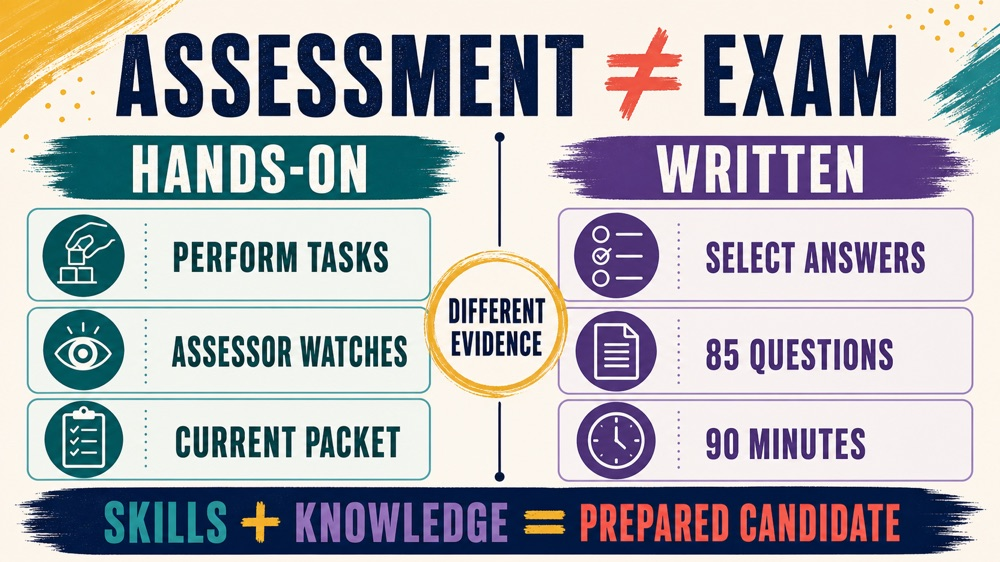
Bottom line: RBT competency is demonstrated performance under the current Initial Competency Assessment, not a formality and not the same thing as the written exam. Use the current packet, verify the assessor relationship, practice the action and the boundary, document every task accurately, and ask for supervision when the plan is unclear.
Strengthen your RBT competency preparation
Use original scenarios to connect current exam concepts with the actions, data, and boundaries an RBT must demonstrate.
Try Free RBT Practice Questions →
Frequently Asked Questions
What is RBT competency?
RBT competency is the demonstrated ability to perform the tasks on the current Initial Competency Assessment. It is a hands-on, role-play, or interview-based evaluation according to the assessment packet, not merely a written quiz.
How many tasks are on the 2026 Initial Competency Assessment?
The current packet effective January 1, 2026, contains 19 task items. All items must be completed competently, and the completed current BACB form must be submitted with the certification application.
When is the RBT competency assessment completed?
Complete it after the qualifying 40-hour training and no more than 90 days before submitting the RBT certification application. Verify the current packet and timing guidance before scheduling.
Is the RBT competency assessment the same as the exam?
No. The competency assessment observes practical performance, while the RBT examination is a later multiple-choice test. You need both forms of preparation.
Can an online quiz replace the competency assessment?
No. A practice quiz can help you study, but it does not replace the current BACB Initial Competency Assessment or the observation and attestation requirements.
What if I do not demonstrate a task?
The current packet allows corrective feedback and reassessment on another day until competence is demonstrated, with no corrective feedback delivered during the final assessment of a task. Follow the assessor’s process and do not request an unsupported signature.
References
- Behavior Analyst Certification Board. RBT Initial Competency Assessment Packet: Effective January 1, 2026.
- Behavior Analyst Certification Board. Guidance for Meeting RBT Requirements During the 2026 Transition.
- Behavior Analyst Certification Board. RBT Handbook.
- Behavior Analyst Certification Board. Examination Information.
- Behavior Analyst Certification Board. RBT Test Content Outline (3rd ed.).
- Behavior Analyst Certification Board. RBT examination resources.
- RBT Hub competency assessment guide. Reviewed for competitor research; not an endorsement.
- ABA Degree competency assessment guide. Reviewed for competitor research; not an endorsement.
- TherapyLake competency assessment guide. Reviewed for competitor research; not an endorsement.