
Functional communication training ABA examples are easiest to understand when you read them as small plan maps, not as universal scripts. A functional communication training (FCT) plan teaches a recognizable communication response that serves the same functional class of reinforcement as the behavior it is intended to replace.
Table of Contents
- Functional communication training ABA examples: how to read the plan
- Functional communication training ABA examples: asking for a break
- Functional communication training ABA examples: asking for attention or help
- Functional communication training ABA examples: requesting a tangible or activity
- Functional communication training ABA examples: requesting interaction or sensory access
- How prompting and reinforcement fit into FCT
- How to collect data for functional communication training
- How to plan generalization and maintenance
- RBT boundaries and safety in FCT examples
- Map functional communication training to the six RBT domains
- Frequently Asked Questions
- References
For an RBT, the important questions are: What function was identified? What response form is written? What prompt should be used? What consequence follows the communication? What data are recorded? When should the RBT stop, protect safety, or contact the supervisor? The answer is not simply “teach the child to ask nicely.”
For example: if a learner throws materials during a difficult task and the written plan teaches a break card, the RBT records whether the learner uses the card independently or after a prompt and follows the planned break consequence; the RBT does not infer function from the throw alone.
The current RBT examination is based on the RBT Test Content Outline, 3rd edition, which describes 43 tasks across six domains. It has 85 multiple-choice questions, including 75 scored questions and 10 unscored questions, four possible answers per question, and 90 minutes. The examples below are newly written for study and are not official, recalled, leaked, or BACB-endorsed questions.
This is independent educational content. RBT Training is not the BACB, is not a certification program, and is not affiliated with or endorsed by the BACB. FCT is individualized and should be implemented under a qualified supervisor’s written plan. No article, example, course, or study guide can guarantee certification, treatment success, or a passing result.
Functional communication training ABA examples: how to read the plan
Use this seven-part map for every example:
| Plan part | Question to ask | What not to assume |
|---|---|---|
| Function | What consequence or outcome has the assessment identified as maintaining the behavior? | One event proves a function. |
| Communication response | What vocal, sign, gesture, picture, device, or other recognizable response is taught? | Speech is the only valid communication form. |
| Antecedent | When and under what motivation or context is the response practiced? | The same cue works in every setting. |
| Prompt | What least-to-most, most-to-least, model, or other prompt procedure is written? | Any prompt level is acceptable. |
| Reinforcement | What consequence follows an independent or prompted communication response? | A generic sticker or praise always serves the identified function. |
| Data | What independent, prompted, problem-behavior, latency, or delay data are collected? | A decrease in behavior alone proves communication improved. |
| Generalization and safety | How will the response work with people, places, activities, and risk levels that the plan names? | The RBT should improvise across settings or unsafe moments. |
Research reviews describe FCT as a function-based treatment, and the evidence base is substantial for efficacy. Reviews also caution that effectiveness in natural home, school, and community contexts, feasibility, social validity, maintenance, and generalization require careful attention. That is why a short example is a study illustration, not a ready-to-run treatment package.
Functional communication training ABA examples: asking for a break
Study scenario: a written plan identifies escape from a difficult task as the maintaining outcome. The plan teaches the learner to hand over a “break” card or activate a break symbol before leaving the work area.
| Component | Example reading |
|---|---|
| Antecedent | The RBT presents the planned task at the stated difficulty and gives the instructional cue. |
| Communication response | The learner hands over the break card or activates the written communication response. |
| Prompt | The RBT uses the prompt level and fading sequence written in the plan. |
| Reinforcement | The planned brief break follows the communication response, according to the written schedule. |
| Data | Record independent and prompted break requests, task attempts, latency, and target behavior as the plan specifies. |
| Boundary | Do not decide independently that every refusal means escape or lengthen the break because the session is difficult. |
The nearest distractor in an exam-style item may be “remove the task immediately after the problem behavior because the learner must need a break.” That answer skips the functional communication response and the written safety procedure. Another distractor may be “do not honor the request until the learner uses spoken words,” which confuses the response form with the function. Use the form of communication the plan teaches and the learner can access.
Functional communication training ABA examples: asking for attention or help
Study scenario: the assessment and plan identify adult attention as the relevant outcome. The learner is taught to tap a help card, raise a hand, press a device button, or say “help,” depending on the selected communication mode.
The RBT arranges a planned moment when attention is briefly unavailable, follows the prompt procedure, and provides the written attention consequence after the communication response. Data might distinguish independent requests, prompted requests, problem behavior, and the delay before the request. A session note should describe what occurred rather than writing “the learner wanted attention.”
Do not turn this into a rule that the adult must ignore every behavior in every situation. The plan may contain safety exceptions, different responses for different contexts, or a separate teaching procedure for waiting. If a learner engages in dangerous behavior, follow the crisis or safety protocol and contact supervision. Do not use an attention-withholding step from a generic internet example without authorization.
Exam reasoning: the best answer will usually preserve the communication response, the identified consequence, the prompting plan, and the RBT’s supervision boundary. “Give attention after any sound” may reinforce an unplanned response. “Withhold all attention for the rest of the session” may ignore the individualized plan and safety needs.
Functional communication training ABA examples: requesting a tangible or activity
Study scenario: the learner engages in grabbing when a preferred art material is visible. The plan teaches a point, picture exchange, sign, device response, or vocal request that the team has selected as a functional way to request access.
| What the example shows | What the RBT checks |
|---|---|
| The preferred item is visible but controlled by the adult. | The item and motivation arrangement match the plan. |
| The learner uses the communication response. | The RBT waits for or prompts the correct response as written. |
| Access follows the response. | The duration, amount, or schedule is the plan’s consequence, not an improvised reward. |
| Grabbing or aggression occurs. | The RBT follows the safety and behavior-reduction procedure and does not invent a consequence. |
Access to a tangible is not the same as handing over the item whenever the learner reaches. The instructional response must be observable and the consequence must be consistent with the written plan. If the learner uses a device or picture system, protect access to that communication mode; do not remove the device as a casual consequence.
Generalization could mean requesting a different item, asking a different adult, or using the same response during a community routine. The plan should state which change is being taught. A new setting is not permission for the RBT to change the response requirement.
Functional communication training ABA examples: requesting interaction or sensory access
Some plans teach communication for social interaction, movement, music, sensory materials, or another outcome identified by assessment. The example must still specify the response, the outcome, and the safety conditions.
Study scenario: during a play routine, the learner pushes materials away and then reaches toward a spinning toy. The plan teaches a “more,” “again,” or symbol response to request continuation. The RBT presents the opportunity, prompts as written, delivers the planned continuation, and records independent versus prompted requests. If the learner rejects the activity, the RBT follows the assent, choice, and safety procedures rather than forcing the response.
This example also illustrates why topography alone is not enough. Reaching may communicate many things depending on the context. Do not label the function from the movement alone. Read the assessment summary, the operational definition, and the supervisor’s plan.
How prompting and reinforcement fit into FCT
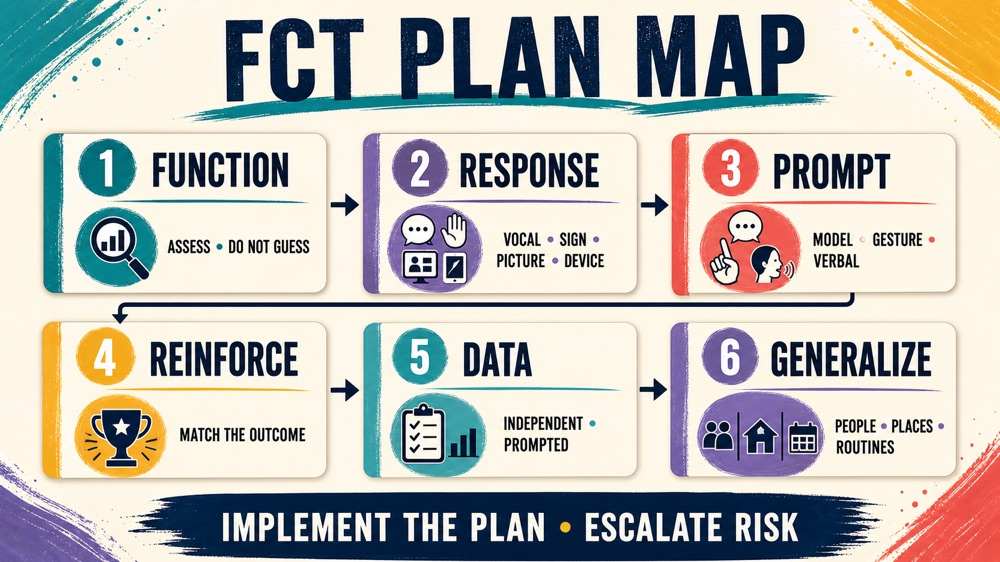
Functional communication training often uses prompts because the learner is being taught a new response. A prompt can be a model, gesture, verbal cue, visual cue, physical guidance, or another planned support. The exact type and fading sequence must come from the program.
- Arrange the opportunity: use the context and motivation condition in the plan.
- Allow the response: give the learner the stated opportunity to communicate.
- Prompt when specified: use the planned level rather than repeating an improvised demand.
- Reinforce the communication: deliver the functional outcome according to the plan.
- Record the result: note independent, prompted, incorrect, no response, and relevant problem behavior codes.
- Fade and generalize under direction: change prompts, delay, or setting only when the plan calls for it.
Reinforcement is not simply praise. In FCT, the functional outcome should match the class of reinforcement identified by the assessment, such as attention, a break, or access to an item. The plan may also use praise, tokens, or other programmed consequences. Do not substitute a preferred outcome because it is convenient.
Some FCT examples include extinction or delayed reinforcement. Those components can create risk, frustration, or escalation if applied without individualized assessment, safety planning, and supervision. The RBT implements the current written procedure; the RBT does not design a new extinction schedule from a blog post.
How to collect data for functional communication training
Choose data that tells the supervising team whether communication is becoming more independent and useful. Possible fields include:
| Data field | What it answers |
|---|---|
| Independent FCR count | How often did the learner use the communication response without a prompt? |
| Prompted FCR count and level | How much support was needed and is prompt dependence changing? |
| Problem-behavior count or duration | What happened to the target behavior under the plan? |
| Latency to FCR | How quickly did the learner communicate after the opportunity or cue? |
| Reinforcement delivery | Was the planned outcome delivered after the response and for the planned amount? |
| Context and generalization | Does the response occur with different people, places, materials, or routines? |
Original data example: across 12 planned opportunities, the learner independently uses “help” 5 times, uses it after a verbal prompt 4 times, and does not respond 3 times. Report those categories separately. “9 successful requests” would hide the prompt level, while “the learner improved” would add an interpretation without a comparison condition.
Also record variables the plan requires, such as task difficulty, available communication mode, interruptions, or safety events. If the communication device was unavailable, label the event; do not treat the session as an ordinary zero-response session.
How to plan generalization and maintenance
FCT is not complete when the learner uses a response with one therapist at one table. A generalization plan may change the person, setting, activity, materials, distance, communication mode, or delay. Maintenance checks whether the response remains available after the intensive teaching period changes.
- People: practice with the adults named in the plan, not a random new person without preparation.
- Places: move from the teaching table to the room, hallway, home, school, or community context when planned.
- Activities: use both easy and difficult routines while preserving the communication consequence.
- Modes: if the plan includes speech, sign, picture, or device responses, keep the response definitions clear.
- Delay: increase waiting only through the written schedule and with attention to problem-behavior and assent data.
- Maintenance: continue to record whether the learner can use the response after prompts and teaching density change.
Research reviews emphasize that generalization and maintenance deserve their own evidence. A response that works in a controlled teaching session may not work at snack time, during a transition, or with a new caregiver. That is a design and supervision question, not an RBT improvisation challenge.
RBT boundaries and safety in FCT examples
| RBT can do under direction | RBT should escalate rather than decide alone |
|---|---|
| Implement the written communication response and prompt sequence. | Infer a new function from one event or rewrite the assessment conclusion. |
| Deliver the planned consequence and record whether it occurred. | Change the reinforcer, delay, extinction component, or schedule without approval. |
| Use the named AAC, sign, picture, vocal, or gesture response. | Remove a communication device, force speech, or restrict access outside the plan. |
| Follow crisis and emergency procedures. | Continue a teaching trial when safety is deteriorating or the protocol is unclear. |
| Report objective data, caregiver information, and implementation barriers. | Promise a behavior reduction result or tell a family that one example will work for everyone. |
Communication is a meaningful skill, not only a replacement for problem behavior. Preserve dignity, choice, access to the communication system, and the learner’s right to pause or seek help within the plan. If an intervention conflicts with safety, consent, medical information, or the current written program, stop and contact the supervisor through the appropriate channel.
Map functional communication training to the six RBT domains
| Domain | FCT study question | Implementation boundary |
|---|---|---|
| A. Data Collection and Graphing | Which data show independent communication, prompts, target behavior, latency, and generalization? | Record the plan’s codes and time window accurately. |
| B. Behavior Assessment | What evidence identifies the relevant functional class and communication response? | Collect and report; do not independently declare function. |
| C. Behavior Acquisition | Which prompt, shaping, reinforcement, and generalization step teaches the FCR? | Follow the teaching and fading sequence. |
| D. Behavior Reduction | How does the plan address target behavior and safety while communication is taught? | Implement the written procedure and escalate risk. |
| E. Documentation and Reporting | What objective event, communication, consequence, and variable belong in the note? | Use observable language and required channels. |
| F. Ethics | Does the response preserve dignity, privacy, competence, and supervision? | Do not force, improvise, or disclose protected information. |
The six-domain map is useful for exam study, but the examples here are not official test items. Practice identifying the nearest distractor: a function guess, an unplanned prompt, an incorrect reinforcer, a scope violation, or an unsafe continuation.
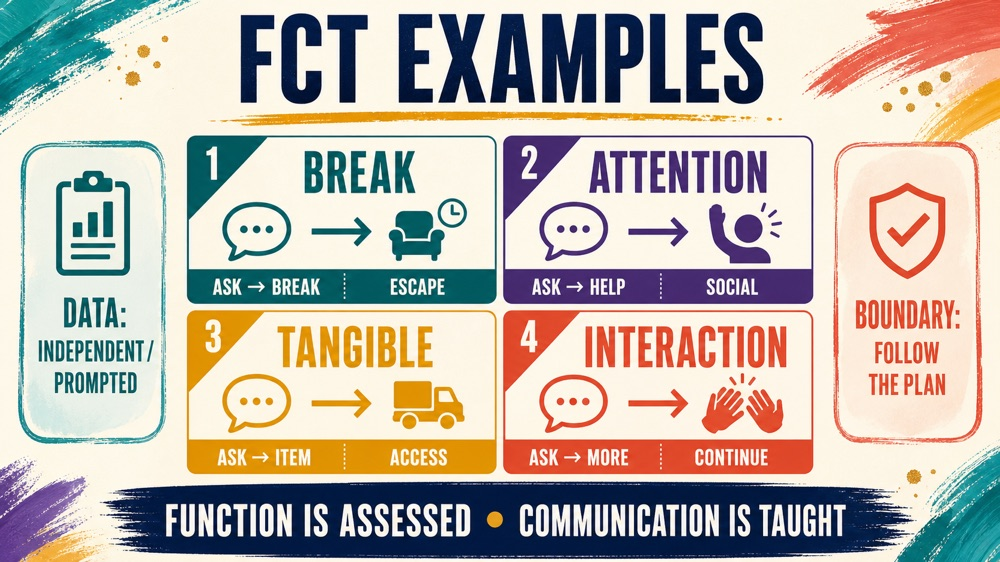
Bottom line: the best functional communication training ABA examples show a function-based communication response, a written prompt and reinforcement plan, observable data, generalization, and a safety boundary. Use examples to learn how to read and implement a plan; do not use a generic example to diagnose function or change treatment.
Practice function-based RBT reasoning
Use original scenarios to connect communication, reinforcement, data, and supervision boundaries.
Try Free RBT Practice Questions →
Frequently Asked Questions
What is functional communication training?
Functional communication training teaches a recognizable communication response that produces the same functional class of reinforcement identified for the behavior it replaces. It is individualized and should be implemented under an appropriate assessment, written plan, and supervision structure.
What are common functional communication training ABA examples?
Examples include requesting a break when escape is relevant, asking for help or attention, requesting a preferred item or activity, and requesting continuation of an interaction. The response and consequence must be selected from the individual plan rather than guessed from topography.
Does FCT require speech?
No. A plan may use vocal speech, signs, gestures, picture exchange, an AAC device, or another recognizable communication response. The appropriate mode depends on the learner, assessment, communication access, and written plan.
Can an RBT create an FCT plan from an online example?
No. An RBT can implement an approved plan and report observations, but should not independently determine function, select a new reinforcer, change prompting or delay, or introduce an extinction procedure from a blog post.
How do I know whether an FCT example is working?
Use the plan’s data: independent and prompted communication, target behavior, latency, consequence delivery, context, and generalization. A single successful request or a short-term behavior decrease is not enough to prove durable effectiveness.
Is FCT guaranteed to reduce behavior?
No. Research supports FCT as an important function-based approach, but outcomes depend on assessment, implementation fidelity, safety, feasibility, generalization, and individual context. No article or intervention example can guarantee treatment success or certification.
References
- Behavior Analyst Certification Board. RBT Handbook.
- Behavior Analyst Certification Board. Examination Information.
- Behavior Analyst Certification Board. RBT Test Content Outline (3rd ed.).
- Behavior Analyst Certification Board. RBT 3rd-Edition Test Content Outline PDF.
- Ghaemmaghami, M., Hanley, G. P., & Jessel, J. Functional communication training: From efficacy to effectiveness. Journal of Applied Behavior Analysis.
- Functional Communication Training in Schools: A Systematic Analysis of the Evidence for Ecological Validity. Reviewed for academic grounding.
- Functional Communication Training: A Review and Practical Guide. Reviewed for academic grounding.
- Guidelines for Using Functional Communication Training. Reviewed for implementation examples; not a universal treatment plan.
- Crown ABA functional communication training examples. Reviewed for competitor research; not an endorsement.