
An ABA competency assessment is a performance assessment, not a multiple-choice version of the RBT exam. The applicant must demonstrate that they can perform defined behavior-analytic tasks, explain role-safe decisions, and respond to feedback under the current assessment requirements.
Table of Contents
- ABA competency assessment: what is actually being measured?
- How the current ABA competency assessment packet is structured
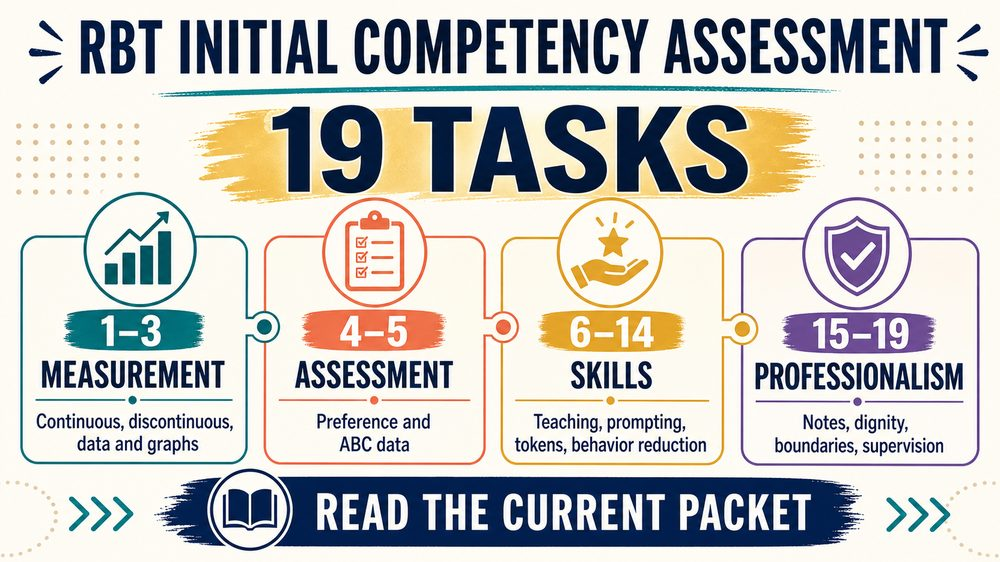
- Measurement tasks 1–3: make the event and unit visible
- Assessment tasks 4–5: preference and ABC data
- Skill acquisition and behavior reduction tasks 6–14
- Professionalism tasks 15–19
- How to prepare for an ABA competency assessment
- Original practice scenarios
- Frequently Asked Questions
- References
For RBT candidates, the current BACB Initial Competency Assessment Packet is the controlling document for the assessment itself. The packet effective January 1, 2026 lists 19 required tasks. The current RBT Test Content Outline, 3rd edition, describes 43 tasks across six domains. It states that the assessment follows completion of the 40-hour training and cannot be completed more than 90 days before an RBT certification application. The current RBT exam frame is separate: it includes 75 scored questions and 10 unscored pilot questions. This article is independent study content, not an official BACB form, assessment, recalled item, leaked item, or guarantee.
ABA competency assessment: what is actually being measured?
The assessment asks whether an applicant can implement and describe procedures in a way that is observable, accurate, safe, and within the RBT role. It is not a personality interview and it is not proof that a candidate can independently design treatment. A strong performance connects the written instruction to the learner, the measurement system, the procedure, and the next communication step.
| Assessment question | Observable evidence | Common mistake |
|---|---|---|
| Can the candidate measure? | Uses the defined unit and records the event or time accurately. | Choosing a measurement system because it is familiar. |
| Can the candidate implement? | Follows the written teaching or behavior-reduction procedure. | Adding an unapproved step when the learner does not respond. |
| Can the candidate explain? | Gives an accurate example, nonexample, or escalation decision. | Reciting a definition without connecting it to action. |
| Can the candidate respond to feedback? | Changes the performance and demonstrates it again. | Defending the first attempt instead of correcting it. |
If you are searching for an ABA competency assessment, begin with the current official packet and your assessor’s instructions, then use study resources only to rehearse the underlying skills.
How the current ABA competency assessment packet is structured
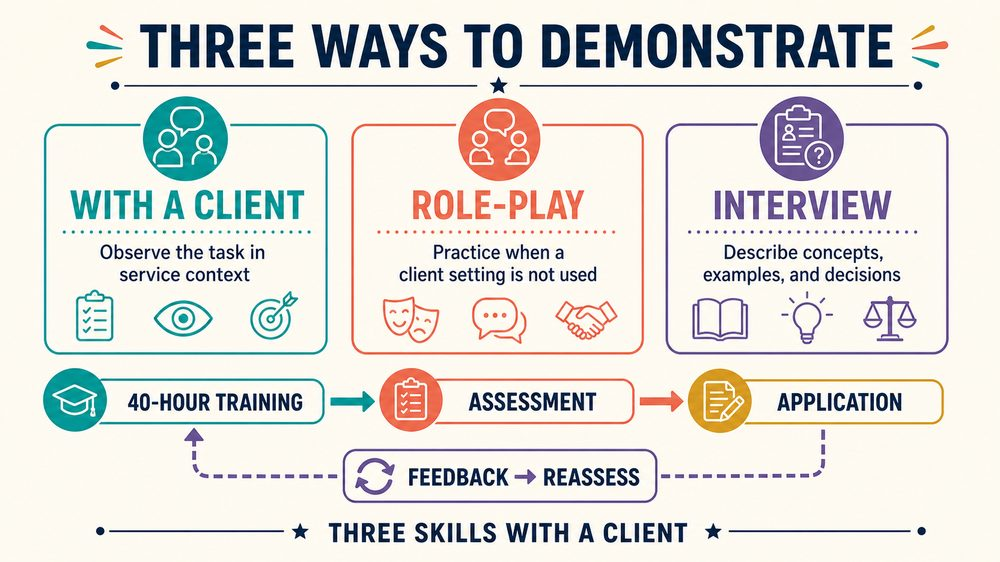
The 2026 packet permits the assessment to occur over one or more sessions, in person, live through the internet, or through recorded videos created specifically for assessment. Depending on the task, the assessor may evaluate performance with a client, through role-play, or through a live interview. The packet also specifies that three tasks in the Skill Acquisition and Behavior Reduction section must be demonstrated with a client.
- Complete the prerequisite: the 40-hour training must be complete before the initial competency assessment.
- Use a qualified assessor: the responsible assessor must meet the current BACB credential, supervision-training, and organization relationship requirements.
- Demonstrate each task: the assessor provides an opportunity and marks the assessment type used after competent performance is observed.
- Use corrective feedback appropriately: if competence is not demonstrated, the assessor may provide feedback and reassess on another day; feedback may not be delivered on the final assessment of a task.
- Complete documentation: the responsible assessor signs the final attestation, and the required assessment record is submitted with the certification application.
Do not substitute a homemade checklist for the BACB packet. The packet states that non-BACB forms will not be accepted, so a personal study sheet can organize practice but cannot replace the required document.
Measurement tasks 1–3: make the event and unit visible
Tasks 1 through 3 cover continuous measurement, discontinuous measurement, and data and graphs. Continuous examples in the packet include frequency, duration, latency, and interresponse time. Discontinuous procedures include partial-interval, whole-interval, and momentary time sampling. The goal is not to list every term from memory; it is to implement the defined measurement procedure and keep the data tied to the target behavior.
- Continuous measurement: identify what starts and stops the measure, then record the correct unit.
- Discontinuous measurement: follow the interval or sampling rule exactly; do not turn an interval estimate into a frequency count.
- Data and graphs: enter the data accurately and update the graph using the authorized convention.
Example: if the target is latency, the candidate should know the event that starts timing, the response that stops timing, and how a missing response is handled by the written procedure. Saying “latency is how long it takes” is not enough if the timing boundaries are wrong.
Assessment tasks 4–5: preference and ABC data
Task 4 requires conducting preference assessments, and task 5 requires collecting ABC data. Both require careful observation and role fidelity. A preference assessment identifies choices or relative preference under the procedure; it does not prove that an item will function as a reinforcer in every context. ABC data records relevant antecedent, behavior, and consequence information without turning an observation into an unsupported function claim.
| Task | Prepare to demonstrate | Keep separate |
|---|---|---|
| Preference assessment | Present choices as directed, record selections, and follow the selected format. | Preference result versus reinforcer effectiveness. |
| ABC data | Record what occurred before, the observable behavior, and what followed. | Observation versus inferred function. |
For an ABA competency assessment, practice saying what you observed before offering an interpretation. That habit protects data quality and makes supervision questions easier to answer.
Skill acquisition and behavior reduction tasks 6–14
The largest section covers nine tasks. The packet requires three tasks from this section to be demonstrated with a client. The exact assessment plan belongs to the qualified assessor and the current form; candidates should know the concepts and rehearse the procedures only under authorized conditions.
| Task | Core performance focus | What to check |
|---|---|---|
| 6. Discrete-trial teaching | Deliver the defined trial sequence and consequence. | Instruction, response opportunity, prompt, consequence, transition. |
| 7. Naturalistic teaching | Use naturally occurring motivation and context. | Opportunity, learner choice, response, consequence, generalization. |
| 8. Chaining | Implement the task analysis and assigned chaining format. | Step order, prompt, reinforcement, and error correction. |
| 9. Shaping | Reinforce successive approximations toward the target. | Current criterion and planned progression. |
| 10. Discrimination training | Teach responding differently to relevant stimuli. | Stimulus control, correct response, and programmed consequence. |
| 11. Prompting and fading | Use the assigned prompt hierarchy and fade as written. | Timing, least-to-most or most-to-least rule, independence. |
| 12. Token systems | Implement the token delivery and exchange procedure. | Contingency, token value, exchange, and schedule. |
| 13. Crisis/emergency procedures | Follow the protocol and safety direction. | Training limits, safety, reporting, and no improvisation. |
| 14. One selected procedure | Implement antecedent intervention, differential reinforcement, or extinction as assigned. | Written plan, safety, reinforcement or extinction conditions. |
For each skill, a useful practice cycle is: read the plan, observe a model, rehearse one small component, receive corrective feedback, and demonstrate the component again. Do not practice extinction, crisis procedures, or other high-risk procedures from a generic internet script.
Professionalism tasks 15–19
The final five tasks are easy to underestimate because several are interview-based. The packet requires objective session notes, examples of client dignity, professional boundaries, BACB supervision standards for RBTs, and at least one situation in which the applicant would seek clinical direction.
- Session notes: describe what occurred, what was measured, relevant changes, and communication actions objectively.
- Client dignity: explain how you protect privacy, choice, respect, and humane treatment in the actual setting.
- Professional boundaries: identify boundaries around gifts, personal relationships, social media, and communication.
- Supervision requirements: study the current RBT Handbook and supervision standards rather than relying on a memorized percentage from an old resource.
- Clinical direction: recognize when a new target, safety concern, ambiguous procedure, or unexpected pattern requires the supervisor’s direction.
A precise clinical-direction answer sounds like: “I would document the observable event, follow the current safety instruction, and contact my supervisor before changing the intervention.” It does not sound like: “I would do whatever seems to work.”
How to prepare for an ABA competency assessment
- Read the current packet: mark each of the 19 task statements and the allowed assessment types.
- Build a skill matrix: for every task, write the observable action, the measurement or decision point, and the question you would ask if the plan is unclear.
- Rehearse with feedback: ask the authorized trainer or assessor to observe the exact component, not just give a general confidence rating.
- Keep an error log: record the first error, the corrected rule, and the next opportunity to demonstrate it.
- Protect role limits: never turn a study exercise into an unauthorized client intervention.
- Verify timing and documents: use the current BACB Handbook and packet immediately before application.
The best answer to how to prepare for an ABA competency assessment is not “memorize 19 definitions.” It is “make each task observable, rehearse it safely, receive specific feedback, and verify the current document requirements.”
Original practice scenarios
Scenario 1—measurement: a candidate records duration but cannot identify when the behavior ended. Pause, ask the assessor to clarify the operational definition, and rehearse the timing boundary before the final demonstration.
Scenario 2—ABC data: a candidate writes “the learner wanted attention” in the consequence column. Rewrite the entry with the observable event and ask the supervisor where interpretation belongs.
Scenario 3—prompt fading: a candidate keeps a verbal prompt in place because the response is correct. Check the written fading plan and practice the next opportunity with the assigned prompt delay or reduction.
Scenario 4—clinical direction: a caregiver asks for an intervention change during the assessment. A role-safe response is to listen, document the request, and route it to the supervisor rather than making a clinical promise.
These are newly written independent study examples. They are not official, recalled, leaked, or BACB-endorsed assessment items.
Bottom line: use the current BACB packet as the authority, separate performance assessment from the RBT exam, and prepare each task through observable practice and feedback. An ABA competency assessment should show safe, accurate, role-appropriate performance—not merely confident vocabulary.
Turn assessment concepts into targeted RBT practice.
Review original scenarios across measurement, assessment, teaching, behavior reduction, professionalism, and supervision.
Try free RBT practice questions →
Frequently Asked Questions
Is the ABA competency assessment the RBT exam?
No. The competency assessment evaluates performance of required tasks, while the RBT exam uses selected-response questions. They are separate requirements and should be prepared for separately.
How many tasks are in the current Initial Competency Assessment?
The BACB packet effective January 1, 2026 lists 19 required task items. Use the current official packet because requirements and forms can change.
Can the assessment use role-play?
Yes. The current packet lists with-client, role-play, and interview options by task. Three Skill Acquisition and Behavior Reduction tasks must be demonstrated with a client.
Who completes the assessment?
A responsible assessor who meets the current BACB requirements oversees the assessment; the packet also describes conditions for assistant assessors and organizational relationships.
Are these practice scenarios official?
No. They are newly written independent study examples and are not official, recalled, leaked, or BACB-endorsed assessment items.
References
- Behavior Analyst Certification Board. RBT Initial Competency Assessment Packet: Effective January 1, 2026.
- Behavior Analyst Certification Board. RBT Handbook.
- Behavior Analyst Certification Board. RBT Test Content Outline (3rd ed.).
- Behavior Analyst Certification Board. Ethics Codes and RBT Ethics Code (2.0).
- RBT competency assessment guide. Reviewed for competitor research; not an endorsement.