
An ABA task list study guide can help organize behavior-analysis concepts for RBT preparation, but the current RBT Test Content Outline is the source for RBT examination coverage. Use the guide to connect terms to observable technician actions, data rules, documentation, and ethics. This page is independent educational content, not a BACB task list, policy, or answer key.
Table of Contents
- Start with an ABA task list study guide source
- Map the six RBT domains
- Translate ABA terms into technician actions
- Study data collection and graphing
- Study assessment participation
- Study acquisition and reduction
- Include documentation and ethics
- Use active recall with original scenarios
- ABA task list study guide checklist
- Frequently Asked Questions
- References
Then reinforce the concepts with free RBT mock exams and review the explanations.
Continue your RBT study with RBT exam study materials and original practice resources.
Quick answer: Treat aba task list study guide as a current-source RBT study topic. Define the concept, connect it to an observable action, use original examples, and keep the supervision boundary visible.
Study boundary: This independent guide is educational content. It is not a BACB policy, certification decision, legal opinion, answer key, or guarantee of examination success. It does not promise a passing score or certification outcome. Examples are original and are not official, recalled, leaked, or BACB-endorsed questions.
Current exam context: The current BACB RBT Test Content Outline describes 43 tasks across six domains; the examination includes 75 scored questions and 10 unscored pilot questions in a 90-minute testing period. Verify the current handbook and outline before relying on a time-sensitive detail.
Start with an ABA task list study guide source
Begin with the current RBT Test Content Outline (3rd ed.) and the current Handbook. Record the version date and official URL before building a printable or digital study file. A general ABA guide may use broader language than the entry-level RBT role, so compare every claim with the current RBT sources.
Keep a source-check margin. When a definition or administrative detail may change, mark it for review instead of rewriting it from memory. Source control is part of responsible study.
Map the six RBT domains
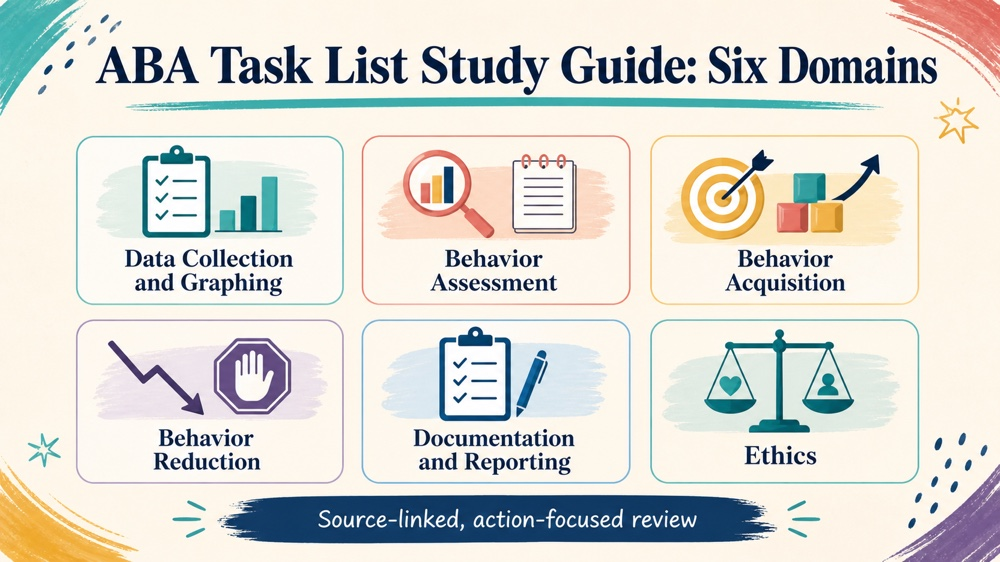
The current outline describes 43 tasks across Data Collection and Graphing, Behavior Assessment, Behavior Acquisition, Behavior Reduction, Documentation and Reporting, and Ethics. A useful study map gives each domain an action question: what does the RBT observe, implement, record, communicate, or protect?
- Name the task in plain language.
- Write an original condition.
- State the observable technician action.
- Add the data or consequence rule.
- Mark where the written plan or supervision controls the next step.
Translate ABA terms into technician actions
Broad ABA terminology becomes useful when the learner can say what happens next. For reinforcement, identify the qualifying response and programmed consequence. For prompting, identify the assistance and how prompt level is recorded. For shaping or chaining, follow the assigned sequence rather than designing a new one.
Add a boundary line to terms such as function, treatment, or assessment. Knowing the concept does not authorize an RBT to independently diagnose, redesign, or promise an outcome.
Study data collection and graphing
Include frequency, rate, duration, latency, interval recording, permanent product, percentage, graphing, and data integrity. Each example should show the operational definition and the start and stop rules. The written program controls which measure is used for a particular learner.
If a timer or data sheet is missing, preserve accuracy, document the barrier, and ask for direction. Never reconstruct a value simply to make the graph complete.
Study assessment participation
Behavior Assessment preparation should describe assigned participation: present materials, follow trial rules, record responses, and communicate observations. It should not turn an RBT into an independent diagnostician. A guide is stronger when it asks who interprets the result and who approves a procedure change.
Use original scenarios that change the setting, material, or instruction. Practice the handoff when the facts do not fit the plan.
Study acquisition and reduction
For acquisition, review reinforcement, prompting, fading, shaping, chaining, discrimination, generalization, and maintenance. For reduction, review antecedent strategies, differential reinforcement, extinction, safety, and reporting. In both areas, the RBT implements as trained, records what occurred, and reports concerns.
Avoid answers that sound clinical but exceed the role. A technician should not invent a consequence or infer a function from one event.
Include documentation and ethics
Add objective notes, confidentiality, competence, supervision, accurate records, and reporting routes. The RBT Ethics Code belongs beside the content, not only in the references. Use fictional examples and disclose only information needed through the proper channel.
Ask whether a sentence records an observable fact or an unsupported interpretation. This small test improves both study answers and workplace documentation.
Use active recall with original scenarios
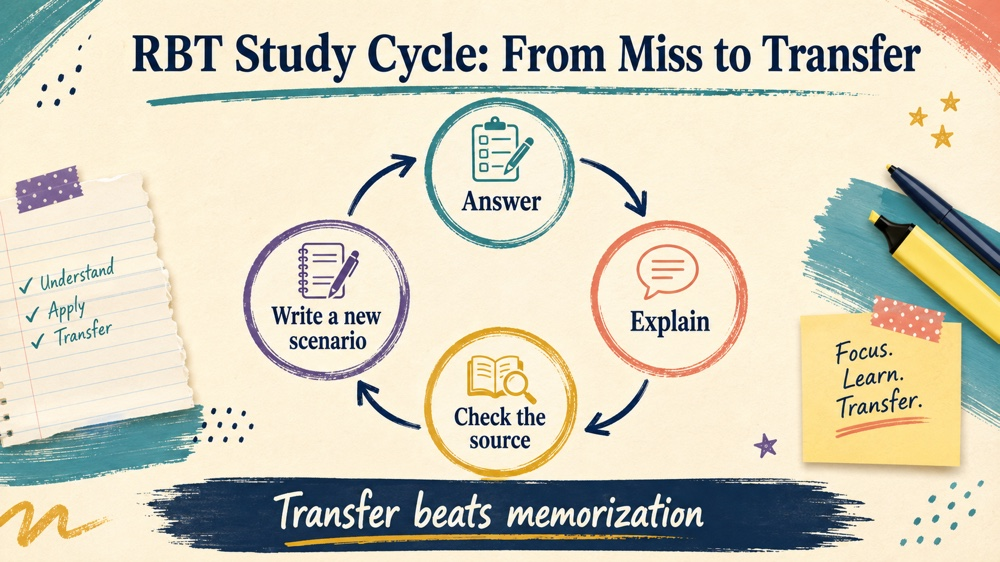
Cover the answer, explain the concept aloud, tag the reason for a miss, check the source, and write a new scenario. Tags may include vocabulary, measurement, discrimination, calculation, reading the condition, or role boundary. Interleave domains so the learner chooses the controlling rule from the facts.
The current examination includes 75 scored questions and 10 unscored pilot questions in a 90-minute testing period. Use current official sources for time-sensitive details and do not treat a practice set as official or predictive.
ABA task list study guide checklist
- Is the current RBT outline version and source URL recorded?
- Does every domain include an observable action and data rule?
- Can I distinguish RBT implementation from independent design or diagnosis?
- Are privacy, documentation, competence, supervision, and ethics included?
- Do my examples change conditions and remain original?
- Do I know what to do after a missed item?
- Will I review the guide when official sources change?
Use this ABA task list study guide as a maintained study tool. It does not promise a passing score or certification outcome. RBT Training is independent educational content and is not affiliated with or endorsed by BACB.
Practice the concept
Review aba task list study guide with original RBT scenarios, current-source reminders, and clear role boundaries.
Review the RBT study resource →
Frequently Asked Questions
Is this an official ABA task list?
No. Use the current BACB RBT Test Content Outline for official RBT examination coverage.
How should an ABA guide be adapted for RBT study?
Connect broad concepts to observable entry-level implementation, data, documentation, ethics, and supervision boundaries.
What current RBT domains should I review?
Review data collection and graphing, assessment, acquisition, reduction, documentation and reporting, and ethics.
Can this guide assure examination success?
No. It is independent study content and does not promise an examination or certification result.
References
- Behavior Analyst Certification Board: Registered Behavior Technician Handbook, updated June 2026.
- Behavior Analyst Certification Board: RBT Test Content Outline (3rd ed.).
- Behavior Analyst Certification Board: RBT resources.
- Behavior Analyst Certification Board: ethics resources.
- Behavior Analyst Certification Board: RBT Ethics Code (2.0).