
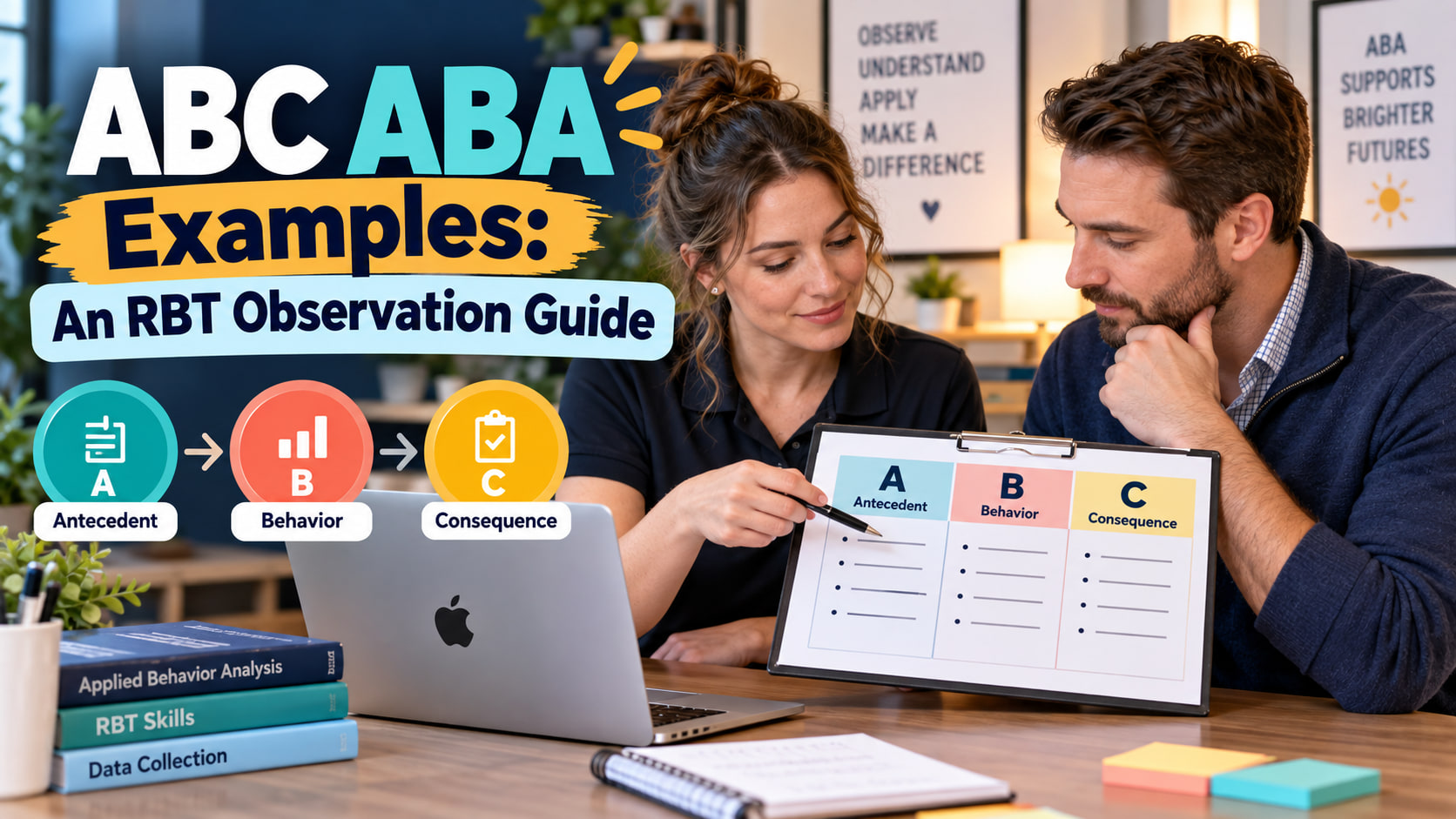
ABC ABA examples become useful when an RBT records what happened before, what was observable, and what happened after without turning an observation into a diagnosis.
Table of Contents
- ABC ABA examples: what ABC recording means
- The ABC sequence
- A: Describe the antecedent
- B: Describe observable behavior
- C: Describe the consequence
- Turn observations into useful data
- What ABC data does not prove
- Worked ABC ABA examples
- Frequently asked questions
- References
ABA KNOWLEDGE · OBJECTIVE OBSERVATION
ABC ABA Examples: An RBT Observation Guide
Describe context, observable behavior, and consequence without guessing what one event proves.
ABC ABA examples become useful when an RBT records what happened before, what was observable, and what happened after without turning an observation into a diagnosis. The letters refer to antecedent, behavior, and consequence. Together, they create a structured description of a sequence that can be reviewed with a supervisor.
ABC recording does not mean guessing why a person acted or deciding that one event caused another. Use the current operational definitions, data system, privacy rules, safety procedure, and supervision process. This guide is educational and does not replace the approved plan or authorize an RBT to independently change treatment.
ABC ABA examples: what ABC recording means
In an ABC observation, the antecedent is the relevant event or condition immediately before the target behavior, the behavior is the observable action defined by the program, and the consequence is what happened immediately after. The sequence may help a team identify patterns over time, but one record is only one observation.
Good ABC notes are concrete. “The teacher said, ‘put the blocks away,’ the learner pushed the blocks to the floor, and the technician helped clear the table” is more useful than “the learner became defiant when asked to clean up.” The first version separates events from interpretation.
Include only information required by the approved record. Protect names, schedules, diagnoses, images, and family details. A training example can use a fictional learner and a neutral setting rather than copying private service information.
The ABC sequence
Use the three parts as a connected timeline. Ask what was happening immediately before, what exactly occurred, and what changed or happened immediately after.
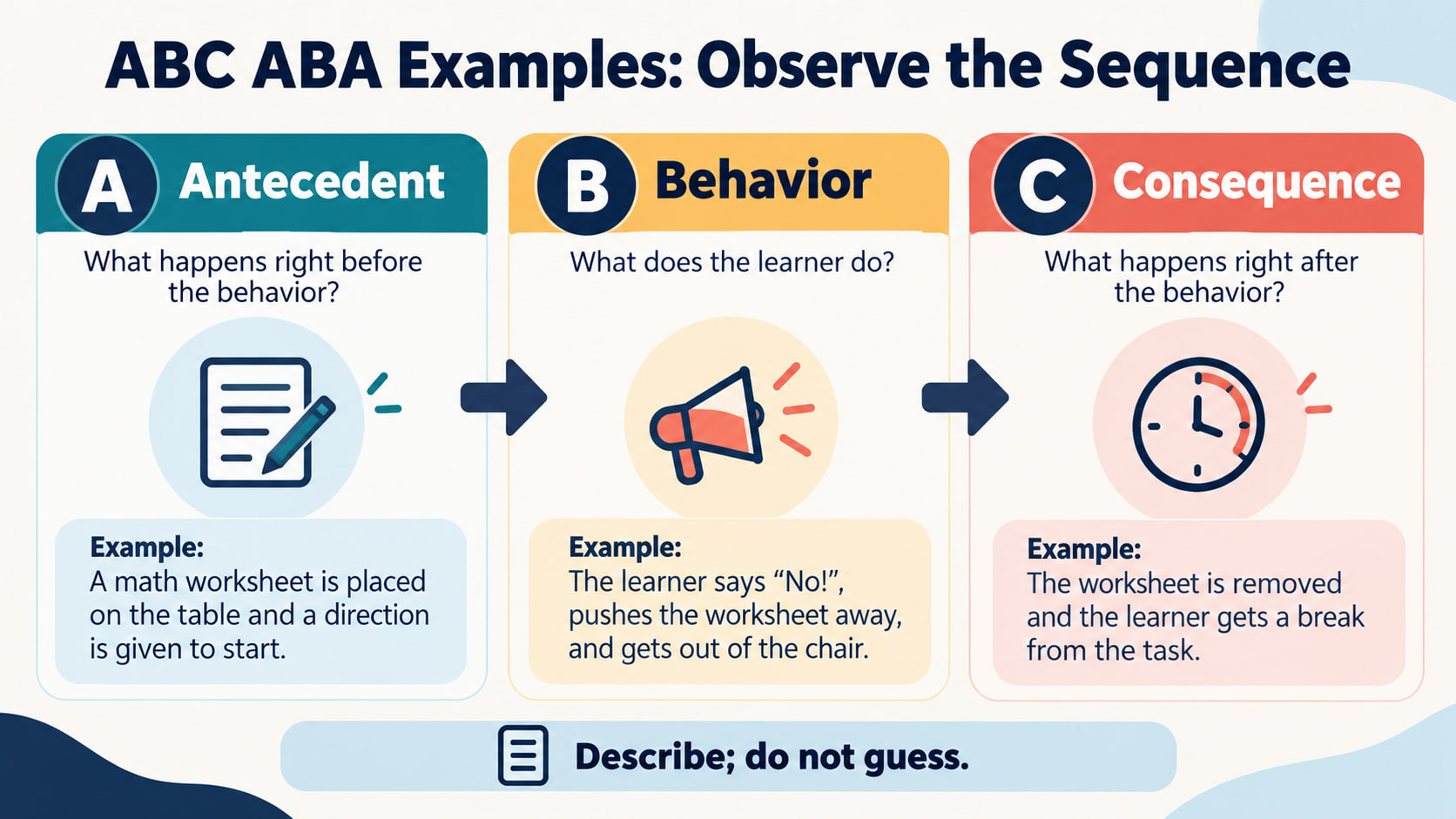
- A — Antecedent: Record the instruction, transition, item, interaction, setting event, or other relevant context defined by the plan.
- B — Behavior: Record the observable response using the current operational definition.
- C — Consequence: Record what immediately followed, including what people did, what changed, and what access occurred.
Do not force every event into a neat story. If the antecedent is unknown, write that it was not observed or was unclear. If several events occurred, follow the record format and ask the supervisor how to capture them. Accurate uncertainty is better than an invented detail.
A: Describe the antecedent
The antecedent is not always a single instruction. It may include a transition, a change in materials, a delay, a peer interaction, a denied request, a task demand, or an environmental condition specified by the program. Record what you actually observed and the timing that the system requires.
Avoid labels such as “the learner was tired” unless the plan defines how that information is collected. Instead, record observable context: “The session began after the schedule changed,” or “The lights were turned off and the group moved to the hallway.” Ask the supervisor whether a broader setting event belongs in the record.
Keep the antecedent separate from the behavior. “The learner was frustrated” is an interpretation. “The learner said, ‘no,’ pushed the worksheet away, and turned their head” describes behavior that can be discussed and measured.
B: Describe observable behavior
Use the operational definition in the current program. Include what the person did, how long or how often if required, and the start or stop criteria. Do not substitute a moral label or a diagnosis for the defined response.
For example, “left the chair and walked six feet toward the doorway” gives a team something to measure. “Escaped the task” may be a hypothesis about function rather than a description of the action. Function can be considered through the approved assessment and supervision process, but the ABC note should preserve the facts.
Record communication and alternative skills as well. A request, gesture, use of a break card, or return to the task may be relevant to the sequence. Do not record only the behavior of concern if the program asks for the replacement response too.
C: Describe the consequence
The consequence is what happened immediately after the behavior, not a judgment about whether the response “worked.” It may include a person’s words, a change in the task, access to an item, attention, a pause, movement to another area, or no observable change.
Write the action without claiming that it caused the behavior. “The technician removed the worksheet for 30 seconds” is different from “the learner escaped.” The first is observed; the second is an interpretation that may require additional evidence.
Follow the current response and safety plan. Do not create a consequence to make the data more interesting, and do not withhold a safety response because you want to observe a complete sequence. When an emergency procedure is used, document and report according to policy.
Turn observations into useful data
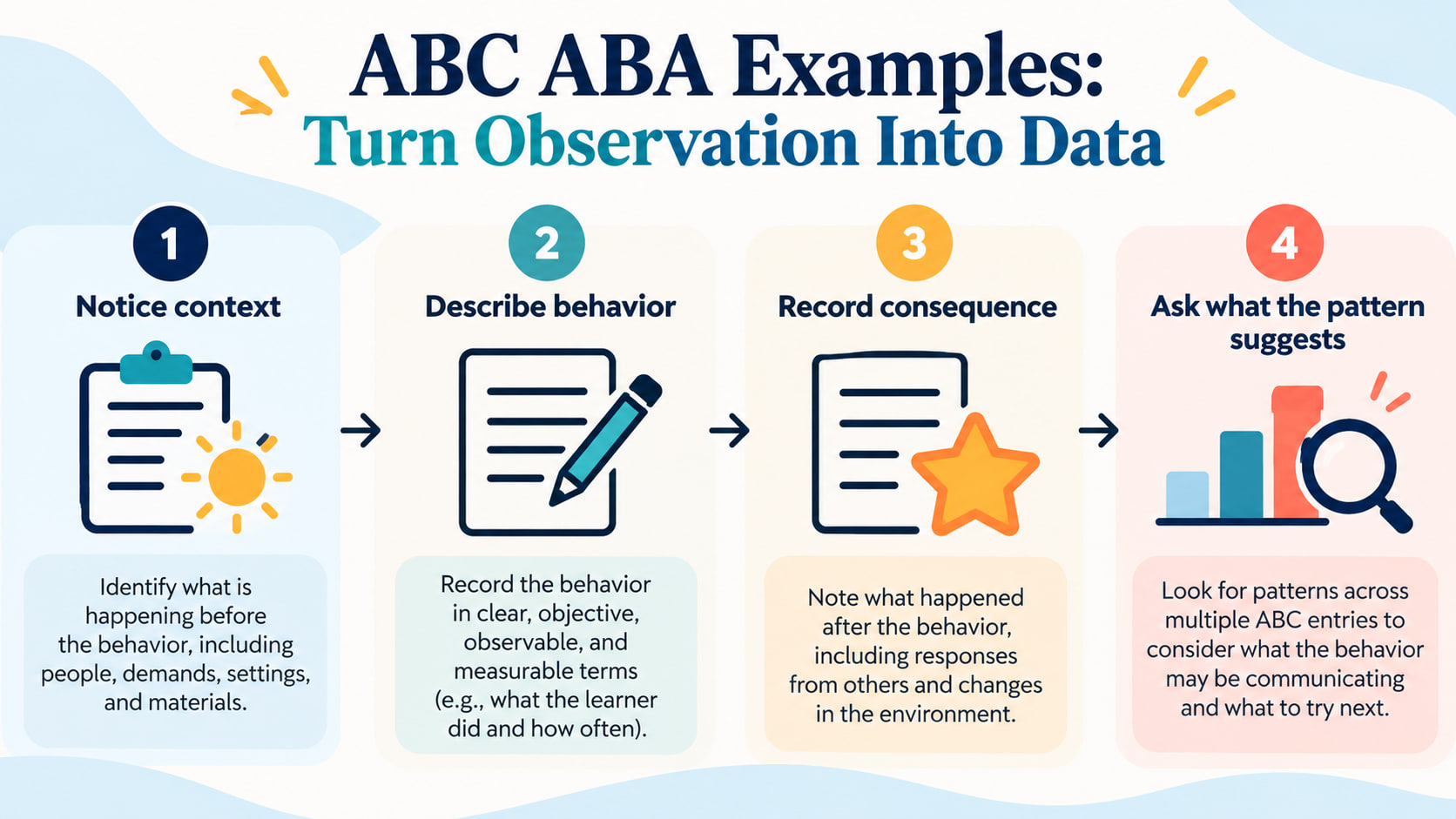
One ABC record can answer “what happened this time.” Multiple records collected with consistent definitions can help the team ask better questions. Compare contexts, task types, communication opportunities, consequences, and replacement responses only when the plan and supervisor direct that review.
Use objective language and complete the record promptly. If a field is unknown, use the approved notation rather than guessing. Correct errors through the approved method; do not erase a record to make the sequence look cleaner.
Share patterns through supervision. An RBT can say, “In four observed transitions, the response occurred after the visual schedule was removed, and the next action was a pause,” if the data supports it. The RBT should not say, “The function is escape,” based on those observations alone unless the authorized process has reached that conclusion.
What ABC data does not prove
ABC data does not automatically prove function, diagnosis, intent, treatment effectiveness, or a cause-and-effect relationship. The consequence may be associated with what happened next without being the reason the behavior occurred. Other variables may matter, and the team may need additional assessment or review.
ABC data also does not authorize a plan change. If observations suggest a new pattern, communicate the pattern and follow the supervisor’s direction. Do not add a new prompt, remove reinforcement, change a demand, or alter a safety response on your own.
Worked ABC ABA examples
- Transition: A: the timer sounded and the technician presented the visual schedule. B: the learner pushed the schedule away and walked behind the chair. C: the technician followed the approved transition-support procedure and recorded the response.
- Requesting help: A: a difficult worksheet was placed on the table. B: the learner pointed to the help card after the planned cue. C: the technician delivered the programmed assistance and recorded the prompt level.
- Waiting: A: the preferred item was visible and the technician said, “wait.” B: the learner vocalized and reached toward the item. C: the technician followed the approved waiting and communication procedure.
- Unclear context: A: the technician did not observe what happened immediately before the response. B: the defined behavior occurred once. C: the technician recorded the observable aftermath and marked the antecedent unknown according to the system.
Frequently asked questions
Does ABC data identify the function of behavior?
Not by itself. It describes a sequence and may contribute to a broader authorized assessment or review. Do not infer a final function from one observation.
Can an RBT write an ABC example for training?
Yes, use a fictional or properly de-identified scenario and follow the organization’s policy. Do not copy identifying client information into personal notes or public tools.
What if I did not see the antecedent?
Record that the antecedent was unknown or not observed using the approved notation. Do not invent a likely event.
Can I change the plan after seeing a pattern?
No. Communicate the objective pattern and ask the authorized supervisor or team to review it through the current process.
Source note: Review the current BACB RBT Handbook, task list, ethics code, employer policy, and supervisor instructions. This article is educational and does not provide individualized legal, clinical, employment, or credentialing advice.
Ready to practice the RBT concepts you just reviewed?
Try an independent, original RBT practice resource with exam-style questions, scoring, and answer explanations.
References
- Behavior Analyst Certification Board. RBT Test Content Outline, 3rd edition.
- Behavior Analyst Certification Board. RBT Handbook.
- Behavior Analyst Certification Board. RBT Ethics Code.