

An assent ABA example should show more than a learner saying yes. Assent can be expressed through vocal or nonvocal participation, and it can be withdrawn through a spoken stop, turning away, using a communication card, or another individualized signal. This guide gives educational examples, explains why assent is ongoing, and shows how an RBT can pause, check safety, report objectively, and seek supervisor direction without independently changing a treatment plan.
Table of Contents
- Assent ABA example: the quick meaning
- Assent ABA example: participation can be vocal or nonvocal
- Assent withdrawal examples and why context matters
- How an RBT can respond when assent appears to change
- Objective documentation without guessing intent
- What assent examples do not decide
- Frequently asked questions
- Official sources and scope
RBT ethics, participation, and respectful communication
Assent ABA Example: What RBTs Can Notice, Respect, and Report
Understand participation and withdrawal signals without turning a general example into a client-specific protocol.
If you are searching for an assent ABA example, you may want to know what respectful participation looks like during a session and what an RBT should do when a learner appears to withdraw. The key point is that assent is not limited to a spoken “yes.” It can include vocal or nonvocal behavior that indicates willingness to participate, and it can change as the interaction changes.
These examples are educational illustrations, not a universal checklist. A learner’s communication, movement, culture, relationship with the practitioner, task, environment, and safety context all matter. The current written program, workplace procedure, and supervisory direction control a particular service situation.
Assent ABA example: the quick meaning
In behavioral services, assent generally refers to behavior that can be taken as an indication that a person who cannot provide legal informed consent is willing to participate. The BACB glossary describes vocal or nonvocal behavior that can indicate willingness; service organizations or review committees may set the parameters for assessing assent.
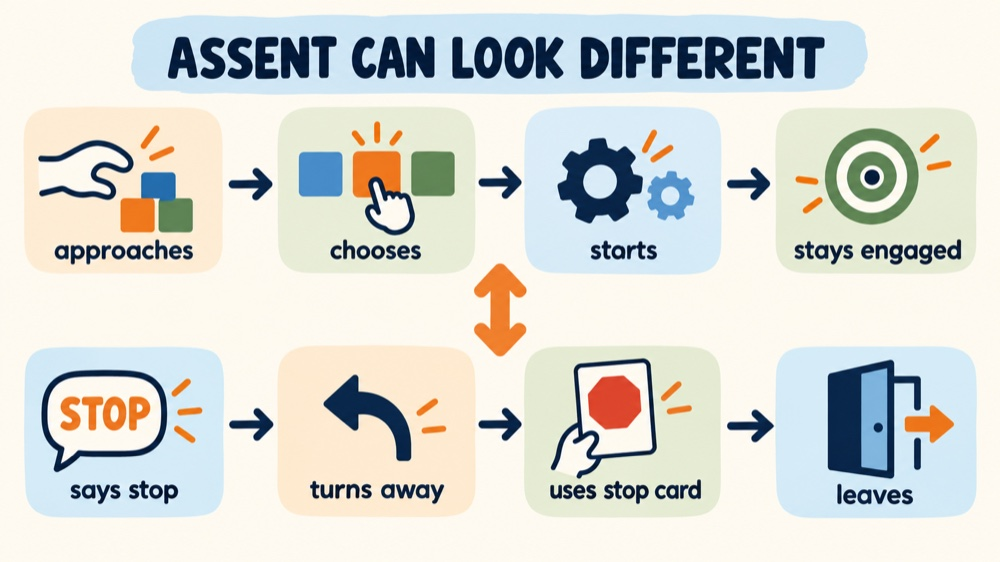
Assent is best understood as an ongoing process rather than a one-time permission slip. A learner may approach an activity, choose between options, begin responding, and remain engaged. The same learner may later communicate “stop,” turn away, use an established communication response, or leave the activity. The change is information about the learner’s current participation, not automatically a character judgment.
Assent ABA example: participation can be vocal or nonvocal
Possible participation signals can include:
- saying “yes” or using a functionally equivalent phrase, sound, sign, or device response;
- approaching the practitioner or activity area;
- selecting an offered activity or material;
- touching a “start” or “ready” symbol that has meaning for the learner;
- orienting toward the materials, arranging them, or beginning the activity; and
- staying engaged in a way that is consistent with the learner’s established communication and behavior.
None of these signals should be treated as proof in isolation. Approaching a table may mean the learner wants access to a preferred item, not that the learner agrees to every activity that follows. A choice between two materials does not automatically mean agreement with every demand, duration, prompt, or consequence. Define the relevant participation signal in the service context and discuss uncertainty with the supervisor.
Assent withdrawal examples and why context matters
Possible withdrawal signals can include saying “no” or “stop,” shaking the head, turning the body away, pushing materials aside, touching a stop or all-done symbol, repeatedly attempting to leave, or using another individualized communication response. Some research examples also describe nonresponse, aggression, self-injury, or elopement as possible forms of assent withdrawal in particular contexts.
That last point requires care. A behavior may communicate withdrawal, but it may also signal pain, a medical issue, confusion, an unrecognized communication need, a change in the environment, or an immediate safety concern. The RBT should not decide the function from the label alone. Describe what happened, check immediate safety, and seek the appropriate direction.
Context changes the meaning of a signal. Turning away during a noisy transition may not mean the same thing as turning away after a specific instruction. A learner may use a stop card consistently in one setting but not yet have a reliable way to use it in another. The goal is not to force every signal into one universal definition; it is to understand the individual’s established communication and respond within the approved process.
How an RBT can respond when assent appears to change
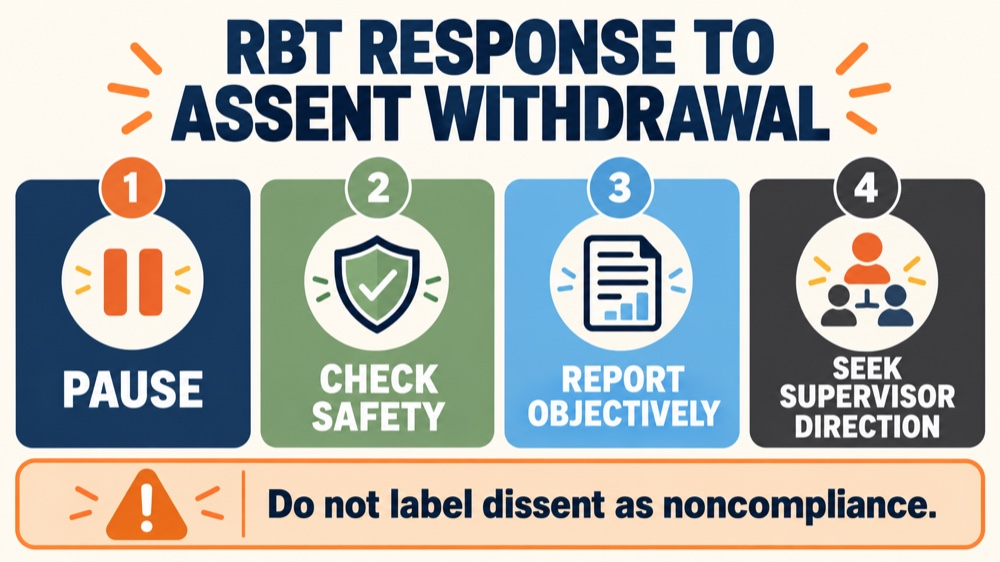
A practical RBT response can be organized around four role-appropriate actions:
- Pause when appropriate. Avoid automatically escalating the demand or treating withdrawal as a reason to intensify prompting. Follow the current safety and session procedure.
- Check immediate safety. If there is risk of injury, elopement, or another urgent concern, follow the organization’s safety plan and call for the appropriate help. Safety procedures are not replaced by a general assent example.
- Report objectively. Record the observable response, what preceded it, the task or condition, what the RBT did, and what happened next, using the authorized documentation system.
- Seek supervisor direction. Ask whether the program needs clarification, whether the learner has an established alternative communication response, and how the next session should be handled.
This process does not mean an RBT independently cancels every activity, rewrites a treatment plan, or makes a clinical decision. It means the RBT treats the signal as relevant information, protects safety, and uses the supervisory chain to decide what the team should do next.
Objective documentation without guessing intent
Objective documentation separates what the learner did from what the RBT thinks the learner felt or intended. Compare:
| Interpretive note | More objective note structure |
|---|---|
| “Client did not want to work.” | “After the instruction was presented, the client said ‘stop,’ pushed the worksheet away, and turned their body from the table.” |
| “Client was happy to participate.” | “The client selected the puzzle from two options, moved to the activity area, and completed three turns before requesting a break.” |
| “Client was being noncompliant.” | “The client did not begin the requested transition within the stated interval and used the stop icon.” |
These are writing examples, not required wording for every record. Use the organization’s approved definitions and fields. Do not include unnecessary identifying details, and do not create a personal assent-tracking file outside the approved system.
What assent examples do not decide
An assent example does not decide:
- whether a specific service is legally authorized or clinically appropriate;
- whether a learner’s particular response means assent or withdrawal without individualized context;
- whether a safety intervention is required in an urgent situation;
- whether a program should be changed, paused, or redesigned; or
- whether a particular provider or RBT has met every ethical or regulatory obligation.
Use the current BACB Ethics Code, workplace policy, written program, and supervisor direction for those decisions. The RBT Test Content Outline emphasizes dignity, respect, objective communication, competence, supervision, and confidentiality; those principles support careful reporting but do not turn a general article into a client-specific protocol.
Frequently asked questions
What is a simple assent ABA example?
A learner selects one of two offered activities, approaches the activity, and begins participating. If the learner later says “stop,” uses a stop card, turns away, or otherwise communicates withdrawal, the team treats that as information to interpret in context rather than automatically labeling it noncompliance.
Can assent be nonverbal?
Yes. Assent can be indicated through gestures, approach, selection, a communication device, symbols, movement, or other individualized behavior. The meaning must be established in context rather than assumed from one gesture.
What should an RBT do when assent is withdrawn?
Follow the current safety and session procedures, pause or respond as appropriate, describe the observable event, protect confidentiality, and seek supervisor direction. Do not independently rewrite the program.
Is assent the same as consent?
No. The terms have different roles in legal, ethical, organizational, and service contexts. Use the definitions and parameters provided by the responsible organization, current law, and applicable professional guidance.
Does a learner have to say “no” to withdraw assent?
No. A learner may use vocal or nonvocal communication. The team should identify meaningful signals for that learner and avoid requiring one communication form before taking a concern seriously.
Official sources and scope
This guide was checked against BACB’s ethics codes page, the RBT Ethics Code, the RBT Test Content Outline, and peer-reviewed assent-based ABA literature in Assent in applied behaviour analysis and positive behaviour support. The examples are original educational illustrations, not client-specific instructions or official BACB templates.
Ready to practice the RBT concepts you just reviewed?
Try an independent, original RBT practice resource with exam-style questions, scoring, and answer explanations.
References
- Behavior Analyst Certification Board. RBT Test Content Outline, 3rd edition.
- Behavior Analyst Certification Board. RBT Handbook.
- Behavior Analyst Certification Board. RBT Ethics Code.