
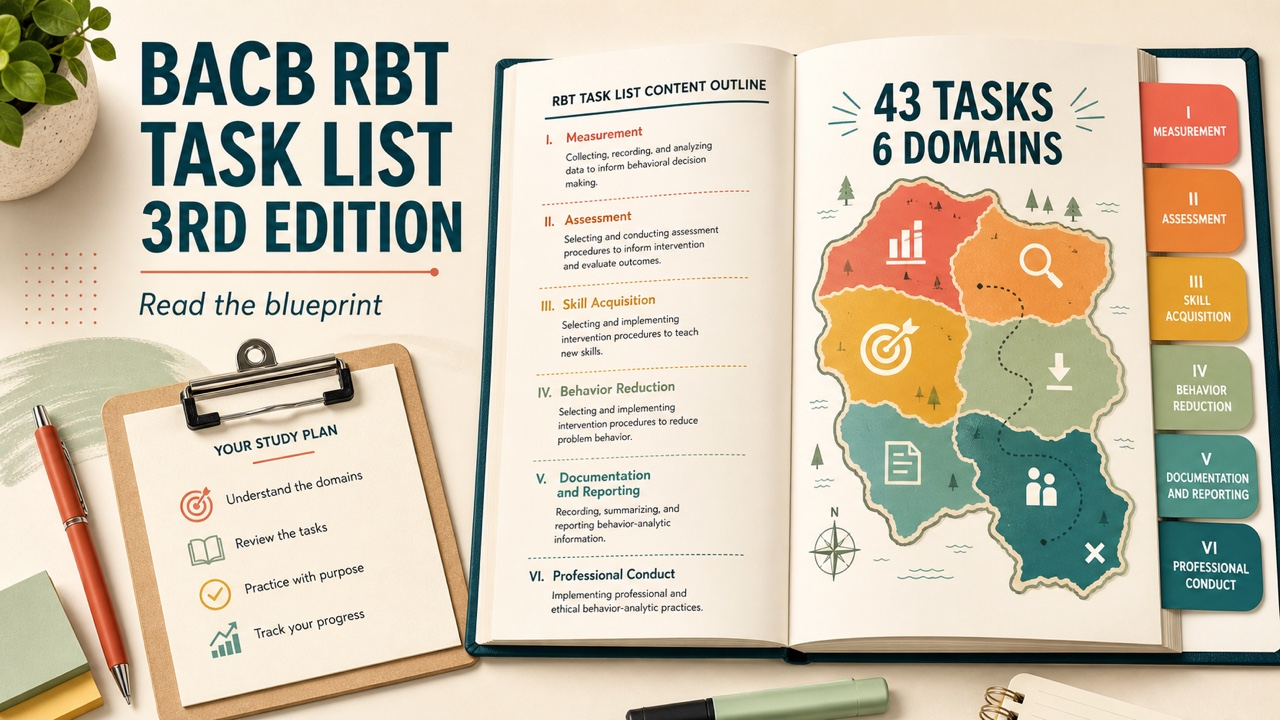
The phrase bacb rbt task list 3rd edition is commonly used by candidates who want a map of what to study. The current official document is the RBT Test Content Outline (3rd ed.), and it is the document to use when you want the current task and domain structure. This guide explains how to read that outline, how the six domains fit together, and how to turn the blueprint into a study plan without presenting an independent summary as BACB material.
Table of Contents
- bacb rbt task list 3rd edition: what the name means
- 43 tasks across six content domains
- Domain A: Data Collection and Graphing
- Domain B: Behavior Assessment
- Domain C: Behavior Acquisition
- Domain D: Behavior Reduction
- Domain E: Documentation and Reporting
- Domain F: Ethics and role boundaries
- Turn the outline into a study system
- Frequently Asked Questions
- References
Quick answer: Treat the RBT Test Content Outline (3rd ed.) as a blueprint, not as a question bank. It describes 43 tasks across six domains. Use the task wording to organize your training notes, add observable examples, and practice deciding what an entry-level RBT implements, records, or reports under supervision.
Study boundary: This is independent exam-preparation content, not an official BACB handbook, task answer key, or application determination. The examples in this article are newly written for study. They are not official, recalled, leaked, or BACB-endorsed exam questions. Requirements and policies can change, so use the current BACB handbook and your supervisor or requirements coordinator for decisions about an individual application or client program.
bacb rbt task list 3rd edition: what the name means
Many study searches still say “task list,” but the current BACB document is titled the RBT Test Content Outline (3rd ed.). The word “outline” matters: it describes the content framework and task statements used to build the examination. It does not publish the live exam questions, answer choices, passing score, or an official set of flashcards.
The current outline applies beginning January 1, 2026. Candidates should use the edition in effect when they schedule their appointment, and should check the current BACB Handbook for application and scheduling requirements. If a future edition is announced, the current official pages control over an older screenshot or study post.
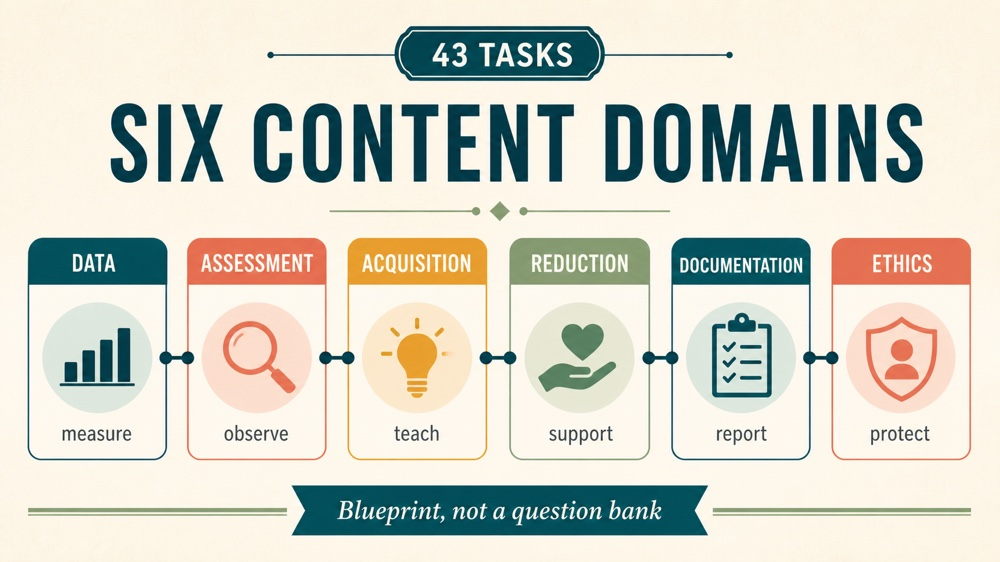
43 tasks across six content domains
The blueprint describes 43 tasks distributed across six content domains. The domain structure is useful because it turns a long list into related work: collect and display data, participate in assessment, teach skills, reduce behavior according to a plan, document and report, and act ethically.
| Domain | Task count in the current outline | Study lens |
|---|---|---|
| A. Data Collection and Graphing | 13 | Operational definitions, measurement, data entry, graphs, and fidelity. |
| B. Behavior Assessment | 8 | Preference and skill assessment participation, observation, and communication. |
| C. Behavior Acquisition | 19 | Teaching, reinforcement, prompting, chaining, generalization, and maintenance. |
| D. Behavior Reduction | 14 | Written reduction procedures, replacement responses, safety, and data. |
| E. Documentation and Reporting | 10 | Objective notes, communication, records, and reporting responsibilities. |
| F. Ethics | 11 | Confidentiality, supervision, competence, boundaries, and professional conduct. |
The domain counts above are a planning aid, not a promise about the exact number of questions on any one appointment. The examination format and the current outline should be verified in official sources.
Domain A: Data Collection and Graphing
Start with the behavior definition and the measure. A question may ask whether frequency, rate, duration, latency, interval recording, or permanent product matches the stated goal. It may also test data entry, graph reading, trend, level, variability, or procedural fidelity.
For example: A 20-minute session has 8 defined responses, while a 40-minute session has 9. If the question asks which session had the higher rate, divide by the observation time rather than selecting the larger count. If it asks how long each episode continued, neither count nor rate answers the question.
Domain B: Behavior Assessment
An entry-level RBT may participate in procedures such as preference assessment or skill assessment when trained and directed to do so. The task is to follow the written procedure, record responses, and communicate accurately. The RBT does not independently diagnose, select a function, or redesign an assessment because an outcome is inconvenient.
Use a role question with every assessment term: What is the RBT observing? What is the supervising professional deciding? That separation helps distinguish data collection from clinical interpretation.
Domain C: Behavior Acquisition
This domain includes teaching and maintaining skills. Connect reinforcement to its effect on future behavior, prompting to added antecedent support, fading to reduced assistance, chaining to a sequence of steps, and generalization to performance across relevant people, materials, or settings. A good study note includes the natural cue, target response, prompt level, correction procedure, reinforcement, and independence data.
For example: A learner completes a handwashing step after a model prompt. Record the prompt level defined by the program; do not mark the trial independent simply because the final movement was correct. Ask how the plan will fade the model and transfer control to the routine cue.
Domain D: Behavior Reduction
Behavior-reduction tasks emphasize implementing a written plan, collecting data, teaching or supporting replacement responses, and following safety procedures. Read the antecedent strategy, consequence, reinforcement schedule, and escalation steps exactly as written. Do not start an extinction procedure, alter a consequence, or add a response-cost rule from memory.
When a scenario includes risk, the best answer often begins with safety and supervisor direction rather than a clever consequence. The RBT communicates changes, follows training, and documents the event in the approved system.
Domain E: Documentation and Reporting
Objective notes state what was observed, what procedure was used, what data were recorded, and what communication occurred. They do not turn a guess into a fact. A note should not say “the learner was manipulative” when the observer can record the request, response, timing, and consequence instead.
Data integrity is part of documentation. If an error is found, use the organization’s correction process so the original record remains traceable. Protect confidentiality and report incidents, suspected abuse, or other required matters through the designated route.
Domain F: Ethics and role boundaries
Ethics questions often combine confidentiality, supervision, competence, conflicts of interest, cultural responsiveness, dignity, and appropriate communication. An RBT should seek supervision when a task is outside training, a plan is unclear, a boundary is pressured, or a client’s safety or privacy may be affected.
An RBT is a paraprofessional who provides behavior-analytic services under the direction and close supervision of the responsible supervisor or requirements coordinator. A strong answer therefore separates what an RBT can implement as written from what requires assessment, clinical interpretation, plan changes, or supervisor direction.
Turn the outline into a study system
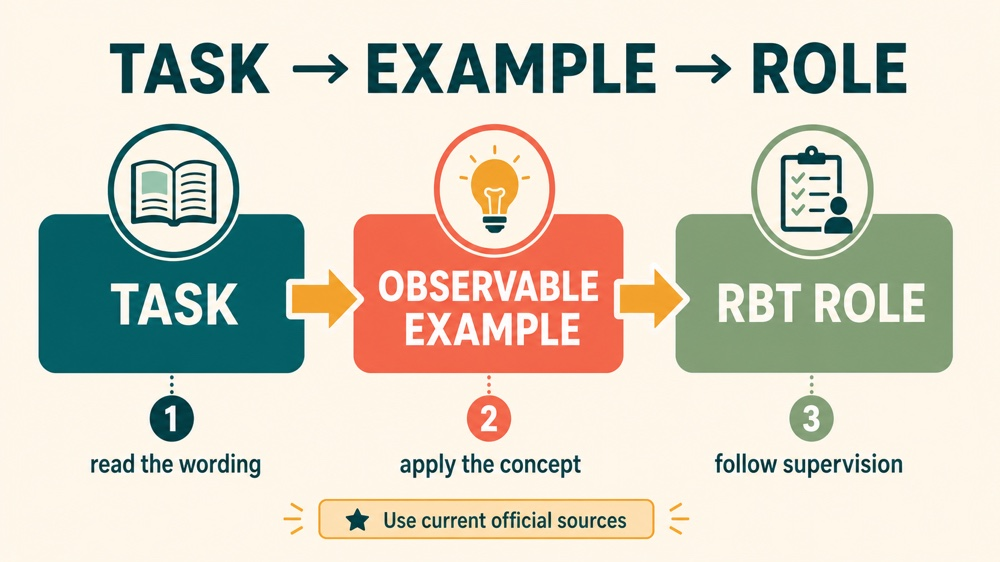
- Map the task: Write the task statement and its current domain.
- Define it: Explain the term in plain language without copying a slogan.
- Add a direct example: Describe what an RBT would see, do, measure, or report.
- Add a boundary: State what requires supervisor or qualified-professional direction.
- Compare a distractor: Explain why a neighboring procedure or role is not the best fit.
- Retrieve later: Review the card after one day, one week, and after a mixed practice set.
Current exam frame: The current RBT Test Content Outline (3rd ed.) applies beginning January 1, 2026. It describes 43 tasks across six content domains. The current examination format is 75 scored questions plus 10 unscored pilot questions, four answer choices per item, and a 90-minute testing period. These facts explain the study frame; they do not turn an independent guide into an official BACB resource.
Use the current outline and Handbook as the controlling sources. Independent summaries can make the blueprint easier to approach, but they are not official BACB resources, do not expose secure examination content, and cannot determine or promise an examination outcome.
Study the blueprint with a clear plan
Use independent RBT study materials for retrieval practice, then verify every current requirement and task detail against the official BACB sources.
Review the RBT resource →
Frequently Asked Questions
Is the current RBT task list called a Test Content Outline?
Yes. Candidates often search for “task list,” but the current official document is the RBT Test Content Outline (3rd ed.).
How many tasks are in the RBT 3rd edition outline?
The current outline describes 43 tasks across six content domains. Verify the edition in effect when you schedule your examination.
Does the outline contain the actual RBT exam questions?
No. It is a content blueprint. It does not publish secure live questions or an answer key.
Which domain is largest?
In the current study map, Behavior Acquisition contains 19 tasks. Use the official outline for the exact task wording and current edition.
Are these official BACB questions?
No. The examples here are newly written independent study content and are not official, recalled, leaked, or BACB-endorsed examination questions.
References
- Behavior Analyst Certification Board: Registered Behavior Technician Handbook, updated June 2026.
- Behavior Analyst Certification Board: RBT Test Content Outline (3rd ed.).
- Behavior Analyst Certification Board: RBT resources.
- Behavior Analyst Certification Board: Test Content Outlines for BACB certifications.
- RBT Training: independent exam study materials.