
A BACB task list study guide PDF can be a convenient review format, but candidates should distinguish an independent study guide from the current official RBT Test Content Outline. The outline and Handbook control wording, requirements, and time-sensitive details. This page explains how to use a PDF responsibly, build original examples, and keep the RBT role boundary visible.
Table of Contents
- BACB task list study guide PDF: check the official source first
- Map the six domains and 43 tasks
- Use data examples instead of keyword lists
- Study assessment, acquisition, and reduction
- Add documentation and ethics notes
- Turn the PDF into active recall
- Current examination context
- Mistakes to avoid with task-list PDFs
- BACB task list study guide PDF checklist
- Frequently Asked Questions
- References
Then reinforce the concepts with free RBT mock exams and review the explanations.
Continue your RBT study with RBT exam study materials and original practice resources.
Quick answer: Treat bacb task list study guide pdf as a current-source RBT study topic. Define the concept, connect it to an observable action, use original examples, and keep the supervision boundary visible.
Study boundary: This independent guide is educational content. It is not a BACB policy, certification decision, legal opinion, answer key, or guarantee of examination success. Examples are original and are not official, recalled, leaked, or BACB-endorsed questions.
Current exam context: The current BACB RBT Test Content Outline describes 43 tasks across six domains; the examination includes 75 scored questions and 10 unscored pilot questions in a 90-minute testing period. Verify the current handbook and outline before relying on a time-sensitive detail.
BACB task list study guide PDF: check the official source first
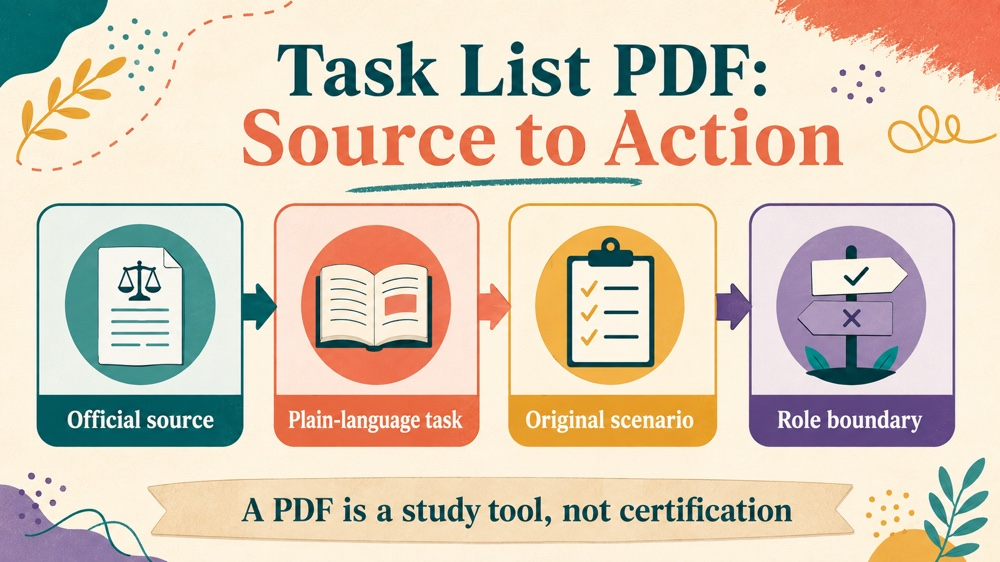
Start with the current BACB RBT Test Content Outline (3rd ed.) and record its version date and official URL. Then check the current Handbook for application, examination, supervision, and maintenance information. A PDF can be easy to print and still be outdated, incomplete, or mislabeled.
Put the source check on the cover page of your study file. When a number, definition, or pathway detail changes, update the file rather than adding an unverified note. The visual convenience of a PDF should never outweigh source control.
Map the six domains and 43 tasks
The current outline describes 43 tasks across six domains: Data Collection and Graphing, Behavior Assessment, Behavior Acquisition, Behavior Reduction, Documentation and Reporting, and Ethics. Build a table with one row per task or concept. Add an observable action, a data rule, and a boundary note so the guide supports decisions instead of simple recognition.
- Copy the task meaning into plain language without changing its scope.
- Write an original condition that requires an RBT action.
- State what is measured, implemented, documented, or reported.
- Mark what requires supervision or a written plan.
- Link the row to the current source and check date.
Use data examples instead of keyword lists
For measurement, include frequency, rate, duration, latency, interval recording, permanent product, and percentage with short examples. A definition should answer what is measured and when scoring begins and ends. The operational definition and program instructions control the actual recording system.
Add a small error check: did the RBT use the specified measure, preserve data integrity, and report a barrier? A task-list PDF that lists terms without these questions may support recognition but not competent implementation.
Study assessment, acquisition, and reduction
Assessment study should focus on what the RBT implements, records, and communicates under the supervising team’s direction. Acquisition study can include prompting, fading, reinforcement, shaping, chaining, discrimination, generalization, and maintenance. Reduction study can include antecedent strategies, differential reinforcement, extinction, safety, and reporting.
For each topic, add a ‘not independently’ line. The RBT does not diagnose a function from one observation or redesign a procedure because a PDF defines the word. The guide should reinforce following the written plan and asking for direction when the facts do not fit it.
Add documentation and ethics notes
Documentation and Reporting and Ethics deserve full sections, not a final footnote. Include objective notes, confidentiality, competence, supervision, accurate records, disclosure of limits, and reporting routes. Pair each with a short scenario: what happened, what can be documented, and who should receive the concern?
Use the current RBT Ethics Code as a source. Avoid client-identifying details in examples and never present an attractive template as permission to share protected information. Professional conduct is part of the task list, not separate from it.
Turn the PDF into active recall
Print one section at a time and cover the answer column. Explain the concept aloud, answer an original scenario, and tag the reason for any miss. Then write a new example with a changed setting, material, prompt, or consequence. This process tests transfer rather than visual familiarity with the page.
Interleave the domains. Move from a graphing question to a prompt-fading question, then to privacy and documentation. The switch makes the learner choose the controlling concept from the facts instead of relying on the page order.
Current examination context
The current examination includes 75 scored questions and 10 unscored pilot questions in a 90-minute testing period. Use that context for planning and verify the current BACB source before relying on it. An independent PDF does not reproduce the official examination and should not claim to predict protected questions.
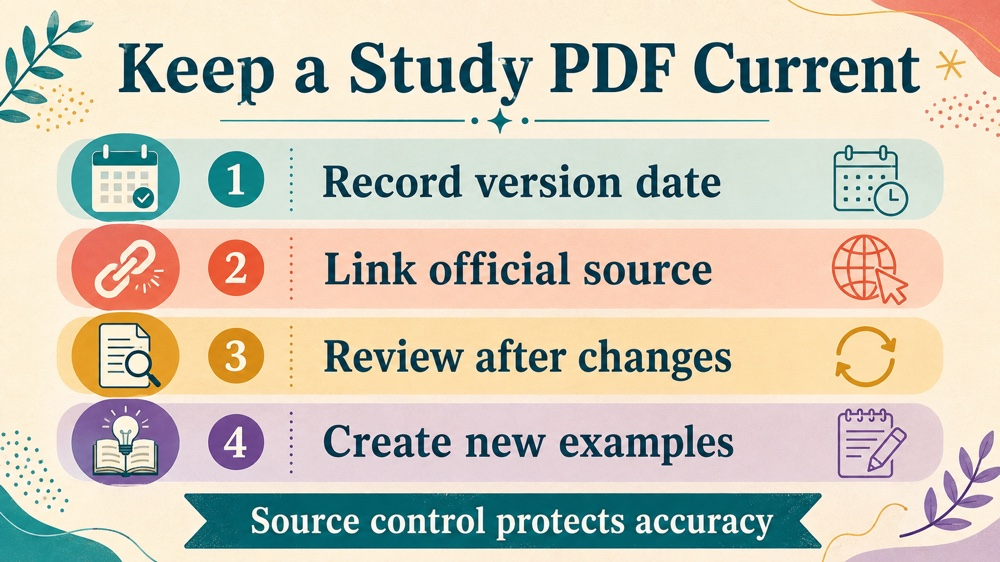
Keep the PDF’s publication date and source links visible. If it includes an administrative number or a pathway statement, check it against the current Handbook. A source-linked guide is easier to maintain than a visually polished file with no provenance.
Mistakes to avoid with task-list PDFs
- Downloading an unlabeled or outdated PDF and treating it as current.
- Calling an independent guide official, endorsed, or predictive.
- Listing definitions without conditions, actions, or data rules.
- Leaving out ethics, documentation, privacy, supervision, or competence.
- Using a task definition as permission for an independent clinical change.
- Copying recalled or protected questions into a study file.
- Failing to record a source date and review the PDF when BACB materials change.
BACB task list study guide PDF checklist
- Is the official outline version and URL recorded?
- Does the guide map the six domains and current task coverage?
- Does each concept include an original condition and observable action?
- Are data, documentation, ethics, privacy, and supervision included?
- Can I explain what the RBT implements and what requires direction?
- Do I use active recall and new scenarios instead of passive rereading?
- Will I update or replace the PDF when official sources change?
A BACB task list study guide PDF is most useful when it points back to current sources and forward to an observable decision. Treat the PDF as a maintained study tool, not as a substitute for BACB materials or a certification service.
Practice the concept
Review bacb task list study guide pdf with original RBT scenarios, current-source reminders, and clear role boundaries.
Review the RBT study resource →
Frequently Asked Questions
Is an independent task list PDF an official BACB document?
No. Check the current BACB RBT Test Content Outline and Handbook for official wording and requirements.
What should a task-list study PDF include?
Include the six domains, source and version notes, original examples, observable actions, data rules, documentation, ethics, and role boundaries.
Can a PDF predict the RBT examination?
No. It should not claim to reproduce or predict official, protected, recalled, or leaked questions.
How do I keep a study PDF current?
Record the source check date, compare it with current BACB materials, and revise or replace pages when official documents change.
References
- Behavior Analyst Certification Board: Registered Behavior Technician Handbook, updated June 2026.
- Behavior Analyst Certification Board: RBT Test Content Outline (3rd ed.).
- Behavior Analyst Certification Board: RBT resources.
- Behavior Analyst Certification Board: ethics resources.
- Behavior Analyst Certification Board: RBT Ethics Code (2.0).