
A BACB task list study guide should point learners back to current BACB materials, not make an unlabeled summary look official. For RBT preparation, use the current RBT Test Content Outline and Handbook, then convert the tasks into observable practice decisions. The explanations and examples here are independent, original, and not official, recalled, leaked, or BACB-endorsed questions.
Table of Contents
- Use a BACB task list study guide source log
- Read the task list as six domains
- Build a source-linked measurement page
- Practice assessment without overclaiming
- Connect acquisition to reduction
- Give documentation and ethics equal weight
- Use the guide for active recall
- Avoid false authority signals
- BACB task list study guide checklist
- Frequently Asked Questions
- References
Then reinforce the concepts with free RBT mock exams and review the explanations.
Continue your RBT study with RBT exam study materials and original practice resources.
Quick answer: Treat bacb task list study guide as a current-source RBT study topic. Define the concept, connect it to an observable action, use original examples, and keep the supervision boundary visible.
Study boundary: This independent guide is educational content. It is not a BACB policy, certification decision, legal opinion, answer key, or guarantee of examination success. It does not promise a passing score or certification outcome. Examples are original and are not official, recalled, leaked, or BACB-endorsed questions.
Current exam context: The current BACB RBT Test Content Outline describes 43 tasks across six domains; the examination includes 75 scored questions and 10 unscored pilot questions in a 90-minute testing period. Verify the current handbook and outline before relying on a time-sensitive detail.
Use a BACB task list study guide source log
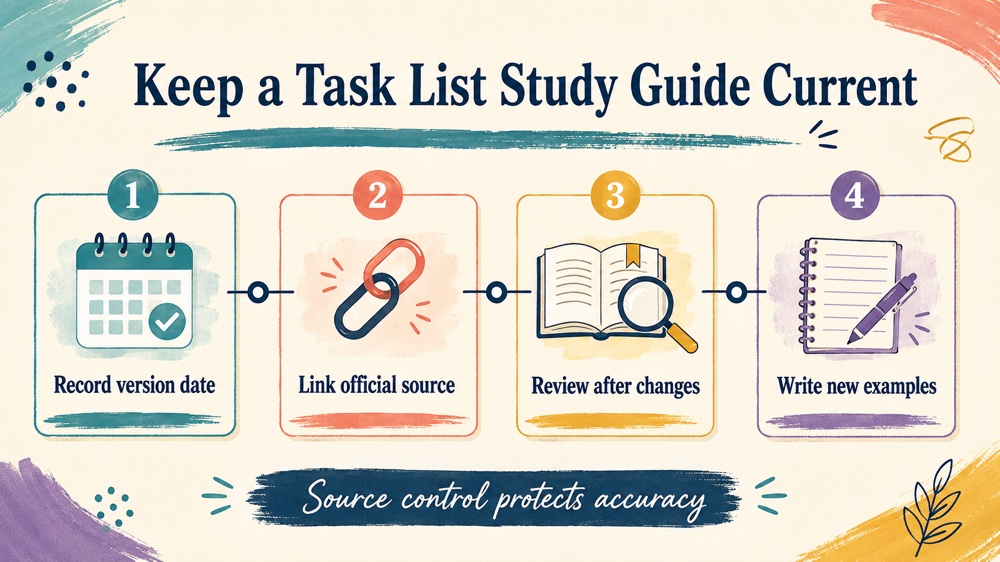
Record the title, edition, update date, and official URL of the source before studying. The RBT Test Content Outline (3rd ed.) describes examination content; the Handbook explains the applicable pathway and administrative steps. A PDF downloaded months ago may need a new check.
Create a small source log. Write the date checked, the claim reviewed, and the page or section used. This makes later updates deliberate instead of cosmetic.
Read the task list as six domains
The current outline describes 43 tasks across six domains: Data Collection and Graphing, Behavior Assessment, Behavior Acquisition, Behavior Reduction, Documentation and Reporting, and Ethics. A study guide should preserve that structure while adding practical examples and role boundaries.
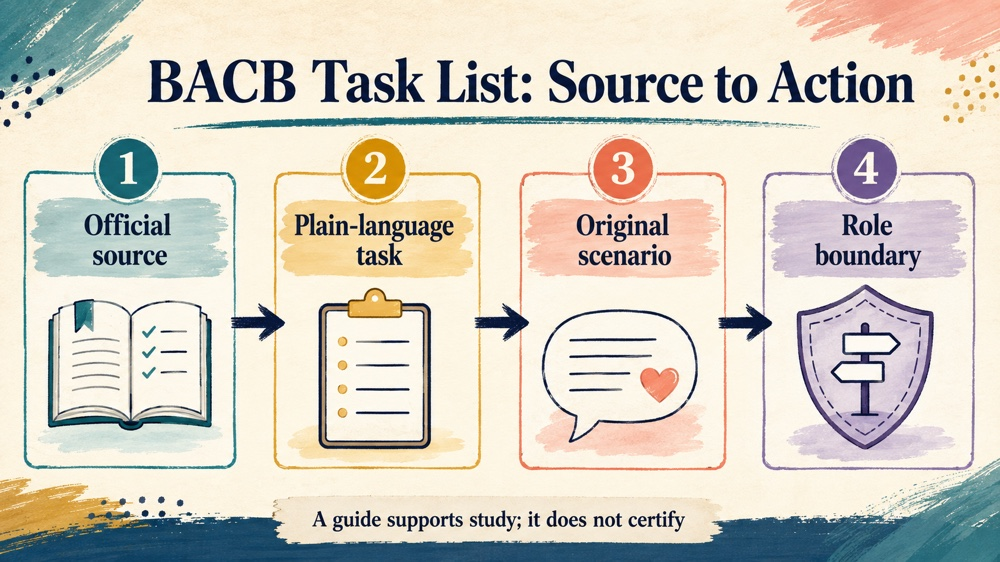
- Read one task in the official source.
- Rewrite it in plain language without widening its scope.
- Create an original scenario.
- State what is observed, implemented, recorded, or reported.
- Add a ‘check the plan’ note where procedures vary.
Build a source-linked measurement page
Include frequency, rate, duration, latency, interval recording, permanent product, percentage, and graphing. Explain each through start and stop rules and an observable example. The operational definition and written program control actual scoring; the guide should not encourage a convenient substitute measure.
Add a data-integrity example involving a missing timer or unclear definition. The correct study habit is to document the barrier and seek direction, not to backfill data.
Practice assessment without overclaiming
An RBT study guide can explain participation in assigned assessment procedures: prepare materials, follow trial rules, record responses, and communicate observations. It should not imply that an RBT independently interprets results or designs treatment. Put the decision-maker beside every assessment concept.
Use original scenarios with different learners, materials, and settings. The learner should practice noticing when a procedure is not specified and a handoff is needed.
Connect acquisition to reduction
Study prompting, fading, reinforcement, shaping, chaining, discrimination, generalization, and maintenance alongside antecedent strategies, differential reinforcement, extinction, safety, and reporting. Ask what the RBT implements and what data are recorded.
A correct answer is often less dramatic than an incorrect one: follow the plan, preserve data, report a concern, and do not make an unsupported clinical change.
Give documentation and ethics equal weight
Documentation and Reporting and Ethics are full domains. Include objective notes, confidentiality, competence, supervision, accurate records, and reporting routes. Use the RBT Ethics Code to frame professional conduct and keep examples free of identifying details.
Separate an observation from an interpretation. If an interpretation is needed, identify the appropriate supervisor or team rather than inserting it into a factual note.
Use the guide for active recall
Cover the explanation, answer an original scenario aloud, tag the miss, check the official source, and write a new scenario with one changed variable. Interleave the six domains so the learner must discriminate from the condition instead of following page order.
Current exam context is a planning aid only: the examination includes 75 scored questions and 10 unscored pilot questions in a 90-minute testing period. Verify current BACB materials before relying on a time-sensitive statement.
Avoid false authority signals
- Calling an independent guide an official BACB document.
- Using an old edition without a visible version date.
- Presenting original examples as real, recalled, or leaked questions.
- Treating a practice score as an administrative result.
- Leaving out privacy, documentation, competence, or supervision.
- Using a task definition to authorize an independent plan change.
- Copying a source without checking whether the wording still applies.
BACB task list study guide checklist
- Is the current outline and Handbook linked?
- Are version dates and check dates visible?
- Does each task connect to an observable RBT action?
- Are all six domains represented?
- Do examples remain original and clearly independent?
- Can I explain the difference between implementation and clinical decision-making?
- Do I have a review plan for future source changes?
Use this BACB task list study guide to organize accurate study, not to replace BACB materials. It is independent educational content and does not promise a passing score or certification outcome.
Practice the concept
Review bacb task list study guide with original RBT scenarios, current-source reminders, and clear role boundaries.
Review the RBT study resource →
Frequently Asked Questions
Is an independent BACB task list guide official?
No. The current BACB RBT Test Content Outline and Handbook are the official sources for RBT information.
What should a task-list study guide add?
It should add plain-language explanations, original scenarios, observable actions, data rules, and supervision boundaries without widening the official scope.
How often should I check the source?
Check version dates and revisit time-sensitive claims whenever the BACB publishes updated materials.
Are the practice examples recalled questions?
No. They are original educational scenarios and are not official, recalled, leaked, or BACB-endorsed.
References
- Behavior Analyst Certification Board: Registered Behavior Technician Handbook, updated June 2026.
- Behavior Analyst Certification Board: RBT Test Content Outline (3rd ed.).
- Behavior Analyst Certification Board: RBT resources.
- Behavior Analyst Certification Board: ethics resources.
- Behavior Analyst Certification Board: RBT Ethics Code (2.0).