
If you search for a Behavioral Buzz RBT mock exam, you may see a portal with a direct-question version and a scenario-based version. That format distinction is useful, but the brand name alone does not tell you whether a resource matches the current RBT exam scope, how its score should be interpreted, or what to study next.
Table of Contents
- What the Behavioral Buzz RBT mock exam search means
- Compare direct and scenario mock exams
- Check current RBT 3rd-edition alignment
- Use the mock for learning or timing
- Audit explanations and distractors
- Turn the result into a study plan
- Practice Behavioral Buzz RBT mock exam decisions
- Avoid these brand and mock-exam mistakes
- Frequently Asked Questions
- References
This independent guide explains how to evaluate a Behavioral Buzz-style RBT mock exam alongside any other practice resource. It focuses on current RBT Test Content Outline, 3rd edition boundaries, question design, practice versus simulation mode, and a correction workflow. It does not represent or speak for Behavioral Buzz.
RBT Training is independent and is not affiliated with, operated by, or endorsed by Behavioral Buzz or the Behavior Analyst Certification Board (BACB). The examples and practice prompts below are newly written for independent study. They are not official, recalled, leaked, or BACB-endorsed questions. No practice site or mock-exam score guarantees a passing result.
What the Behavioral Buzz RBT mock exam search means
A branded search usually has a practical intent: the learner wants to find a known mock exam quickly, understand whether it is free, see whether it has a timer, or decide whether the scenario version is worth using. A useful article should answer those questions without pretending to be the brand.
| Search question | What to verify on the resource | Why it matters |
|---|---|---|
| Is there a direct-question mock? | Does it test recognition of definitions and distinctions? | Useful for a quick content check, but may not test applied reasoning deeply. |
| Is there a scenario-based mock? | Does the stem contain a real decision condition and plausible distractors? | Useful for applying a rule rather than spotting a definition. |
| Is it timed? | Does the timer create a controlled exam-mode condition? | Useful for pacing, but not a substitute for explanation-based review. |
| Does it show a score? | Does it identify domains, confidence, and explanations? | A number without a correction path does not tell you what to study next. |
The most important comparison is not “Which site is best?” It is “Which practice condition answers my current study question?” A direct quiz can be efficient after reading a guide. A scenario mock can expose whether the rule transfers. A full timed attempt can reveal pacing. These are different jobs.
Do not copy questions, answers, screenshots, or explanations from a third-party site into your article or public notes. Use original study language and link readers to the provider if you are discussing the resource. Academic honesty and clear attribution matter in a branded query.
Compare direct and scenario mock exams
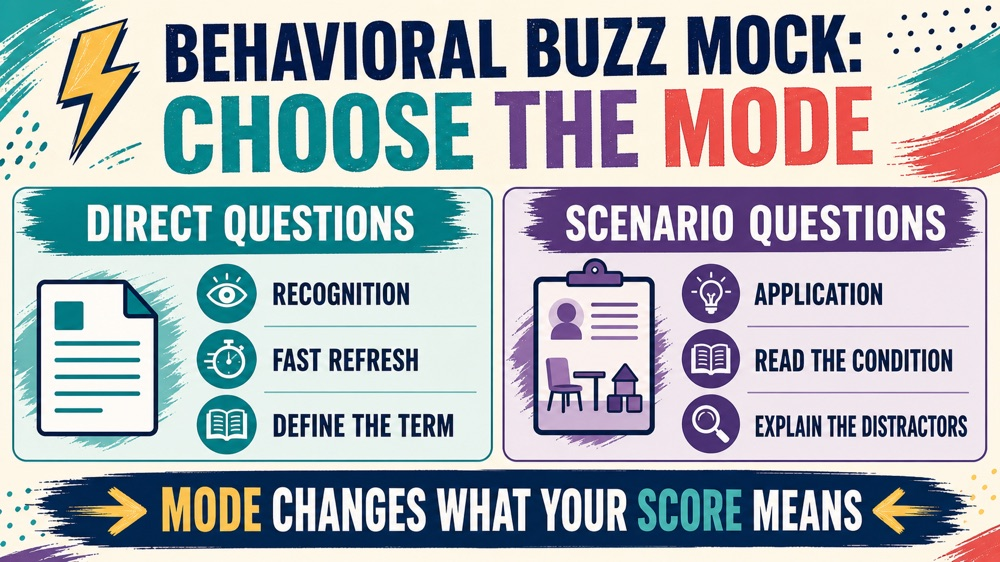
A direct-question mock often asks for a definition, term, or simple distinction. A scenario-based mock adds context such as an instruction, a data rule, a written plan, or a professional boundary. Neither is automatically superior.
| Feature | Direct-question practice | Scenario-based practice |
|---|---|---|
| Primary demand | Recall and recognition. | Application and discrimination. |
| Best time to use | Early review or rapid refresh. | After learning the rule and before full simulation. |
| Common trap | Confusing familiar words with understanding. | Missing the controlling condition in a long stem. |
| Review question | Can I define the term? | Can I explain why this action fits this context? |
| Evidence limit | Does not show applied transfer alone. | Does not guarantee full-domain readiness alone. |
For example, a direct item may ask which measure records the time between an instruction and response onset. A scenario item may describe the instruction, the timer, and the response, then ask you to identify latency. The concept is the same, but the reading demand differs.
When you use a Behavioral Buzz RBT mock exam or another provider’s resource, record which version you used. Do not compare a direct-question score with a scenario score as if they were identical measurements of knowledge.
Check current RBT 3rd-edition alignment
The current RBT TCO is the RBT Test Content Outline, 3rd edition. It describes 43 tasks across six domains. Current exam context includes 75 scored questions and 10 unscored pilot questions. A third-party mock may use 85 practice items, fewer items, or a custom structure, but its page should make that distinction clear.
| Alignment check | Evidence to look for | Red flag |
|---|---|---|
| Edition | A link to the current official TCO and an update date. | Only “latest task list” with no source. |
| Domain map | Questions tagged or explained across A–F. | One broad category claims to cover everything. |
| Question count | Practice count is labeled separately from official exam context. | All practice questions are called scored or official. |
| Independence | Questions are described as original practice items. | “Real,” “recalled,” or “leaked” item language. |
| Role boundary | Rationales say to follow the plan and supervision route. | Answers invite the RBT to diagnose or change treatment independently. |
Because branded resources can remain online for several years, check the page’s date and wording rather than assuming it is current. Older content can still teach a concept, but an old edition should be labeled and supplemented with the current source.
Keep the official source authoritative for scope. Keep the third-party mock authoritative only for its own practice experience and explanations. That separation protects readers from confusing a commercial or free resource with a certification authority.
Use the mock for learning or timing
Use two passes:
- Learning pass: pause, mark confidence, and read the rationale after committing to an answer. Write the rule in your own words.
- Timing pass: hide explanations, use a clean answer sheet, and complete a fresh set under the planned time window.
A score from a learning pass may be inflated by immediate feedback. A score from a timing pass may be lower because it adds pacing and fatigue. That does not mean one pass failed; it means the conditions were different.
If a mock shows instant feedback after each question, use it to learn the clue and distractor logic. If a mock offers a timed scenario mode, use it to practice keeping the plan, measurement unit, and role boundary in mind while moving forward. Review afterward, not during the simulation.
Audit explanations and distractors
A high-quality explanation should do three things:
- identify the exact fact that makes the best answer fit;
- explain why the tempting alternatives do not fit the condition;
- state the transferable rule without turning an independent example into official exam content.
Watch for explanations that claim a preferred item is automatically a reinforcer, treat every “data” question as a count, or ask the RBT to make a clinical decision outside the written plan. Those are academic warning signs even when the page looks polished.
| Question clue | Decision rule | Common distractor |
|---|---|---|
| “At any point during the interval” | Partial-interval scoring. | Whole interval or momentary time sampling. |
| “Time from instruction to response onset” | Latency. | Duration or rate. |
| “Follow the written plan” | Implement and report; do not improvise. | Choose the answer that changes the procedure. |
| “Protect client information” | Use the authorized privacy and communication route. | Share details to be helpful. |
When reviewing a brand-name mock, do not rate it only by the number of items. Sample several rationales from different domains. The explanation quality is where most of the learning value lives.
Turn the result into a study plan
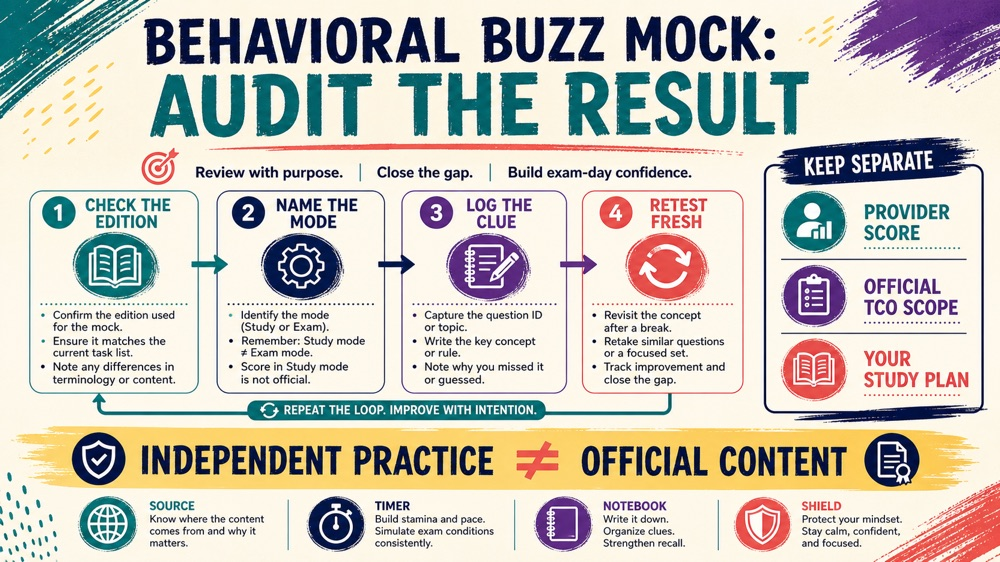
Use a correction log with these fields:
| Field | Example |
|---|---|
| Mock and version | Direct or scenario; date completed. |
| Domain | A, B, C, D, E, or F based on the current map. |
| Confidence | Sure, unsure, or guess. |
| Decisive clue | The unit, timeline, plan, or privacy phrase. |
| Correction sentence | One original sentence explaining the rule. |
| Retest | Fresh scenario and date, not the same item repeated. |
Group errors by decision rule. If three items involve measurement but the same mistake is “I ignored the time boundary,” one short review block may repair all three. If errors are spread across domains, schedule mixed practice rather than overdrilling one attractive topic.
Do not report a brand-specific score as a universal pass threshold. Use it as an internal signal under known conditions, and look for stable performance across fresh questions, domains, and timing modes.
Practice Behavioral Buzz RBT mock exam decisions
These original prompts help you evaluate a branded mock without copying its content:
- A portal offers a direct version and a scenario version. Which one should you use after memorizing definitions but missing application questions?
- A page says its 85 practice questions are “the actual exam.” What evidence and wording should you challenge before trusting the resource?
- You score 88% with instant feedback and 72% in a fresh timed scenario set. What changed between the two measurement conditions?
- A rationale says an RBT should modify the intervention because the current step is inconvenient. Which current role boundary makes that answer unsafe?
- A correct answer was a guess. Should it be removed from the correction log? Why or why not?
- A resource uses “professional conduct” while the current outline uses “Ethics.” What should you do before mapping the result to the current study plan?
Answer each with the source, clue, and next action. That keeps the article useful even if a third-party page changes its layout or offers a new mock version.
Avoid these brand and mock-exam mistakes
- Implying affiliation: a brand query does not authorize a partnership claim.
- Copying third-party items: write original examples and link to the source when discussing it.
- Calling a practice score official: use the official TCO for scope, not a provider’s marketing label.
- Comparing unlike modes: direct, scenario, study, and timed scores have different conditions.
- Ignoring edition dates: record the current source and supplement older content.
- Trusting an answer letter alone: inspect the clue and distractor explanation.
- Promising a pass: present practice as preparation, not a guarantee.
Bottom line: a Behavioral Buzz RBT mock exam can be evaluated by its direct-versus-scenario design, timing mode, explanation quality, current-edition source, and correction workflow. Use the resource for the question it can answer, keep the official TCO as the scope authority, and keep your own article independent.
Want a neutral next step after any mock?
Use independent RBT practice questions, log the decisive clue, and retest the rule with a fresh scenario.
Try Free RBT Practice Questions →
Frequently Asked Questions
Is this Behavioral Buzz RBT mock exam guide affiliated with Behavioral Buzz?
No. It is an independent comparison and study guide. It does not speak for, represent, or claim partnership with Behavioral Buzz.
What is the difference between a direct and scenario-based mock?
Direct questions emphasize recognition. Scenario-based questions add context and ask you to apply a rule to a specific condition.
Can a Behavioral Buzz mock score predict my official result?
No. A practice score is evidence from one provider and one set of conditions. Use it to identify study targets, not to guarantee an outcome.
How do I check 3rd-edition alignment?
Look for the current RBT Test Content Outline, 3rd edition, a source link, a six-domain map, and a clear distinction between independent practice and official content.
Should I review a correct answer?
Yes when it was guessed or low confidence. The goal is to learn the decisive clue and why distractors fail.
References
- Behavior Analyst Certification Board. RBT Test Content Outline, 3rd edition.
- Behavior Analyst Certification Board. RBT Handbook, updated June 2026.
- Behavior Analyst Certification Board. RBT Ethics Code.
- Behavioral Buzz RBT Mock Exam Portal. Accessed for independent competitor research; not an endorsement.