
When you search for a Blossom RBT mock exam, you may be looking for a free quiz associated with Blossom Children’s Center, a community recommendation, a mirror hosted on another platform, or a generic RBT practice test that uses “Blossom” in its title. Those are different sources with different update histories. Before you trust a score, check the page, edition, explanations, and claims.
Table of Contents
- What the Blossom RBT mock exam query may mean
- Check the source and edition
- Compare the quiz with the current TCO
- Judge questions, explanations, and scoring
- Use a four-step mock-exam audit
- Original practice decisions
- Turn a score into a study plan
- Avoid common branded mock-exam mistakes
- Frequently Asked Questions
- References
The current BACB RBT Test Content Outline, 3rd edition, describes 43 tasks across six domains. The current written-exam context includes 75 scored questions and 10 unscored pilot questions. A third-party mock may use a different number of questions, timer, score scale, or delivery format. Its format does not make it official, and a branded name does not prove current alignment.
RBT Training is an independent educational resource. It is not affiliated with Blossom Children’s Center, the Behavior Analyst Certification Board (BACB), or any third-party mock-exam provider. The examples in this guide are newly written for independent study. They are not official, current, recalled, leaked, or BACB-endorsed questions. No practice quiz or score can guarantee certification or a passing result.
What the Blossom RBT mock exam query may mean
A branded search does not tell you exactly what the learner needs. Search results and community discussions can point to a free resource, while current practice sites may rank for the same words because they cover the broader RBT mock-exam intent. Start by identifying the job the resource is meant to do.
| If you need | Look for | Do not assume |
|---|---|---|
| A quick diagnostic | A short, clearly labeled set with explanations and a correction path. | That a fast score predicts the BACB examination. |
| Full-length pacing | A stated timer, question count, review controls, and a current-edition note. | That the provider’s timer or total equals the official exam. |
| Concept learning | Domain labels, original examples, contrast explanations, and source links. | That a flashcard mirror has the same context as the original. |
| Exam facts | The current BACB TCO and Handbook. | That a branded quiz page controls eligibility, scheduling, or policy. |
The useful question is not “Is this the famous mock?” It is “What evidence will this resource give me, and what decision will I make with it?” A free branded quiz can be a reasonable first signal if you treat the result as local study data. It becomes risky when the page claims to contain real questions, promises a passing outcome, or blurs independent content with the BACB examination.
Check the source and edition
Third-party practice pages are not static documents. A URL can redirect, a quiz can be copied to a mirror, and a title can remain online after the official outline changes. Use this source check before investing a study week in any Blossom RBT mock exam result:
- Open the original page: record the domain, publisher, title, date, and whether the page is a quiz, article, downloadable file, or mirror.
- Find the edition: look for “RBT Test Content Outline, 3rd edition” and an update date. A generic “RBT exam” label is not enough.
- Separate brand from authority: a community post, Quizlet set, or affiliate page may describe the resource, but none replaces the BACB source.
- Check the claims: reject language that calls questions official, real, recalled, leaked, or guaranteed to predict the secure test.
- Save a study note: write what the page actually covers and the date you checked it. Do not treat a screenshot or old mirror as a current rule.
For example, if one result says “85 questions” and another says “20 questions,” that difference does not automatically mean one is wrong. An independent provider may choose a full-length simulation, a sampler, or a topic quiz. The important check is whether the page explains its own format and keeps that format separate from the official exam facts.
Use the current BACB Handbook and official TCO for application, eligibility, scheduling, examination, and policy decisions. Use a third-party page only for the independent study function it clearly describes.
Compare the quiz with the current TCO
The current TCO is a coverage map. It organizes 43 tasks into six domains:
| Domain | Current task range | What a strong independent mock should let you practice |
|---|---|---|
| A. Data Collection and Graphing | A.1–A.8 | Observable definitions, measurement selection, data integrity, and graph interpretation. |
| B. Behavior Assessment | B.1–B.3 | Assigned assessment procedures, preference information, and objective observation. |
| C. Behavior Acquisition | C.1–C.11 | Teaching procedures, prompting, reinforcement, shaping, chaining, maintenance, and generalization. |
| D. Behavior Reduction | D.1–D.7 | Plan fidelity, antecedent and consequence procedures, safety, and role boundaries. |
| E. Documentation and Reporting | E.1–E.4 | Objective notes, accurate communication, privacy, and reporting concerns. |
| F. Ethics | F.1–F.10 | Competence, supervision, dignity, confidentiality, boundaries, and professional conduct. |
Do not require a third-party mock to reproduce the TCO wording. Instead, ask whether the questions make the six domains visible and whether the explanations show the decision rule. A page with a large item count but no domain map can leave gaps hidden. A shorter set with clear coverage and corrections may be more useful for the first diagnostic round.
Also keep exam-count language precise. The current exam context describes 75 scored questions plus 10 unscored pilot questions, for 85 questions presented. That does not mean every third-party mock must contain 85 questions, and it does not mean a third-party 85-question score is the BACB score. The provider should explain whether its questions are scored, how its percentage is calculated, and what the result is intended to measure.
Judge questions, explanations, and scoring
A mock exam is not only a question bank. Its value depends on the quality of the feedback after each decision. Use these checks:
| Quality check | Strong signal | Warning sign |
|---|---|---|
| Question stem | States an observable fact, the relevant procedure, and the RBT role. | Uses vague labels or asks the learner to guess a motive. |
| Answer choices | Tests a meaningful contrast, such as frequency versus duration or prompt versus reinforcement. | Relies on “all of the above” tricks or obviously silly distractors. |
| Explanation | Shows why the best option fits the facts and why the nearest distractor fails. | Repeats the answer letter without a decision rule. |
| Source note | Links current official facts to the TCO or Handbook and labels independent examples. | Claims “real exam questions” without a verifiable source. |
| Scoring | Explains item count, unanswered items, timing, and how to review misses. | Turns one score into a pass guarantee or credential prediction. |
Read three explanations before you decide whether to keep using a resource. Choose one measurement question, one teaching or reduction question, and one ethics or documentation question. If all three explanations can be reduced to “the answer is B,” the quiz may be useful for retrieval but weak for learning. Pair it with a source-grounded correction log.
Use a four-step mock-exam audit
Run the audit before you trust a score:
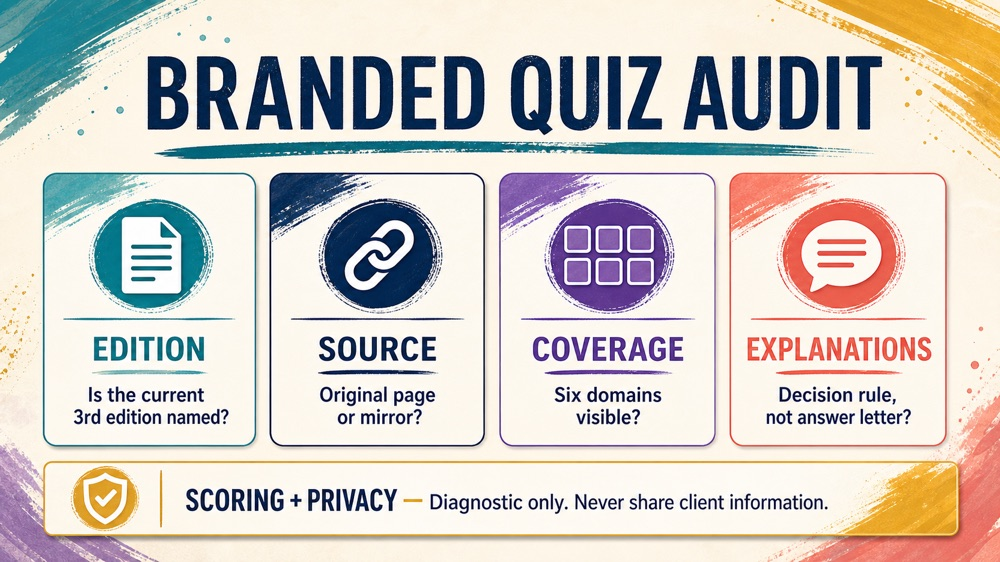
- Edition and source: record the page and check whether its claimed edition matches the current official TCO.
- Coverage and explanations: sample the six domains and confirm that explanations teach observable decisions rather than only answer letters.
- Format and scoring: note the number of presented items, timer, unanswered-item rule, score calculation, and whether the result is diagnostic only.
- Privacy and claims: avoid entering client information; reject official-question, leaked-content, or guarantee language.
Give each category a simple status: ready, needs checking, or stop. “Needs checking” means you can still use the resource for a limited study purpose while you verify the gap. “Stop” means the page makes a claim or asks for information that should not be trusted. This keeps the decision proportional instead of treating every free quiz as either perfect or useless.
A branded resource can pass the basic audit without being your only study tool. Use it for an initial diagnostic, then compare your error pattern with the current TCO. If all your misses are in measurement, review Domain A. If your score is high but explanations are shallow, create original scenarios before increasing the timer.
Original practice decisions
The following prompts are newly written for this guide. They are not copied from Blossom Children’s Center, a mirror, Quizlet, the BACB, or any secure examination. They are not official, recalled, leaked, or BACB-endorsed questions.
- Measurement: A stem says the response lasted from 10:04:12 to 10:04:29. The learner is asked for the time the response continued. Which measurement family should you review, and what fact controls the choice? Look for duration because the question describes how long the response lasted, not how many times it occurred.
- Procedure fidelity: A written plan specifies a three-second wait before the prompt. A practice-taker says the learner “looked confused” after one second and prompts immediately. What should the correction identify? The observable timing and the written prompt rule; an inferred state does not authorize a procedure change.
- Domain coverage: A mock has 80 items but none labeled documentation or ethics. What should you do before calling the score comprehensive? Mark the coverage gap, review Domains E and F separately, and do not infer six-domain readiness from the total score.
- Source claims: A quiz says its questions are “actual exam items.” What is the study-safe response? Do not treat the claim as authority or seek leaked content. Use independent, original questions and official sources for current exam information.
- Explanation quality: The answer key says “C is correct” but does not explain the observable clue. What should your correction log record? The missing decision rule. Check the official concept, write your own rationale, and use another scenario to test transfer.
- Privacy: A free quiz asks you to paste a recognizable client note so it can generate a personalized explanation. What should you do? Do not submit identifying client information. Use a fictional or fully de-identified study scenario and follow workplace privacy rules.
For each prompt, change one fact and answer again. If the answer changes, name the changed fact. That is more useful than repeatedly memorizing the original option.
Turn a score into a study plan
Use a third-party score as a starting measurement, not a label. Record:
| Record | Why it matters | Next action |
|---|---|---|
| Edition and date checked | Prevents an old or mirrored page from silently controlling your plan. | Verify current official sources before changing the scope. |
| Domain or topic of each miss | Shows whether the problem is concentrated or broad. | Choose one domain block and one contrast pair. |
| Confidence before answer | Separates lucky guesses from stable retrieval. | Review low-confidence correct answers too. |
| Explanation quality | Shows whether the resource teaches a rule. | Write a source-grounded rationale when feedback is thin. |
| Transfer result | Checks whether the decision survives a changed fact. | Retest after a delay with an original scenario. |
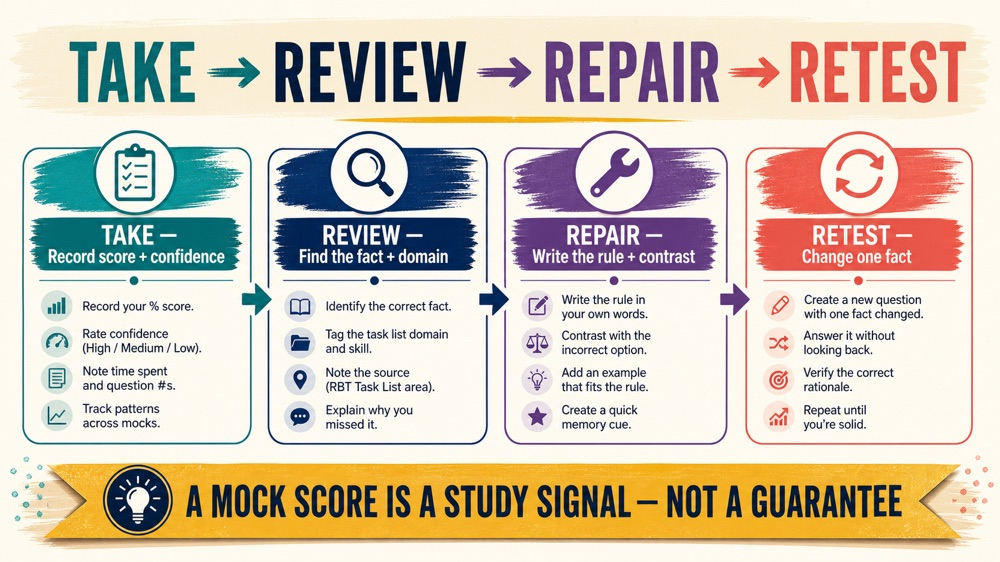
Use the sequence take → review → repair → retest. “Review” means locate the fact and rule. “Repair” means write the contrast and role-safe action. “Retest” means solve a changed item without looking at the answer key. A high first score with no correction may be less useful than a lower score followed by specific repair.
Keep exam pacing as a later stage. Early sessions should make explanations complete. When you add timing, preserve the review block so speed does not hide unsupported guesses. The current official exam facts belong in your source note; the independent score belongs in your personal study log.
Avoid common branded mock-exam mistakes
- Searching only by the brand: identify the actual publisher, page type, and current edition.
- Confusing a mirror with the original: record the source and do not assume a copied quiz has current explanations.
- Treating 85 questions as official: distinguish third-party presented items from 75 scored and 10 unscored pilot questions.
- Using a score as a promise: practice cannot guarantee certification or a passing result.
- Ignoring domains: audit A through F instead of relying on a total percentage.
- Skipping explanations: review the decision rule and nearest contrast after every miss.
- Sharing client information: use fictional or properly de-identified study material.
- Calling independent content official: label original practice honestly and return to BACB sources for current rules.
Bottom line: use a Blossom RBT mock exam or any branded third-party quiz as a diagnostic only after checking its source, edition, coverage, explanations, scoring, privacy, and claims. Then use the current RBT TCO and Handbook to anchor your study plan. The best outcome is not a branded score; it is a clear correction list that tells you what to review next.
Ready to repair your next weak domain?
Use original RBT practice questions, review every explanation, and turn the largest error group into your next study block.
See the Three RBT Mock Exams →
Frequently Asked Questions
What is the Blossom RBT mock exam?
The branded search may refer to a free third-party quiz associated with Blossom Children’s Center, a community mention, or a mirror. Check the original page and current availability before relying on it.
Is a Blossom RBT mock exam official?
No third-party brand name makes a quiz official. Use the current BACB TCO and Handbook for official examination information, and treat independent questions as study content.
How many questions should an RBT mock exam have?
There is no required third-party length. The current written-exam context includes 75 scored questions and 10 unscored pilot questions, but an independent provider may use a sampler, topic set, or different simulation length.
Can a practice score predict whether I will pass?
No. A practice score is a local study signal. It cannot guarantee certification, a passing result, eligibility, or alignment with secure examination content.
How should I review a branded mock-exam result?
Record the edition, map misses to the six current domains, read the explanation, write the decision rule, and retest with an original scenario after a delay.
References
- Behavior Analyst Certification Board. RBT Test Content Outline, 3rd edition.
- Behavior Analyst Certification Board. RBT Test Content Outline, 3rd-edition PDF.
- Behavior Analyst Certification Board. RBT Handbook.
- Blossom Children’s Center RBT mock-exam page. Reviewed as a third-party branded search result; not an endorsement and availability may change.
- Independent RBT practice-exam resource. Reviewed for competitor research; not an endorsement.
- Independent RBT practice-question resource. Reviewed for competitor research; not an endorsement.