

If you are looking for discontinuous measurement ABA examples, the key is to identify exactly when the RBT records behavior. Discontinuous measurement samples behavior across predefined intervals instead of recording every occurrence continuously. The three procedures named in the current RBT Test Content Outline, 3rd edition, are partial-interval recording, whole-interval recording, and momentary time sampling.
Table of Contents
- Discontinuous measurement ABA examples: start with the recording question
- One behavior, one eight-interval time line, three scoring rules
- Partial-interval recording: examples and common traps
- Whole-interval recording: examples and common traps
- Momentary time sampling: examples and common traps
- Discontinuous measurement ABA examples: how to read the clue
- RBT implementation and data-fidelity checklist
- Original discontinuous measurement practice examples
- Map discontinuous measurement to the six current TCO domains
- Frequently Asked Questions
- References
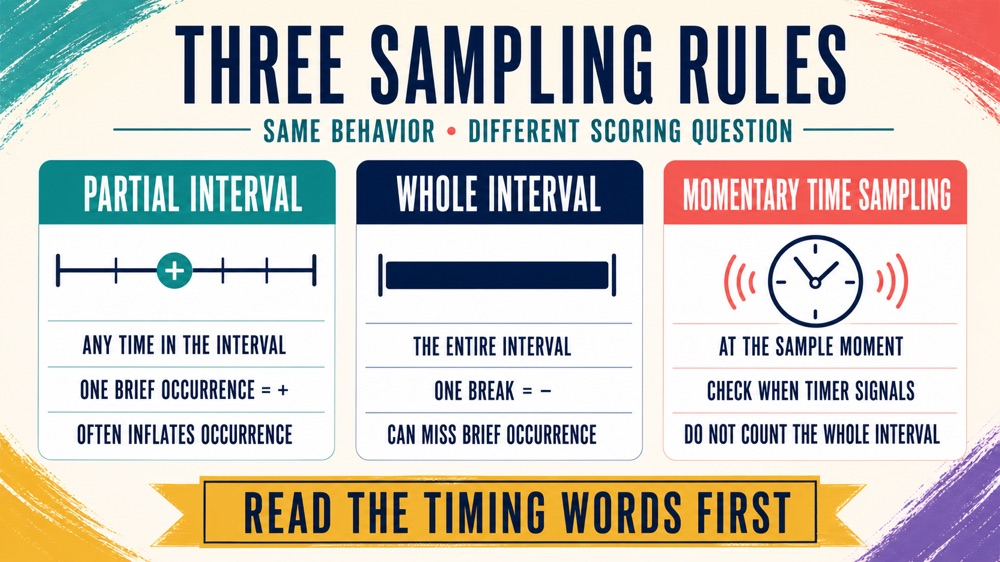
They are not three names for the same rule. Partial interval asks whether the behavior occurred at any time during the interval. Whole interval asks whether it occurred for the entire interval. Momentary time sampling asks whether it is occurring at the specified sample moment. A small wording change in an exam stem can change the correct answer.
The current TCO includes 43 tasks across six domains and places discontinuous measurement in A.2. The current exam presents 85 multiple-choice questions: 75 scored questions and 10 unscored pilot questions, with four answer choices and 90 minutes. This article uses original examples and is not an official question bank. RBTs implement the assigned measurement procedure; they do not independently redesign the data system because one method feels easier.
RBT Training provides independent exam-preparation content and is not affiliated with or endorsed by the BACB. The examples below are newly written for study, not official, recalled, leaked, or BACB-endorsed questions. No study guide can guarantee certification or a passing result.
Discontinuous measurement ABA examples: start with the recording question
Continuous measurement attempts to capture each relevant occurrence or the full duration, latency, or interresponse time defined by the plan. Discontinuous measurement samples only part of the observation period. The result is useful only when the sampling rule, interval length, target definition, and recording instructions are clear.
| Procedure | Question answered | Record a “yes” when… |
|---|---|---|
| Partial interval | Did the behavior occur at any point in the interval? | It occurred even once or briefly during the interval. |
| Whole interval | Did the behavior occur for the entire interval? | It was present throughout the complete interval. |
| Momentary time sampling | Was the behavior occurring at the sample moment? | It is occurring when the timer signals the defined moment. |
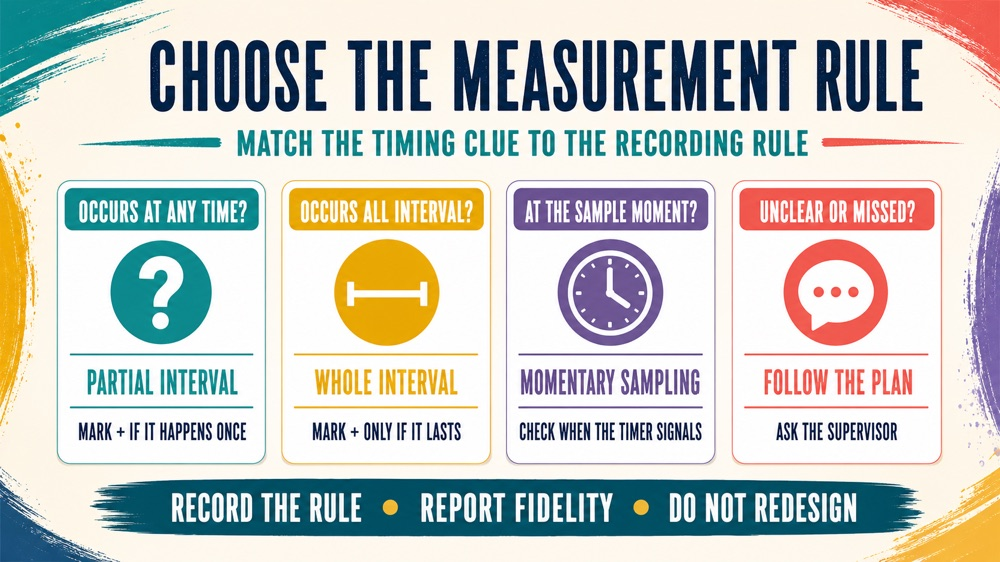
The phrase “at any time” points toward partial interval. “Throughout the entire interval” points toward whole interval. “At the end,” “at the beginning,” or “when the signal sounds” points toward momentary time sampling, depending on the plan’s stated sample moment.
One behavior, one eight-interval time line, three scoring rules
Use the same example to see why the procedures produce different percentages. Suppose an RBT observes hand-to-head contact for eight 30-second intervals. The behavior occurs briefly in intervals 1, 3, and 5; it continues through all of interval 6; it is absent in intervals 2, 4, 7, and 8. At the end of each interval, the observation record looks like this:
| Interval | Observed pattern | Partial | Whole | MTS at end |
|---|---|---|---|---|
| 1 | Brief contact, then stops | + | − | − |
| 2 | No contact | − | − | − |
| 3 | Brief contact, then stops | + | − | − |
| 4 | No contact | − | − | − |
| 5 | Brief contact, then stops | + | − | − |
| 6 | Contact throughout interval | + | + | + |
| 7 | No contact | − | − | − |
| 8 | No contact | − | − | − |
For this made-up session, partial interval is 4/8, or 50%. Whole interval is 1/8, or 12.5%. Momentary time sampling at the end is 1/8, or 12.5%. The percentage is not a direct count of every contact; it is the output of the defined sampling rule.
Partial-interval recording: examples and common traps
In partial-interval recording, mark the interval if the target behavior occurs at any point during it. A one-second occurrence and a 29-second occurrence can both produce the same “+” for that interval. That is why partial interval answers an occurrence-across-intervals question, not a duration question.
Example 1—calling out: the plan divides a group lesson into 1-minute intervals. A learner calls out once for two seconds in interval 2 and remains quiet for the rest of the interval. Partial interval for interval 2 is “+.” It is not “−” because the behavior did not last long.
Example 2—movement: during a 10-minute observation with 10 one-minute intervals, a learner leaves the seat for any amount of time in intervals 1, 2, 5, and 9. The partial-interval percentage is 4/10, or 40%.
Common trap: a stem says “the behavior was present for the entire interval.” That is a whole-interval rule, even if the behavior also occurred at some point. Another trap is counting each occurrence within an interval; partial interval normally records whether the interval is scored, not how many times the behavior occurred inside it.
Partial interval can be useful when the team needs a practical sample of whether a behavior occurred during periods that are difficult to observe continuously. Because a brief occurrence can mark a whole interval, the method can tend to overestimate occurrence relative to a continuous measure. That is a measurement characteristic, not proof that the method is always wrong.
Whole-interval recording: examples and common traps
In whole-interval recording, mark the interval only when the behavior occurs for the complete interval. If the learner stops for even part of the interval, the interval is scored “−” for whole-interval occurrence. This makes whole interval sensitive to sustained behavior across the entire sample.
Example 1—on-task behavior: an RBT observes 5-minute work intervals and the definition says “on task” requires hands engaged with the assigned materials and eyes oriented toward the relevant materials. The learner is on task for the first four minutes but looks away for 10 seconds. That interval is “−” under whole-interval recording.
Example 2—staying in area: a learner remains in the designated area for three complete intervals, steps outside briefly during interval 4, and returns before interval 5. Whole-interval recording scores intervals 1–3 as “+,” interval 4 as “−,” and scores interval 5 according to what happens during all of interval 5.
Common trap: a stem says “the behavior occurred at least once.” That is not whole interval. Another trap is treating a short break as irrelevant; under the stated rule, the break means the behavior did not occur for the whole interval.
Whole interval can tend to underestimate occurrence or sustained performance when the behavior is interrupted briefly. It may be appropriate when the team cares about behavior continuing for the entire interval, such as sustained engagement, but the RBT follows the written plan rather than selecting the rule based on a preferred result.
Momentary time sampling: examples and common traps
Momentary time sampling records whether the behavior is occurring at a specified moment, often when a timer signals at the end or beginning of each interval. The RBT observes the defined moment, records the result, and then waits for the next sample. Behavior that occurred earlier but is absent at the sample moment is not scored for that sample.
Example 1—independent work: the timer signals at the end of each 2-minute interval. The learner worked for 90 seconds, played with a pencil for 20 seconds, and resumed work just before the signal. If the learner is working at the signal, MTS scores “+,” even though the entire interval was not on task.
Example 2—stereotypy: the target behavior occurs for 15 seconds near the middle of interval 3 but stops before the sample moment. MTS scores “−” for interval 3. It does not count every occurrence during the interval.
Common trap: “at any time during the interval” is partial interval, not MTS. “For the entire interval” is whole interval. The sample moment must be identified from the plan; do not invent a different timing point because it is easier to notice.
Discontinuous measurement ABA examples: how to read the clue
When an exam question gives a scenario, underline the decision phrase before calculating anything:
| Stem phrase | Likely rule | Why |
|---|---|---|
| “At any point” or “once or more” | Partial interval | Any occurrence marks the interval. |
| “For the entire interval” or “throughout” | Whole interval | The behavior must persist for all of the interval. |
| “When the timer sounds” or “at the end” | Momentary time sampling | The record is taken at one defined moment. |
| “How many times?” | Check whether frequency or event recording is specified | Discontinuous sampling does not automatically count every event. |
| “How long?” | Check whether duration is specified | Interval percentages are not automatically total duration. |
For example: a question says, “The RBT marks an interval if hand flapping occurs at least once during the 20-second interval.” The phrase “at least once” is the scoring clue for partial interval. If the question instead says, “The RBT marks an interval only if hand flapping occurs for all 20 seconds,” choose whole interval. If it says, “The RBT checks whether hand flapping is occurring when the beep sounds,” choose momentary time sampling.
RBT implementation and data-fidelity checklist
The current TCO says the RBT implements discontinuous measurement procedures. That does not mean the RBT independently designs the study, chooses a new interval length, or changes the method to make the graph look better. Use this checklist:
- Read the operational definition and confirm the target behavior.
- Confirm the interval length, number of intervals, sample moment, and recording symbols.
- Use the timer or approved tool consistently.
- Record according to the rule, not according to how intense or important the behavior feels.
- Ask the supervisor when the definition, timing, or procedure is unclear.
- Document interruptions, missed intervals, device problems, or other fidelity concerns according to the plan.
- Never alter data after the fact to remove an inconvenient “+” or create a cleaner trend.
Reliable data also depends on the rest of the measurement system. Domain A.5 asks for observable and measurable descriptions; A.6 includes calculating and summarizing data; A.8 addresses risks associated with unreliable data and poor procedural fidelity. Documentation and ethics matter because a percentage without a clear rule can mislead the team.
Original discontinuous measurement practice examples
Question 1: the RBT records “+” if a learner makes any vocal protest during a 1-minute interval. The learner protests for three seconds. Which method is being used?
Answer: partial-interval recording. The interval is marked because the behavior occurred at any point.
Question 2: the RBT records “+” only when the learner remains engaged for the full 2-minute interval. The learner looks away for five seconds. What should be recorded?
Answer: “−” for that whole interval, because the behavior did not meet the throughout-the-entire-interval rule.
Question 3: the timer beeps at the end of each interval. The target behavior occurred earlier but is absent at the beep. What does the RBT record?
Answer: “−” for that momentary sample, assuming the plan defines the end-of-interval beep as the sample moment.
Question 4: the RBT notices that partial-interval data are high because a brief behavior marks a full interval and asks whether to change the method immediately.
Answer: continue the assigned procedure, document the concern, and contact the supervisor. The RBT should not independently redesign the measurement system.
These examples are newly written for study and are not official, recalled, leaked, or BACB-endorsed questions. Explain the rule in one sentence after answering; if you cannot explain why the other two procedures do not fit, review the timing words again.
Map discontinuous measurement to the six current TCO domains
| Domain | Connection | Review prompt |
|---|---|---|
| A. Data Collection and Graphing | Implement partial, whole, and momentary procedures; summarize and graph the resulting data. | What does one “+” represent? |
| B. Behavior Assessment | Use the assigned observation system when participating in assessment procedures. | Am I following the assigned method? |
| C. Behavior Acquisition | Measure teaching targets with the plan’s stated response and sampling rule. | Does the data match the skill criterion? |
| D. Behavior Reduction | Record target behavior safely and consistently without changing the intervention. | What should be reported if risk or fidelity changes? |
| E. Documentation and Reporting | Record interruptions, missing samples, and objective context. | Could the supervisor reconstruct the observation? |
| F. Ethics | Protect data integrity, competence, privacy, and client interests. | Am I reporting the result honestly? |
Bottom line: partial interval means “at any time,” whole interval means “throughout,” and momentary time sampling means “at the sample moment.” Use these discontinuous measurement ABA examples to rehearse the timing words, then use the current plan, record the defined rule, explain the measurement tradeoff, and ask the supervisor before changing the system.
Practice the timing words before a full mock.
Use original RBT questions to distinguish partial interval, whole interval, momentary sampling, and continuous measurement.
Try free RBT practice questions →
Frequently Asked Questions
What are the three main discontinuous measurement procedures?
The current RBT TCO names partial-interval recording, whole-interval recording, and momentary time sampling as examples of discontinuous measurement procedures.
What does partial interval mean?
Record the interval if the target behavior occurs at any point during it, even if the occurrence is brief.
What does whole interval mean?
Record the interval only if the target behavior or performance occurs for the entire interval.
What does momentary time sampling mean?
Record whether the behavior is occurring at the defined sample moment, such as when a timer signals at the end of an interval.
Which discontinuous method is best?
There is no universal answer. The supervisor or behavior analyst selects the system for the target, context, and purpose; the RBT implements it as written and reports fidelity concerns.
Are these discontinuous measurement examples official exam questions?
No. They are newly written educational examples and are not official, recalled, leaked, or BACB-endorsed questions.
References
- Behavior Analyst Certification Board. RBT Test Content Outline, 3rd edition.
- Fiske, K. E., et al. Use of Discontinuous Methods of Data Collection in Behavioral Intervention: Guidelines for Practitioners.
- LeBlanc, L. A., et al. Procedures and Accuracy of Discontinuous Measurement of Problem Behavior in Common Practice of Applied Behavior Analysis.
- RBT Hub discontinuous measurement questions. Reviewed for competitor research; not an official BACB source.
- Theralytics discontinuous measurement guide. Reviewed for competitor research.
- Praxis Notes measurement comparison. Reviewed for competitor research.