
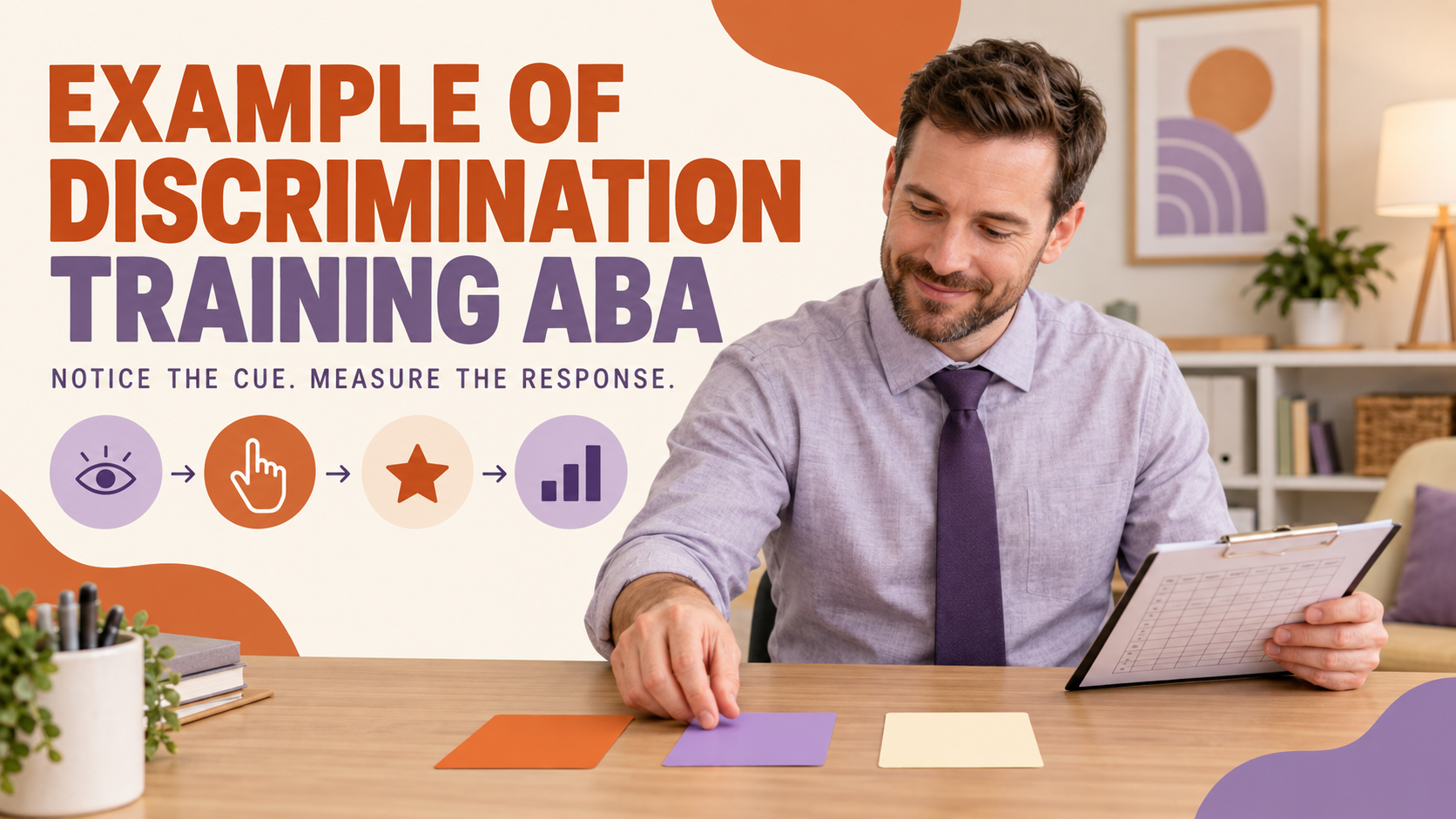
An example of discrimination training ABA becomes easier to understand when you separate the cue, the learner’s response, the programmed outcome, and the data.
Table of Contents
- Example of discrimination training ABA: quick answer
- What discrimination training means
- SD, S-delta, response, and outcome
- A worked color-card example
- Other everyday and ABA examples
- How a supervised teaching sequence works
- What the RBT records
- Errors, prompts, and fading
- Discrimination versus generalization
- RBT scope and ethical boundaries
- Frequently asked questions
Stimulus discrimination, SD and S-delta, reinforcement, data collection, generalization, and RBT role boundaries
Example of Discrimination Training ABA: A Clear RBT Guide
An example of discrimination training ABA becomes easier to understand when you separate the cue, the learner’s response, the programmed outcome, and the data. In a simple discrimination, one stimulus signals that reinforcement is available for a particular response, while another stimulus signals that the same response will not produce that programmed outcome. This guide explains the idea with original examples, shows how discrimination differs from generalization, and clarifies what an RBT implements under supervision.
Example of discrimination training ABA: quick answer
Suppose a written program teaches a learner to touch a red card when the instruction is “touch red.” The red card is the target stimulus in that trial, the learner’s touch is the response, and the specified reinforcer follows a correct response. When a blue card is presented as the non-target comparison, the program does not deliver that same programmed consequence for touching blue. Across repeated, carefully arranged opportunities, the learner learns to respond differently in the presence of the relevant cue.
This is only an educational example. An RBT should not create a new discrimination-training procedure, choose a reinforcer, change the comparison stimuli, or decide the mastery criterion without the authorized supervisor’s plan. The technician implements the current procedure, records what occurs, and reports unclear instructions or patterns in the data.
What discrimination training means
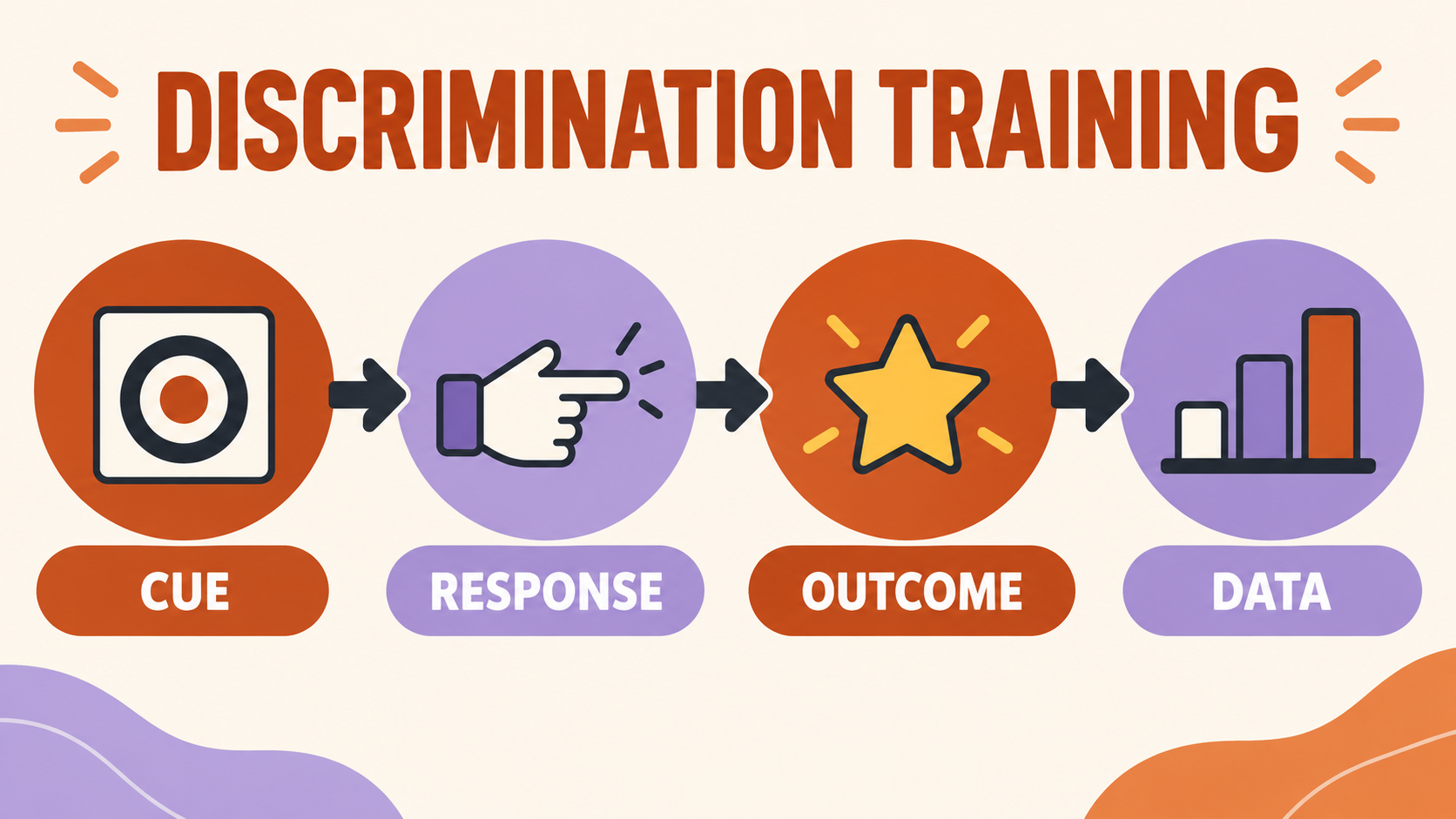
Discrimination training teaches a learner to respond differently to different stimuli or stimulus conditions. The stimuli may be objects, colors, words, sounds, gestures, people, locations, or combinations of features. The important question is not whether the stimuli look different to an adult; it is whether the teaching arrangement establishes a reliable relation between a relevant cue, a response, and its consequence.
Stimulus control is the result of learning in which behavior occurs more reliably in the presence of some conditions than others. A learner may learn to select a cup when asked for “cup,” stop at a particular safety signal, sort items by color, or follow a classroom direction when it is given by the designated teacher. These skills can be useful, but the team must define the goal in a way that respects the learner’s communication, safety, culture, and daily environment.
Discrimination training is not the same as making a learner obey every adult or ignore their own preferences. A plan should specify why the discrimination matters, what response is being taught, what choices remain available, and how the learner can request help or a break.
SD, S-delta, response, and outcome
Several terms help organize an example:
- SD: a stimulus or condition that signals reinforcement is available for a particular response under the programmed contingency.
- S-delta (SΔ): a stimulus or condition that signals that the same programmed reinforcement is not available for that response under the current contingency.
- Response: the observable action the learner is expected to perform, such as selecting, pointing, saying, moving, matching, or using AAC.
- Outcome: what follows the response according to the plan, such as reinforcement, correction, another opportunity, or no programmed consequence.
The labels are not magic words. The team must arrange the teaching history and measure responding. A stimulus is not an SD simply because an adult calls it one. It functions as an SD when the relevant learning history and current arrangement make the response more likely and reinforcement is available as specified.
A worked color-card example
Imagine an authorized program for color identification. The program presents one red card and one blue card, gives the instruction “touch red,” and defines a correct response as touching the red card within the stated response interval. The supervising clinician has already selected the materials, prompt procedure, reinforcement, error correction, and data system.
- Arrange the trial: place the cards as the program directs and deliver the stated instruction.
- Observe the response: record whether the learner touches red, touches blue, does not respond, or needs a prompt.
- Follow the consequence: deliver the programmed outcome for the defined correct response and use the approved correction for an error.
- Vary the arrangement as authorized: change position or materials only according to the written plan so the learner does not learn “red is always on the left.”
- Review the data: report accuracy, prompt level, errors, and any relevant context to the supervisor.
The discrimination is not simply “red is good and blue is bad.” The learner is learning which response is relevant under a specific instruction and arrangement. If the learner touches any item that is closest, the plan may need to address position bias. If the learner responds to brightness rather than color, the team may need to review stimulus salience. The RBT records the pattern rather than guessing at the cause.
Other everyday and ABA examples
Here are additional examples that illustrate the same structure. They are study examples, not ready-to-run programs:
- Instruction discrimination: when the instruction is “stand,” the learner stands; when the instruction is “sit,” the learner sits. The words and the programmed consequences distinguish the responses.
- Picture selection: when shown a field of pictures and asked for “dog,” the learner selects the dog picture rather than the cat or bird picture.
- Functional communication: when the snack-choice board is available and the learner selects “cracker,” the team responds according to the communication plan; an unrelated card does not produce the same programmed outcome.
- Community cue: a written safety plan may teach a learner to pause when a specific signal appears and then check with a trusted adult. The signal, response, and safety follow-up must be individualized and directly supervised.
- Social context: a learner may learn that a particular conversation opener is appropriate during a group activity, while a different response is appropriate during quiet work. The goal should support flexible, meaningful communication rather than a rigid performance.
In each case, ask what the relevant stimulus is, what response is being measured, what outcome is programmed, and how the team will know whether the skill works outside the teaching arrangement.
How a supervised teaching sequence works
A well-designed sequence usually begins with a clearly defined target and a baseline or initial observation. The supervisor selects stimuli that are meaningful and sufficiently distinct for the learner’s current skill level. Early teaching may use clear contrasts, then gradually introduce more similar examples as the learner demonstrates accuracy.
The team may use prompts to prevent repeated errors or to help the learner contact the correct response. The prompt type, timing, and fading rule belong in the plan. Reinforcement should follow the stated response and should be meaningful to the learner. If the learner shows distress, disengagement, or a new communication need, the RBT documents it and contacts the supervisor.
Variation matters. If the learner only responds to one card, one table, one teacher, or one position, the skill may not yet be under the intended stimulus control. Planned variation can include new exemplars, positions, people, rooms, materials, or natural opportunities. Do not add variation randomly during a session if it changes the program or creates a safety risk.
What the RBT records
The data system should match the written program. It may include:
- the number of opportunities presented;
- correct, incorrect, no-response, and prompted responses;
- which comparison or stimulus arrangement was used;
- prompt type and prompt level;
- latency or response interval when specified;
- reinforcement delivered according to the plan; and
- generalization or maintenance probes when authorized.
Write objective notes. “The learner was confused” is an interpretation. “Across ten trials, the learner selected the card nearest the right hand on six trials, including four incorrect selections; the RBT used the programmed model prompt on three trials” gives the supervisor something to analyze.
Errors, prompts, and fading
An error is information about the current teaching arrangement. It may show that the instruction is unclear, the stimuli are too similar, the learner needs a prompt, the response definition is incomplete, or the task is not meaningful at that moment. The RBT follows the approved error-correction procedure instead of adding a personal consequence.
Prompting can help the learner experience the correct relation, but a prompt can also become an unintended cue. Prompt fading should be planned and based on the learner’s data. If a learner responds only after a point, model, or verbal hint, record the prompt level. Do not mark the response independent just because the learner eventually answered correctly.
If errors increase after a prompt is faded, if accuracy depends on a position or person, or if the learner stops participating, communicate the pattern. The supervisor may review the stimulus arrangement, reinforcement, response effort, prompt procedure, or goal. An RBT’s responsibility is accurate implementation and communication—not independent program redesign.
Discrimination versus generalization
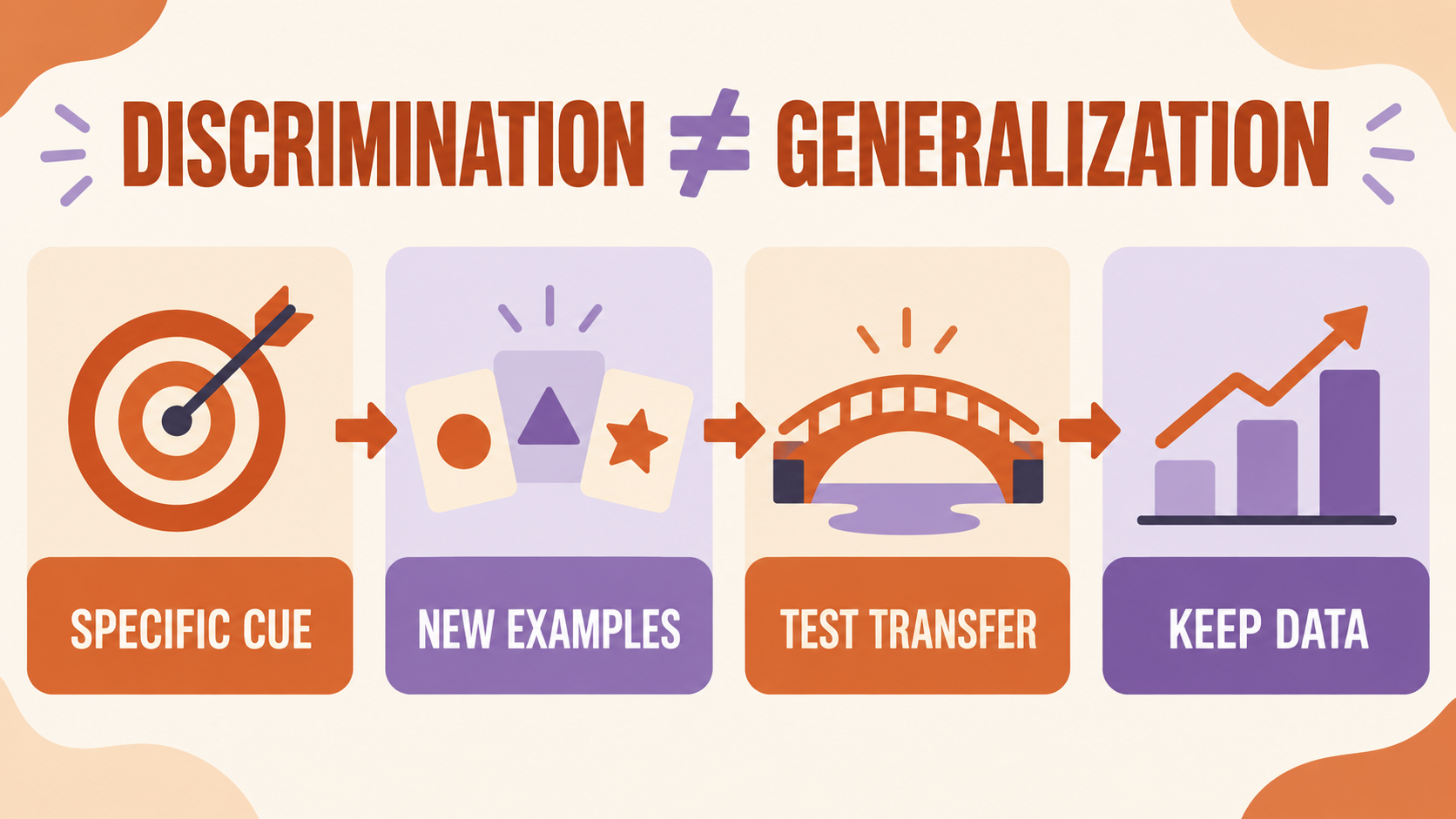
Discrimination narrows responding to relevant differences. Generalization broadens a learned response across appropriate new examples, people, settings, or materials. They are not opposites in practice; good teaching often needs both.
For example, a learner may correctly identify the red card in a clinic but fail to identify a red cup at home. That may indicate limited generalization, not that the original discrimination was meaningless. The team can plan new exemplars and settings, then measure whether the response transfers. Conversely, if the learner touches every colored item, the team may need stronger discrimination of the relevant cue.
Use the learner’s real goals to decide what should generalize. A safety response may need broad transfer across locations, while a narrowly defined sorting task may require precise stimulus features. The supervisor determines the plan and criteria.
RBT scope and ethical boundaries
The BACB RBT Ethics Code requires RBTs to provide behavior-technician services within a clearly defined role under close, ongoing supervision. The RBT should work only after competence has been confirmed, inform the supervisor when a task exceeds competence, protect client dignity and privacy, and communicate necessary information through approved channels.
That means an RBT may implement an authorized discrimination-training program, collect the defined data, and report what was observed. The RBT should not independently choose the target, create a new SD/SΔ arrangement, decide that a learner has mastered the skill, or change reinforcement because a different method seems faster. Ask the supervisor for direction when the plan is missing, contradictory, unsafe, or not producing interpretable data.
Respectful practice also matters. A learner can communicate by speech, sign, picture, device, gesture, or another authorized mode. Do not treat eye contact, stillness, or adult-like performance as the only signs of learning. The goal is meaningful, safe, and functional responding within the learner’s plan.
Frequently asked questions
What is the simplest example of discrimination training in ABA?
A learner is taught to touch a red card when told “touch red” while a blue card is present as a comparison. The correct response contacts the programmed reinforcement, and the team records accuracy and prompts. This is an educational example, not a complete intervention protocol.
What is the difference between SD and S-delta?
An SD signals that reinforcement is available for a particular response under the current contingency. An S-delta signals that the same programmed reinforcement is not available for that response under that condition.
Is discrimination training the same as generalization?
No. Discrimination teaches responding differently to relevant stimuli. Generalization tests or teaches whether the response occurs with appropriate new examples, people, settings, or materials.
Can an RBT design discrimination training?
An RBT should not independently design or change a clinical procedure. The RBT implements the authorized plan, records objective data, and asks the supervisor to review targets, prompts, reinforcement, fading, and mastery criteria.
Where can I verify the RBT role?
Read the BACB RBT Ethics Code and the current RBT Handbook. For research context on stimulus control and discrimination training, review the peer-reviewed overview in PubMed Central. This article is educational information, not individualized clinical advice.
Source note: This article was reviewed against the BACB RBT Ethics Code, current RBT resources, and a peer-reviewed overview of stimulus control and discrimination training, retrieved September 28, 2026. Examples are original teaching scenarios and are not instructions to create an unsupervised intervention.
Ready to practice the RBT concepts you just reviewed?
Try an independent, original RBT practice resource with exam-style questions, scoring, and answer explanations.
References
- Behavior Analyst Certification Board. RBT Test Content Outline, 3rd edition.
- Behavior Analyst Certification Board. RBT Handbook.
- Behavior Analyst Certification Board. RBT Ethics Code.