

When people search for final exam RBT exam questions, they may mean a last practice set, a final-week review plan, or a request for “real” answers. Those are not the same thing. A responsible final review uses original scenarios and clear explanations; it does not search for recalled, leaked, or supposedly guaranteed exam content.
Table of Contents
- What final exam RBT exam questions should do
- Separate final practice from “real answers”
- Map final review to the current TCO
- Use the question decision filter
- Original final-review scenarios
- Build a seven-day correction plan
- Use the last 48 hours wisely
- Avoid common final-exam question mistakes
- Frequently Asked Questions
- References
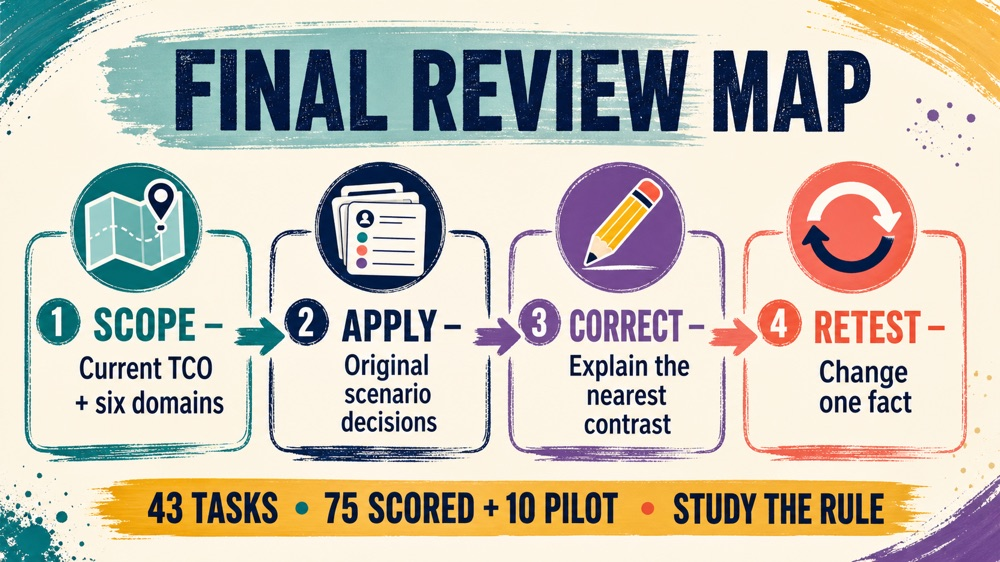
The current BACB RBT Test Content Outline, 3rd edition, describes 43 tasks across six domains. The current written-exam context includes 75 scored questions and 10 unscored pilot questions. A third-party practice test can use 20, 75, 85, or another number of questions, but its item count, timer, and score are independent study features.
RBT Training is an independent educational resource. It is not affiliated with or endorsed by the Behavior Analyst Certification Board (BACB), Pearson VUE, or any practice provider. The examples below are newly written for independent study. They are not official, current, recalled, leaked, or BACB-endorsed questions. No practice score, final review, or study schedule can guarantee certification or a passing result.
What final exam RBT exam questions should do
Final review is not the time to collect random answer letters. A useful final exam RBT exam questions set should make you perform four actions:
- Locate the fact: identify what the stem actually says, not what you assume about the client.
- Match the concept: select the measurement, teaching, reduction, documentation, or ethics rule that fits.
- Respect the role: choose implementation, recording, reporting, or supervision when the situation requires it.
- Explain the contrast: state why the closest distractor fails.
| Weak final review | Strong final review |
|---|---|
| Chases a claimed answer key or “guaranteed” score. | Uses original scenarios and verifies the decision rule. |
| Repeats definitions without a situation. | Changes one fact and tests whether the decision transfers. |
| Treats 75 or 85 as a third-party requirement. | Separates official exam facts from independent practice format. |
| Reviews only wrong letters. | Reviews misses, guesses, low-confidence correct answers, and domain gaps. |
In the final stage, the quality of the explanation matters more than the size of the bank. If an item tells you only that “C is correct,” write your own rationale from the facts and compare it with the current source. Do not let a timer turn an unsupported guess into a false sense of readiness.
Separate final practice from “real answers”
Search results sometimes use phrases such as “final exam answers,” “paper exam,” or “real questions.” Treat that language as a warning. Sharing or seeking secure, recalled, or leaked questions is not a sound study method, and a page claiming to provide them is not made trustworthy by a high score, a file download, or a “graded A+” title.
| Claim or format | Safe interpretation | Better action |
|---|---|---|
| “Real exam questions” | Unverifiable and potentially inappropriate. | Use original questions and current official source documents. |
| “Correct final answers” | May encourage answer memorization or answer sharing. | Study the observable facts and explain the nearest contrast. |
| “85-question simulation” | An independent format that may resemble the presented-item count. | Check its edition, six-domain coverage, timer, and diagnostic limits. |
| “75-question practice exam” | May mirror the official scored-item count. | Remember that matching the count does not make questions official. |
| “Pass guarantee” | A marketing claim, not evidence of readiness. | Use a correction log and consult current BACB information. |
Keeping the boundary explicit protects the learner and the site. This article provides no recalled or leaked material. It teaches how to reason through new practice scenarios and how to verify current facts without turning an independent resource into a substitute for the BACB process.
Map final review to the current TCO
The current TCO gives your final review a coverage check. Do not memorize the domain labels in isolation; use each domain to choose a decision type.
| Domain | Current task range | Final-review question |
|---|---|---|
| A. Data Collection and Graphing | A.1–A.8 | What is observable, which measurement fits, and what does the data show? |
| B. Behavior Assessment | B.1–B.3 | Which assigned assessment procedure applies, and what should be recorded? |
| C. Behavior Acquisition | C.1–C.11 | Which teaching, prompt, reinforcement, maintenance, or generalization step fits? |
| D. Behavior Reduction | D.1–D.7 | What does the written plan require, and when should uncertainty be escalated? |
| E. Documentation and Reporting | E.1–E.4 | How can the note or communication be objective, accurate, and useful? |
| F. Ethics | F.1–F.10 | What protects competence, dignity, privacy, supervision, and boundaries? |
Use the official examination numbers carefully. The written exam presents 75 scored questions and 10 unscored pilot questions. A practice provider may present 75 questions for scored-item practice, 85 for a presented-item simulation, or fewer for a diagnostic set. None of those independent formats reveals which questions will appear on a secure examination or guarantees a result.
Make a quick six-domain grid. Put a check beside the domain if you have completed at least one timed set, one explanation review, and one changed-fact transfer item. A check means “reviewed,” not “mastered.” Use the error log to decide what requires another block.
Use the question decision filter
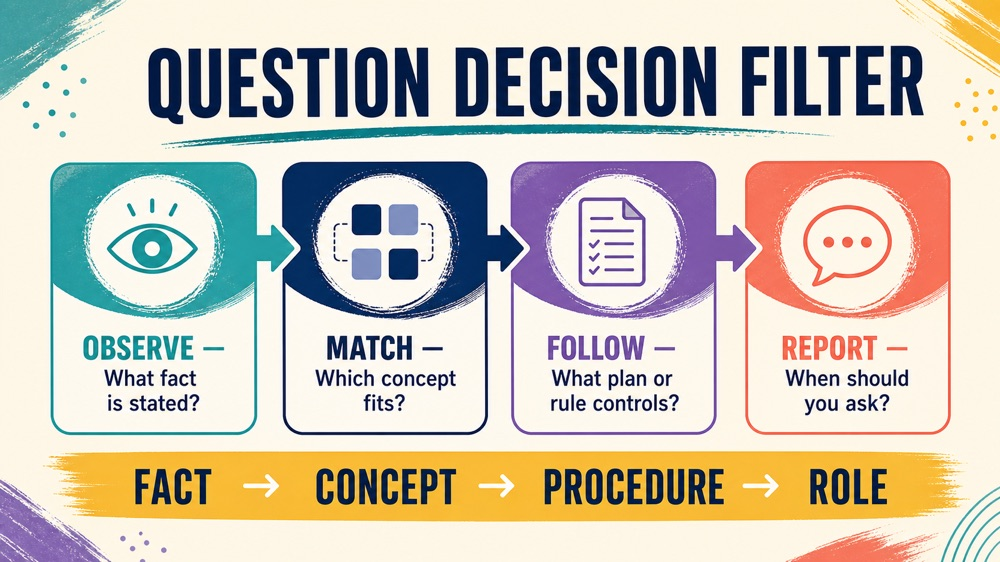
When time is short, use this filter on every difficult stem:
- Observe: underline the behavior, event, measurement, or exact communication described.
- Match: identify the technical concept that controls the decision.
- Follow: locate the written plan, prompt hierarchy, data rule, or ethics boundary.
- Report: if the facts do not authorize an independent change, choose the appropriate supervision or reporting action.
Then eliminate choices that introduce an unsupported motive, change the plan, confuse an antecedent with a consequence, choose a measurement by habit, promise confidentiality outside the proper route, or ask the RBT to make a clinical decision outside the assigned role. The “best” answer is usually the one supported by the facts and the written procedure, not the one with the most impressive vocabulary.
For example: if a stem says a response lasted 20 seconds, do not choose frequency because the number 20 feels measurable. Find the timeline. If it asks how long the response continued, duration is the relevant measurement family. If it asks how many times the response occurred, count or frequency may be relevant. The word “measured” alone is not the clue.
Original final-review scenarios
These are newly written practice prompts. They are not official, current, recalled, leaked, or BACB-endorsed questions, and they are not copied from a final examination.
- Data: During a 30-minute session, a learner leaves the table four times. The plan asks for the average time away from the table. What must you identify before calculating? The duration of each episode and the plan’s calculation rule; the count alone is insufficient.
- Assessment: A supervisor assigns a paired-choice preference procedure, but one listed item is unavailable. What is the safest next step? Pause and ask for the approved adjustment rather than replacing the item or procedure from memory.
- Acquisition: A learner completes the target response independently after the instruction. The plan specifies reinforcement for independent responding. What should you do? Deliver the programmed consequence and record the response accurately; do not add an unnecessary prompt.
- Reduction: A new safety concern appears and the current behavior plan does not state what to do. What should the RBT prioritize? Follow established safety and escalation instructions, protect the client, document observable facts, and contact the responsible professional.
- Documentation: A note says, “The client was manipulative and had a bad attitude.” How should final review classify the problem? Subjective or inferential language; rewrite with observable actions, context, procedure, data, and communication.
- Ethics: A friend asks for a recognizable success story to use in a presentation. What is the role-safe response? Protect confidentiality and use only approved, de-identified communication through the proper professional route.
After each answer, name the nearest distractor and why it fails. Then change one fact: alter the timing, the prompt level, the available material, or the communication request. If your answer changes, explain which fact controlled the change. This is the final-review skill most likely to expose memorized but fragile knowledge.
Build a seven-day correction plan
If the exam is a week away, use the practice result as a map:
| Day | Focus | Evidence to produce |
|---|---|---|
| 7 | Baseline mixed set | Score, confidence, time, six-domain error list. |
| 6 | Data and assessment | Measurement contrasts and one procedure-fidelity correction. |
| 5 | Behavior acquisition | Prompt, reinforcement, chaining, and generalization transfer items. |
| 4 | Behavior reduction | Plan-fidelity, safety, and escalation decisions. |
| 3 | Documentation and ethics | Objective-note rewrites and privacy/scope corrections. |
| 2 | Mixed timed practice | Review of every miss and low-confidence correct answer. |
| 1 | Light retrieval and logistics | Short contrast review, test-center plan, sleep and materials check. |
Do not turn every day into another full-length test. A second or third mock is useful only if you review it. Group errors by decision type: wrong unit, wrong timeline, unsupported inference, procedure change, role boundary, documentation, privacy, or ethics. Your next block should repair the largest group.
Use the last 48 hours wisely
In the last two days, reduce novelty and increase clarity:
- Review your own correction log and the nearest contrasts, not a new “final answer” file.
- Complete a short mixed set without chasing a perfect score.
- Explain one example for each current domain aloud or in writing.
- Confirm current administrative information through the BACB Handbook and examination information page.
- Protect privacy; never paste identifiable client notes into a public quiz or AI prompt.
- Stop studying early enough to arrive rested. A late-night answer hunt is not a substitute for retrieval and reasoning.
If a resource changes its policy, edition, or question count while you are studying, record the date and return to the official source for current facts. Do not let a last-minute marketing message redefine the exam.
Avoid common final-exam question mistakes
- Searching for leaked answers: use original scenarios and protect examination integrity.
- Confusing 75 with 85: distinguish scored questions from total presented items and independent mock length.
- Using a third-party pass mark as official: treat it as a provider’s study threshold only.
- Memorizing the stem: change one fact and practice transfer.
- Ignoring the six-domain map: a high total can hide a weak domain.
- Changing the written plan: follow the assigned procedure and seek direction.
- Writing subjective documentation: replace labels with observable, reportable facts.
Bottom line: a strong final review does not need real or leaked questions. Use current official sources for scope and exam facts, original scenarios for application, detailed explanations for correction, and a six-domain log for prioritization. Your target is not to memorize a final answer file; it is to make accurate, role-safe decisions when the wording changes.
Ready for a final diagnostic set?
Use original RBT practice questions, review the rationale behind every miss, and choose your final study block from the error pattern.
Try Free RBT Practice Questions →
Frequently Asked Questions
Where can I find final exam RBT exam questions?
Use original independent practice questions from a clearly labeled resource, then review them against the current TCO and Handbook. Do not seek recalled, leaked, or supposedly official answer files.
Are final exam RBT exam questions online official?
Third-party pages are not official simply because they use “final,” “Pearson,” or a matching question count. The examples in this guide are independent and not BACB-endorsed.
Should I practice 75 or 85 questions?
Both can be useful independent formats. The current written-exam context includes 75 scored questions and 10 unscored pilot questions, while a provider may choose a shorter set or an 85-question simulation.
How should I review a final practice score?
Map misses and low-confidence answers to the six domains, write the decision rule and nearest contrast, then retest with one changed fact.
Can final practice guarantee that I will pass?
No. A practice score or study plan cannot guarantee certification, a passing result, eligibility, or the content of a secure examination.
References
- Behavior Analyst Certification Board. RBT Test Content Outline, 3rd edition.
- Behavior Analyst Certification Board. RBT Test Content Outline, 3rd-edition PDF.
- Behavior Analyst Certification Board. RBT Handbook.
- Behavior Analyst Certification Board. Examination information.
- Independent RBT practice-question hub. Reviewed for competitor research; not an endorsement.
- Independent RBT practice-exam resource. Reviewed for competitor research; not an endorsement.