
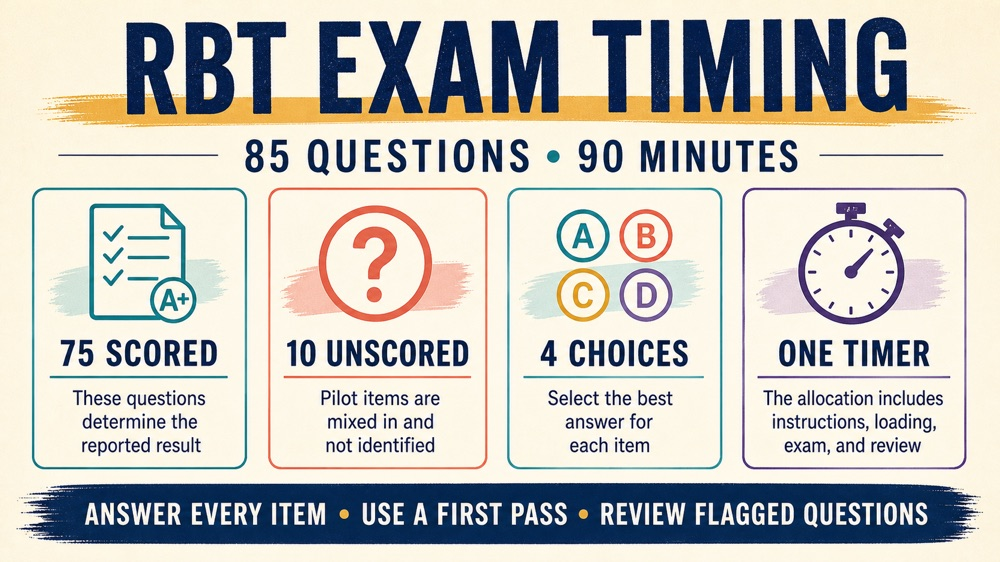
If you are asking how long is the RBT exam, the current answer is 90 minutes. The official RBT certification examination presents 85 multiple-choice questions, and each question has four answer choices. That headline number is the total examination allocation, not a promise that every second is available for uninterrupted question solving.
Table of Contents
- How long is the RBT exam? The direct answer
- How long is the RBT exam? What the 90 minutes includes
- How 85 questions fit into a 90-minute RBT exam
- Why 75 scored and 10 unscored questions still require the same pace
- How the 3rd-edition blueprint affects your timing plan
- A practical timed-practice plan for the 90-minute limit
- How to pace scenario questions without guessing
- What to do before and on RBT exam day
- Common timing mistakes on the RBT exam
- Frequently Asked Questions
- References
The current RBT Handbook explains that the allocation includes reviewing the Terms and Conditions, the exam navigation tutorial, a load-time prompt, the examination itself, and any review. That is why a good study plan practices the full experience: instructions, navigation, question decisions, flagging, and final review.
Of the 85 presented questions, 75 are scored and 10 are unscored. Candidates cannot identify the unscored questions, so every item deserves a serious attempt. The current RBT Test Content Outline (3rd ed.) organizes the scored examination around 43 tasks across six domains. RBT Training’s examples are independent study content, not official, recalled, leaked, or BACB-endorsed questions.
This guide separates official timing facts from independent pacing suggestions. It does not guarantee a passing result, certification, a particular score, or extra time. Recheck the current BACB Handbook and Pearson VUE BACB page before scheduling.
How long is the RBT exam? The direct answer
The current RBT certification examination is 90 minutes long and presents 85 multiple-choice questions. It is delivered in person through the BACB examination program at an authorized Pearson VUE testing site. Pearson VUE, not an independent study provider, controls the appointment and current delivery instructions.
| Exam fact | Current detail |
|---|---|
| Total examination allocation | 90 minutes |
| Questions presented | 85 multiple-choice questions |
| Scored questions | 75 |
| Unscored questions | 10; candidates cannot identify them during the exam |
| Answer choices | Four choices per question, with one best answer |
| Delivery | In person at an authorized Pearson VUE testing site or eligible military-base site where available |
The phrase “90 minutes” answers the official time-limit question. It does not tell you how much time to spend on a single item, which questions will feel easy, or whether your own practice score predicts a result. Use the facts to design practice, then use the current official pages to verify any policy that could affect your appointment.
How long is the RBT exam? What the 90 minutes includes
The Handbook’s timing language matters because candidates often divide 90 minutes by 85 and assume they have 90 uninterrupted minutes to solve questions. The official allocation includes more than the question screens.
- Terms and Conditions: review the testing rules and acknowledge the required terms.
- Navigation tutorial: learn how to move through the computer-based exam and use available review controls.
- Load-time prompt: allow the examination system to load.
- Question-solving time: read the stems, compare answer choices, make decisions, and flag items when useful.
- Review time: return to flagged or uncertain items and check that every item has an answer before submission.
The list is a description of what the official allocation covers, not a promise that each part consumes a fixed number of minutes. The interface, instructions, and current center procedures control what you see. Practice the whole sequence instead of turning the time limit into a rigid script.
For example: a candidate who spends the first several minutes reading a difficult item repeatedly may feel behind before reaching the later questions. A better independent practice habit is to read for the tested decision, choose the best-supported answer, flag uncertainty when the interface allows it, and preserve time for a second pass.
How 85 questions fit into a 90-minute RBT exam
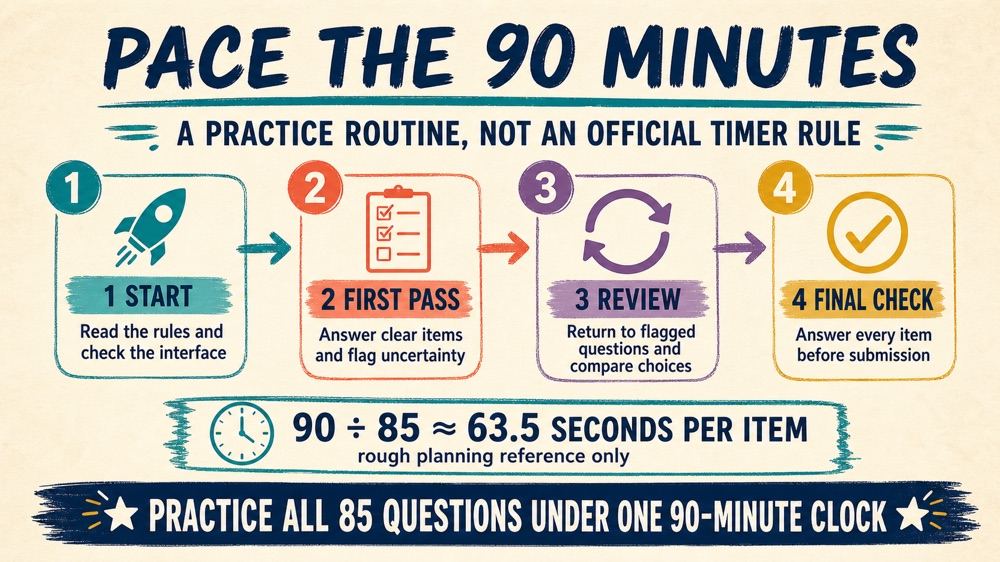
A simple calculation gives 90 minutes divided by 85 presented questions, or about 1.06 minutes per question, roughly 63.5 seconds. That is a planning reference, not an official allocation and not a rule that every item should take exactly 63.5 seconds. Some scenario items require more reading; others should be resolved quickly when the measurement, prompt, reinforcement, or documentation cue is clear.
| Planning idea | How to use it safely |
|---|---|
| Average pace | Use about one minute per presented item as a rough warning against spending five minutes on one question. |
| Flagging | Mark uncertainty and continue when the exam interface permits; do not let one ambiguous stem consume the whole review window. |
| All 85 items | Answer every question because you cannot identify which 10 are unscored. |
| Review buffer | Build a second-pass goal into practice rather than reaching the final item with no time to check omissions. |
The calculation also explains why a full-length practice exam should use the official question count and total time. A 20-question quiz can check a concept, but it cannot reveal whether your reading speed, decision habits, and review routine hold up across 85 items.
Why 75 scored and 10 unscored questions still require the same pace
The exam presents 85 questions, but the Handbook identifies 75 scored questions and 10 unscored questions. The candidate is not given a reliable label that says which item is unscored. Treating a question as “probably pilot” is therefore a poor timing strategy.
- Read every item: do not skip a question because you hope it will not count.
- Use the stem: identify the observable behavior, measurement system, teaching step, ethical boundary, or documentation decision being tested.
- Compare all choices: select the best answer supported by the scenario, not the first familiar term.
- Keep moving: if two choices remain plausible, flag the item if possible and protect time for the rest of the exam.
- Review systematically: return to flagged questions after reaching the later items, rather than restarting the entire exam.
Do not use an unofficial “you can miss exactly X questions” rule to budget time. The BACB uses its own scoring and exam-development procedures, and public practice-site percentages are not a substitute for the current official score report or Handbook.
How the 3rd-edition blueprint affects your timing plan
The time limit stays fixed while the content decisions change from item to item. The current RBT Test Content Outline (3rd ed.) contains 43 tasks across six domains: Data Collection and Graphing, Behavior Assessment, Skill Acquisition, Behavior Reduction, Documentation and Reporting, and Professional Conduct and Scope of Practice. The time plan should therefore train applied discrimination across domains rather than memorize a single definition list.
| Study question | Timing connection |
|---|---|
| Can I identify what is directly observable? | Fast, precise reading helps with measurement and objective-note items. |
| Can I match a method to the scenario? | Practice choosing among continuous, discontinuous, preference, ABC, teaching, and reduction procedures. |
| Can I recognize a scope boundary? | Do not invent a clinical decision when the correct action is to follow the plan or contact the supervisor. |
| Can I explain why the choice fits? | Reasoning practice reduces rereading when distractors use familiar vocabulary. |
A full-length timed set should sample all six domains and use original scenarios. RBT Training’s study explanations can help you review a mistake, but they are not the BACB exam, recalled content, leaked content, or a guarantee of the official result.
A practical timed-practice plan for the 90-minute limit
The following is an independent study routine, not a BACB rule. Use it to rehearse the total format and then adjust it to your reading speed and accommodation plan. The goal is controlled decisions, not racing.
- Start with a complete simulation: use 85 original questions, four choices, and a 90-minute total timer. Include instructions and a short navigation check before the first item.
- Set checkpoint reminders: during practice, note your progress around the first third, the two-thirds mark, and the final review window. The checkpoints should tell you whether you are stuck, not force every question into the same number of seconds.
- Use a first pass: answer clear items, mark uncertainty, and move on. Write down the item number and reason for uncertainty only if your practice system allows it.
- Run a second pass: return to flagged items, reread the stem, eliminate choices that violate the facts, and choose the best remaining answer.
- Audit omissions: before submitting the practice set, confirm that every question has an answer. Do not assume an unscored item is identifiable.
- Review the error type: classify each miss as a concept gap, measurement mismatch, distractor trap, reading error, or pacing error. Review the cause, not just the letter.
Practice example: if you reach item 40 with several unanswered questions because you reread every scenario three times, the remedy is not simply “study harder.” Use shorter first-pass decisions, flag uncertainty, and rehearse the second pass until your total exam routine becomes stable.
How to pace scenario questions without guessing
Timing should not turn into careless guessing. Use a repeatable reading sequence:
- Read the final question: what decision is the item asking you to make?
- Locate the evidence: identify the behavior, antecedent, consequence, measurement, teaching context, or professional boundary.
- Eliminate unsafe choices: remove answers that invent a diagnosis, change a plan without authority, expose private information, or use a mismatched measurement system.
- Choose the best fit: select the option that follows the written plan, current task expectation, and supervision structure.
- Flag only meaningful uncertainty: do not create a review list so large that it becomes a second exam.
When an item is difficult because the concept is unfamiliar, a timed practice record can show that. When it is difficult because the stem was misread, the fix is different. This distinction lets you improve without adding unnecessary speed pressure.
What to do before and on RBT exam day
Timing preparation begins before the computer session. The current exam is scheduled through Pearson VUE after the BACB application path and authorization are complete. Exact appointment availability, fees, ID rules, and center procedures can change, so verify the official pages before paying or traveling.
- Confirm the program: make sure the appointment is for the BACB RBT examination.
- Check your confirmation: save the date, start time, location, and current arrival guidance.
- Prepare ID: bring the required current original government-issued ID and confirm the name matches your account.
- Arrive early: plan about 30 minutes for check-in and security, subject to the current center instructions.
- Protect sleep and travel time: a rushed arrival can use mental energy before the timed session begins.
- Recheck official rules: do not rely on an old forum post for permitted items, breaks, accommodations, or rescheduling.
The Initial Competency Assessment is a separate practical certification requirement. It is not the 90-minute Pearson VUE written examination, and completing one does not automatically complete the other.
Common timing mistakes on the RBT exam
- Confusing total allocation with pure question time: the official timing includes setup and review components.
- Spending five minutes on one stem: use a first pass and return when the interface allows.
- Skipping because an item may be unscored: you cannot identify the 10 unscored items.
- Practicing only short quizzes: concept checks do not test 85-question endurance.
- Using a fixed seconds-per-item rule: 63.5 seconds is a rough average, not an official instruction.
- Ignoring review: a strong first pass still needs an omission check and a targeted second pass.
- Using outdated format claims: verify the 2026 Handbook and Pearson VUE page before scheduling.
Bottom line: how long is the RBT exam? The current official examination allocation is 90 minutes for 85 multiple-choice questions, including 75 scored and 10 unscored items. Because that allocation also covers terms, navigation, loading, the exam, and review, practice the entire sequence rather than assuming 90 uninterrupted minutes for solving. Use a flexible first pass, a targeted review pass, and current official sources to guide your final preparation.
Build your timing before test day.
Use original RBT scenarios, explanations, and full-length practice to find whether each missed item is a concept, reading, or pacing problem.
Review the RBT study materials →
Frequently Asked Questions
How long is the RBT exam?
The current RBT certification examination is 90 minutes and presents 85 multiple-choice questions. The allocation includes the Terms and Conditions, navigation tutorial, load-time prompt, examination, and review.
How many questions are on the RBT exam?
The exam presents 85 questions: 75 scored questions and 10 unscored questions. Candidates cannot identify the unscored items, so answer every question.
How much time is available per RBT question?
Dividing 90 minutes by 85 presented questions gives a rough average of about 63.5 seconds per question. That is a planning calculation, not an official per-item rule, and the total allocation includes more than question solving.
Does the RBT exam have four answer choices?
Yes. The current official format describes four answer choices for each multiple-choice question, with one best answer.
Are all 85 RBT questions scored?
No. The current Handbook describes 75 scored questions and 10 unscored questions. You are not told which questions are unscored, so treat every item as important.
Is the RBT competency assessment the same as the 90-minute exam?
No. The Initial Competency Assessment is a separate practical requirement completed with a qualified assessor. The 90-minute written certification examination is scheduled through Pearson VUE after the application path and authorization are complete.
References
- Behavior Analyst Certification Board. Registered Behavior Technician Handbook.
- Pearson VUE. BACB Certification Examinations.
- Behavior Analyst Certification Board. Examination Information.
- Behavior Analyst Certification Board. RBT Test Content Outline, 3rd edition.
- RBT Exam Structure 2026. Reviewed for competitor research; not an official source.
- RBT Hub test-day walkthrough. Reviewed for competitor research; not an official source.
- National RBT exam overview. Reviewed for competitor research; not an official source.