

Multiple relationship examples RBT professionals may encounter include a client’s family asking for a personal favor, a caregiver connecting through social media, a technician becoming involved in a community relationship, or a service relationship overlapping with another role. The risk is not a label alone; it is the possible effect on objectivity, privacy, power, service quality, and the person receiving services.
Table of Contents
- Multiple relationship examples RBT: the short answer
- Map the role, connection, power, and possible harm
- Fictional examples to discuss
- What to do when a boundary feels unclear
- Protect privacy and records
- Use supervision instead of guessing
- Common boundary mistakes
- Frequently asked questions
RBT ethics, multiple relationships, privacy, power, supervision, and professional boundaries
Multiple Relationship Examples RBT: Spot the Risk
Use fictional examples to identify overlapping roles, protect privacy, and ask for direction early.
Multiple relationship examples RBT professionals may encounter include a client’s family asking for a personal favor, a caregiver connecting through social media, a technician becoming involved in a community relationship, or a service relationship overlapping with another role. The risk is not a label alone; it is the possible effect on objectivity, privacy, power, service quality, and the person receiving services.
These examples are fictional. A real situation should be checked against the current RBT Ethics Code, employer policy, Handbook, supervision structure, and applicable law or professional guidance. An RBT should not investigate or manage a complex boundary concern alone.
Multiple relationship examples RBT: the short answer
When a relationship feels complicated, ask:
- What is the professional role and what other connection is present?
- Does the overlap create power, access, privacy, objectivity, or dependency concerns?
- Could the situation affect service quality or the person’s ability to say no freely?
- What does the current written policy or supervisor direction say?
- How can the RBT pause, protect information, ask for guidance, and document objectively?
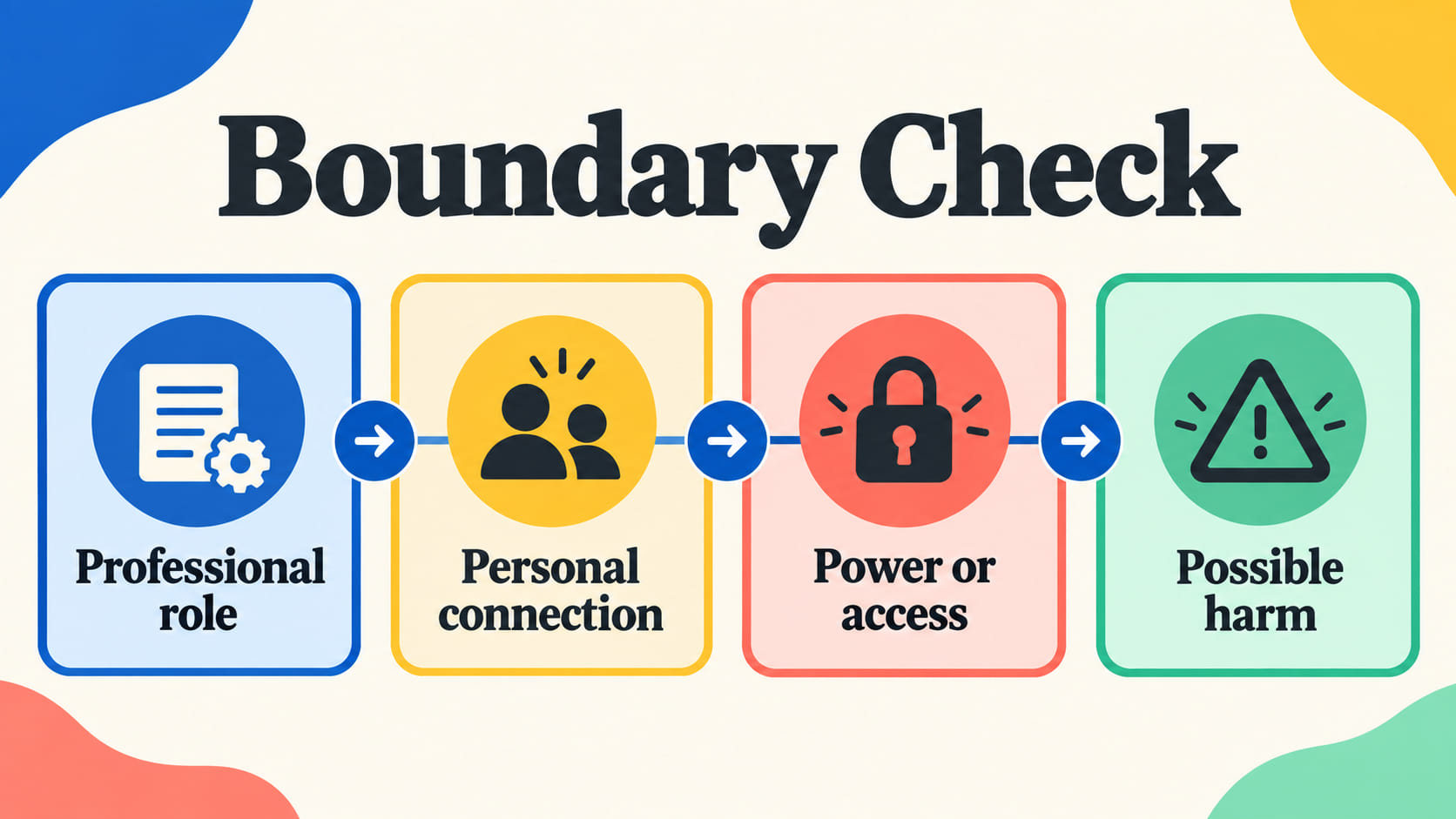
Map the role, connection, power, and possible harm
The professional role includes the services, access, information, influence, and responsibilities attached to the job. The second connection might be social, financial, family-related, community-based, online, or another work relationship. Write each part in plain language instead of using a conclusion as the starting point.
Power can be obvious, such as control over services, scheduling, records, or access to a supervisor. It can also be indirect: a caregiver may believe that declining a favor could affect service quality, or a technician may know private information that changes how another interaction feels. The possibility of pressure deserves attention even when everyone says they are comfortable.
Consider possible harm without assuming that harm has already occurred. Could the overlap reduce objectivity, expose confidential information, create favoritism, confuse consent, or make it harder to end the relationship? These are questions for supervision and policy review, not for a technician to solve through a private agreement.
Fictional examples to discuss
Social-media connection. A caregiver sends an RBT a friend request. The RBT wants to be polite but realizes the account includes personal posts and may expose information about other clients or coworkers. A careful response follows the employer’s communication policy, avoids discussing services through a personal account, and asks a supervisor what channel to use.
Personal favor. A family asks the RBT to babysit outside scheduled services. The request could create an additional role, blur payment and responsibility, and make the family worry that refusing will affect care. The RBT should not make a private arrangement to “help out.” The situation belongs with the supervisor or employer’s appropriate process.
Community overlap. An RBT discovers that a client’s caregiver and the RBT attend the same community organization. A shared setting may be unavoidable, but it can create questions about greetings, conversations, and confidentiality. The RBT should follow policy, avoid discussing services in public, and ask how to respond if contact occurs.
Gift or discount. A family offers a valuable gift or asks the RBT to use a private business discount. The issue is not solved by saying “it was kind.” Value, timing, power, expectations, and policy matter. The RBT should pause and seek direction before accepting, declining in a way that shames the family, or creating a reciprocal obligation.
Former relationship. An RBT is assigned to someone connected to a former employer, neighbor, friend, or personal contact. The overlap may or may not create a risk, but it should be disclosed through the correct channel. Do not hide the connection or make a private promise about how records or communication will be handled.
What to do when a boundary feels unclear
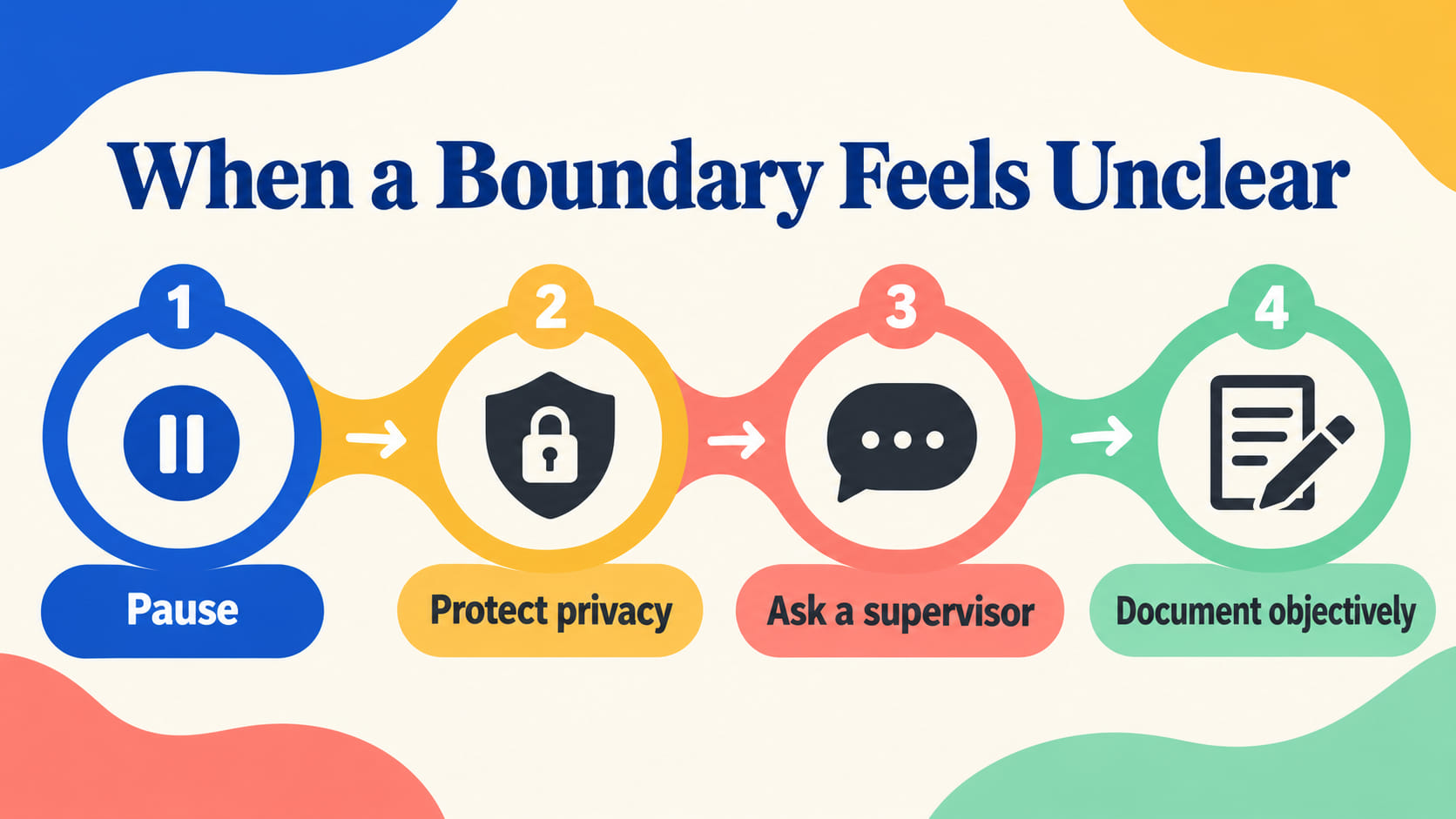
Pause before responding impulsively. Do not promise secrecy, accept an arrangement, or move the conversation to a personal account. Protect client information and use the organization’s approved communication channel.
Ask a supervisor or designated manager a concise question based on facts: what was requested, who was involved, what role the RBT holds, what access or information exists, and what policy or plan applies. Avoid adding gossip or unnecessary personal details.
Document objectively when the organization requires a record. Record the request or event, the response taken, who was notified, and any direction received. Do not backdate, delete, or rewrite a record to make an uncomfortable interaction disappear.
Protect privacy and records
A second relationship can expose information even when no one intends harm. Do not discuss a client in a community setting, forward screenshots, share schedules, or use personal messages for convenience. If an unavoidable public encounter occurs, use a neutral response that does not confirm service details.
Keep records in approved systems and share them only with people who have a legitimate role. A boundary concern should not become a reason to copy a full client file into a personal note or ask a friend for advice. Share the minimum necessary facts through the appropriate supervision or reporting channel.
Use supervision instead of guessing
Supervision is not only for technical procedures. It is also the place to clarify communication, gifts, social settings, online contact, dual roles, documentation, and possible conflicts. Bring the question early, before the overlap becomes a promise, financial arrangement, or public disclosure.
Supervisors and employers should give clear policies and respectful feedback. An RBT should be able to say, “I am not sure whether this creates a boundary concern; can we review it?” without being pushed to improvise. If the first channel does not address a serious safety, privacy, or ethics concern, follow the organization’s escalation process.
Common boundary mistakes
- Using a universal rule: context, power, policy, and possible harm matter.
- Solving it privately: a personal agreement can increase the risk rather than remove it.
- Promising confidentiality: do not promise secrecy before understanding reporting and safety duties.
- Sharing too much: ask for help with minimum necessary information.
- Waiting for proof of harm: ask for guidance when the overlap first becomes visible.
- Using judgmental notes: record observable facts, requests, responses, and direction.
Frequently asked questions
What are multiple relationship examples for an RBT?
Examples include a caregiver’s personal social-media request, a family asking for a private favor, a gift or discount that creates pressure, a shared community setting, or a former personal connection overlapping with services. Each situation must be evaluated in context.
Is every dual role automatically prohibited?
Do not assume a universal answer from a label alone. Review the current Ethics Code, employer policy, power and access, possible harm, and supervisor direction. The risk may be significant even when no harm is intended.
Should an RBT confront a caregiver about a boundary?
Use the approved supervision or management channel rather than managing a complex issue alone. Protect privacy, avoid promises, and ask for clear direction about the next response.
What should an RBT document?
When required, document objective facts, the request or event, the response taken, who was notified, and the direction received. Do not include gossip or unnecessary private information.
Role reminder: This is educational information, not legal advice, ethics-board advice, or a substitute for the current Ethics Code, Handbook, employer policy, or supervisor direction. Consult the appropriate qualified channel when a boundary is unclear.
Official starting points: the BACB RBT Ethics Code, ethics resources, RBT Handbook, and supervision and training resources.
Ready to practice the RBT concepts you just reviewed?
Try an independent, original RBT practice resource with exam-style questions, scoring, and answer explanations.
References
- Behavior Analyst Certification Board. RBT Test Content Outline, 3rd edition.
- Behavior Analyst Certification Board. RBT Handbook.
- Behavior Analyst Certification Board. RBT Ethics Code.