
RBT competency assessment practice free resources can help you rehearse concepts and reduce surprises, but they cannot turn a multiple-choice quiz into the official assessment. The Initial Competency Assessment is a hands-on demonstration and discussion of technician tasks observed by a qualified assessor. It is separate from the written certification examination.
Table of Contents
- What RBT competency assessment practice free resources can do
- The current 2026 Initial Competency Assessment boundary
- Map the 19 assessment task items
- Understand client, role-play, and interview formats
- Prepare by demonstration, not memory
- RBT competency assessment practice free scenarios
- Use feedback and repeat with integrity
- Separate the assessment from the written RBT exam
- Common competency-practice mistakes
- Frequently Asked Questions
- References
The current BACB packet, effective January 1, 2026, states that all RBT applicants must demonstrate competence on the Initial Competency Assessment. The packet lists task items 1–19 and allows evaluation through a client, role-play, or interview depending on the task. The current RBT Test Content Outline, 3rd edition, separately describes 43 tasks across six domains, and the written exam context includes 75 scored questions plus 10 unscored pilot questions.
RBT Training is an independent educational resource. It is not affiliated with, operated by, or endorsed by the Behavior Analyst Certification Board (BACB). The practice prompts in this article are newly written for independent study. They are not official, current, retired, recalled, leaked, or BACB-endorsed questions. No free practice page, rehearsal, or score can guarantee certification or a passing result.
What RBT competency assessment practice free resources can do
A free practice page can help you recognize task names, explain a concept, rehearse a sequence, prepare questions for your assessor, and identify skills that need live practice. It cannot observe your hands, timing, tone, data entry, response to an error, or adherence to a client-specific protocol.
| Free practice can help you | It cannot replace |
|---|---|
| Recall the difference between frequency, duration, latency, and interval methods. | Being observed while implementing the assigned measurement procedure. |
| Explain what an objective session note contains. | An assessor evaluating your actual note and professional communication. |
| Rehearse a discrete trial or prompting sequence with a study partner. | Demonstrating the authorized procedure with a client or approved role-play. |
| Practice describing client dignity, professional boundaries, and supervision. | Submitting the completed official assessment signed by the responsible assessor. |
| Build a list of questions to ask before assessment day. | Determining your own competence or choosing an assessor. |
Search results for the exact keyword mix direct learners to a hands-on explainer, broad written-exam sites, user-created quizzes, and videos. The first question to ask any resource is therefore: “Is this testing knowledge, or is it preparing me to perform a task?” Both can be useful, but they are not the same evidence.
The current 2026 Initial Competency Assessment boundary
The official BACB packet in the current source set is titled RBT Initial Competency Assessment Packet: Effective January 1, 2026. Use the current packet and Handbook for administrative decisions. The following facts are study orientation, not a replacement for reading the form:
| Packet point | Study implication | Do not infer |
|---|---|---|
| Completed after the 40-hour training | Rehearse the skills after training and bring unclear procedures to the qualified assessor or supervisor. | A free quiz completes the training or assessment. |
| Cannot be completed more than 90 days before submitting an RBT certification application | Check the current timing before scheduling or relying on an old form. | An old practice page controls your application timeline. |
| May occur over one or more sessions | Prepare a repeatable practice routine instead of expecting one short quiz to cover everything. | Every task must be completed in one sitting. |
| May be in person, live online, or through specified assessment videos | Confirm the current arrangement and evidence requirements with the responsible assessor. | Any self-recorded video automatically counts. |
| All task items 1–19 must be completed | Use a checklist and mark the practice evidence for each item. | A written score can stand in for the signed form. |
The responsible assessor must be a BACB certificant—BCaBA or BCBA—who has completed the 8-hour supervision training and meets the packet’s relationship requirements. The packet also describes how an assistant assessor may participate. A learner should verify the current requirements with the responsible assessor and official BACB materials rather than relying on a commercial page.
Map the 19 assessment task items
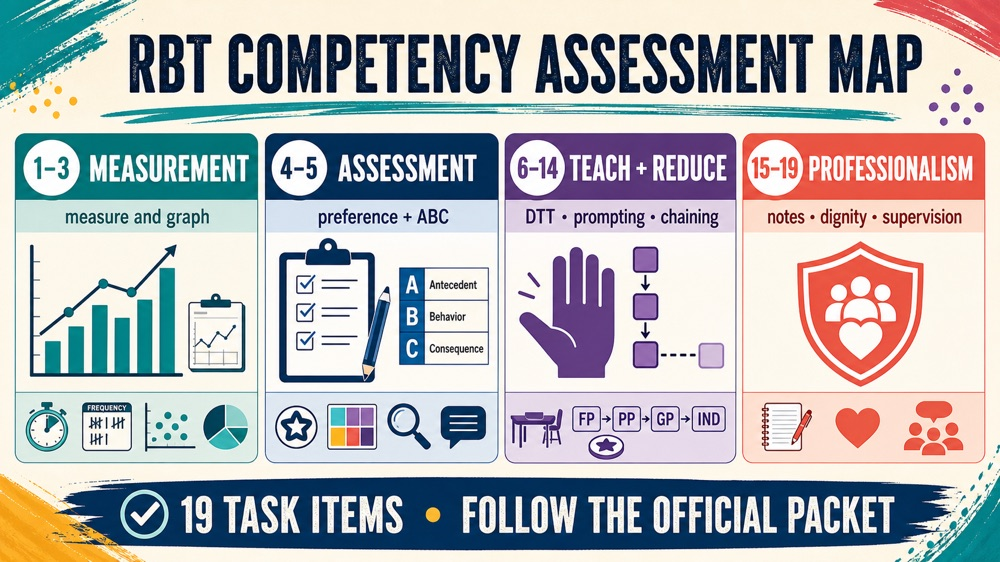
Use the current packet’s task sequence as a rehearsal map. The summary below preserves the task boundary without reproducing the form as a substitute for the official document.
| Items | Assessment family | What to rehearse |
|---|---|---|
| 1–3 | Measurement and data | Implement continuous measurement; implement discontinuous measurement; enter data and update graphs. |
| 4–5 | Assessment | Conduct preference assessments and collect ABC data according to the assigned procedures. |
| 6 | Discrete-trial teaching | Implement the assigned DTT sequence, including the response, consequence, correction, and data rules. |
| 7 | Naturalistic teaching | Implement the assigned naturalistic or incidental-teaching procedure in context. |
| 8 | Chaining | Implement task-analyzed chaining with the specified prompt and reinforcement arrangement. |
| 9 | Shaping | Implement successive-approximation teaching as written. |
| 10 | Discrimination training | Present the assigned stimuli and record the learner’s response under the plan. |
| 11 | Prompting | Implement prompting and prompt fading according to the written hierarchy. |
| 12 | Token systems | Implement the assigned token system, exchange rule, and data procedure. |
| 13 | Crisis or emergency | Implement the protocol safely; this task may also use an interview format according to the packet. |
| 14 | One selected behavior-reduction task | Demonstrate antecedent interventions, differential reinforcement, or extinction as assigned. |
| 15–19 | Professionalism and requirements | Write objective notes; explain dignity, boundaries, supervision requirements, and when to seek clinical direction. |
The packet states that three tasks in the Skill Acquisition and Behavior Reduction section must be demonstrated with a client. Confirm which tasks and arrangements apply to your assessment with the responsible assessor. Do not assume a self-study role-play automatically satisfies a client-demonstration requirement.
Understand client, role-play, and interview formats
The packet describes three ways a task may be evaluated:
| Format | What happens | How to practice |
|---|---|---|
| With a client | The assessor observes you performing the task with a client receiving behavior-analytic services. | Rehearse the exact protocol, materials, safety steps, data system, and communication expected for that client. |
| Role-play | The assessor observes you in a situation similar to a client interaction, with another person acting in the client role. | Practice saying the instruction, delivering the prompt, responding to an error, and recording the result without relying on a script. |
| Interview | The assessor conducts a live interview in person or online; you describe or discuss a concept and provide examples or nonexamples where applicable. | Explain the decision rule aloud, then give an observable example and a clear nonexample. |
A practice question can prepare your explanation, but it cannot show whether you can implement the task fluently. Ask your study partner to change one condition: a different material, a different prompt level, a missing response, or an unclear data rule. Then state what you would do under the written plan and when you would ask the supervisor.
Prepare by demonstration, not memory
Use a five-part rehearsal card for each task:
- Task: write the official task family in your own words.
- Set-up: list the materials, context, target definition, and safety or privacy considerations.
- Action: demonstrate the sequence exactly as the assigned plan requires.
- Record: state or enter the data, prompt level, response, error, or note required by the procedure.
- Explain: describe what would make you pause, document, or seek clinical direction.
For example: for continuous measurement, do not only memorize “frequency, duration, latency, and IRT.” Set up a defined response, identify the timing unit, demonstrate when the timer starts and stops, record the result, and explain what you would do if the definition or equipment were unclear.
For another example: for an objective session note, write what was observed, what procedure was implemented, what data were collected, and what communication occurred. Avoid mental-state labels or unsupported explanations. Ask a qualified reviewer to mark whether the note is observable, complete, and consistent with the plan.
RBT competency assessment practice free scenarios
These original prompts are designed for rehearsal and discussion. They are not the BACB form, official tasks, current exam items, recalled content, or a substitute for an assessor.
Scenario 1: measurement set-up
Prompt: Your plan measures latency from the instruction “start worksheet” to the beginning of the first written response. What should you say before starting?
Practice answer: Confirm the operational definition, the start cue, the response-onset rule, the timing device, and the recording field. Start and stop according to the plan. If the rule is unclear, ask the supervisor rather than choosing a new timing rule.
Scenario 2: preference assessment
Prompt: A study partner asks you to run a preference assessment, but the procedure sheet does not identify which presentation format to use. What is the role-safe response?
Practice answer: Do not select a format from memory. Check the written protocol or ask the responsible supervisor or assessor for clarification, then implement and record the assigned procedure.
Scenario 3: discrete-trial teaching
Prompt: The learner gives an incorrect response after the assigned instruction. What should your practice focus include?
Practice answer: Rehearse the written error-correction sequence, prompt rule, consequence, and data entry. Do not add an unapproved prompt or reward merely to make the trial look successful.
Scenario 4: chaining
Prompt: A routine has five steps, and the plan specifies backward chaining. What should you be able to demonstrate?
Practice answer: Identify the task-analyzed steps, implement the assigned backward sequence, provide the specified support for earlier steps, reinforce the target link as written, and record which steps were independent or prompted.
Scenario 5: crisis or emergency protocol
Prompt: A role-play partner asks you to invent a new response because the written crisis protocol does not cover the situation. What should you do?
Practice answer: Follow the established safety and escalation protocol, seek the responsible supervisor or designated clinical direction, and document the concern. A free practice exercise cannot authorize a new crisis procedure.
Scenario 6: professionalism interview
Prompt: Give an example of when you would seek clinical direction.
Practice answer: Use an observable situation, such as a plan instruction becoming unclear, a new behavior appearing, or the assigned procedure not matching available materials. Explain what you would document and how you would contact the supervisor without independently changing the program.
Use feedback and repeat with integrity
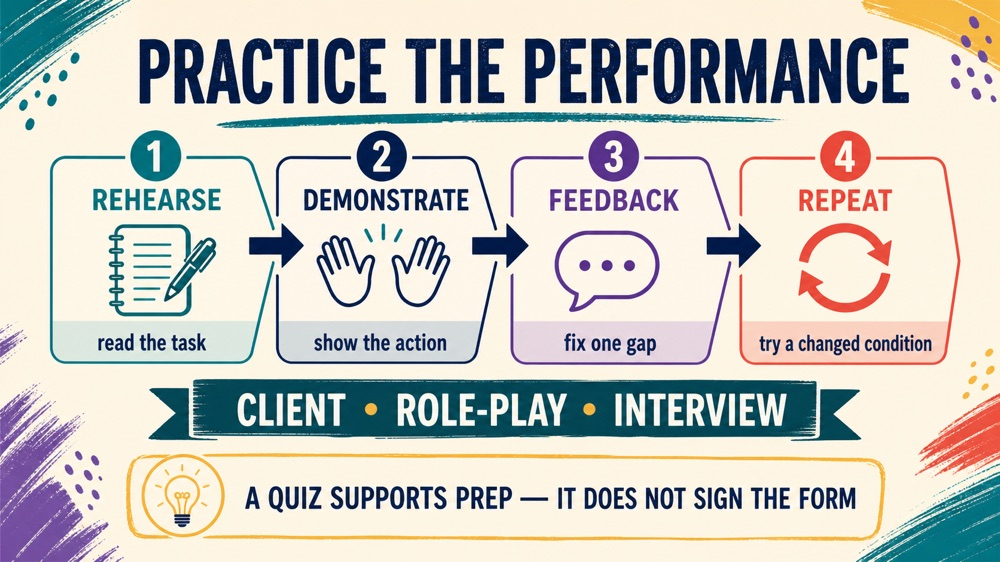
The current packet states that if competence is not demonstrated, the assessor may provide corrective feedback and assess the task on another day. Corrective feedback may not be delivered on the final assessment of that task. Build your study routine around that distinction:
| Practice round | Action | Evidence to keep |
|---|---|---|
| Read | Review the official task wording and the assigned client or role-play protocol. | One-sentence task goal and source note. |
| Rehearse | Perform the task from set-up through documentation. | Materials, timing, prompt, response, and data checklist. |
| Explain | State the decision rule and give an example and nonexample when relevant. | Short spoken explanation without answer-letter memory. |
| Feedback | Ask the supervisor or qualified reviewer what was missing or unclear. | Specific correction, not only “practice more.” |
| Repeat | Change one condition and demonstrate again on a later practice round. | Evidence that the skill transfers beyond one script. |
Keep the official assessment form and the practice notes separate. The assessor must initial the official form, mark the assessment type, and the responsible assessor must complete the attestation after all tasks have been competently performed. A learner’s checklist is useful preparation, but it is not the signed submission.
Separate the assessment from the written RBT exam
The initial competency assessment is a performance evaluation. The written RBT certification exam is a separate examination under the current Handbook and TCO. They overlap in content, which is why a learner may study measurement, assessment, acquisition, reduction, documentation, and ethics for both. Their evidence is different.
| Question | Initial competency assessment | Written certification exam |
|---|---|---|
| What is demonstrated? | Performance, explanation, documentation, and professional behavior. | Knowledge and application through multiple-choice items. |
| Who evaluates? | A responsible qualified assessor under the current packet. | The official examination process. |
| What practice helps? | Live rehearsal, role-play, interview practice, data entry, and feedback. | Original scenarios, concept review, mixed practice, and later pacing work. |
| What does not transfer automatically? | A high quiz score does not prove hands-on competence. | A smooth demonstration does not replace study of the written content outline. |
Use the current official sources for application and scheduling decisions. Do not rely on a provider’s claimed pass threshold, “real questions,” or assertion that a free practice score completes the competency requirement.
Common competency-practice mistakes
- Calling the assessment a written test: it is a demonstration and discussion evaluated by an assessor.
- Using a quiz as the official form: the current BACB packet and signed documentation control.
- Ignoring assessment format: prepare for client, role-play, and interview conditions as applicable.
- Practicing only definitions: rehearse set-up, implementation, data, and explanation.
- Changing a procedure to look successful: follow the written plan and bring uncertainty to supervision.
- Forgetting the client demonstration requirement: confirm the current packet and assessor instructions for tasks 6–14.
- Seeking feedback at the final assessment: distinguish practice correction from the packet’s final evaluation rule.
- Combining the competency assessment with the written exam: use separate evidence and separate preparation plans.
Bottom line: Use RBT competency assessment practice free materials to learn task language, rehearse observable performance, and prepare questions for a qualified assessor. Then use the current BACB Initial Competency Assessment Packet, Handbook, and TCO to confirm the actual requirements. A free quiz can support preparation; it cannot evaluate, sign, or replace the official assessment.
Ready to rehearse the next task?
Use original RBT practice questions to identify the task, explain the decision rule, and prepare for live demonstration under supervision.
Start Free RBT Practice Questions →
Frequently Asked Questions
What is the RBT Initial Competency Assessment?
It is a hands-on assessment in which a qualified assessor evaluates whether an RBT applicant can competently perform the required task items. It is separate from the written RBT certification examination.
Can I complete the RBT competency assessment with a free online quiz?
No. A free quiz can help you learn terms and rehearse explanations, but it cannot replace performance with a client or approved role-play, the required interview, assessor evaluation, or the signed BACB form.
How many task items are in the current initial assessment packet?
The current packet in the source set lists task items 1–19. It also specifies which tasks use client, role-play, or interview formats and includes documentation and assessor attestations.
What are the three assessment formats?
The packet describes evaluation with a client, role-play, or interview. The applicable format depends on the task and current assessor instructions.
When should the initial competency assessment be completed?
The current packet states that it follows completion of the 40-hour training and cannot be completed more than 90 days before submitting an RBT certification application. Verify current requirements with the BACB and responsible assessor.
Can practice guarantee that I will pass?
No. A free quiz, rehearsal, or practice score cannot guarantee competent performance, certification, a passing result, or approval of an application.
References
- Behavior Analyst Certification Board. RBT Test Content Outline, 3rd edition.
- Behavior Analyst Certification Board. RBT Test Content Outline, 3rd-edition PDF.
- Behavior Analyst Certification Board. RBT Handbook.
- Behavior Analyst Certification Board. RBT Initial Competency Assessment form. The current 2026 packet was checked in the project source set.
- Independent competency-assessment practice explainer. Reviewed for competitor research; not an endorsement.
- Independent RBT practice-question hub. Reviewed for competitor research; not an endorsement.
- Independent free RBT practice page. Reviewed for competitor research; not an endorsement.