

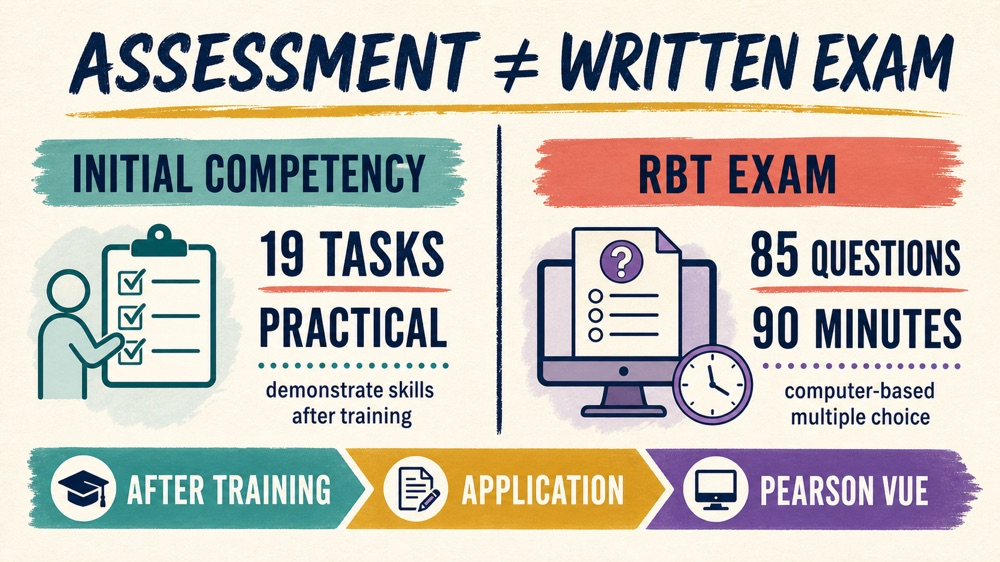
If you search for rbt competency exam, you are probably asking about the practical requirement that the BACB formally calls the RBT Initial Competency Assessment. It is not the same as the Pearson VUE RBT certification examination. The assessment asks you to demonstrate entry-level technician skills; the later certification exam is a computer-based multiple-choice test.
Table of Contents
- RBT competency exam: what is the official name?
- RBT competency exam versus the Pearson VUE examination
- When to complete the Initial Competency Assessment
- Who can oversee the assessment?
- Three ways a task may be evaluated
- The 19-task structure
- What if you are not competent on the first try?
- How to prepare for the RBT competency assessment
- What happens after the assessment?
- Common RBT competency assessment mistakes
- Frequently Asked Questions
- References
The current Initial Competency Assessment Packet is effective January 1, 2026. It requires all RBT applicants to demonstrate competence on 19 task items, using the assessment type allowed for each task. The assessment may involve a client, role-play, or interview, and it must be completed after the qualifying 40-hour training and no more than 90 days before the certification application is submitted.
The written RBT examination remains a separate step: it presents 85 questions, including 75 scored questions and 10 unscored pilot questions, has four answer choices per question, and allows 90 minutes. The current RBT Test Content Outline (3rd ed.) contains 43 tasks across six domains. RBT Training’s scenarios are independent study content, not official, recalled, leaked, or BACB-endorsed questions.
This guide explains the current assessment structure, how to prepare, what to verify with the assessor, and how the assessment fits into certification. It does not replace the current BACB packet, assessor judgment, or application instructions. No course, assessment-prep guide, or practice score can guarantee certification or a passing result.
RBT competency exam: what is the official name?
“RBT competency exam” is a common search phrase, but the official document is the RBT Initial Competency Assessment Packet: Effective January 1, 2026. The word assessment matters. You demonstrate whether you can perform the task competently under the conditions described by the packet; you do not sit alone at a Pearson VUE computer and answer a scored multiple-choice form.
| Search phrase | Official checkpoint | What it tests |
|---|---|---|
| RBT competency exam | Initial Competency Assessment | Practical implementation, objective notes, professionalism, supervision, and clinical-direction knowledge. |
| RBT written exam | RBT certification examination | Knowledge and judgment through computer-based multiple-choice questions. |
| RBT renewal competency | Recertification Competency Assessment or later maintenance process | Ongoing proficiency and the maintenance rules in effect for the certification cycle. |
Using the formal name helps you download the correct form, ask the right assessor, and avoid paying a testing center for the wrong requirement.
RBT competency exam versus the Pearson VUE examination
| Feature | Initial Competency Assessment | RBT certification examination |
|---|---|---|
| When? | After 40-hour training and before the certification application is submitted. | After the application is approved and the candidate is authorized to test. |
| Format | Client demonstration, role-play, interview, or the packet’s allowed format for a task. | Computer-based, multiple-choice exam at an authorized testing site. |
| Scope | 19 current task items must be completed and signed. | 43 TCO tasks are sampled through 85 presented questions. |
| Who evaluates? | Responsible assessor with the qualifications and relationship required by the packet. | Pearson VUE test-center administration under the BACB examination program. |
| Where? | Arranged with the responsible organization and assessor; may use permitted live or recorded formats. | In person at an authorized Pearson VUE site or other approved location. |
| Evidence | Completed current BACB packet uploaded with the certification application. | Exam result and application/certification record. |
For example: a candidate may perform continuous measurement correctly during the Initial Competency Assessment and still need to study graph trends for the written exam. One checkpoint supports the other, but neither one substitutes for the other.
When to complete the Initial Competency Assessment
The current packet gives a clear sequence:
- Complete the qualifying 40-hour RBT training.
- Arrange the current Initial Competency Assessment with the responsible assessor.
- Complete it after the training is finished.
- Submit the certification application no more than 90 days after the assessment is completed.
- Upload the completed BACB packet with the other application documents.
The 90-day window is not a general suggestion to “apply soon.” It is a document-timing condition. Record the training completion date, each assessment date, the final attestation date, and the planned application submission date. If the window may lapse, contact the responsible assessor and check the current BACB instructions before assuming the form remains usable.
The 2026 transition also matters. An older training program or older competency packet may not satisfy the requirements for a current application. Use the current BACB packet and compare the training certificate with the current 2026 guidance; do not create a homemade bridge form.
Who can oversee the assessment?
The responsible assessor must be an active BACB certificant who is a BCaBA or BCBA and has completed the required 8-hour supervision training. The assessor oversees the assessment, ensures the packet is followed, signs the final attestation, and maintains assessment records.
- The responsible assessor must be employed by, or have a contractual relationship with, the same organization as the applicant and the client involved.
- The assessor cannot be related to, subordinate to, or employed by the applicant during the assessment.
- The responsible assessor may delegate portions to a qualified assistant assessor who holds an active RBT certification or higher and is properly overseen.
- The assessor may be the same person who delivered the 40-hour training when the packet’s other requirements are satisfied.
- The responsible assessor must maintain assessment documentation for at least seven years.
These are not details to solve by finding a friend willing to sign a form. Ask the organization how the responsible assessor, any assistant assessor, and the client-service relationship satisfy the current packet.
Three ways a task may be evaluated
The current packet allows three assessment types, depending on the task instructions:
| Mode | What it means | Preparation focus |
|---|---|---|
| With a client | The assessor observes the applicant perform the task with a client receiving behavior-analytic services. | Follow the written protocol, protect dignity and privacy, and collect the correct data. |
| Role-play | The applicant performs in a situation similar to client work with another person acting as the client. | Explain the action, use the plan’s steps, and respond to realistic changes without improvising outside scope. |
| Interview | The assessor asks the applicant to describe or discuss a concept and give examples and nonexamples when applicable. | Explain why the action is correct, where the role boundary is, and when to seek direction. |
The packet may be completed over one or more sessions. It may be conducted in person, live via the internet, or through recorded videos created specifically for the assessment, subject to the packet’s requirements. A casual old video or a generic course quiz is not automatically an acceptable assessment.
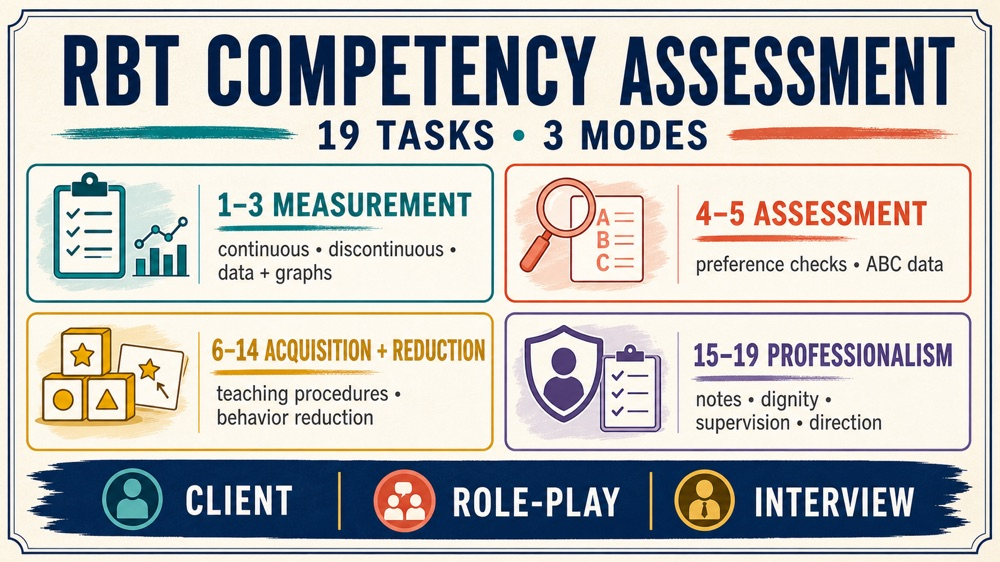
The 19-task structure
The current form groups the 19 task items into practical measurement, assessment, skill-acquisition/behavior-reduction, and professionalism/requirements areas. You do not need to memorize the form’s layout as a poster; you do need to know what each group asks you to demonstrate.
| Task group | Current tasks represented | What to rehearse |
|---|---|---|
| Measurement: 1–3 | Continuous measurement; discontinuous measurement; enter data and update graphs. | Use the definition and measurement rule, record accurately, and update the correct graph. |
| Assessment: 4–5 | Preference assessments; ABC data. | Follow the assigned format and describe observable antecedents, behavior, and consequences. |
| Skill acquisition and behavior reduction: 6–14 | DTT, naturalistic teaching, chaining, shaping, discrimination, prompting, token systems, crisis/emergency procedures, and one selected antecedent/differential-reinforcement/extinction task. | Run procedures as written, use the stated prompt and reinforcement rules, and follow safety protocol. |
| Professionalism and requirements: 15–19 | Objective session notes, client dignity, professional boundaries, supervision standards, and when to seek clinical direction. | Use objective language, protect the client, and explain the supervisor-contact decision. |
All 19 task items must be completed. The packet also specifies that three tasks from the Skill Acquisition and Behavior Reduction group (tasks 6–14) must be demonstrated with a client. Your assessor marks the assessment type used for each task and signs the final attestation after all tasks are competently performed.
What if you are not competent on the first try?
The assessment is not a one-minute “gotcha” test. If you do not demonstrate competence on a task, the assessor may provide corrective feedback and assess the task again on another day. The process repeats until competence is demonstrated. The packet also states that corrective feedback may not be delivered on the final assessment of a task.
This means preparation should focus on accurate performance and responsive learning, not on hiding uncertainty. Ask the assessor what criterion was missed, practice within the written protocol, and return for a clean demonstration. Do not ask someone to initial a task that was not actually performed competently.
Example: an applicant enters a graph value correctly but cannot explain which target or phase the value belongs to. The assessor may give corrective feedback and arrange another assessment opportunity. The applicant should repair the data-entry and graph-reading skill, not copy a signature or substitute an unrelated worksheet.
How to prepare for the RBT competency assessment
- Read the current packet: confirm the 01/2026 version and understand which assessment type is permitted for each task.
- Use the written programs: practice the actual definitions, prompts, reinforcement rules, data sheets, and crisis protocol you are authorized to use.
- Rehearse explanations: practice explaining objective notes, dignity, boundaries, supervision, and when you would seek clinical direction.
- Check measurement fluency: practice frequency, duration, latency, interval rules, data entry, and graph updates without using client-identifying information.
- Practice role-play ethically: role-play is rehearsal, not permission to invent a client procedure or record real client details in a public study group.
- Ask the assessor early: confirm schedule, client or role-play arrangements, documents, signatures, and the 90-day application window.
Use original practice questions for the written examination separately. The assessment asks “Can you perform and explain the task?” The written exam asks “Which answer best fits the scenario and current role?” Strong preparation trains both forms of reasoning.
What happens after the assessment?
After all tasks are competently demonstrated, the responsible assessor completes and signs the current BACB packet. You submit the completed packet with the certification application. The BACB states that non-BACB forms will not be accepted. After the application is approved, you schedule the separate written RBT examination through Pearson VUE.
| Before submitting | Confirm |
|---|---|
| Packet | Current BACB Initial Competency Assessment packet, complete and legible. |
| Tasks | All 19 task items completed and assessment type marked. |
| Client demonstrations | Three tasks from 6–14 demonstrated with a client as required. |
| Attestation | Responsible assessor signed and dated after competence was demonstrated. |
| Timing | Assessment was after training and within 90 days before the application. |
| Application | Packet, training certificate, attestation, checks, and other requested documents match the current instructions. |
Do not schedule the Pearson exam merely because you have started the competency assessment. The official written-exam authorization arrives through the application process.
Common RBT competency assessment mistakes
- Using the phrase as if it were a written test: download the Initial Competency Assessment Packet, not only a practice quiz.
- Using an old form: check the current BACB document version and application updates.
- Completing it before training: the current assessment follows the qualifying 40-hour training.
- Missing the 90-day window: schedule the application and keep the assessment date visible.
- Using an unqualified signer: verify the responsible assessor and relationship requirements.
- Skipping task items: all 19 items must be completed; a good performance in one area does not waive another.
- Sharing client information: use de-identified, original practice materials and protect client dignity.
- Changing the program to look competent: follow the plan and ask for clinical direction when the plan is unclear.
Bottom line: the RBT competency exam search usually points to the Initial Competency Assessment: a current 19-task practical demonstration completed after training, within the application window, and signed by the responsible assessor. Treat it as one certification gate. Prepare the hands-on skills for the assessment and the scenario reasoning for the separate Pearson VUE examination.
Prepare for both certification gates.
Review current RBT concepts with original scenarios, explanations, and error correction while your assessor handles the official competency evaluation.
Review RBT study materials →
Frequently Asked Questions
What is the RBT competency exam?
The official pre-application requirement is called the RBT Initial Competency Assessment. It evaluates whether an applicant can competently perform the current task items using permitted client, role-play, or interview methods.
How many tasks are on the 2026 RBT competency assessment?
The current Initial Competency Assessment Packet requires all 19 task items to be completed. Three tasks from the Skill Acquisition and Behavior Reduction group, tasks 6–14, must be demonstrated with a client.
When do I take the Initial Competency Assessment?
Complete it after the qualifying 40-hour training and no more than 90 days before submitting the RBT certification application.
Can the RBT competency assessment be online?
The current packet allows in-person, live internet, or recorded-video assessment formats when the requirements for that task and assessment are met. This is different from the formal written RBT examination, whose current delivery is in person.
Who can assess an RBT applicant?
The responsible assessor is an active BCaBA or BCBA with the required 8-hour supervision training and the relationship required by the packet. Qualified assistant assessors may complete delegated portions under responsible-assessor oversight.
Is the competency assessment the same as the RBT written exam?
No. The assessment is a practical certification requirement; the written RBT examination is a separate, computer-based multiple-choice test scheduled after application approval.
References
- Behavior Analyst Certification Board. RBT Initial Competency Assessment Packet: Effective January 1, 2026.
- Behavior Analyst Certification Board. Supervision, Assessment, Training, and Oversight.
- Behavior Analyst Certification Board. Guidance for Meeting RBT Requirements During the 2026 Transition.
- Behavior Analyst Certification Board. RBT Handbook.
- Behavior Analyst Certification Board. RBT Test Content Outline (3rd ed.).
- ABA Degree RBT competency assessment guide. Reviewed for competitor research; not an official BACB source.
- RBT Hub competency assessment guide. Reviewed for competitor research.
- The New ABA competency assessment guide. Reviewed for competitor research.